📋 Table of Contents
Finding a workwear rain jacket reflective trim manufacturer that delivers both hi-vis compliance and durable waterproof performance requires more than catalog browsing. Corporate uniform buyers and team-gear managers face three recurring challenges: reflective trim that meets EN ISO 20471 or ANSI/ISEA 107 standards, fabric that stays waterproof at stress points after repeated wear, and MOQ structures that fit budget constraints for small-batch orders. This guide walks through the technical specifications, compliance requirements, and sourcing considerations that determine whether a rain jacket performs in real-world construction, utility, and outdoor work environments.
Executive Summary
- Reflective trim compliance: EN ISO 20471 Class 3 requires a minimum of 0.20 m² of reflective material arranged in horizontal and vertical bands for 360-degree visibility.
- Waterproof performance: A hydrostatic head rating of 10,000 mm or higher ensures reliable protection in heavy rain; seam-sealed construction prevents leakage at stitched joints.
- Sample and bulk MOQ: Sample orders start at 1 piece with a refundable fee; production minimums of 30 pieces per SKU enable small uniform programs to order without excess inventory.
- Breathability threshold: Fabrics with moisture vapor transmission rates (MVTR) above 5,000 g/m²/24h reduce internal condensation during active work, addressing the sweat-trap complaint common in budget rain jackets.
- Trim durability: Heat-sealed reflective tape bonded at 120-140°C withstands 50+ industrial wash cycles without delamination, a critical factor for corporate uniform programs with weekly laundering schedules.
Why Reflective Trim Placement Determines Compliance
Buyers ordering workwear rain jackets for construction crews or utility teams must ensure reflective trim meets regional hi-vis standards. The two dominant frameworks are EN ISO 20471 (Europe, UK, Australia) and ANSI/ISEA 107 (United States, Canada). Both specify minimum areas of reflective material and precise placement rules.
EN ISO 20471 Class 3 Requirements
Class 3 garments require at least 0.20 m² of retroreflective material arranged in horizontal bands around the torso and vertical bands over the shoulders. The horizontal band must sit at least 50 mm below the waist, and the vertical band must connect the shoulder to the horizontal band. A workwear rain jacket reflective trim manufacturer that understands these spatial rules will position 50 mm-wide reflective tape in a way that maintains visibility when the wearer bends, kneels, or raises arms.
Corporate buyers report that jackets with only shoulder strips or a single chest logo fail job-site inspections. Compliance officers measure trim area and check for 360-degree coverage. Jackets that lack a rear vertical band or have gaps in the horizontal torso loop are rejected, even if the reflective material itself is certified.
ANSI/ISEA 107 Type R Class 3 Standards
The ANSI framework divides garments into Type O (off-road), Type R (roadway), and Type P (public safety). Type R Class 3 requires 310 square inches of background material and 201 square inches of retroreflective trim. The trim must form a closed loop around the torso and include shoulder straps that extend at least to mid-chest in front and mid-back in rear.
Buyers sourcing for highway maintenance or utility crews should request a compliance report from the manufacturer showing trim area calculations and placement diagrams. A factory experienced in OEM jacket manufacturing will provide technical drawings with trim dimensions and reflective material certifications before sampling begins.
Reflective Material Certification
The reflective tape itself must meet minimum retroreflectance values measured in candelas per lux per square meter (cd/lx/m²). EN ISO 20471 requires 330 cd/lx/m² at an observation angle of 0.2° and entrance angle of 5°. ANSI/ISEA 107 requires 500 cd/lx/m² at the same angles. Buyers should verify that the manufacturer sources tape certified to these thresholds and can provide test reports from accredited labs.
Fabric Performance Beyond Waterproof Claims
Waterproof ratings printed on spec sheets do not guarantee performance in real work conditions. Buyers evaluating a workwear rain jacket reflective trim manufacturer should request hydrostatic head test reports, seam-sealing method details, and abrasion resistance data.
Hydrostatic Head and Seam Integrity
A hydrostatic head rating measures the water column height a fabric can withstand before leaking. Ratings below 5,000 mm are suitable for light drizzle; 10,000 mm handles steady rain; 20,000 mm or higher withstands heavy downpours and prolonged exposure. Corporate buyers ordering for outdoor utility crews should specify a minimum of 10,000 mm.
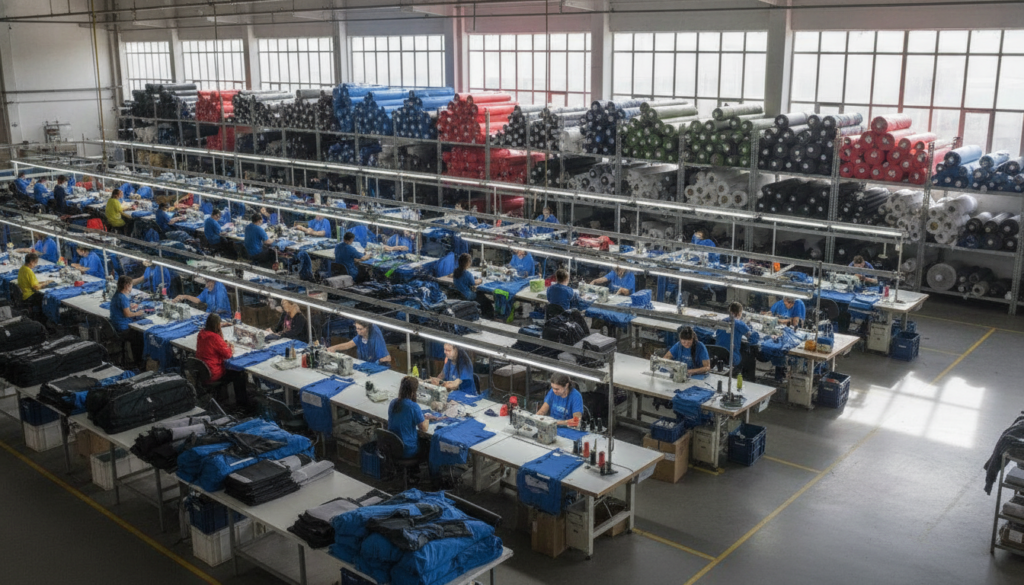
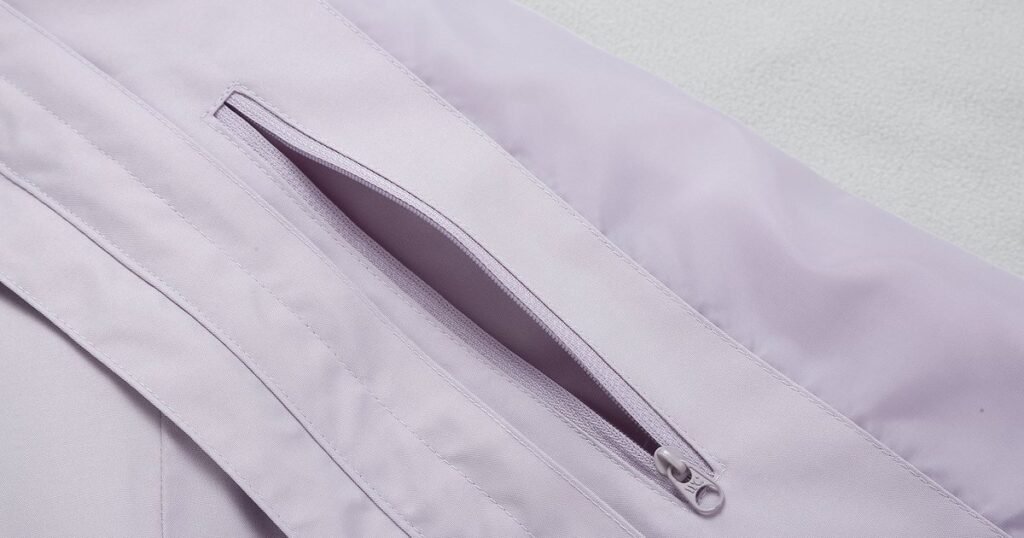
Seam-sealed construction is equally important. Stitched seams create needle holes that allow water ingress unless sealed with waterproof tape applied under heat and pressure. Buyers report that jackets advertised as waterproof often wet out at shoulder seams, cuff closures, and zipper flaps because seam tape was omitted or poorly bonded. A reliable manufacturer will confirm that all critical seams are taped and provide photos of the seam-sealing equipment used in production.
Breathability and Moisture Vapor Transmission
Waterproof fabrics that lack breathability trap perspiration inside the jacket, leaving workers damp and uncomfortable during active tasks. Moisture vapor transmission rate (MVTR) measures how much water vapor passes through the fabric in 24 hours. Fabrics with MVTR below 3,000 g/m²/24h feel clammy; 5,000-10,000 g/m²/24h provides adequate breathability for moderate activity; above 10,000 g/m²/24h suits high-exertion work.
Buyers sourcing jackets for construction or landscaping crews should request MVTR test data. A private-label manufacturer experienced in technical outerwear will offer fabric options with documented breathability ratings and explain the trade-offs between waterproofing and vapor permeability.
Abrasion Resistance at Stress Points
Workwear jackets endure friction from tool belts, harness straps, and rough surfaces. Fabrics rated below 10,000 Martindale cycles show visible wear after a few months of daily use. Buyers should specify a minimum of 20,000 cycles for shoulders, elbows, and lower back panels. Reinforced overlays in these zones extend garment life and reduce replacement frequency.
Hydrostatic head: 10,000 mm minimum. MVTR: 5,000 g/m²/24h or higher. Abrasion resistance: 20,000 Martindale cycles at stress points.
MOQ and Sampling for Team Uniform Buyers
Small corporate uniform programs and team-gear buyers often encounter MOQ barriers that force them to order excess inventory or settle for off-the-shelf options that do not meet hi-vis compliance. Understanding how sampling and production minimums work at a workwear rain jacket reflective trim manufacturer helps buyers plan budgets and timelines.
Sample Development Process
A 1-piece sample allows buyers to verify fit, fabric hand-feel, reflective trim placement, and waterproof performance before committing to a production order. Sample development typically follows this sequence: the buyer submits a tech pack or reference garment with trim placement diagrams, the factory sources certified reflective tape and waterproof fabric, a sample-room technician cuts and sews the prototype, and the finished sample ships within 7-10 days.
Buyers should budget a sample fee that covers material, labor, and shipping. This fee is often refundable against the bulk order, reducing the effective cost to zero if the buyer proceeds to production. A manufacturer offering sample development with transparent timelines and refund terms demonstrates commitment to small-batch clients.
Production MOQ and Order Tiers
Production minimums vary by factory. Large contract manufacturers require 500-1,000 pieces per style; mid-tier factories accept 100-300 pieces; low-MOQ specialists work with 30 pieces per SKU. A 30-piece minimum enables a corporate buyer to order jackets in three sizes (small, medium, large) with 10 units per size, fitting a small crew without tying up cash in excess stock.
Buyers managing multi-site teams can consolidate orders across locations to meet minimums. For example, a facilities management company with crews in three cities can order 10 jackets per site in two colorways, totaling 60 pieces across two SKUs. A factory experienced in low-MOQ jacket manufacturing will structure pricing tiers that reward volume without penalizing small initial orders.
Lead Time and Production Scheduling
Production lead time depends on fabric availability, trim sourcing, and factory queue. Standard fabrics and stock reflective tape ship within 25-35 days after order confirmation. Custom colorways or specialized trim require 40-50 days. Buyers planning seasonal rollouts should place orders 60-90 days before the target delivery date to accommodate sampling, revisions, and production.
Reflective Trim Durability and Washability
Reflective trim that peels, cracks, or loses retroreflectance after a few wash cycles undermines both safety and compliance. Corporate uniform programs with weekly laundering schedules need trim that survives 50+ industrial wash cycles without delamination.
Heat-Sealed vs. Sewn Trim Application
Reflective tape can be attached by sewing or heat-sealing. Sewn trim uses a zigzag or straight-stitch topstitch to secure the tape to the shell fabric. This method is durable but creates stitch holes that can allow water ingress if not sealed. Heat-sealed trim bonds the tape to the fabric using heat and pressure, creating a waterproof seal without stitching. The bond strength depends on the adhesive layer on the tape and the bonding temperature.
Buyers should specify heat-sealed trim bonded at 120-140°C for maximum durability. Lower temperatures produce weak bonds that fail after repeated flexing; higher temperatures can scorch the shell fabric or melt the reflective layer. A manufacturer with in-house heat-sealing equipment will provide bonding parameters and wash-test data.
Wash-Test Standards and Reporting
EN ISO 20471 requires that reflective material maintain minimum retroreflectance after 25 wash cycles at 60°C. Industrial laundries often exceed this threshold, so buyers ordering for long-term use should request 50-cycle or 100-cycle wash tests. The manufacturer should provide before-and-after retroreflectance measurements showing that the tape retains at least 80% of its initial performance.
Trim delamination often occurs at edges and corners where mechanical stress is highest. Buyers report that tape lifts at the bottom hem, cuff edges, and shoulder seams after 10-15 washes. A factory that reinforces trim edges with a narrow topstitch or applies edge-sealing reduces this risk.
Care Instructions and End-User Guidance
Even durable trim benefits from proper care. Buyers should include wash-and-care labels that specify cold or warm water (40-60°C), tumble-dry low or hang-dry, and no bleach or fabric softener. Fabric softener leaves a residue that reduces retroreflectance. Bleach can discolor the reflective layer. Buyers ordering jackets for distribution to end users should request care labels in the local language with pictograms that match ISO 3758 symbols.
Breathability and Comfort in Active Work
Waterproof fabrics that trap perspiration create discomfort during active work, leading to complaints that the jacket feels clammy or causes overheating. Buyers sourcing jackets for construction, landscaping, or utility crews should prioritize breathability alongside waterproof performance.
Membrane Technology and Fabric Construction
Waterproof-breathable fabrics use a microporous membrane or hydrophilic coating laminated to the shell fabric. Microporous membranes like expanded polytetrafluoroethylene (ePTFE) have billions of tiny pores per square inch. Each pore is large enough to allow water vapor molecules to escape but too small for liquid water droplets to penetrate. Hydrophilic coatings absorb moisture vapor and transport it to the outer surface through molecular diffusion.
Buyers should ask the manufacturer which membrane or coating technology is used and request MVTR test data. Fabrics with MVTR above 10,000 g/m²/24h provide the best comfort for high-activity work. Lower MVTR ratings are acceptable for light-duty tasks or sedentary roles.
Ventilation Features
Mechanical ventilation supplements fabric breathability. Pit zips, back vents, and mesh-lined pockets allow air circulation when the wearer is active. Buyers should specify underarm zippers with waterproof coil zippers and storm flaps to prevent rain ingress when the vents are closed. Back vents should include a double-layer flap that blocks wind-driven rain while allowing hot air to escape.
Mesh lining in the body and sleeves creates an air gap between the shell and the wearer’s clothing, improving moisture transport. Buyers ordering jackets for warm-weather rain should request full mesh lining; cold-weather jackets benefit from partial mesh lining in high-sweat zones like the back and underarms.
Fit and Layering Allowance
Workwear rain jackets must fit over base layers, mid-layers, and sometimes insulated vests. Buyers should specify a relaxed or loose fit with extra room in the chest, shoulders, and sleeves. A jacket that fits snugly over a T-shirt will be too tight over a fleece or work shirt, restricting movement and reducing comfort.
Sizing inconsistency is a common complaint among team uniform buyers. Buyers should request a size chart with chest, waist, and sleeve measurements and order samples in multiple sizes to verify fit before placing the bulk order. A manufacturer offering custom logo service can also adjust pattern grading to match the buyer’s preferred fit.
Key Takeaways
- EN ISO 20471 Class 3 requires a minimum of 0.20 m² of reflective material arranged in horizontal and vertical bands for 360-degree visibility in low-light conditions.
- Hydrostatic head ratings of 10,000 mm or higher ensure reliable waterproof performance in heavy rain, while seam-sealed construction prevents leakage at stitched joints.
- Sample MOQ of 1 piece and production MOQ of 30 pieces per SKU enable small corporate uniform programs to order without tying up cash in excess inventory.
- Moisture vapor transmission rates (MVTR) above 5,000 g/m²/24h reduce internal condensation during active work, addressing the sweat-trap complaint common in budget rain jackets.
- Heat-sealed reflective tape bonded at 120-140°C withstands 50+ industrial wash cycles without delamination, a critical factor for uniform programs with weekly laundering schedules.
- Abrasion resistance of 20,000 Martindale cycles at stress points like shoulders and elbows extends garment life and reduces replacement frequency in high-wear environments.
FAQ
What is the best reflective trim placement on a rain jacket?
The best placement follows EN ISO 20471 or ANSI/ISEA 107 standards: a horizontal band around the torso at least 50 mm below the waist, vertical bands over the shoulders connecting to the horizontal band, and 360-degree coverage ensuring visibility from all angles. This configuration maintains compliance during dynamic movement and meets job-site inspection requirements.
What standards apply to hi-vis rain jackets?
In Europe, the UK, and Australia, EN ISO 20471 governs hi-vis garments, with Class 3 requiring 0.20 m² of reflective material. In the United States and Canada, ANSI/ISEA 107 Type R Class 3 requires 201 square inches of reflective trim. Both standards specify minimum retroreflectance values and precise trim placement rules to ensure 360-degree visibility.
Can rain jackets be customized with reflective tape and logos?
Yes, workwear rain jackets can be customized with heat-sealed or sewn reflective tape in specific placements, and corporate logos can be added via embroidery, screen printing, or heat-transfer patches. Buyers should ensure that logo placement does not obstruct required reflective trim areas or reduce the total reflective surface below compliance thresholds.
What fabric is best for waterproof workwear jackets?
Polyester or nylon shell fabrics with a waterproof-breathable membrane or coating perform best. Look for a hydrostatic head rating of 10,000 mm or higher, MVTR above 5,000 g/m²/24h for breathability, and abrasion resistance of 20,000 Martindale cycles at stress points. Seam-sealed construction is essential to prevent water ingress at stitched seams.
How do I choose a reflective rain jacket manufacturer?
Evaluate manufacturers based on compliance documentation (EN ISO 20471 or ANSI/ISEA 107 test reports), fabric performance data (hydrostatic head, MVTR, abrasion resistance), MOQ flexibility (30-piece minimums suit small uniform programs), and sampling process (1-piece samples with 7-10 day turnaround). Request wash-test data showing reflective trim durability over 50+ cycles and verify seam-sealing methods.
Ready to source compliant workwear rain jackets with certified reflective trim and flexible MOQ?
Request a 1-Piece Sample →
Written by Ivan Chen, Sales Engineer at PTOUTWEAR – 13 years in outdoor apparel manufacturing.