Wholesale windbreaker jacket small brand startup sourcing requires three non-negotiables: a verifiable factory with low minimum order quantities, fast sampling to validate fit and performance before bulk commitment, and transparent landed-cost modeling that accounts for samples, freight, duties, and defect allowances. PTOUTWEAR offers 1-piece sample MOQ with a $100 fee refunded against a 30+ piece first order, 10-piece bulk MOQ per style with mixed colors and sizes, and 7-10 day sampling from our 3,000m² Taizhou Sanmen facility with in-house cut-and-sew and quality control.
📋 Table of Contents
- Executive Summary
- Why Low MOQ Matters for Startup Brands
- Stock Wholesale vs Private Label vs OEM: Which Route Fits Your Budget?
- Landed-Cost Model: What a Windbreaker Actually Costs Delivered
- How Do You Verify a Jacket Factory Before Ordering?
- Technical Specs That Separate a Real Windbreaker from a Shell
- Compliance and Labeling for US, UK, EU, and Australia
- Key Takeaways
- Frequently Asked Questions
Executive Summary
- Minimum order quantity: Private-label and OEM factories typically require 10-300 pieces per style, with marketplace stock wholesale starting at 1-100 pieces but offering zero brand differentiation.
- Sampling investment: Budget $100-$300 per style for pre-production samples; reputable factories refund sample fees against confirmed bulk orders above a threshold, typically 30 pieces.
- Landed cost components: Unit price is one-third to one-half of total delivered cost; freight, duties, customs brokerage, payment fees, packaging, and a 2-3% defect allowance add the rest.
- Factory verification: Request ISO 9001 and SGS certificates, tour the facility via video call, and insist on a pre-production sample that replicates your bulk fabric and construction before any deposit.
- Technical performance: A windbreaker rated for outdoor use should show water-column resistance above 5,000mm, DWR coating on the face fabric, and taped or sealed seams; without these, the jacket is a fashion shell.
Why Low MOQ Matters for Startup Brands
Cash flow kills more outdoor apparel startups than product-market fit. A 500-piece minimum order at $18 per unit ties up $9,000 before you validate a single sale, and that figure excludes freight, duties, or the cost of unsold inventory sitting in a garage. Low-MOQ manufacturing lets you test three colorways with 10 pieces each, gather real customer feedback, and iterate without burning through seed capital.
Capital Efficiency in the First 12 Months
Brands below $100,000 in annual revenue need every dollar to work twice. A 10-piece low-MOQ jacket manufacturer order at $22 per unit costs $220 in product, roughly $180 in air freight for a 5kg shipment, and $60 in duties assuming a 10% ad-valorem rate, landing at $460 total or $46 per jacket delivered. Compare that to a 300-piece order at $16 per unit: $4,800 in product, $900 in sea freight for a 90kg shipment, $720 in duties, $6,420 total or $21.40 per jacket delivered. The per-unit economics favor bulk, but the startup survives on the $460 test, not the $6,420 gamble.
Speed to Market and Iteration Cycles
A 10-piece sample run ships in 7-10 days by air, reaches your warehouse in 3-5 days, and lets you photograph, test, and list the product within two weeks of order confirmation. A 300-piece sea shipment takes 25-35 days to produce, 30-45 days to transit, and another week to clear customs, putting your product in-market 60-80 days after payment. For a DTC brand testing demand on Instagram or a Shopify store, that speed delta is the difference between validating a SKU in Q1 and missing the spring season entirely.
Stock Wholesale vs Private Label vs OEM: Which Route Fits Your Budget?
Stock wholesale, private label, and OEM represent three distinct trade-offs between cost, speed, and brand control. Stock wholesale pulls from a supplier’s finished inventory with no customization, private label applies your logo to a factory’s existing design library, and OEM builds your specification from fabric selection through final packaging.
Stock Wholesale: Fast and Cheap, Zero Differentiation
Marketplace platforms list windbreakers at $4-$12 per unit with MOQs as low as 1-2 pieces and immediate shipping. The jacket arrives with a generic hang tag, no custom branding, and identical specs to 50 other sellers. Stock wholesale works for testing a price point or fulfilling a one-time corporate order, but it cannot build a brand because your product is indistinguishable from a competitor’s. Buyers on Alibaba and Made-in-China report stock windbreakers often lack documented fabric specs, with claimed waterproof ratings unverifiable and DWR coatings that wash out after three cycles.
Private Label: Your Logo, Factory’s Design
Private-label programs let you choose from a factory’s catalog of 20-50 pre-developed styles, select colorways, and add your woven label, embroidered logo, or custom hang tag. MOQs typically range from 10 to 50 pieces per style, sampling costs $100-$200, and production runs 25-35 days. PTOUTWEAR’s private-label windbreaker service offers 10-piece bulk MOQ with mixed colors and sizes, 1-piece sample MOQ, and a $100 sample fee refunded against a first order of 30+ pieces. Private label gives you faster time-to-market than OEM and stronger brand identity than stock wholesale, but you share the base design with other brands using the same factory.
OEM Custom: Your Fabric, Your Features
OEM manufacturing builds to your specification: you select the shell fabric, lining, zipper hardware, pocket configuration, hood design, and DWR treatment. MOQs start at 10-300 pieces depending on fabric minimums and construction complexity, sampling costs $100-$300 per style, and lead times extend to 30-40 days for bulk production. OEM gives you full control over technical performance and brand differentiation, but it requires deeper product knowledge and higher upfront investment. Brands that specify a 3-layer laminate with taped seams and a 20,000mm water column pay $35-$50 per unit; brands that choose a single-layer ripstop with a basic DWR pay $18-$28 per unit.
ODM Full Development: Ground-Up Design
ODM (original design manufacturing) means the factory’s design team creates the pattern, sources the materials, and develops the prototype based on your brief. MOQs typically start at 300-1,000 pieces to justify the pattern-making and sampling investment, development fees run $500-$2,000 per style, and timelines stretch to 15-25 days for sampling and 40-50 days for bulk. ODM suits brands with proprietary tech requirements or unique silhouettes, but it is rarely cost-effective for startups below $500,000 in revenue.
Landed-Cost Model: What a Windbreaker Actually Costs Delivered
Unit price is the starting point, not the finish line. A $20 FOB windbreaker becomes a $32-$38 landed jacket after freight, duties, customs brokerage, payment fees, packaging, and a defect allowance. Startups that budget only the FOB price run out of cash before the container clears the port.
FOB Unit Price
FOB (free on board) is the ex-factory price: the cost to manufacture the jacket, pack it in a polybag, and load it onto a truck at the factory gate. Private-label windbreakers with basic ripstop fabric and a standard DWR coating cost $18-$25 FOB for orders of 100-300 pieces. OEM windbreakers with custom fabric, taped seams, and YKK zippers cost $28-$45 FOB for the same quantity. Prices drop 10-20% at 500+ pieces and another 10-15% at 1,000+ pieces as fabric waste decreases and cutting efficiency improves.
International Freight
Air freight for a 10-piece test order (roughly 5kg at 0.5kg per jacket) costs $180-$250 and delivers in 3-5 days. Sea freight for a 300-piece order (roughly 150kg) costs $600-$1,200 depending on port pair and season, and delivers in 30-45 days. DDP (delivered duty paid) shipping transfers freight and customs risk to the factory, adding 15-25% to the FOB price but eliminating surprise fees at the destination port.
Duties and Customs Brokerage
US Harmonized Tariff Schedule classifies men’s and women’s windbreakers under HTS 6201 and 6202, with ad-valorem duty rates of 7.1-27.7% depending on fiber content and country of origin. A polyester windbreaker from China pays 27.7% duty; the same jacket from Vietnam or Bangladesh pays 16.5-17.8% under trade agreements. Customs brokerage fees add $75-$150 per shipment for document filing and port clearance. UK and EU imports pay VAT (20% UK, 19-25% EU) on the CIF (cost, insurance, freight) value plus duty, calculated as (FOB + freight + insurance) × (1 + duty rate) × VAT rate. Australia applies 5% GST and 5-10% duty on most textile imports.
Payment Fees and Currency Conversion
Wire transfer fees cost $25-$50 per transaction, and banks charge 1-3% for currency conversion on international payments. PayPal and Alibaba Trade Assurance add 3-5% transaction fees. A $5,000 order paid by wire transfer incurs roughly $100 in fees; the same order paid through Trade Assurance incurs $200-$250.
Packaging and Labeling
Polybag packaging is included in FOB pricing, but custom printed boxes, hang tags, woven labels, and care labels add $0.50-$2.00 per unit depending on quantity and print complexity. US Federal Trade Commission regulations require fiber-content labels, country-of-origin labels, and RN (registered identification number) or company name on all textile imports. UK and EU require CE marking for certain categories, REACH-compliant chemical disclosure, and care-symbol labels per ISO 3758.
Defect Allowance
Industry-standard AQL (acceptable quality limit) 2.5 allows 2.5% major defects and 4% minor defects in a statistically sampled inspection. Budget 2-3% of order value as a defect buffer: on a 100-piece order, expect 2-3 jackets with stitching flaws, fabric pulls, or zipper malfunctions that cannot be sold at full price.
How Do You Verify a Jacket Factory Before Ordering?
Factory verification separates manufacturers with documented production capacity from resellers operating out of a trade-office desk. Resellers quote low prices, collect deposits, then subcontract to unknown workshops with no quality control, leading to shipments that fail inspection or never arrive. A verified factory owns its production floor, employs its own workers, and holds third-party certifications that prove compliance with labor and environmental standards.
Request Certifications and Business Licenses
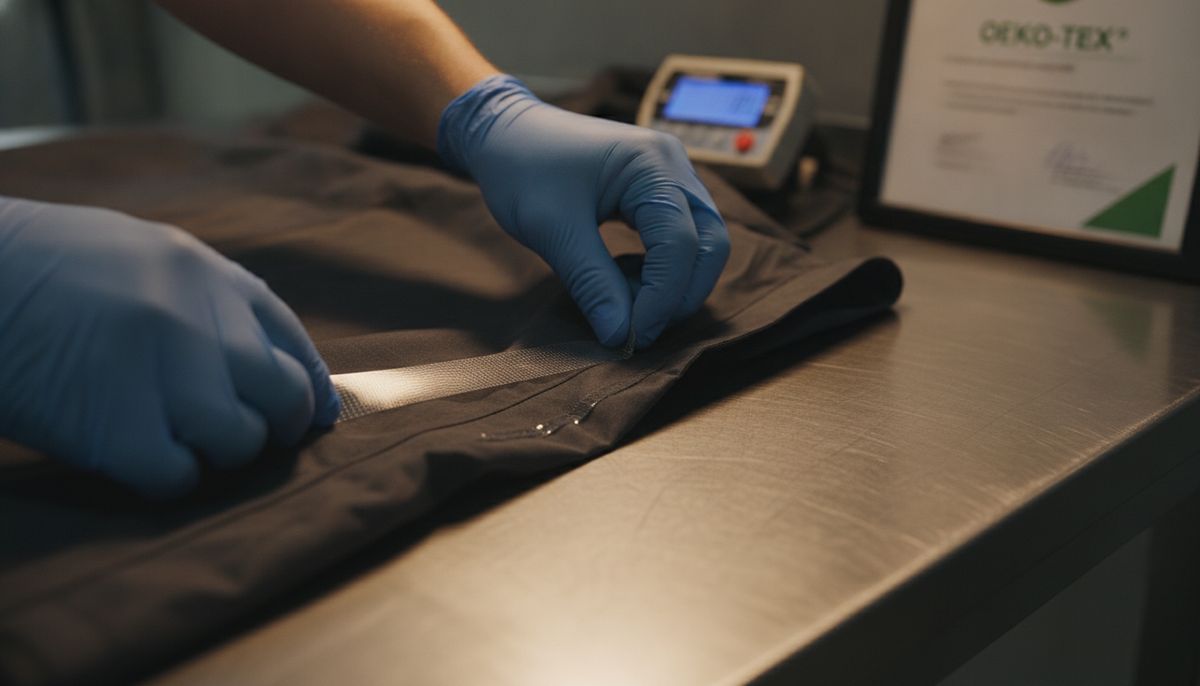
ISO 9001 certification documents a factory’s quality-management system, including incoming material inspection, in-process checkpoints, and final audit procedures. SGS or Bureau Veritas factory-audit reports verify the facility’s physical location, worker count, production capacity, and compliance with local labor law. BSCI (Business Social Compliance Initiative) audits screen for child labor, forced labor, unsafe working conditions, and wage violations. OEKO-TEX Standard 100 certification tests finished garments for harmful substances including formaldehyde, heavy metals, and restricted dyes. Request PDF copies of all certificates and cross-check the certificate number on the issuing body’s public registry; counterfeit certificates circulate widely on supplier platforms.
Conduct a Video Factory Tour
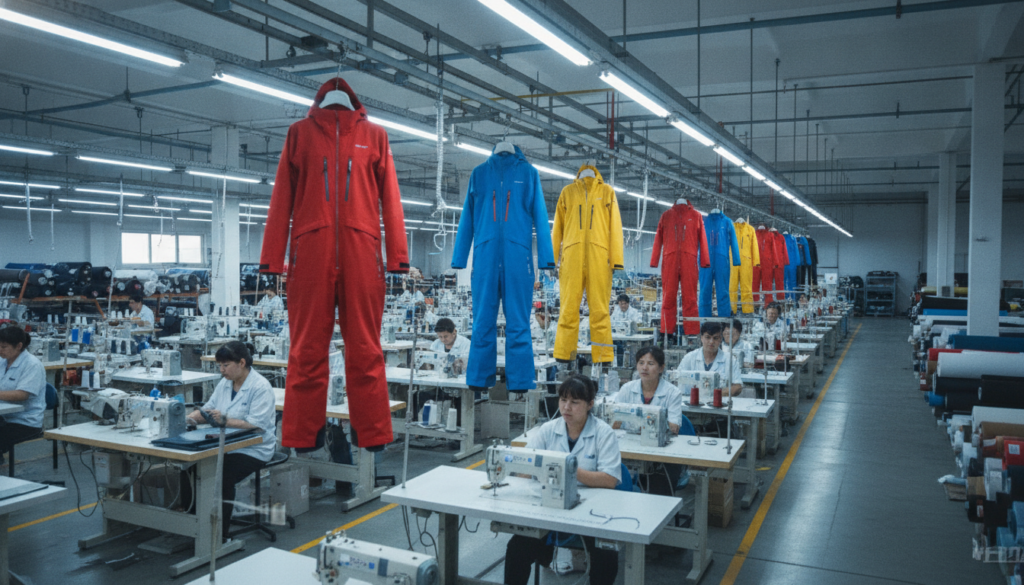
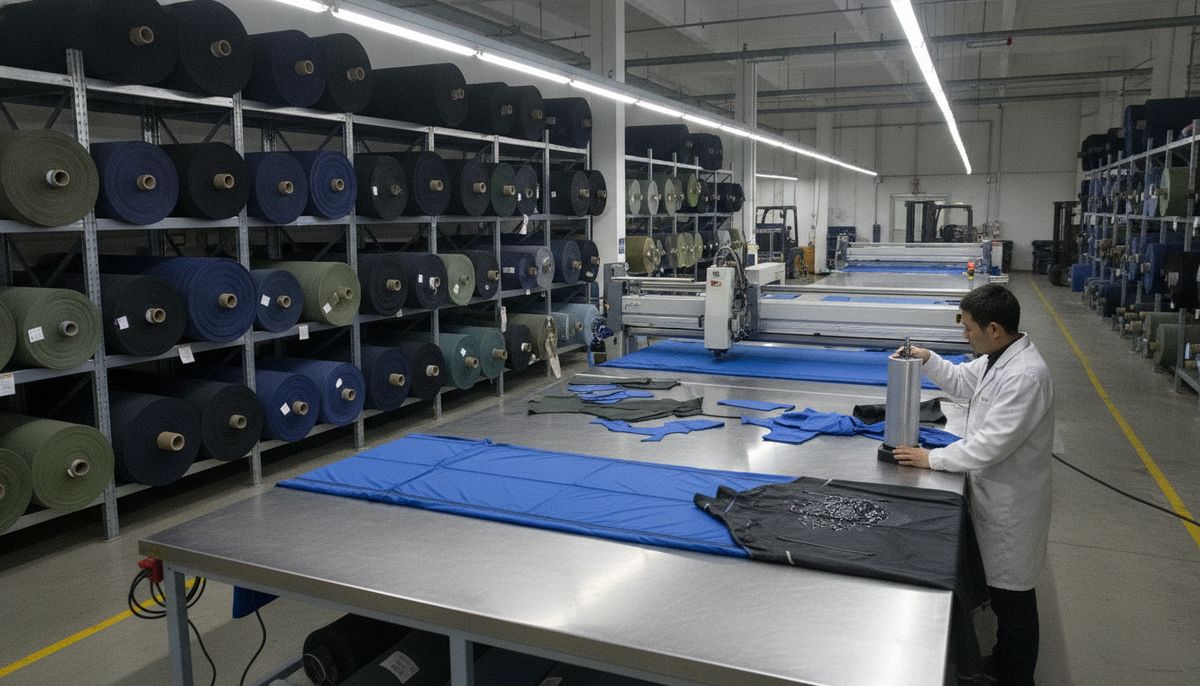
A live video call showing the cutting floor, sewing lines, quality-control station, and finished-goods warehouse confirms the factory exists and operates at the claimed scale. Ask the factory contact to walk through the facility during working hours, showing workers at their stations, fabric rolls in the warehouse, and finished jackets on the packing line. Resellers refuse video tours or show only a small office space. PTOUTWEAR’s 3,000m² Taizhou Sanmen facility runs 20 production lines with 240 workers and in-house cut-and-sew, visible on video tour by request.
Verify Material Traceability
Request mill certificates for the shell fabric, lining, and insulation (if applicable). A mill certificate states the fiber content, weight per square meter, water-column rating, breathability (MVTR), and test-method standard (ISO 811 for hydrostatic head, ISO 11092 for breathability). Factories that cannot provide mill certificates are sourcing from spot markets with no quality assurance. Buyers on Reddit r/BuyItForLife report that windbreakers lose waterproofing after a few washes when the factory substitutes a cheaper fabric without DWR coating, a problem that mill certificates prevent by locking in the spec.
Order a Pre-Production Sample
A pre-production sample replicates the exact fabric, construction, and hardware confirmed for the bulk order. It is cut from the same fabric roll, sewn on the same machines, and finished with the same DWR treatment as the production run. Pre-production samples cost $100-$300 per style and take 7-15 days to produce. Factories that skip pre-production sampling and ship bulk directly from a photo approval often deliver jackets that differ in color, fit, or durability from the approved prototype. PTOUTWEAR offers 1-piece sample MOQ with a $100 sample fee refunded against a first bulk order of 30+ pieces, ensuring you validate fit and performance before committing to production.
In practice: Seam taping is the construction step that determines whether a jacket’s waterproof rating survives a washing-machine test or delaminates after three cycles, which is why the pre-production sample must show the same seam-taping method confirmed for bulk.
Technical Specs That Separate a Real Windbreaker from a Shell
A windbreaker marketed for outdoor use should deliver measurable wind resistance, water repellency, and breathability. Jackets without documented test data are fashion shells, not performance outerwear.
Water-Column Rating and DWR Coating
Water-column rating measures the hydrostatic pressure a fabric withstands before water penetrates, tested per ISO 811. A rating of 5,000mm means the fabric holds a 5,000mm column of water without leaking. Windbreakers rated 5,000-10,000mm handle light rain and drizzle; jackets rated 10,000-20,000mm handle steady rain; jackets rated above 20,000mm handle heavy rain and snow. DWR (durable water repellent) coating on the face fabric causes water to bead and roll off rather than soaking into the fabric weave. Without DWR, even a high-rated membrane wets out, blocking breathability and making the jacket feel clammy. Buyers on SectionHiker note that DWR coatings wear off over time and require reapplication with spray-on or wash-in treatments every 10-20 washes. PTOUTWEAR applies PFC-free DWR on all windbreaker and hardshell production, meeting environmental restrictions in the US, EU, and Australia without sacrificing water repellency.
Breathability (MVTR)
MVTR (moisture vapor transmission rate) measures how much water vapor passes through a fabric in 24 hours, tested per ISO 11092 or ASTM E96. A windbreaker with 5,000-10,000 g/m²/24h breathability suits low-intensity activities like walking; a jacket with 10,000-20,000 g/m²/24h suits moderate hiking; a jacket with above 20,000 g/m²/24h suits high-output climbing and trail running. Breathability only functions when the face fabric stays dry; once the fabric wets out, vapor transmission stops and sweat condenses inside the jacket. REI expert advice recommends pit zips or ventilation panels on windbreakers used for strenuous activity, because even a breathable membrane cannot evacuate heat fast enough during hard climbs.
Seam Construction and Taping
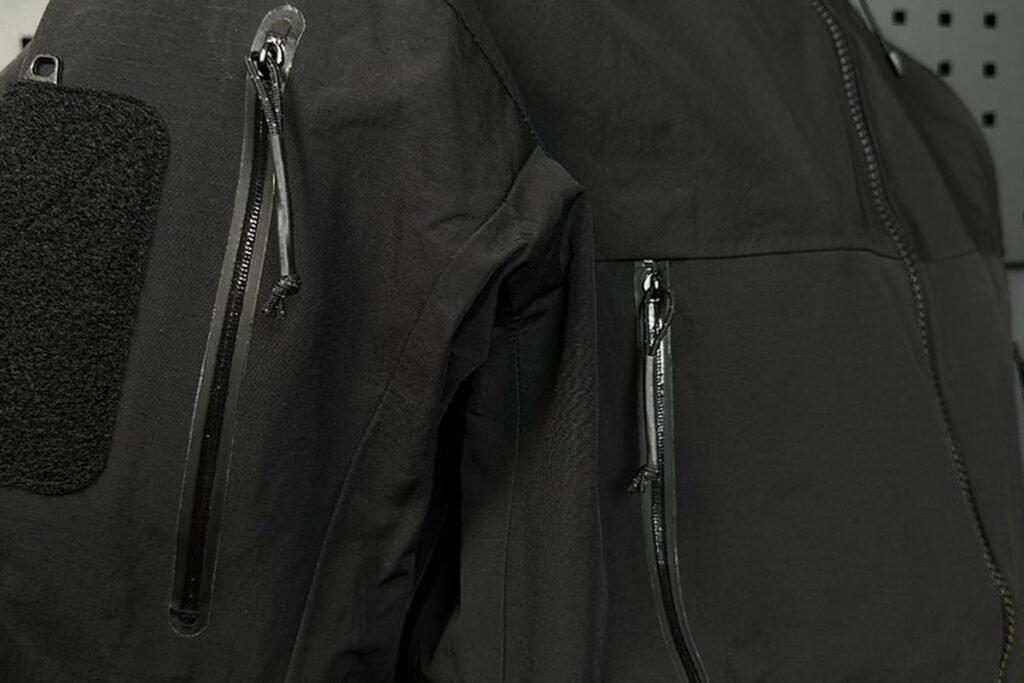
Seams are the weak point in any waterproof jacket. Needle holes create micro-gaps where water seeps through under pressure. Taped seams seal those gaps with a waterproof tape applied by heat press on the inside of the seam. Fully taped construction seals every seam; critically taped construction seals only the shoulders, hood, and front zipper. Windbreakers without taped seams are water-resistant at best, not waterproof. Factories that claim waterproof performance without showing seam-taping photos or test reports are misrepresenting the product.
Wind Resistance and Fabric Density
Wind resistance depends on fabric tightness and weave density. Ripstop nylon and polyester fabrics with a tight weave (200-300 threads per inch) block wind effectively; loose-weave fabrics with visible gaps between threads allow air penetration. Windbreakers rated for outdoor use should specify the fabric weight (typically 50-100 gsm for packable shells, 100-200 gsm for durable everyday jackets) and the denier count (20D-70D for lightweight, 70D-210D for abrasion resistance). Factories that list only fiber content without weight or denier data are offering unverified performance.
Compliance and Labeling for US, UK, EU, and Australia
Textile imports into the United States, United Kingdom, European Union, and Australia require country-specific labeling, chemical-restriction compliance, and extended producer responsibility registration. Non-compliant shipments face customs holds, fines, or destruction orders.
United States: FTC and CPSC Requirements
The Federal Trade Commission Textile and Wool Acts require fiber-content labels, country-of-origin labels, and manufacturer identification (RN number or company name and address) on all textile products sold in the US. Care labels must follow ASTM D5489 symbols or written instructions in English. The Consumer Product Safety Commission restricts lead content in zippers, snaps, and trims to below 100 ppm for children’s products and below 300 ppm for adult products. California Proposition 65 requires warning labels for products containing listed chemicals above safe-harbor levels, including certain dyes and flame retardants. US Customs and Border Protection enforces Section 301 tariffs on Chinese imports, currently 7.5-25% on textile categories depending on exclusion status.
United Kingdom: UKCA and REACH
Post-Brexit UK requires UKCA (UK Conformity Assessed) marking for certain product categories, though textiles generally fall under general product safety rather than UKCA. REACH (Registration, Evaluation, Authorization, and Restriction of Chemicals) restricts substances of very high concern (SVHC) in textile products, including certain azo dyes, phthalates, and per- and polyfluoroalkyl substances (PFAS). UK REACH maintains a restricted-substance list similar to EU REACH but with separate registration. Textile products must carry fiber-content labels, care labels per ISO 3758, and country-of-origin labels. EPR (extended producer responsibility) for packaging requires registration with a compliance scheme if you import more than 50 tonnes of packaging material annually or have turnover above £2 million.
European Union: REACH, CLP, and EPR
EU REACH restricts SVHC substances in textile products, with concentration limits below 0.1% by weight for listed chemicals. CLP (Classification, Labelling, and Packaging) regulation requires hazard pictograms and safety data sheets for chemical products but generally does not apply to finished textiles unless they contain biocidal treatments. Textile products must carry fiber-content labels per Regulation (EU) 1007/2011, care labels per ISO 3758, and country-of-origin labels. Germany, France, and Italy have implemented EPR schemes requiring producers to register and pay fees for textile waste collection and recycling. France’s AGEC law (Anti-Waste for a Circular Economy) mandates traceability and eco-design scores for textile products sold in France.
Australia: ACCC and Mandatory Standards
The Australian Competition and Consumer Commission enforces mandatory fiber-content labeling, care labeling per AS/NZS 1957, and country-of-origin labeling for textile products. Products must carry a business name and Australian address or ABN (Australian Business Number). Certain children’s products face mandatory safety standards including drawstring restrictions and flammability testing. Australia applies 5% GST and 5-10% duty on most textile imports, calculated on the CIF value. Product Safety Australia maintains a banned and recalled products list that importers must check before shipping.
Key Takeaways
- Wholesale windbreaker jacket small brand startup sourcing prioritizes low MOQ, fast sampling, and transparent landed-cost modeling over rock-bottom unit prices that hide freight, duty, and defect costs.
- Private-label programs offer 10-50 piece MOQs with custom logo application on factory-designed styles, balancing speed and brand control for startups below $100,000 in revenue.
- Landed cost per unit includes FOB price, freight, duties, customs brokerage, payment fees, packaging, and a 2-3% defect allowance, often adding 50-80% to the ex-factory price.
- Factory verification requires ISO 9001 and SGS certificates, a live video tour of the production floor, mill certificates for all fabrics, and a pre-production sample using the exact materials confirmed for bulk.
- A windbreaker rated for outdoor use should document water-column resistance above 5,000mm, DWR coating on the face fabric, and taped or sealed seams, with test reports per ISO 811 and ISO 11092.
- US, UK, EU, and Australia textile imports require fiber-content labels, care labels, country-of-origin labels, chemical-restriction compliance, and extended producer responsibility registration where applicable.
Frequently Asked Questions
What is the typical lead time for a wholesale windbreaker jacket small brand startup order?
Sampling takes 7-10 days for private-label styles and 10-15 days for OEM custom designs. Bulk production runs 25-35 days for private label and 30-40 days for OEM. Air freight adds 3-5 days for delivery, sea freight adds 30-45 days. A 10-piece test order placed today ships within two weeks by air; a 300-piece bulk order ships in 5-7 weeks by sea. Rush production is available for orders of 1,000+ pieces at a 25% surcharge, delivering bulk in two weeks.
How do I calculate the break-even retail price for a wholesale windbreaker?
Multiply landed cost per unit by 2.5-3.0 for wholesale pricing to retailers, or by 4.0-5.0 for direct-to-consumer pricing. A windbreaker with a $30 landed cost sells wholesale at $75-$90 or DTC at $120-$150. Factor in payment processing fees (2.9% + $0.30 for Shopify Payments), returns and exchanges (5-10% of revenue), marketing cost per acquisition ($15-$40 for paid social), and operating expenses (15-25% of revenue). A $30 landed jacket sold DTC at $120 yields roughly $120 revenue minus $3.78 payment fee minus $12 return allowance minus $25 CAC minus $18 operating expense, netting $61.22 before tax, or a 51% gross margin.
Can I mix colors and sizes within a 10-piece minimum order?
PTOUTWEAR allows mixed colors and sizes within the 10-piece bulk MOQ per style. You can order 3 black medium, 3 navy large, 2 gray small, and 2 olive XL as a single 10-piece order. School and corporate uniform programs require 30 pieces per style per color due to dye-lot consistency requirements. Mixing colors across styles (for example, 5 windbreakers and 5 softshells) does not qualify; each style carries its own 10-piece minimum.
Ready to source wholesale windbreaker jackets with 10-piece MOQ and 7-10 day sampling?
Request Your Sample Pack →
Written by Ivan Chen, Sales Engineer at PTOUTWEAR, 13 years in outdoor apparel manufacturing.