Custom ski gear manufacturing for teams, brands, and corporate buyers centers on three production routes: OEM development (design from scratch, 30-piece bulk MOQ), private label (rebrand existing styles, same 30-piece minimum), and made-to-order sampling (1-piece samples available, $100 refundable fee). Lead times run 7-10 days for samples and 25-35 days for bulk production, with PFC-free DWR and seam-taped construction standard across hardshell and insulated categories.
📋 Table of Contents
- Executive Summary
- What Does Custom Ski Gear Mean for B2B Buyers?
- Three Production Routes: OEM, Private Label, Made-to-Order
- MOQ and Pricing Structure for Custom Ski Apparel
- Material and Construction Requirements for Ski Outerwear
- Customization Scope: Logos, Colors, Fit, and Features
- Lead Times and Production Workflow
- Key Takeaways
- FAQ
Executive Summary
- Production routes: OEM development allows full design control from fabric to trim, private label rebadges proven styles, and made-to-order sampling validates fit before bulk commitment.
- Minimum order quantities: Sample MOQ is 1 piece with a $100 refundable fee; bulk MOQ is 30 pieces per SKU for both OEM and private label orders.
- Lead times: Sampling takes 7-10 days, bulk production runs 25-35 days, and rush orders of 1,000 pieces can be completed in 2 weeks at a 25% surcharge.
- Material performance: PFC-free DWR coatings and fully taped seams are standard for hardshell ski jackets to meet waterproof and breathability requirements in wet snow conditions.
- Customization options: Logos can be embroidered, heat-transferred, or woven; color blocking, fit adjustments, and feature additions are all possible within the OEM workflow.
What Does Custom Ski Gear Mean for B2B Buyers?
Custom ski gear in a B2B context refers to ski jackets, pants, and insulated layers manufactured to a buyer’s specification, branded with team or company logos, and ordered in quantities that support team programs, corporate gifting, or small-brand launches. This is distinct from retail-level boot fitting or equipment customization services. Buyers include ski clubs, corporate outfitters, school uniform programs, and DTC outdoor brands launching ski-specific product lines.
Most buyers enter this market because off-the-shelf wholesale options lack the branding flexibility or specific feature combinations their end users require. A corporate ski trip organizer may need 50 jackets with a company logo and specific color blocking. A Nordic ski club may require race-fit shells with reinforced elbows and reflective trim. A new outdoor brand may want to test three hardshell styles before committing to a full seasonal buy.
Buyers frequently report uncertainty about sizing, returnability, and whether the wait time justifies the customization. Made-to-order performance apparel sounds attractive, but the inability to touch a sample before committing to a 100-piece order creates hesitation. This is why 1-piece sampling has become the standard entry point for B2B buyers in this category.
Three Production Routes: OEM, Private Label, Made-to-Order
OEM Development
OEM jacket manufacturing gives buyers full control over fabric, insulation, trim, fit, and branding. The factory sources materials to your specification, cuts patterns to your tech pack, and assembles the garment from scratch. OEM is the right choice when you need a feature combination that does not exist in the market, such as a hardshell ski jacket with pit zips, a powder skirt, and a helmet-compatible hood in a specific colorway.
The OEM workflow begins with a tech pack or design brief. The factory sources fabric swatches, submits them for approval, then produces a pre-production sample. Once approved, bulk production begins. Typical bulk MOQ is 30 pieces per SKU. Lead time from approved sample to finished goods is 25-35 days.
Private Label
Private label production allows buyers to rebrand an existing factory style with their own logo and hang tags. The factory maintains a catalog of proven ski jacket designs, each with established patterns, tested materials, and known production costs. Buyers select a base style, specify logo placement and method (embroidery, heat transfer, woven label), and place an order.
Private label reduces lead time and design risk. Because the pattern and material are already validated, sampling can be as fast as 5 days, and bulk production follows the same 25-35 day timeline as OEM. Bulk MOQ remains 30 pieces per SKU. Private label works best for buyers who need branded gear quickly and are willing to accept a pre-designed silhouette.
Made-to-Order Sampling
Made-to-order sampling allows buyers to order a single finished garment before committing to bulk. The factory produces one piece to the buyer’s specification, ships it for fit and quality review, and adjusts the pattern or materials based on feedback. Sample MOQ is 1 piece, with a $100 sample fee that is refunded against the first bulk order.
This route is critical for buyers who are uncertain about fit or who need to show a physical sample to stakeholders before placing a larger order. Sampling takes 7-10 days from order to shipment. Once approved, the buyer places a bulk order with the same 30-piece MOQ as OEM or private label.
MOQ and Pricing Structure for Custom Ski Apparel
Sample MOQ: 1 piece. Bulk MOQ: 30 pieces per SKU. Sampling time: 7-10 days. Bulk production: 25-35 days.
Minimum order quantities vary by production route, but all routes share the same bulk floor: 30 pieces per SKU. A SKU is defined as a unique combination of style, color, and size. If a buyer orders a hardshell jacket in three colors and four sizes, the 30-piece minimum applies to each color, not to the total order. This structure allows small teams and corporate buyers to order branded gear without tying up capital in excess inventory.
Pricing depends on fabric, insulation, trim complexity, and order volume. A basic softshell ski jacket with a single-color logo starts lower than a 3-layer hardshell with pit zips, a powder skirt, and multi-color embroidery. Buyers should request a detailed quote that breaks out fabric cost, trim cost, labor, and logo application separately. This transparency allows buyers to adjust specifications to meet a target price without sacrificing critical performance features.
Material and Construction Requirements for Ski Outerwear
Waterproofing and Breathability
Ski jackets must resist water penetration from wet snow while allowing sweat vapor to escape during high-output activity. Waterproofing is measured by hydrostatic head (how much water pressure the fabric can withstand before leaking), and breathability is measured by moisture vapor transmission rate (MVTR, how many grams of water vapor pass through one square meter of fabric in 24 hours).
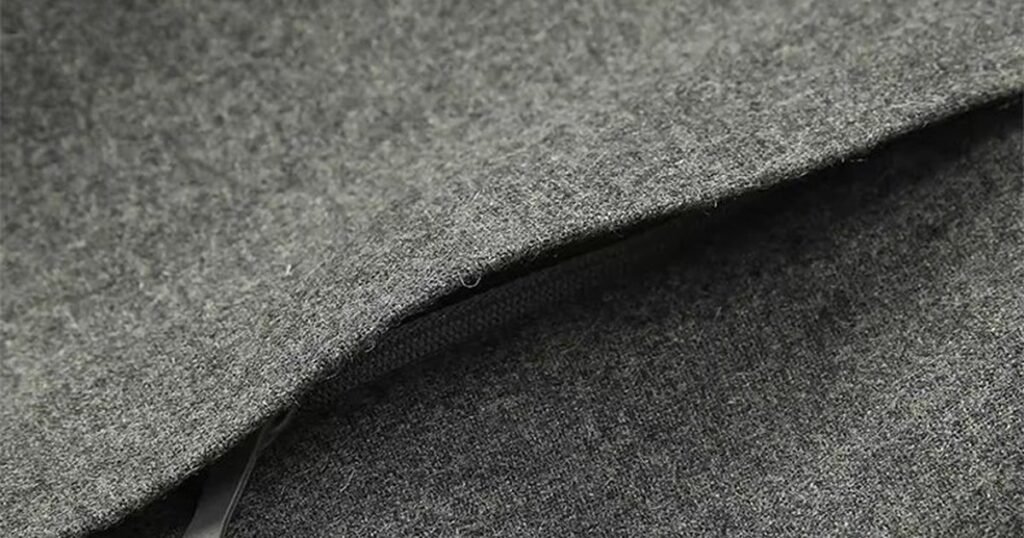
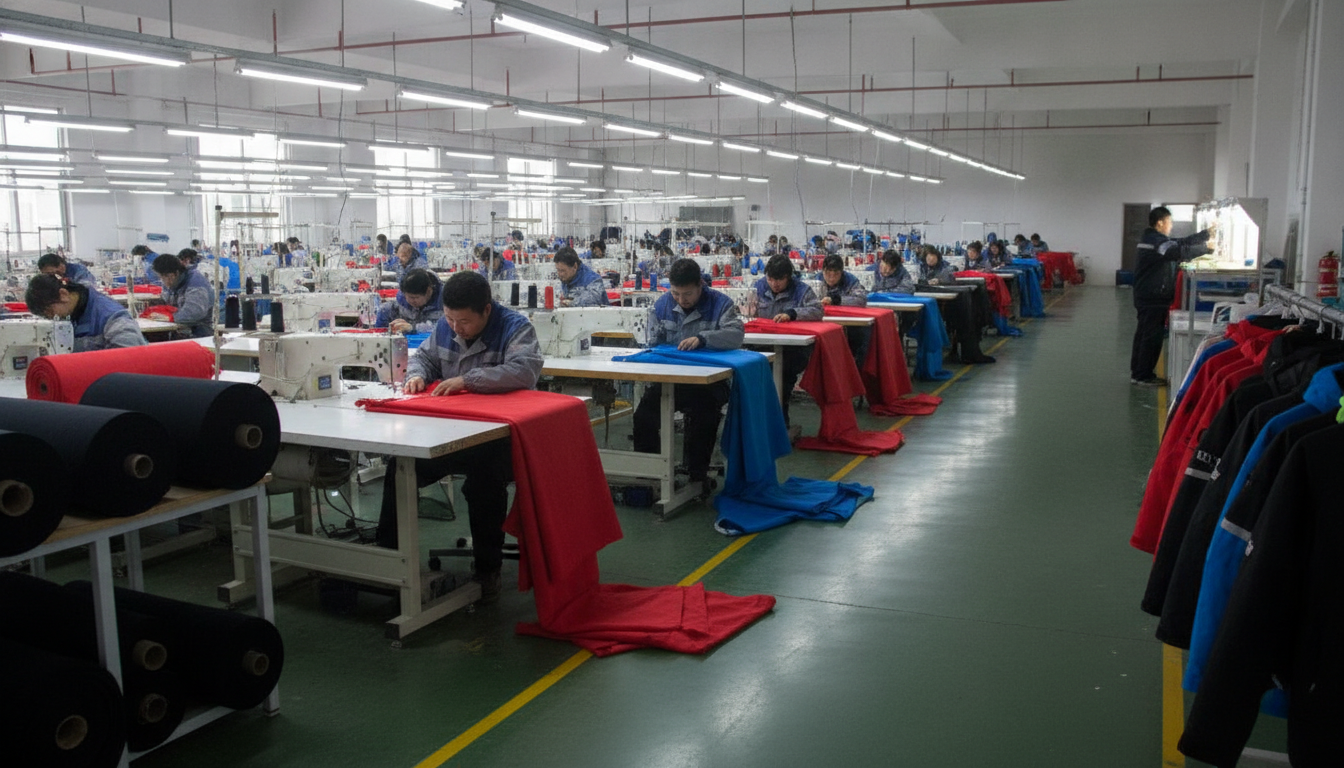
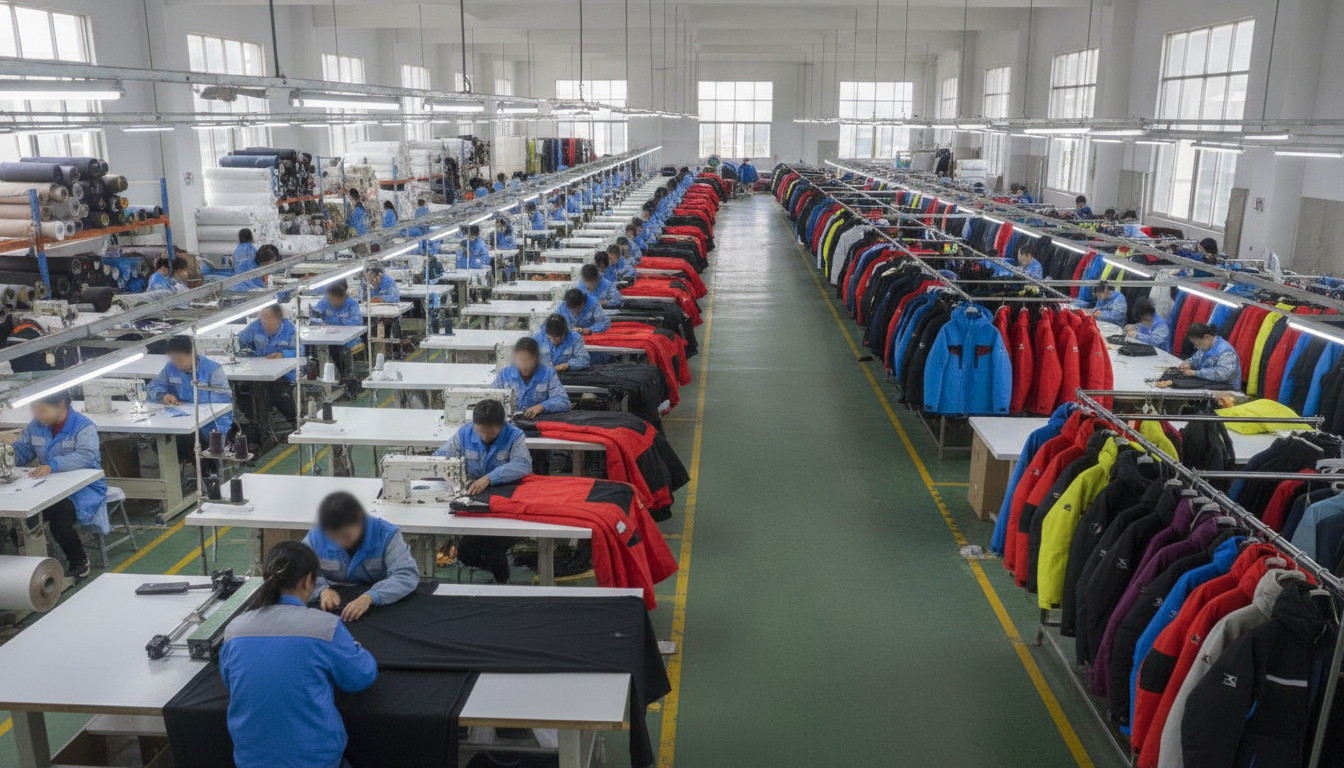
A hardshell ski jacket typically uses a 2-layer or 3-layer laminate with a hydrostatic head of 10,000mm or higher and an MVTR of 10,000 g/m²/24h or higher. The outer face fabric is treated with a durable water repellent (DWR) finish to prevent water from saturating the fabric surface. PFC-free DWR is now standard at PTOUTWEAR’s 3,000m² Taizhou Sanmen facility, where 240 workers produce 200,000 pieces per year across 20 production lines.
Seam Taping
Waterproof fabric is only as good as its seams. Needle holes created during stitching become leak points unless sealed with seam tape. Fully taped seams (every seam sealed) are standard for hardshell ski jackets. Critically taped seams (only high-exposure areas like shoulders and hood seams) are acceptable for softshell or insulated layers where breathability is prioritized over maximum waterproofing.
Seam tape is applied using a hot-air or hot-wedge machine that bonds the tape to the seam allowance. The tape width, adhesive type, and application temperature all affect durability. A seam that passes a factory wash test but fails after 10 customer washes indicates poor tape selection or incorrect application temperature. This is why sampling and wash testing are non-negotiable before bulk production begins.
Insulation
Insulated ski jackets use synthetic insulation (polyester fill) or down insulation (duck or goose down). Synthetic insulation retains warmth when wet, dries quickly, and costs less than down. Down insulation offers a better warmth-to-weight ratio but loses loft when saturated. Most ski jackets use 60-100 grams per square meter of synthetic insulation in the body and 40-60 grams in the sleeves to balance warmth and mobility.
Down is rated by fill power (the volume in cubic inches that one ounce of down occupies). Higher fill power (600+, 700+, 800+) means more loft and warmth per gram of insulation. Down must be treated with a water-resistant finish to maintain performance in wet conditions. Buyers should specify fill power, fill weight, and whether the down is RDS-certified (Responsible Down Standard) if animal welfare is a brand concern.
Customization Scope: Logos, Colors, Fit, and Features
Logo Application Methods
Custom logo services include embroidery, heat transfer, woven labels, and printed labels. Embroidery works best for logos with fewer than six colors and simple shapes. Heat transfer allows full-color graphics but may crack or peel after repeated washing if the adhesive is not selected correctly. Woven labels are durable and add a premium feel but require a minimum order of 500-1,000 labels from most label suppliers.
Logo placement is constrained by garment construction. A chest logo on a hardshell jacket must avoid the seam-taped areas where the embroidery needle would puncture the waterproof membrane. A back yoke logo must be positioned high enough to remain visible when a backpack is worn. Buyers should provide a logo file in vector format (AI, EPS, or high-resolution PDF) and specify Pantone color codes to ensure color accuracy.
Color Blocking and Fabric Combinations
Custom color blocking allows buyers to combine two or more fabric colors in a single garment. A common pattern is a darker color on the shoulders and elbows (high-wear areas) and a lighter color on the body. Color blocking adds labor cost because each color requires a separate cutting and sewing step, but it allows brands to create a distinctive look without custom fabric dyeing.
Buyers can also mix fabric types within a single garment. A ski jacket might use a 3-layer hardshell on the shoulders and chest for maximum weather protection, and a lighter 2-layer fabric on the back and underarms for better breathability. This approach is common in high-output ski touring and Nordic racing jackets where weight and ventilation are prioritized.
Fit Adjustments and Feature Additions
Fit adjustments include changing the body length, sleeve length, shoulder width, or chest circumference of a base pattern. Small adjustments (1-2 cm) are straightforward. Larger adjustments may require a new pattern grade, which adds sampling time. Buyers should provide a fit sample or detailed measurements for the factory to follow.
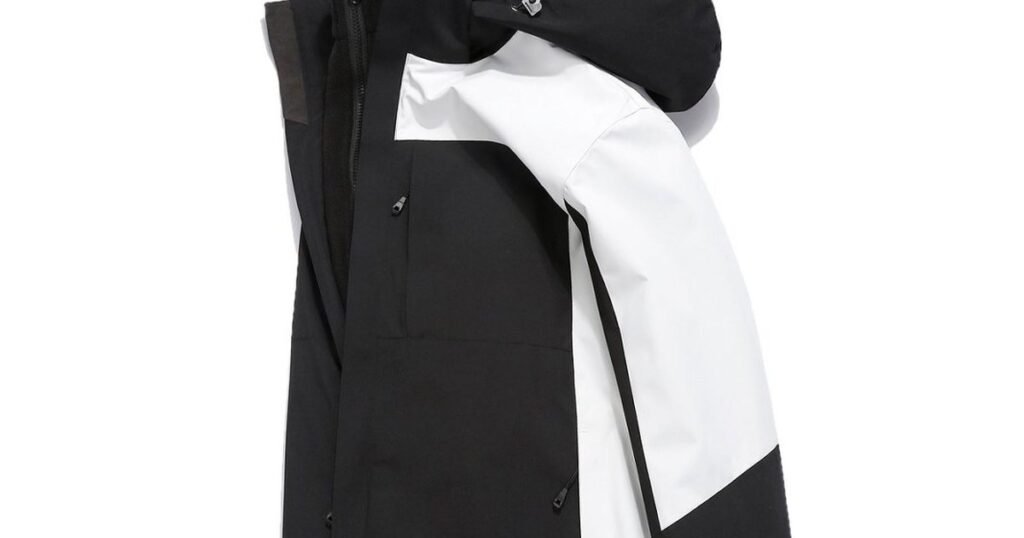
Feature additions include pit zips, powder skirts, helmet-compatible hoods, internal pockets, goggle wipes, and pass pockets. Each feature adds labor and material cost. A powder skirt with snap attachments costs more than a simple elastic hem. A helmet-compatible hood requires a larger hood opening and a rear adjustment system, both of which add labor steps. Buyers should prioritize features that directly support the end user’s activity and remove features that do not.
Lead Times and Production Workflow
Pre-Production Phase
The pre-production phase begins when the buyer submits a tech pack or design brief. The factory sources fabric swatches, submits them for approval, and produces a pre-production sample. This phase takes 7-10 days for private label orders (where the pattern already exists) and 10-14 days for OEM orders (where a new pattern must be drafted).
Buyers should review the pre-production sample for fit, fabric hand feel, color accuracy, logo placement, and construction quality. Any changes requested at this stage are incorporated into the final production pattern. Once the sample is approved, the factory orders bulk fabric and schedules the order on the production line.
Bulk Production Phase
Bulk production takes 25-35 days from fabric receipt to finished goods. The factory cuts all pieces, sews them into garments, applies logos, presses seams, inspects each piece, and packs them for shipment. Rush orders of 1,000 pieces or more can be completed in 2 weeks at a 25% surcharge, but this option is only available when production capacity allows.
Buyers should specify packaging requirements during the pre-production phase. Standard packaging is a polybag with a barcode sticker. Custom packaging (branded boxes, hang tags, folded presentation) adds cost and lead time. DDP (Delivered Duty Paid) shipping is available, meaning the factory handles customs clearance and delivers the goods to the buyer’s warehouse.
Quality Control Checkpoints
Quality control happens at three stages: fabric inspection (checking for dye defects, holes, or off-grain fabric), in-line inspection (checking stitching, seam tape application, and logo placement during production), and final inspection (checking finished garments for defects before packing). Each checkpoint reduces the risk of defects reaching the buyer.
In practice: In-line inspection catches seam-taping errors before a full production run is completed, which is why it is scheduled after the first 10% of garments are sewn rather than waiting until the end.
Key Takeaways
- Custom ski gear for B2B buyers includes OEM development, private label rebranding, and made-to-order sampling, each with a 30-piece bulk MOQ and 1-piece sample MOQ.
- Waterproof ski jackets require a hydrostatic head of 10,000mm or higher, fully taped seams, and PFC-free DWR to resist wet snow while allowing sweat vapor to escape.
- Logo application methods include embroidery, heat transfer, and woven labels, with placement constrained by seam-taped areas and garment construction.
- Lead times run 7-10 days for sampling and 25-35 days for bulk production, with a 2-week rush option available for orders of 1,000 pieces or more at a 25% surcharge.
- Fit adjustments, color blocking, and feature additions are all possible within the OEM workflow, but each adds labor cost and requires clear specification during the pre-production phase.
- Quality control checkpoints at fabric inspection, in-line inspection, and final inspection reduce the risk of defects and ensure that bulk production matches the approved sample.
FAQ
Can I order custom ski gear with my company logo in quantities smaller than 30 pieces?
Sample orders allow a 1-piece MOQ with a $100 refundable sample fee, but bulk production requires 30 pieces per SKU. A SKU is a unique combination of style, color, and size. If your team needs fewer than 30 jackets in a single color and size, consider ordering multiple sizes to reach the 30-piece minimum, or explore private label options where existing styles can be rebranded with lower per-unit costs.
How do I verify that the fabric will stay waterproof after washing?
Request a wash-tested sample before approving bulk production. The factory should wash the sample three to five times using a standard home wash cycle, then retest the hydrostatic head and check the seam tape for delamination. A fabric that starts at 15,000mm hydrostatic head and drops below 10,000mm after five washes indicates a weak DWR or poor seam tape adhesive. Specify PFC-free DWR and request wash test results in writing before placing the bulk order.
What is the difference between 2-layer and 3-layer hardshell fabric for ski jackets?
A 2-layer fabric bonds the waterproof membrane to the outer face fabric, with a separate mesh lining sewn inside the garment to protect the membrane. A 3-layer fabric bonds the membrane between the outer fabric and a lightweight inner fabric, creating a single laminate. Three-layer fabrics are more durable, lighter, and pack smaller, but cost more per meter. Two-layer fabrics are less expensive and easier to repair, but add weight and bulk. For high-output skiing or ski touring, 3-layer is preferred. For resort skiing or corporate team jackets, 2-layer is often sufficient.
Ready to source custom ski gear for your team or brand?
Request a 1-piece sample →
Written by Ivan Chen, Sales Engineer at PTOUTWEAR, 13 years in outdoor apparel manufacturing.