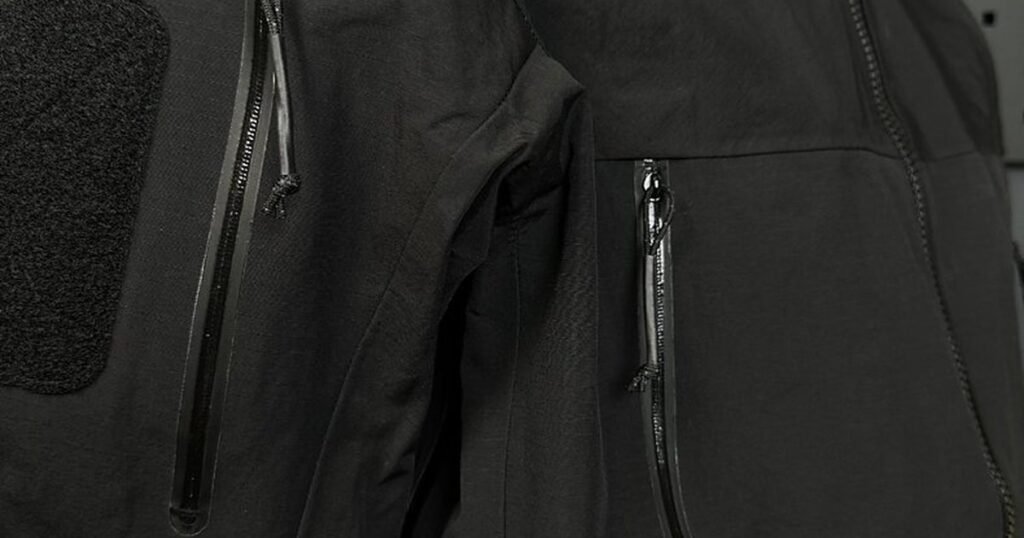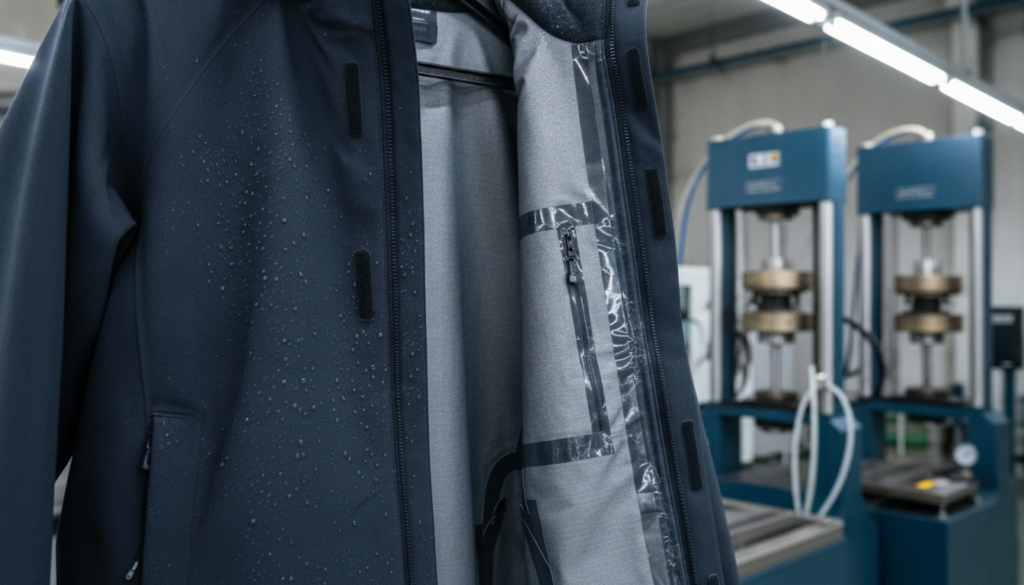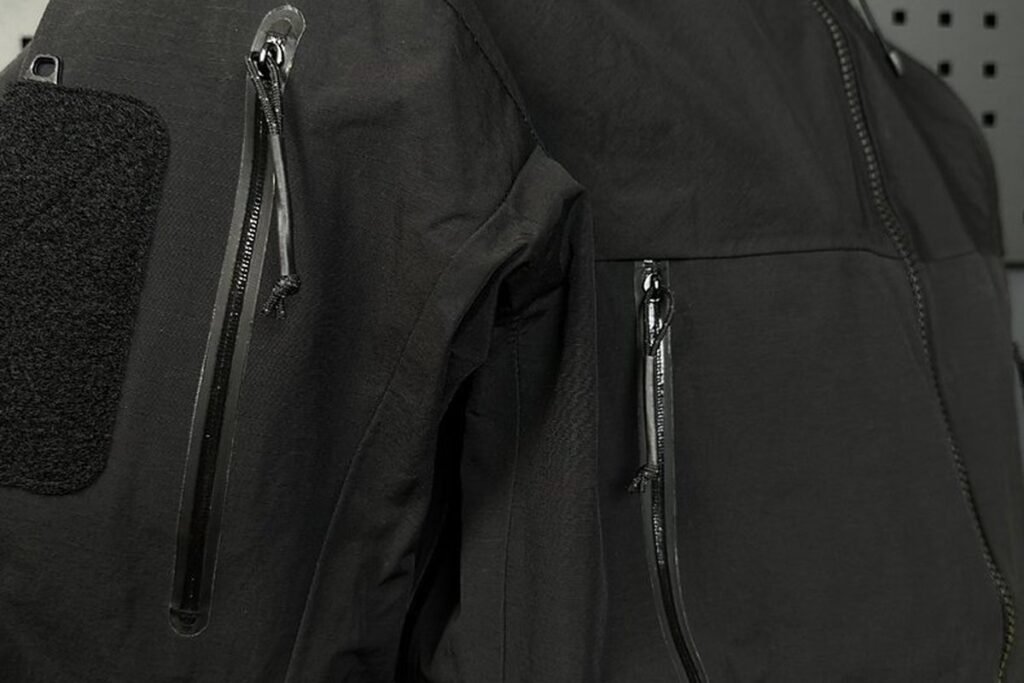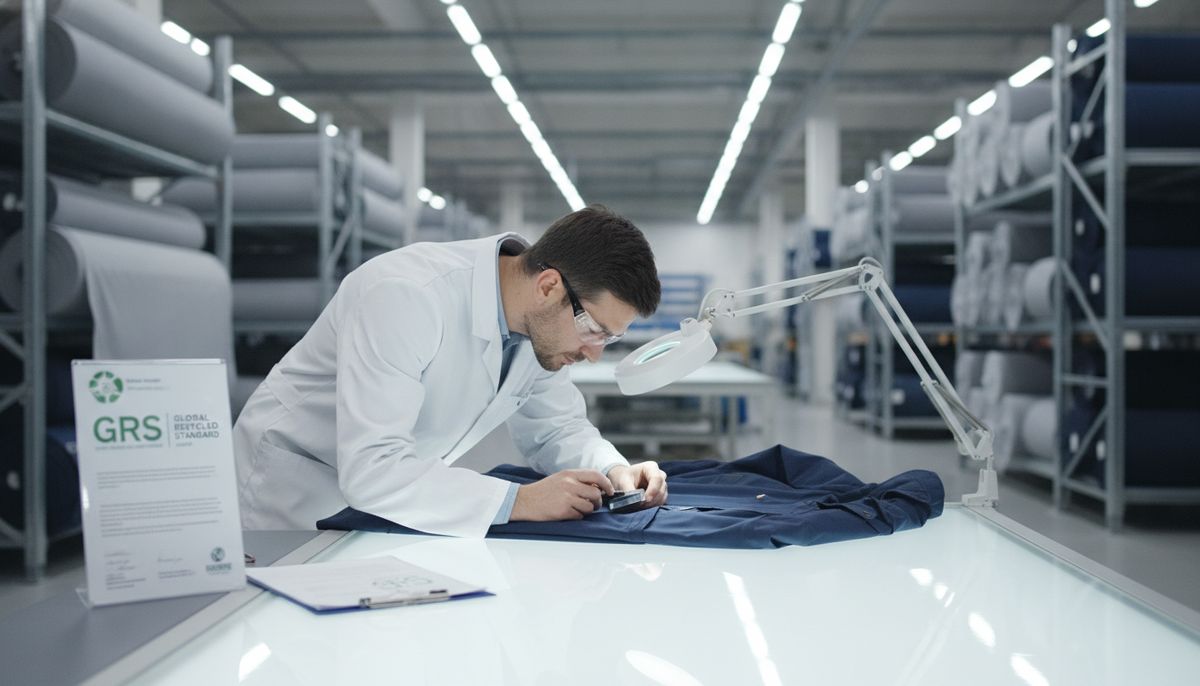
A private label workwear rain jacket GRS certified supplier must hold a valid Global Recycled Standard certificate covering the product categories you intend to order, maintain chain-of-custody documentation from fiber through finished garment, and issue transaction certificates (TC) for every GRS-labeled shipment. GRS certification requires at least 20% recycled content by weight; most workwear rain jackets use 50-100% recycled polyester face fabric and lining to meet the standard. Sample MOQ 1 piece, bulk MOQ 10 pieces per style at PTOUTWEAR.
📋 Table of Contents
- Executive Summary
- What GRS Certification Proves for Workwear Rain Jackets
- How to Verify a Supplier’s GRS Certificate Scope
- GRS vs OEKO-TEX vs bluesign: Which Certifications Matter
- MOQ, Pricing, and Lead Times for Private Label GRS Rain Jackets
- Technical Validation: Testing Finished Jackets Beyond Certification
- Key Takeaways
- Frequently Asked Questions
Executive Summary
- GRS minimum threshold: The Global Recycled Standard requires at least 20% recycled material content before a product can carry the GRS label; most workwear rain jackets use 50-100% recycled polyester to meet buyer expectations and certification thresholds.
- Chain-of-custody documentation: A genuine GRS-certified supplier maintains transaction certificates from fiber supplier through garment factory and issues a TC for every GRS-labeled shipment you receive.
- Certificate scope matters: Many factories hold GRS certification for one product category but not another; verify that the certificate explicitly covers outerwear or jackets before placing an order.
- MOQ and sampling economics: Sample MOQ 1 piece with a refundable fee; bulk MOQ 10 pieces per style at PTOUTWEAR, colours and sizes can be mixed, which reduces cash commitment for small brands validating a workwear line.
- Testing beyond certification: GRS verifies recycled content and chemical compliance but does not test hydrostatic head, breathability, seam-seal integrity, or wash durability; request lab reports for EN 343 Class 3 or ISO 811 before approving bulk production.
What GRS Certification Proves for Workwear Rain Jackets
The Global Recycled Standard certifies that a garment contains a verified percentage of recycled material and that the supply chain meets social, environmental, and chemical requirements. For a workwear rain jacket, GRS typically covers recycled polyester face fabric, recycled polyester mesh lining, and sometimes recycled polyester insulation fill. The standard requires at least 20% recycled content by weight, but most European buyers expect 50% or higher to justify the GRS label on a product hang-tag or website.
Recycled Content Verification
GRS-certified suppliers trace recycled polyester from post-consumer PET bottles or post-industrial textile waste through every processing step. The certification body audits material invoices, production records, and mass-balance calculations to confirm that the declared recycled percentage matches actual input. A transaction certificate accompanies every shipment and states the exact recycled content percentage for that batch. Buyers in Germany, France, and the United Kingdom increasingly require transaction certificates to substantiate recycled-content claims under extended producer responsibility (EPR) regulations.
Chemical and Environmental Compliance
GRS prohibits a list of restricted substances aligned with REACH and California Proposition 65, covering heavy metals, phthalates, and certain azo dyes. The standard also requires wastewater treatment and energy management at dyeing and finishing facilities. For workwear rain jackets, this means the durable water repellent (DWR) coating must be free of long-chain per- and polyfluoroalkyl substances (PFAS). PTOUTWEAR applies PFC-free DWR on all rain-jacket shells, which satisfies both GRS chemical requirements and the growing number of corporate sustainability policies that ban fluorinated treatments.
Social and Labor Standards
GRS incorporates the core labor principles of the International Labour Organization (ILO), including freedom of association, no forced labor, no child labor, and safe working conditions. The certification body audits payroll records, working hours, and factory safety protocols. For European buyers sourcing private-label workwear, GRS social compliance reduces the risk of supply-chain liability under modern slavery and due-diligence legislation in the United Kingdom, Germany, and France.
In practice: A jacket that passes GRS fiber-content verification can still fail a hydrostatic-head test if the lamination or seam-taping process introduces defects, which is why finished-product testing is a separate step from certification.
How to Verify a Supplier’s GRS Certificate Scope
Not every GRS certificate covers every product category. A factory may hold GRS certification for knit T-shirts but not for woven outerwear, or for non-waterproof softshell jackets but not for laminated hardshell rain jackets. Certificate scope determines whether the supplier can legally issue a transaction certificate for your order.
Request the Certificate PDF
Ask the supplier for a PDF copy of the current GRS certificate. The certificate lists the certification body (Control Union, ECOCERT, ICEA, or another accredited body), the certificate number, the expiry date, and the product categories covered. Look for explicit mention of outerwear, jackets, or coats. Generic phrases like “apparel” or “garments” may not cover technical outerwear if the factory has not demonstrated chain-of-custody for waterproof membranes, laminated fabrics, or taped seams.
Verify on the Textile Exchange Database
The Textile Exchange maintains a public database of GRS-certified facilities. Enter the factory name or certificate number to confirm that the certificate is active and that the scope matches the product you intend to order. Certificates expire annually and must be renewed through re-audit. A certificate issued in 2024 but not renewed in 2025 is no longer valid, and any transaction certificate issued under an expired certificate is non-compliant.
Ask for a Recent Transaction Certificate
A transaction certificate (TC) is proof that a specific shipment meets GRS requirements. Request a sample TC from a recent order the factory fulfilled for another customer (with customer details redacted). The TC should state the recycled content percentage, the GRS certificate number, and the certification body. If the supplier cannot provide a sample TC or if the TC shows a different product category, the factory may not have the systems in place to issue compliant TCs for your order.
GRS vs OEKO-TEX vs bluesign: Which Certifications Matter
GRS, OEKO-TEX Standard 100, and bluesign address different risks in the textile supply chain. A private label workwear rain jacket GRS certified supplier may hold one, two, or all three certifications, but each serves a distinct buyer need.
GRS: Recycled Content and Chain of Custody
GRS verifies that a product contains a minimum percentage of recycled material and that the supply chain maintains traceability from fiber through finished garment. The standard also covers chemical restrictions, environmental management, and social compliance, but its primary value is proving recycled-content claims. European buyers prioritizing circular-economy positioning and EPR compliance require GRS for recycled polyester workwear jackets.
OEKO-TEX Standard 100: Finished-Product Chemical Safety
OEKO-TEX Standard 100 tests the finished garment for harmful substances, including heavy metals, formaldehyde, phthalates, and certain dyes. The certification applies to the final product as it reaches the end user, which means every component (fabric, lining, zippers, thread, labels) must pass testing. OEKO-TEX does not verify recycled content or environmental management; it focuses exclusively on human health and skin contact. Buyers in Germany and Austria often require OEKO-TEX for workwear sold to corporate clients, schools, or public-sector tenders where chemical safety is a procurement criterion.
bluesign: Chemical Input Management at Mills
bluesign certifies that textile mills use approved chemicals, dyes, and finishes and that wastewater, emissions, and energy consumption meet strict environmental thresholds. The certification applies to the fabric-production stage, not the finished garment. A bluesign-approved fabric can be sewn into a jacket at a non-bluesign factory, but the jacket cannot carry the bluesign product label unless the entire supply chain (fabric mill, trim suppliers, garment factory) is bluesign system partners. European outdoor brands and technical workwear buyers value bluesign for its focus on chemical input management and resource efficiency, but the certification is less common than GRS or OEKO-TEX because it requires mill-level compliance.
Which Combination to Require
A private label workwear rain jacket targeting sustainability-focused corporate buyers in Europe benefits from GRS (recycled content proof) plus OEKO-TEX Standard 100 (finished-product safety). If the fabric supplier holds bluesign approval, the combination of GRS and bluesign strengthens the environmental story, but bluesign alone does not prove recycled content. PTOUTWEAR currently holds ISO 9001, SGS, and PFC-Free DWR certification; OEKO-TEX, BSCI, GRS, and bluesign are pending, not yet held.
MOQ, Pricing, and Lead Times for Private Label GRS Rain Jackets
Minimum order quantities, sample fees, and production lead times vary widely across suppliers. Small brands launching a workwear line need transparent economics to validate the business case before committing to bulk orders.
Sample MOQ and Fees
Sample MOQ at PTOUTWEAR is 1 piece, with a $100 sample fee that is refunded against a first bulk order of 30+ pieces. Sampling time is 7-10 days from artwork approval. The sample uses the same recycled polyester face fabric, waterproof membrane, and seam-taping process as bulk production, which ensures that the sample accurately represents finished quality. Buyers can test hydrostatic head, breathability, seam integrity, and wash durability on the sample before approving bulk production.
Bulk MOQ and Colour Mixing
Bulk MOQ is 10 pieces per style at PTOUTWEAR; colours and sizes can be mixed within that 10-piece minimum. For example, a buyer can order 3 pieces in navy, 4 pieces in black, and 3 pieces in grey, with sizes ranging from S to XXL, all within a single 10-piece order. School and corporate uniform programmes start at 30 pieces per style per colour. This low MOQ structure reduces cash commitment and inventory risk for brands validating a new workwear category or testing a European market.
Lead Times and Rush Options
Bulk production lead time is 25-35 days (approximately 4 weeks) from deposit and final artwork approval. Rush production is available for orders of 1,000 pieces or more, with a 2-week turnaround at a 25% surcharge. DDP (Delivered Duty Paid) shipping to the United Kingdom, Germany, France, and other European destinations is available, which simplifies customs clearance and reduces landed-cost uncertainty for buyers without import experience.
Sample MOQ: 1 piece. Bulk MOQ: 10 pieces per style (mix colours and sizes). Sampling time: 7-10 days. Bulk production: 25-35 days.
Pricing Ranges
Pricing for a private label workwear rain jacket with 50-100% recycled polyester face fabric, waterproof breathable membrane, taped seams, and PFC-free DWR depends on fabric weight, membrane specification, and customization complexity. Entry-level 2-layer jackets with a 5,000mm hydrostatic head and basic screen-printed logo start lower than 3-layer jackets with a 10,000mm hydrostatic head, embroidered patches, and custom woven labels. Request a detailed quote with fabric specifications, membrane type, and customization scope to compare suppliers accurately.
Technical Validation: Testing Finished Jackets Beyond Certification
GRS certification proves recycled content and chemical compliance but does not test waterproof performance, breathability, seam-seal integrity, or wash durability. Buyers must request lab reports for these performance metrics before approving bulk production.
Hydrostatic Head (ISO 811 or EN 20811)
Hydrostatic head measures how much water pressure a fabric can withstand before leaking. The test applies increasing water pressure to a fabric sample until water penetrates. Results are reported in millimeters (mm). A 5,000mm hydrostatic head is the minimum for light rain; 10,000mm is standard for moderate rain; 20,000mm is suitable for heavy rain or high-pressure hosing in industrial cleaning applications. Request a test report from an accredited lab (SGS, Intertek, TÜV) showing hydrostatic head for both the face fabric and the finished jacket after seam taping.
Moisture Vapor Transmission Rate (ASTM E96 or ISO 11092)
Breathability measures how much water vapor (sweat) can escape through the fabric. Higher breathability reduces clammy, wet-out feeling during strenuous work. Results are reported in grams per square meter per 24 hours (g/m²/24h). A 3,000 g/m²/24h rating is acceptable for low-activity workwear; 10,000 g/m²/24h or higher is preferred for construction, farming, or logistics work where employees move continuously. Buyers should verify that the breathability test was conducted on the finished jacket, not just the membrane or face fabric in isolation, because lamination and seam taping can reduce breathability.
Seam-Seal Integrity and Wash Durability
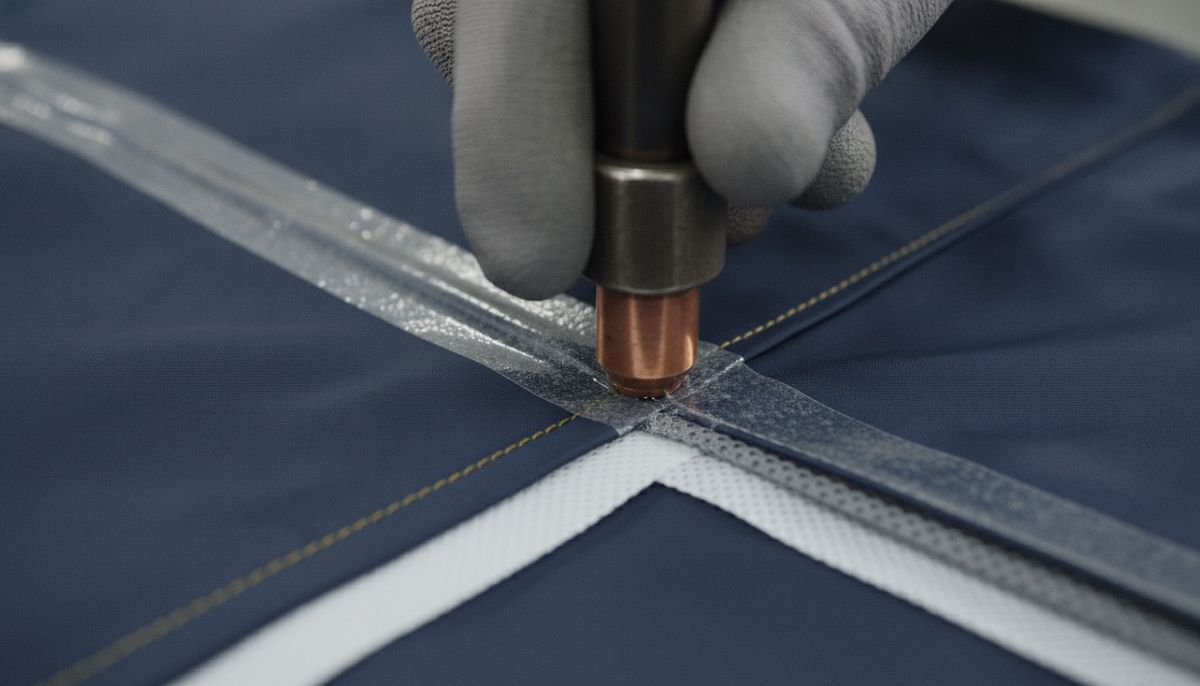
Seam taping is what separates a jacket that survives a wash test from one that delaminates. Request a wash-durability test (ISO 6330 or AATCC 135) showing that taped seams remain waterproof after 20-30 home-laundry cycles. The test should include a hydrostatic-head measurement after washing to confirm that waterproofing has not degraded. A jacket that passes a pre-wash hydrostatic-head test but fails after 10 washes will generate returns and damage brand reputation.
EN 343 Classification for European Workwear
EN 343 is the European standard for protective clothing against rain. The standard classifies garments into three classes for water-penetration resistance and three classes for water-vapor resistance (breathability). Class 3 is the highest rating for both metrics. Corporate buyers, public-sector tenders, and safety-equipment distributors in Germany, France, and the United Kingdom often require EN 343 Class 3 for outdoor workwear. Request an EN 343 test report from a notified body if your target market includes European B2B or institutional buyers.
Key Takeaways
- The Global Recycled Standard requires at least 20% recycled material content by weight, but most European workwear buyers expect 50-100% recycled polyester to justify a GRS label on the product.
- A valid GRS certificate must explicitly cover outerwear or jackets in its product scope; a certificate for knit apparel does not authorize the supplier to issue transaction certificates for woven rain jackets.
- Transaction certificates (TC) accompany every GRS-labeled shipment and state the exact recycled content percentage, the GRS certificate number, and the certification body; request a sample TC from a recent order to verify the supplier’s compliance systems.
- GRS verifies recycled content and chemical compliance but does not test hydrostatic head, breathability, seam-seal integrity, or wash durability; request lab reports for ISO 811, ASTM E96, ISO 6330, and EN 343 before approving bulk production.
- Sample MOQ 1 piece, bulk MOQ 10 pieces per style at PTOUTWEAR, colours and sizes can be mixed, which reduces cash commitment and inventory risk for small brands validating a workwear line in Europe.
- OEKO-TEX Standard 100 tests the finished garment for harmful substances and focuses on human health, while bluesign certifies chemical input management at textile mills; GRS, OEKO-TEX, and bluesign address different risks and are often combined for comprehensive sustainability and safety positioning.
Frequently Asked Questions
What does GRS certified mean for a rain jacket?
GRS certification for a rain jacket means the garment contains a verified percentage of recycled material (minimum 20%, typically 50-100% for workwear), that the supply chain maintains traceability from fiber through finished product, and that the factory meets chemical, environmental, and social compliance requirements. The certification body audits material invoices, production records, and mass-balance calculations, and the supplier issues a transaction certificate (TC) for every GRS-labeled shipment stating the exact recycled content percentage.
What is the difference between GRS and OEKO-TEX certification?
GRS verifies recycled content and chain-of-custody traceability, while OEKO-TEX Standard 100 tests the finished garment for harmful substances including heavy metals, formaldehyde, phthalates, and certain dyes. GRS focuses on proving recycled-material claims and environmental management; OEKO-TEX focuses on human health and skin contact. A jacket can hold both certifications, and many European buyers require both: GRS for circular-economy positioning and OEKO-TEX for chemical safety in corporate or public-sector procurement.
How do I verify a supplier’s GRS certificate scope?
Request a PDF copy of the current GRS certificate and check that the product scope explicitly includes outerwear, jackets, or coats. Verify the certificate number, expiry date, and certification body on the Textile Exchange public database. Ask the supplier for a sample transaction certificate (TC) from a recent order; the TC should state the recycled content percentage, the GRS certificate number, and the product category. If the supplier cannot provide a sample TC or if the TC shows a different product category, the factory may not have the systems in place to issue compliant TCs for your order.
Ready to source a private label workwear rain jacket with verified recycled content, low MOQ, and transparent lead times?
Request 1-Piece Samples →
Written by Ivan Chen, Sales Engineer at PTOUTWEAR, 13 years in outdoor apparel manufacturing.