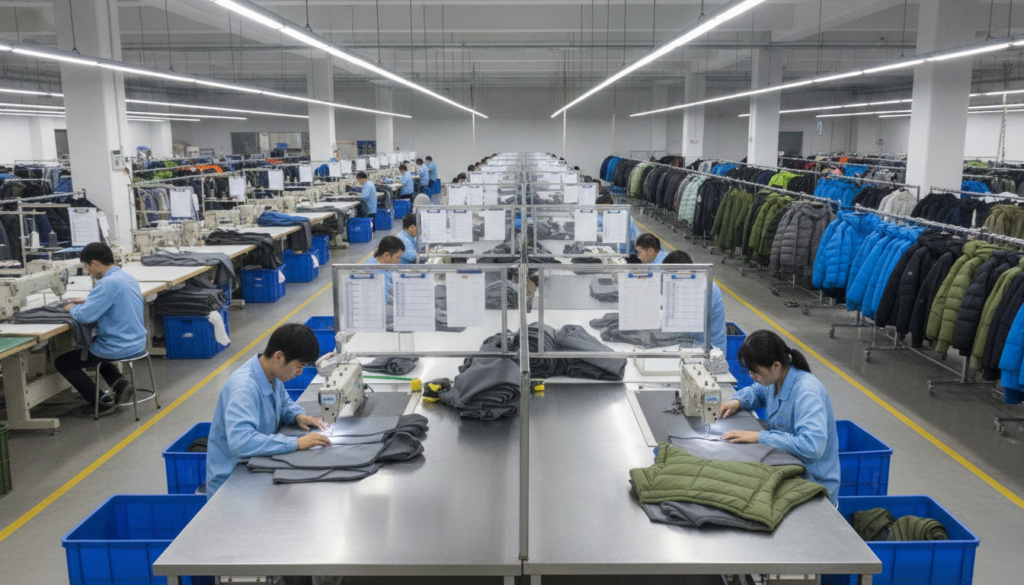
The private label fleece jacket sample approval process establishes the physical reference that governs bulk production: you submit a tech pack with fabric specs, measurements, and branding, receive a pre-production sample in 7 to 10 days, inspect it for fleece weight (GSM), pile height, anti-pilling performance, seam quality, and dimensional accuracy, document corrections, and provide written approval before cutting begins. According to Eationwear (2026), developed-style sampling takes approximately 7 to 10 days, while more complex outerwear sampling may take about 7 to 14 working days. PTOUTWEAR’s OEM jacket manufacturing delivers 1-piece samples with a $100 sample fee refunded against a first bulk order of 30+ pieces, 10-piece bulk MOQ per style, and 25 to 35 day production after approval.
📋 Table of Contents
Executive Summary
- Sample timing: Developed-style fleece jackets typically require 7 to 10 days for pre-production sampling, with more complex technical outerwear extending to 7 to 14 working days.
- Fleece-specific testing: A complete approval checklist covers GSM, pile height, anti-pilling performance, stretch recovery, warmth-to-weight ratio, moisture wicking, and seam behavior under stress.
- Approval workflow: Written approval with named decision owners, revision limits, and documented change orders prevents scope drift and protects deposit milestones.
- Commercial controls: Sample-fee ownership, revision charges, approval-related delays, MOQ consequences, and cancellation rights must be defined before sampling begins.
- Regional compliance: United States, United Kingdom, European Union, Canada, and Australia each impose fiber labeling, care labeling, chemical restrictions, and children’s-apparel requirements that must be verified on the approved sample.
What Documents Start the Sampling Phase?
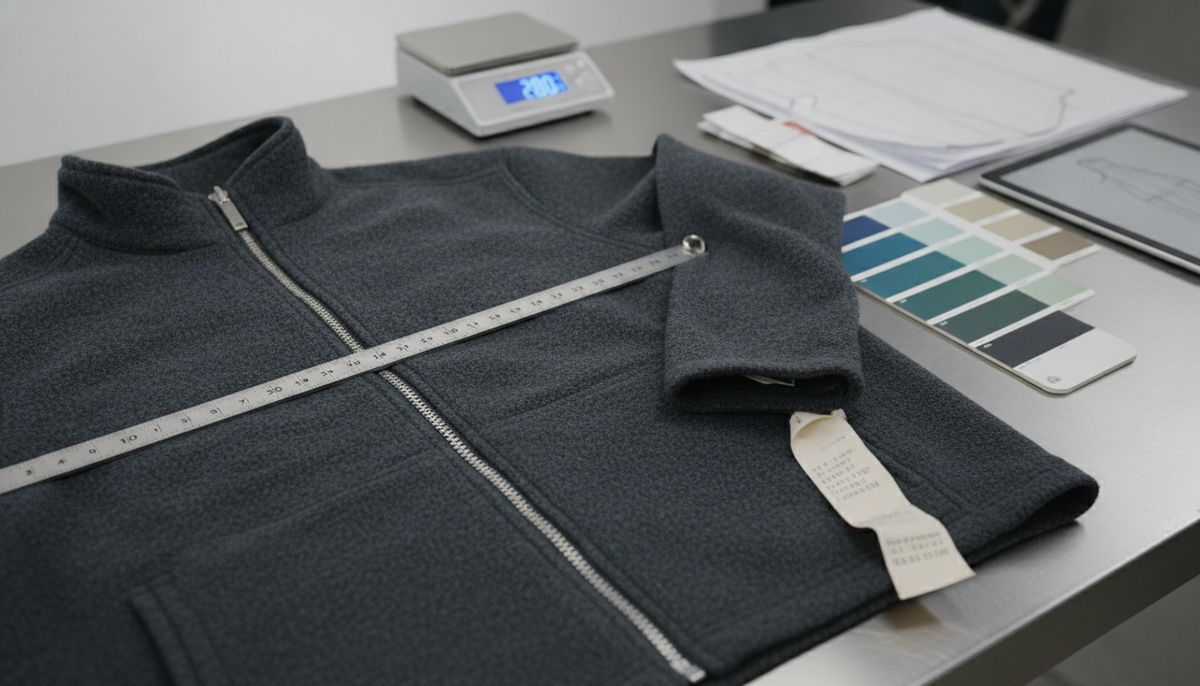
A complete tech pack initiates the private label fleece jacket sample approval process. The package includes fabric specifications, garment measurements, artwork files, and a physical reference garment when available. Fabric specs state fleece type (polar, micro, bonded, sherpa), GSM weight, pile height, fiber content, and any performance treatments (anti-pilling, moisture wicking, DWR). Garment measurements list every dimension: chest, length, sleeve, shoulder, hem, cuff, and collar in the grading run you intend to produce. Artwork files arrive as vector EPS or AI for embroidery digitization and screen printing, with Pantone color codes for exact color matching. A reference garment clarifies fit intent and construction details that a flat sketch cannot convey.
Tech Pack Components
- Fabric specification: Fleece type, GSM weight (180 to 400 typical range), pile height, fiber content percentages, and performance treatments with test-method references (ASTM D3511 for pilling, AATCC 195 for retention).
- Measurement chart: Every dimension in the size run, stated in centimeters or inches with tolerance bands (±1 cm for body measurements, ±0.5 cm for sleeve and collar).
- Artwork package: Vector files for logos, embroidery digitization sheets, Pantone codes, placement diagrams with measurements from seams or hems.
- Construction notes: Stitch type (flatlock, overlock, coverstitch), seam allowances, zipper brand and model, elastic type and width, binding or trim specifications.
- Reference garment: A physical sample that demonstrates fit, hand feel, and construction intent; particularly valuable when transitioning from a competitor product.
Fabric Swatch Review
Request fabric swatches before committing to a full sample. A swatch confirms color match, hand feel, weight, and pile density without the cost of a sewn garment. Swatches also reveal whether the mill can match a reference fabric or if substitutions will be necessary. Buyers often discover that a requested fleece is unavailable in the required color or minimum yardage, forcing a pivot to an alternative fabric before sampling begins. According to Linenwind (2026), sample fees range from approximately US$40 to US$150 depending on garment complexity, with the fee refundable against a bulk order under stated terms.
Sampling Timeline Expectations
Sampling begins when the factory receives a complete tech pack and confirms fabric availability. Standard fleece jackets without technical features (no bonding, no membrane, no complex colorblocking) sample in 7 to 10 days. Technical fleece with bonded membranes, taped seams, or multi-panel construction extends to 10 to 14 days. Rush sampling is possible but typically adds 25 to 40% to the sample fee. PTOUTWEAR’s sample development delivers 1-piece samples in 7 to 10 days with a $100 fee refunded against a first bulk order of 30+ pieces.
Fleece-Specific Inspection Checklist
Fleece performance depends on fabric characteristics that a visual inspection alone cannot verify. The approved sample must be tested for GSM weight, pile height, anti-pilling performance, stretch recovery, warmth-to-weight ratio, moisture wicking, and seam behavior under stress. These properties determine whether the bulk production will match the sample’s hand feel, warmth, and durability after repeated washing and wearing.
GSM and Pile Height Verification
Weigh a 10 cm × 10 cm swatch on a precision scale to confirm GSM. A 280 GSM fleece spec that arrives at 260 GSM will feel noticeably thinner and less warm. Pile height is measured with a thickness gauge under controlled pressure (ISO 5084). A pile height variance of more than 0.5 mm changes the hand feel and warmth. Buyers sometimes approve a sample based on visual inspection, only to discover that the bulk production used a lighter-weight fleece from a different mill run, resulting in garments that feel cheap and perform poorly in cold weather.
Anti-Pilling Performance
Pilling ruins fleece aesthetics and signals low quality to end customers. ASTM D3511 (Martindale abrasion) or ASTM D3512 (random tumble) grades pilling on a 1 to 5 scale, with 5 being no pilling. Specify a minimum grade of 3.5 for consumer-facing products and 4.0 for premium outdoor brands. Anti-pilling treatments (resin finishes, fiber modifications) must be documented in the tech pack and verified on the sample. A sample that pills after five wash cycles indicates that the bulk production will pill even faster, leading to returns and brand damage.
Stretch Recovery and Seam Behavior
Fleece with spandex or mechanical stretch must recover after extension. ASTM D2594 measures recovery percentage after repeated stretching. Specify a minimum 90% recovery after five cycles to prevent bagging at elbows and knees. Seam behavior under stress is equally critical: flatlock seams in high-stretch areas, overlock seams in low-stress areas, and coverstitch hems for a clean finish. Pull the sample’s shoulder seams, underarm seams, and pocket attachments with firm hand pressure to check for slippage or puckering. Seam failure in the approved sample predicts seam failure in bulk production.
Technical Testing Requirements
Outdoor technical fleece requires performance testing beyond visual inspection. Dimensional stability after washing, colorfastness, abrasion resistance, zipper durability, and seam strength determine whether the garment will survive real-world use. These tests must be completed on the approved sample before bulk production begins, because correcting a performance failure after cutting is prohibitively expensive.
Dimensional Stability
Wash the sample five times according to the care label instructions and measure every dimension after each cycle. AATCC 135 (dimensional changes in automatic home laundering) specifies test conditions. Acceptable shrinkage is typically ±3% for length and ±3% for width. Fleece that shrinks 5% in length will result in jackets that no longer fit the size chart, triggering returns and negative reviews. Dimensional stability testing also reveals whether the fabric will pill, fade, or lose pile density after repeated washing.
Colorfastness Testing
Colorfastness to washing (AATCC 61), crocking (AATCC 8), and light (AATCC 16) prevents color transfer and fading. Specify a minimum grade of 4 for washing and crocking, and grade 4 for light exposure if the garment will be displayed in retail windows or worn in high-UV environments. Fleece dyed with low-quality dyes will bleed onto lighter-colored garments in the wash and fade to an uneven tone after a season of outdoor use. Colorfastness failures are common in low-cost fleece and are rarely discovered until the bulk production is already shipped.
Abrasion and Zipper Durability
Martindale abrasion testing (ASTM D4966) measures cycles to failure. Outdoor fleece should withstand at least 20,000 cycles; technical fleece for backpacking or climbing should exceed 50,000 cycles. Zipper durability is tested by cycling the zipper 500 times under light tension (ASTM D2061). A zipper that jams or separates after 200 cycles will fail in customer hands within weeks. Specify YKK or SBS zippers with a minimum cycle rating and verify the exact model on the approved sample. Buyers often approve a sample with a branded zipper, only to receive bulk production with an unbranded substitute that fails durability testing.
Seam Strength
Seam strength (ASTM D1683) measures the force required to rupture a seam. Outdoor fleece jackets should meet or exceed 90 N (newtons) for body seams and 70 N for sleeve seams. Seam strength depends on stitch type, thread quality, and seam allowance. A seam that passes visual inspection but fails strength testing will rupture under normal wear, particularly at stress points like underarms, shoulders, and pocket attachments. Seam strength testing on the approved sample is the only way to verify that the specified stitch type and thread gauge are correct for the fabric weight and intended use.
Approval Workflow and Commercial Controls
A documented approval workflow prevents scope drift and protects both buyer and manufacturer. The workflow defines decision owners, revision limits, approval deadlines, and a change-order process. Without these controls, the private label fleece jacket sample approval process becomes an open-ended negotiation that delays production and erodes margins.
Decision Owners and Approval Authority
Name the individuals who have approval authority for fit, fabric, construction, and branding. A common failure mode is multiple stakeholders requesting conflicting changes without a single decision owner to resolve them. Specify that one person has final approval authority and that all revision requests must be consolidated into a single approval document. PTOUTWEAR’s private label process requires written approval from a named decision owner before production begins, preventing the scenario where a buyer approves a sample verbally but later claims it did not match their expectations.
Revision Limits and Charges
Define how many revision rounds are included in the sample fee and what charges apply to additional rounds. A typical structure includes one revision round in the base fee, with subsequent rounds billed at 50 to 100% of the original sample fee. Unlimited revisions are unsustainable for both parties and signal that the tech pack was incomplete or that the buyer has not finalized their design. Revision charges also incentivize buyers to consolidate feedback rather than requesting incremental changes across multiple rounds.
Approval Deadlines and Production Milestones
Link sample approval to deposit milestones and production start dates. A common structure requires 30% deposit upon sample approval, with production beginning within 5 business days of deposit receipt. If the buyer delays approval beyond the agreed window, the production slot is released and a new lead time is quoted. This protects the factory’s production schedule and prevents buyers from holding a sample for weeks while they secure financing or finalize their product line. According to GoodCan Trading (2026), typical bulk production timing is approximately 30 to 45 days after sample approval, depending on order size and fabric lead time.
Change Orders After Approval
Define the change-order process for requests made after sample approval. Changes to fabric, measurements, or construction after approval are treated as new orders, with new sampling, new lead times, and potential MOQ increases. Buyers sometimes approve a sample and then request a fabric change or a fit adjustment, assuming the factory can accommodate the change without restarting the approval process. A documented change-order policy prevents this scenario by making the cost and timeline impact explicit. PTOUTWEAR’s low MOQ jacket manufacturing allows changes before sample approval at no charge, but changes after approval are quoted as new orders with separate sampling and production timelines.
Sample Ownership and Refund Terms
Clarify who owns the sample after approval and under what conditions the sample fee is refunded. A typical structure refunds the sample fee against a minimum bulk order (30 to 50 pieces), with the sample becoming the buyer’s property upon payment. If the buyer does not proceed to bulk production, the sample fee is retained as compensation for the factory’s time and materials. Some factories offer free sampling for established buyers or for orders above a certain value threshold, but this is rare in the outdoor apparel industry where sampling costs are significant.
In practice: Branding approval determines whether a finished garment is usable; a jacket rejected because it lacked the correct logo becomes unsaleable inventory even if the low-cost replacement option exists, illustrating why logo placement, size, and color must be verified on the approved sample before bulk production begins.
Regional Compliance Verification
The approved sample must comply with the labeling, chemical, and safety regulations of the destination market. United States, United Kingdom, European Union, Canada, and Australia each impose fiber labeling, care labeling, chemical restrictions, and children’s-apparel requirements that must be verified before bulk production begins. Non-compliant labeling or restricted substances discovered after shipment can result in customs holds, fines, or forced product recalls.
United States Compliance
The Textile Fiber Products Identification Act (TFPIA) requires fiber content labels listing each fiber by generic name and percentage by weight, in descending order. Care labels must follow FTC Care Labeling Rule 16 CFR 423, with at least one safe cleaning method. Country of origin must be disclosed. California Proposition 65 restricts lead, phthalates, and other chemicals; products sold in California must carry warnings if they exceed safe harbor levels. Children’s sleepwear (sizes 9 months through 14) must meet flammability standards under 16 CFR 1615 and 1616, which typically exclude fleece unless it passes the vertical flame test.
European Union Compliance
REACH Regulation (EC) 1907/2006 restricts over 200 substances in textiles, including azo dyes, formaldehyde, and heavy metals. CLP Regulation (EC) 1272/2008 requires hazard labeling for chemical treatments. Textile Regulation (EU) 1007/2011 mandates fiber content labeling in the official language of each member state. Children’s products must comply with EN 14682 (drawstring and cord safety) and Toy Safety Directive 2009/48/EC if marketed to children under 14. OEKO-TEX Standard 100 certification simplifies REACH compliance by screening textiles against restricted substances, but certification is not held by all factories and must be verified on the approved sample.
United Kingdom, Canada, and Australia
The United Kingdom follows REACH and CLP post-Brexit under UK REACH, with fiber labeling requirements similar to the EU. Canada enforces the Textile Labelling Act and the Canada Consumer Product Safety Act, which restrict lead, phthalates, and flammability in children’s products. Australia applies the Competition and Consumer Act 2010 for fiber labeling and the Australian Consumer Law for product safety. Each market requires care labels in English (or French for Canada), with country of origin disclosed. Restricted substances lists are broadly aligned with REACH, but specific thresholds and test methods vary.
Label Verification on Approved Sample
The approved sample must carry the exact labels that will appear in bulk production. Verify fiber content percentages, care instructions, country of origin, and brand name. Check label placement (center back neck, side seam, or pocket) and attachment method (sewn-in, heat-transfer, or printed). Labels that fade, peel, or detach after washing fail compliance and must be replaced before bulk production. PTOUTWEAR’s custom logo service includes label verification on the pre-production sample, ensuring that fiber content, care instructions, and brand placement match the approved tech pack before cutting begins.
Key Takeaways
- A complete tech pack with fabric specs, measurements, artwork, and a reference garment initiates the private label fleece jacket sample approval process, with developed-style sampling typically requiring 7 to 10 days.
- Fleece-specific inspection covers GSM weight, pile height, anti-pilling performance, stretch recovery, moisture wicking, and seam behavior, with each property tested against specified tolerances.
- Technical testing on the approved sample includes dimensional stability after washing, colorfastness, abrasion resistance, zipper durability, and seam strength, preventing performance failures in bulk production.
- A documented approval workflow with named decision owners, revision limits, approval deadlines, and a change-order process prevents scope drift and protects deposit milestones.
- Regional compliance verification for the United States, United Kingdom, European Union, Canada, and Australia must confirm fiber labeling, care labeling, chemical restrictions, and children’s-apparel requirements on the approved sample before bulk production begins.
Frequently Asked Questions
Can a manufacturer start bulk production without sample approval?
No reputable manufacturer begins bulk production without written sample approval. The approved sample establishes the physical reference for fabric, measurements, construction, and branding that governs bulk production. Starting production without approval eliminates the buyer’s ability to verify quality before cutting and creates liability for both parties if the bulk production does not match expectations. Factories that offer to skip sampling or begin production before approval are signaling weak quality controls and should be avoided.
How many revision rounds are typical before bulk production?
One revision round is typical for buyers who submit a complete tech pack with accurate measurements and fabric specifications. Buyers who are refining a design or working from a competitor reference garment may require two to three revision rounds. More than three revisions indicates an incomplete tech pack or unclear design intent, and most factories will begin charging for additional rounds at 50 to 100% of the original sample fee. Consolidating feedback into a single approval document after each round reduces revision cycles and accelerates the approval timeline.
What happens if the bulk production does not match the approved sample?
If bulk production deviates from the approved sample in fabric weight, measurements, construction, or branding, the buyer has grounds to reject the shipment or negotiate a discount. The approved sample serves as the contractual reference, and deviations are considered manufacturing defects. Buyers should specify tolerance bands in the tech pack (±5% for GSM, ±1 cm for body measurements) and document the approved sample with photographs and written notes. A pre-shipment inspection or third-party QC audit verifies that bulk production matches the approved sample before the balance payment is released.
Ready to start your private label fleece jacket project with a factory that delivers 1-piece samples in 7 to 10 days and 10-piece bulk MOQs?
Request Your Sample Today →
Written by Ivan Chen, Sales Engineer at PTOUTWEAR – 13 years in outdoor apparel manufacturing.