📋 Table of Contents
- Executive Summary
- What Private Label Technical Jacket Manufacturing Means for Startups
- MOQ Reality Check for First-Time Founders
- Technical Fabric Selection and Performance Claims
- Sampling Workflow for Brand Validation
- Branding & Customization Options for Private Label
- Cost Structure by Launch Stage
- Compliance & Testing for US, UK, EU, Australia
- Vetting Your Manufacturer Before Commitment
- Key Takeaways
- FAQ
Launching a technical outerwear brand without tying up tens of thousands in inventory is possible when you partner with the right private label technical jacket manufacturer startup founders can trust. Most founders discover that traditional factory minimums of 500 or 1,000 pieces per style lock up capital before market validation. A vertically integrated facility with low-MOQ capabilities, in-house waterproof membrane construction, and rapid sampling changes that equation.
Executive Summary
- Sample MOQ: 1 piece at many private-label factories, enabling pre-launch validation without bulk commitment.
- Bulk production MOQ: 30 pieces per SKU at select manufacturers, compared to industry-standard 100-500 minimums.
- First-collection budget: According to Uniouter (2026), launching 3-4 styles at 300-500 pieces each typically requires $8,000-$15,000 excluding branding, marketing, and website costs.
- Gross margin advantage: According to Commercive (2026), private-labeled products return 50% to 70% gross margin, compared with 20% to 40% for dropshipped goods.
- Production timeline: According to Uniouter (2026), a technical outdoor apparel launch commonly requires 13 weeks from concept to shipping when sampling, testing, sign-off, and production are managed sequentially.
- Certification scope: OEKO-TEX Standard 100 screens textiles against more than 1,000 harmful substances, critical for US and EU market entry.
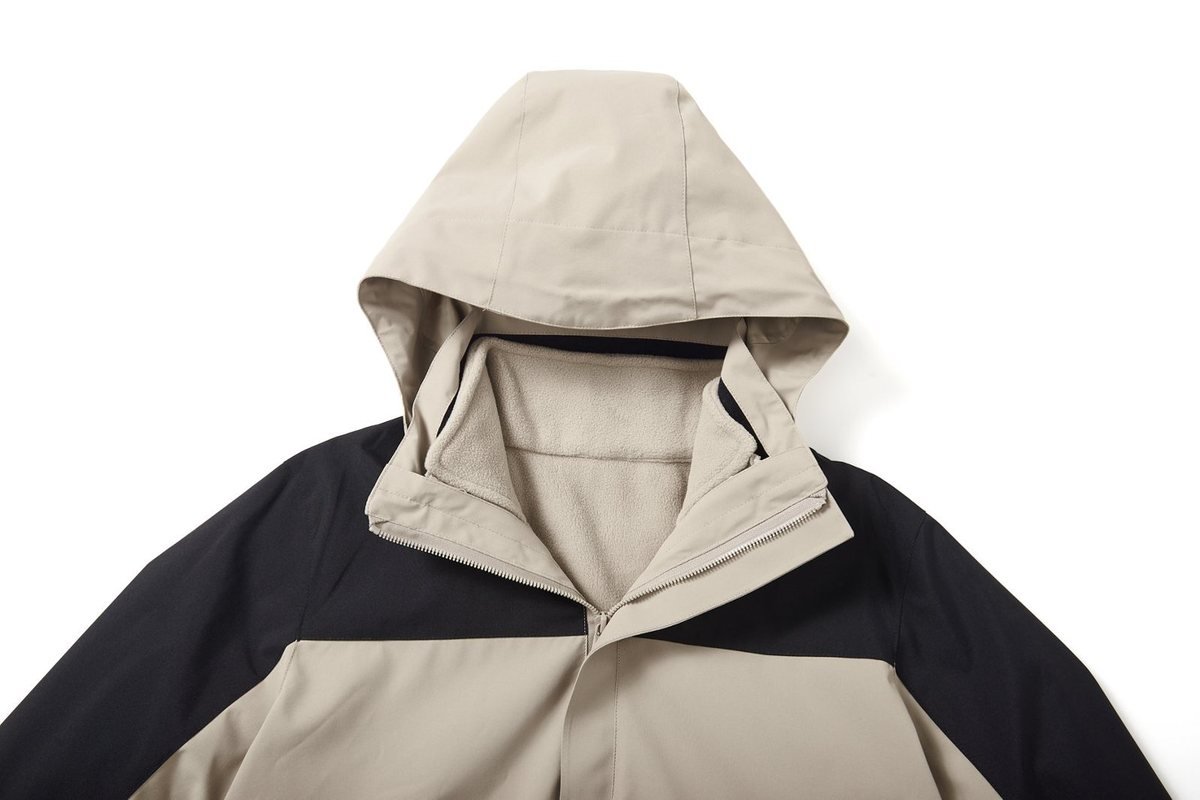
What Private Label Technical Jacket Manufacturing Means for Startups
Private label manufacturing allows a startup to sell factory-made garments under its own brand name, without owning production equipment or hiring sewing staff. The factory handles pattern development, fabric sourcing, cutting, sewing, and quality control. The startup supplies branding assets like woven labels, hang tags, and packaging artwork. Technical jackets add a layer of complexity because performance claims like waterproofing, breathability, and seam sealing require verifiable construction methods and material specifications.
Private Label vs. OEM vs. ODM
Private label typically refers to a factory’s existing design catalog that you rebrand. OEM (Original Equipment Manufacturer) means the factory produces your custom design to your exact specifications. ODM (Original Design Manufacturer) means the factory offers design consultation and pattern development as part of the service. For a private label technical jacket manufacturer startup, the distinction matters because ODM partnerships provide faster time-to-market with lower upfront design costs, while OEM gives complete control over fit, fabric, and feature details.
Why Technical Outerwear Requires Specialized Factories
A general apparel contractor can sew cotton hoodies, but waterproof shells demand seam-taping equipment, lamination presses for bonding membranes to face fabrics, and climate-controlled testing chambers. Factories that handle softshell, hardshell, rain, ski, and insulated jackets maintain relationships with membrane suppliers like Hipora, Sympatex, and proprietary alternatives. They understand DWR (durable water repellent) application, taped-seam failure modes, and breathability testing protocols. Choosing a manufacturer without this infrastructure leads to the performance gaps buyers frequently complain about: jackets that wet out in moderate rain, seam tape that peels after a few washes, and zippers that fail under pack-strap pressure.
Market Fit for Startup Brands
p>DTC outdoor brands, corporate team-gear buyers, school uniform programs, and small wholesalers each face different constraints. A DTC founder needs sampling flexibility to test styles with a small audience before scaling. Corporate buyers need consistent sizing across 50-200 pieces for a single order. School programs prioritize washability and simple branding over membranes. A low-MOQ jacket manufacturer that offers modular branding options and multiple fabric tiers serves all three segments without forcing every customer into a high-volume, high-complexity production model.
MOQ Reality Check for First-Time Founders
Minimum order quantity determines how much cash you lock up before your first sale. According to Passion Outerwear (2026), basic private-label heated jackets often start at an MOQ of 50-100 units per SKU. Customized runs with different colors or fabrics commonly move to 200-300 units per SKU, and full custom designs typically start at 300-500 units per SKU. These thresholds reflect fabric-mill minimums, cutting efficiency, and the factory’s willingness to retool production lines for small batches.
Sample MOQ vs. Bulk MOQ
Sample MOQ refers to the smallest quantity a factory will produce for pre-production evaluation. One-piece sampling allows a founder to hold the garment, test the fit on real users, photograph it for crowdfunding campaigns, and validate construction quality before committing to bulk. Bulk MOQ is the smallest production run the factory will accept for a sellable order. A factory offering 1-piece sampling and 30-piece bulk MOQ per SKU enables a founder to launch with three colorways of one style for 90 total units, a $3,000-$6,000 inventory investment instead of $15,000-$30,000.
How Fabric Minimums Drive MOQ
Waterproof-breathable membranes and technical face fabrics often carry mill minimums of 300-500 meters per colorway. A factory that stocks common colors like black, navy, and charcoal in 2.5-layer and 3-layer constructions can offer lower MOQs because they buy fabric in bulk and allocate yardage across multiple clients. Custom fabric colors or proprietary membrane laminates push MOQ back up because the mill will not run a small dye lot. Founders who choose from a factory’s stocked fabric menu unlock the lowest MOQs; those who demand unique colorways pay for the mill’s setup cost in higher minimums or fabric surcharges.
SKU Proliferation Risk
Offering four styles in three colors and four sizes creates 48 SKUs. If bulk MOQ is 30 pieces per SKU, the founder must produce 1,440 jackets. A smarter approach is to launch one or two hero styles in two colors and five sizes, producing 30 pieces per size for a total of 300 units. This concentrates inventory dollars into proven sellers and simplifies fulfillment, photography, and size-chart accuracy.
Technical Fabric Selection and Performance Claims
Waterproof and breathability numbers like “10K/10K” appear on every product page, but buyers frequently complain that jackets wet out sooner than expected or fail in real rain despite marketing language. The gap between claimed and delivered performance comes from three sources: membrane construction quality, DWR durability, and seam-sealing execution.
Membrane Construction: 2-Layer, 2.5-Layer, 3-Layer
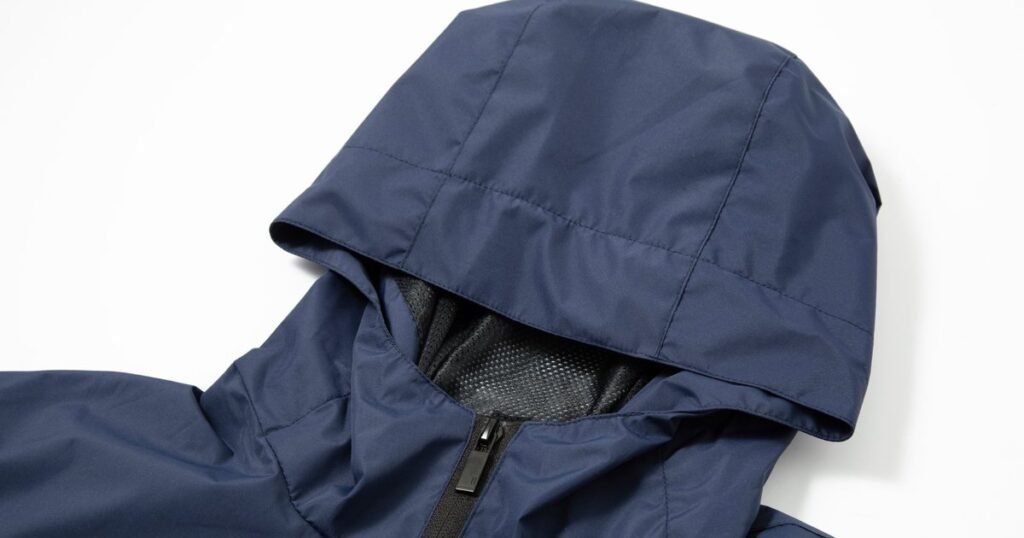
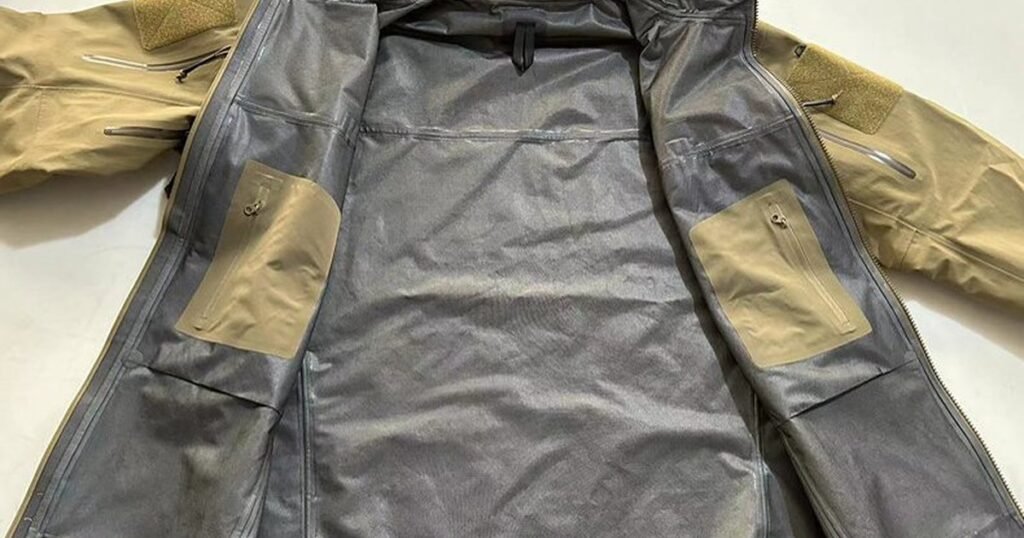
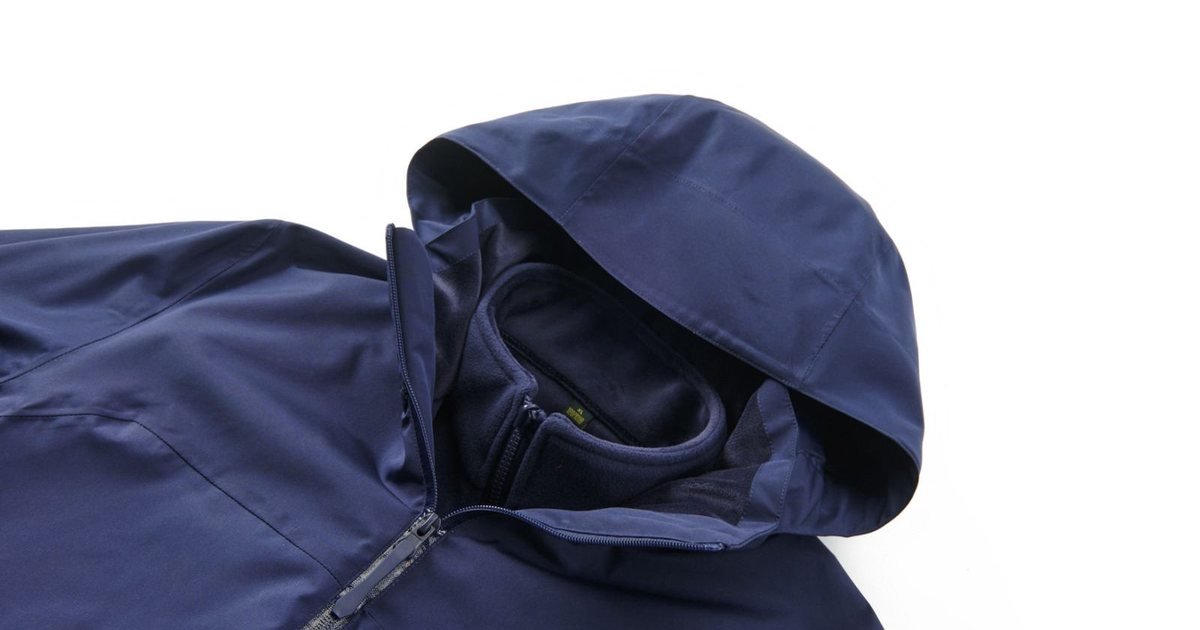
A 2-layer jacket bonds the waterproof membrane to the face fabric, leaving the membrane exposed on the inside, which requires a separate mesh lining to protect it from abrasion and body oils. A 2.5-layer construction adds a thin protective coating or print to the membrane interior, eliminating the need for a full lining and reducing weight. A 3-layer laminate bonds face fabric, membrane, and inner lining into a single material, creating the most durable and breathable construction but at higher cost and stiffer hand feel. For a private label technical jacket manufacturer startup, 2.5-layer fabrics offer the best balance of performance, weight, and cost for first collections targeting hiking, trail running, and urban commuting.
Waterproof and Breathability Ratings
Waterproof rating measures how much water pressure a fabric can withstand before leaking, expressed in millimeters (10,000mm = 10K). Breathability measures moisture-vapor transmission, expressed in grams per square meter per 24 hours (10,000g/m²/24hr = 10K MVTR). A 10K/10K fabric handles moderate rain and light activity; 15K/15K suits heavier rain and higher-output activities like ski touring; 20K/20K and above targets alpine and expedition use. Most startup brands should specify 10K/10K or 15K/10K fabrics because they cover 80% of customer use cases at a third the cost of 20K+ membranes, leaving margin for better zippers, reinforced elbows, and pit-zip ventilation.
DWR and Face-Fabric Durability
Durable water repellent is a chemical finish applied to the face fabric that causes water to bead and roll off instead of soaking in. When DWR fails, the face fabric saturates, the jacket feels clammy, and breathability drops because moisture vapor cannot escape through a wet outer layer. PFC-free DWR formulations meet environmental regulations in the EU and California but require more frequent reapplication than older C8 and C6 chemistries. A factory that applies PFC-free DWR in-house and tests bead angle after five wash cycles delivers more predictable field performance than one that subcontracts finishing and skips wash testing.
Seam Sealing and Taped-Seam Durability
Every needle hole in a waterproof fabric is a potential leak point. Seam tape is a thin polyurethane film applied with heat and pressure to cover stitching lines on the inside of the garment. Buyers complain about noisy fabrics, weak zippers, and failing seam taping on technical shells after only light use. Seam-tape failure happens when the factory uses low-grade tape, insufficient bonding temperature, or skips taping on secondary seams like pocket flaps. A manufacturer with dedicated seam-sealing machines and a QC protocol that pull-tests taped seams before packing prevents this failure mode.
Sampling Workflow for Brand Validation
Sampling converts a concept into a physical garment you can test, photograph, and show to potential customers or investors. The workflow has four stages: design brief, pattern development, pre-production sample, and fit confirmation.
Design Brief and Tech Pack
A design brief specifies style, fabric, color, hardware, and branding placement. A tech pack adds measurements, construction details, and quality standards. Many startup founders skip the tech pack and describe the jacket verbally or with reference photos, which leads to fit inconsistency across sizes and construction details that do not match expectations. A manufacturer that provides a tech-pack template and assigns a product-development contact reduces this risk. The template should include a measurement spec sheet (chest, sleeve length, hem width, hood depth), a bill of materials (fabric, zippers, cord locks, labels), and construction notes (seam allowances, stitch type, topstitching color).
Pre-Production Sample Timeline
Pre-production samples typically take 7-10 days after the factory receives the design brief and fabric selection. Rush sampling in 3-5 days is possible for an additional fee if the factory has the specified fabric in stock and no backlog on the sampling line. Founders often underestimate this timeline and expect a sample within 48 hours of initial contact. A realistic sampling calendar allocates two weeks for design finalization and sample production, one week for shipping, and one week for fit testing and feedback, totaling four weeks before bulk-order sign-off.
Fit Testing and Iteration
Fit testing means wearing the sample during the intended activity (hiking with a pack, cycling in rain, layering over a midweight fleece) and documenting issues: sleeve length when arms are extended, hood fit over a helmet, hem length when seated, pocket placement with a harness. Users often report poor fit consistency across sizes, especially in shells and insulated jackets, making bulk-branding risky without strong tech packs and grading. Grading is the process of scaling a pattern up and down across sizes while maintaining proportional fit. A factory that grades in-house and provides a fit sample in your most common size (usually medium or large) plus one size above and one below allows you to confirm the grade before committing to full production.
Sample Cost and Refund Policy
Sample fees typically range from $80 to $150 per piece depending on fabric cost and construction complexity. Some factories refund the sample fee when you place a bulk order above a minimum threshold, commonly 100-300 pieces total across all SKUs. A factory offering 1-piece sampling with a refundable $100 fee and a 30-piece bulk MOQ allows a founder to test three styles for $300 upfront, recover that cost with a 90-piece first order, and avoid the $5,000-$10,000 sampling expense that comes with higher-MOQ suppliers.
Branding & Customization Options for Private Label
Private label branding transforms a factory’s base design into your product. The most common customization points are woven labels, hang tags, embroidery, screen printing, and packaging.
Woven Labels and Care Labels
Woven labels carry your brand name, logo, and country-of-origin statement. They are sewn into the neck, side seam, or interior pocket. Care labels list washing instructions and fiber content, required by law in the US, UK, EU, and Australia. Label minimums typically start at 500-1,000 pieces per design, but factories that stock blank labels and offer digital printing can produce custom labels in runs as small as 50-100 pieces. A custom logo service that includes label design, digital mockups, and low-MOQ production simplifies this step for first-time founders.
Embroidery and Screen Printing
Embroidery works well for logos on the chest, sleeve, or back yoke. It adds texture and durability but increases cost by $1.50-$3.00 per placement depending on stitch count. Screen printing is cheaper ($0.50-$1.50 per print) and better for large graphics, but it can crack or fade after repeated washing. For technical outerwear, embroidery on the chest and a small woven label inside the collar provides clean branding without compromising breathability or adding print-failure risk.
Hang Tags and Packaging
Hang tags communicate product features, care instructions, and brand story at the point of sale. Custom hang tags with your logo, tagline, and a QR code linking to sizing guides or warranty registration cost $0.15-$0.40 per unit at 500-piece minimums. Polybags are the default packaging for factory shipments, but branded polybags with your logo and a sustainability statement (recycled content, reusable design) cost an additional $0.10-$0.25 per unit. For DTC brands, upgraded packaging increases unboxing appeal and reduces return rates by reinforcing quality perception.
Custom Color and Hardware
Custom fabric colors require a mill dye lot, which typically adds 3-4 weeks to the production timeline and raises MOQ to 200-300 pieces per SKU. Custom zipper pulls, snap buttons, and cord locks add $0.30-$1.00 per garment and require tooling fees of $200-$500 per component. Most startup brands should defer custom hardware until the second or third production run, after validating demand with stock colors and standard hardware.
Cost Structure by Launch Stage
Launch costs vary by production volume, fabric tier, and branding complexity. Breaking the budget into stages helps founders allocate capital and avoid over-investing before market validation.
Stage 1: Pre-Launch Sampling and Validation
Pre-launch sampling includes design consultation, one to three pre-production samples, and fit testing. Budget $300-$600 for samples, $200-$400 for label and hang-tag design, and $100-$200 for photography props and location fees. Total pre-launch cost: $600-$1,200. This stage generates the assets needed for crowdfunding campaigns, pre-order pages, and investor pitches without committing to bulk inventory.
Stage 2: First Production Run (90-150 Pieces)
A first production run of 90-150 pieces across two or three SKUs typically costs $3,000-$6,000 for garment production, $300-$600 for labels and hang tags, and $150-$300 for polybag packaging. Shipping via ocean freight adds $400-$800 for a small carton shipment (0.5-1 cubic meter). Total first-run cost: $3,850-$7,700. This stage supports initial DTC sales, wholesale samples to retailers, and corporate pilot programs.
Stage 3: Scale Production (300-500 Pieces)
Scaling to 300-500 pieces unlocks better per-unit pricing (typically 10-15% lower than the first run), justifies custom hang tags and upgraded packaging, and supports multi-channel distribution. Garment production costs $9,000-$18,000, branding and packaging $800-$1,500, and ocean freight $1,200-$2,000. Total scale-stage cost: $11,000-$21,500. According to Uniouter (2026), first-collection launch budgets for 3-4 styles at 300-500 pieces each are often estimated at $8,000-$15,000 excluding branding, marketing, and website costs, which aligns with this range when branding is included.
Hidden Costs and Margin Traps
Founders often overlook duties, freight forwarding fees, and payment-processing charges. US import duty on jackets ranges from 4.4% to 27.7% depending on fiber content and construction, with synthetic shells typically falling in the 7.1%-16% range. Freight forwarders charge $150-$300 for customs clearance and delivery to your warehouse or fulfillment center. Payment platforms like PayPal or Stripe take 2.9% plus $0.30 per transaction. Budgeting an additional 20-25% on top of FOB (free on board) factory cost covers these expenses and prevents margin erosion.
Compliance & Testing for US, UK, EU, Australia
Each target market has specific labeling, testing, and safety requirements. Non-compliance can result in customs holds, retailer rejection, or consumer complaints.
US Requirements: CPSIA, FTC, CA Prop 65
The Consumer Product Safety Improvement Act (CPSIA) requires that children’s outerwear be tested for lead content in zippers, snaps, and decorative trim. Adult garments are exempt unless marketed to children under 12. The Federal Trade Commission (FTC) mandates care labels with fiber content, country of origin, and washing instructions. California Proposition 65 requires warnings if the product contains chemicals known to cause cancer or reproductive harm, which can include certain dyes and DWR formulations. A factory that uses PFC-free DWR and lead-free hardware simplifies Prop 65 compliance.
UK and EU Requirements: REACH, UKCA, CE
REACH (Registration, Evaluation, Authorization, and Restriction of Chemicals) restricts harmful substances in textiles sold in the EU and UK. OEKO-TEX Standard 100 certification provides third-party verification that fabrics meet REACH limits for heavy metals, formaldehyde, and phthalates. UKCA (UK Conformity Assessed) and CE (Conformité Européenne) marks are required for certain product categories, but most apparel is exempt unless it includes electronic components like heated elements or LED lights. Heated jackets need CE or UKCA marking and a declaration of conformity from the battery and heating-element supplier.
Australia Requirements: Fiber Labeling, Flammability
Australia requires fiber-content labels in English, care instructions, and country-of-origin marking. Flammability standards apply to children’s nightwear but not to outerwear. The Australian Competition and Consumer Commission (ACCC) enforces product-safety recalls, so maintaining factory QC records and material certifications protects against liability if a defect is discovered post-sale.
Testing Protocols and Certification Costs
Third-party testing for waterproof rating, breathability, and colorfastness costs $300-$800 per test depending on the lab and turnaround time. OEKO-TEX Standard 100 certification costs $1,500-$3,000 annually and covers all fabrics and trims used in production. Many factories hold facility-level certifications (ISO 9001, BSCI, SGS audits) that streamline compliance, but product-level testing remains the buyer’s responsibility unless the factory offers certified fabric from pre-tested suppliers.
Vetting Your Manufacturer Before Commitment
Choosing a private label technical jacket manufacturer startup founders can rely on requires evaluating production capacity, quality systems, communication responsiveness, and financial stability.
Production Capacity and Lead Time
Ask how many jackets the facility produces per month, how many production lines they operate, and what their current backlog looks like. A factory with 20 production lines and 200,000-piece annual capacity can absorb a 300-piece startup order without delaying your timeline, while a smaller contractor with two lines and a full order book may push your delivery date by 4-6 weeks. Standard lead time for bulk production is 25-35 days after deposit for 30 to 200 pieces, assuming fabric is in stock. Custom fabric orders add 3-4 weeks for dyeing and lamination.
Quality Control and Defect Rate
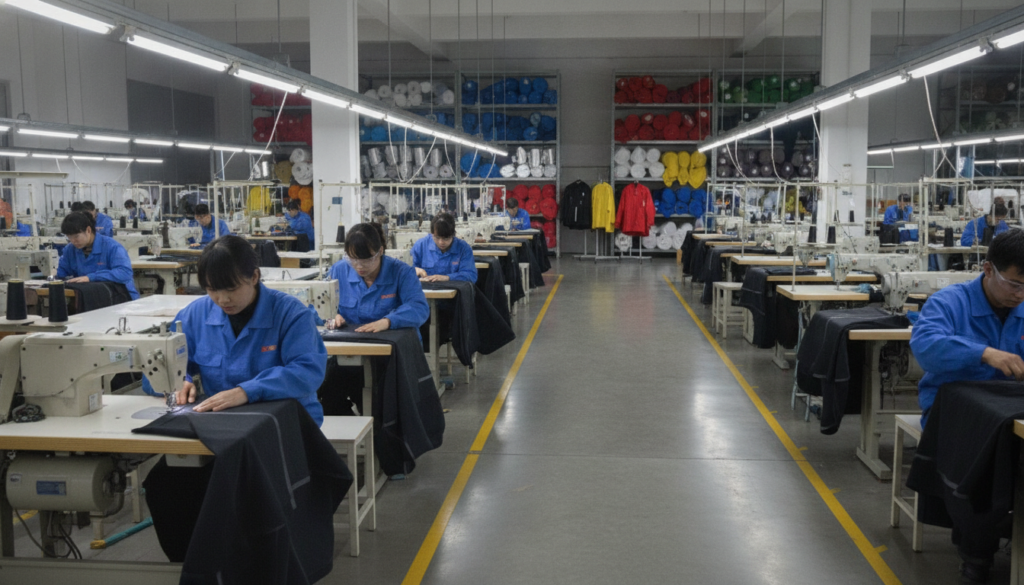
Request the factory’s QC checklist and ask what their acceptable defect rate is. Industry standard is 2-4% for minor defects (loose threads, slight color variation) and 0.5-1% for major defects (broken zippers, seam-tape failure, incorrect sizing). A factory that conducts inline inspection (checking garments during sewing), pre-shipment inspection (full order review before packing), and provides photo documentation of the inspection process reduces your risk of receiving off-spec goods. Our 3,000m² Taizhou Sanmen facility runs 20 production lines with in-house cut-and-sew and QC, and we maintain a defect log for every order to track failure modes and implement corrective actions.
Communication and Responsiveness
Overseas factory communication is a common pain point. Test responsiveness by asking detailed questions during the quoting process: What is your sample turnaround time? Can I see photos of a similar jacket you produced? What fabric options do you stock in black and navy? A factory that replies within 24 hours with specific answers, attaches reference photos, and offers a video call to review your design brief demonstrates the communication standard you will experience during production. Factories that reply with generic one-line answers or disappear for three days between messages create project delays and increase the risk of misunderstood specifications.
Payment Terms and Financial Risk
Standard payment terms are 30% deposit upon order confirmation, 70% balance before shipment. Some factories offer net-30 or net-60 terms for established clients, but first-time buyers typically pay upfront. Verify the factory’s business registration, request references from other brands they have produced for, and use a trade-assurance platform like Alibaba Trade Assurance or Escrow.com for the first order to protect against non-delivery or quality disputes. A factory that provides its business license, export history, and client testimonials without hesitation signals financial stability and operational transparency.
Key Takeaways
- According to Uniouter (2026), a technical outdoor apparel launch commonly requires 13 weeks from concept to shipping when sampling, testing, sign-off, and production are managed sequentially.
- According to Passion Outerwear (2026), basic private-label heated jackets often start at an MOQ of 50-100 units per SKU, while customized runs commonly move to 200-300 units per SKU.
- According to Commercive (2026), private-labeled products return 50% to 70% gross margin, compared with 20% to 40% gross margin for dropshipped goods.
- OEKO-TEX Standard 100 screens textiles against more than 1,000 harmful substances, providing third-party verification for US and EU market entry.
- Waterproof membranes rated 10K/10K handle moderate rain and light activity, covering 80% of customer use cases at a third the cost of 20K+ expedition-grade fabrics.
- US import duty on synthetic-shell jackets typically falls in the 7.1%-16% range, requiring founders to budget an additional 20-25% on top of FOB factory cost for duties, freight forwarding, and payment processing.
FAQ
What is the MOQ for private label jackets?
Sample MOQ is often 1 piece at manufacturers focused on startup brands. Bulk production MOQ ranges from 30 to 100 pieces per SKU depending on fabric availability and factory capacity. Custom fabric colors or proprietary membranes typically raise the minimum to 200-300 pieces per SKU due to mill dye-lot requirements.
How do I find a private label jacket manufacturer?
Start by searching for factories that specialize in technical outerwear and offer private label services with low MOQs. Request facility photos, sample turnaround times, and client references. Verify certifications like ISO 9001, SGS audits, and OEKO-TEX if your target market requires compliance documentation. Test communication responsiveness by asking detailed questions during the quoting process.
What is the difference between private label and OEM jackets?
Private label typically refers to rebranding a factory’s existing design catalog with your labels and hang tags. OEM (Original Equipment Manufacturer) means the factory produces your custom design to your exact specifications, including unique patterns, fabric choices, and construction details. ODM (Original Design Manufacturer) adds design consultation and pattern development as part of the service.
How much does it cost to start a jacket brand?
Pre-launch sampling and validation costs $600-$1,200. A first production run of 90-150 pieces costs $3,850-$7,700 including garment production, branding, packaging, and ocean freight. Scaling to 300-500 pieces costs $11,000-$21,500. These figures exclude website development, marketing, and payment-processing fees, which add another $2,000-$5,000 for a basic DTC launch.
How do I make a technical jacket for my brand?
Start with a design brief specifying style, fabric, color, and branding placement. Work with a factory that provides a tech-pack template including measurements, bill of materials, and construction notes. Order 1-3 pre-production samples for fit testing, then refine the pattern based on feedback. Approve the final sample and place a bulk order at the factory’s minimum quantity, typically 30-100 pieces per SKU for private label technical jacket manufacturer startup partnerships.
Ready to launch your technical outerwear brand without locking up capital in untested inventory?
Request 1-piece samples and a custom quote →
Written by Ivan Chen, Sales Engineer at PTOUTWEAR – 13 years in outdoor apparel manufacturing.