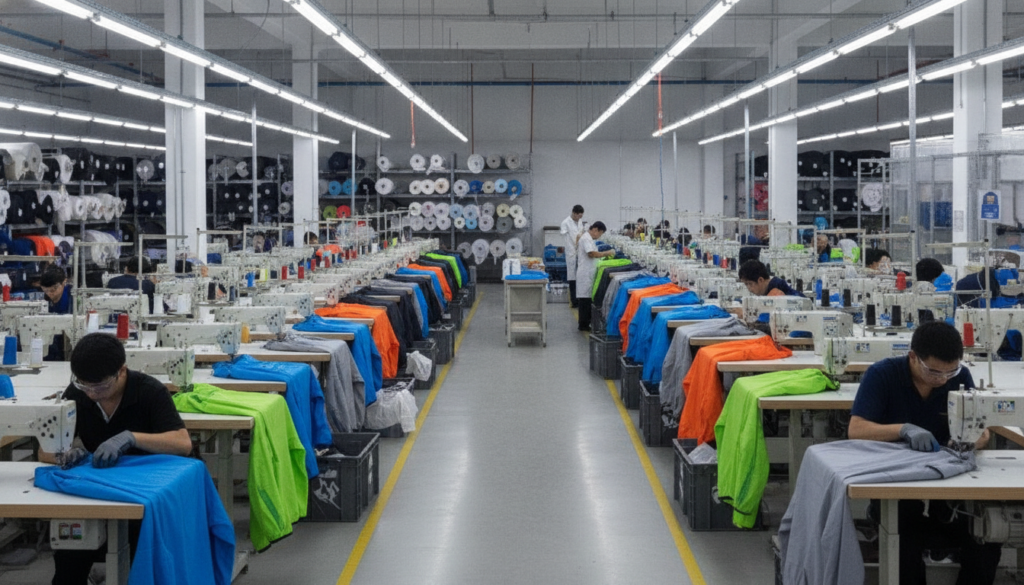
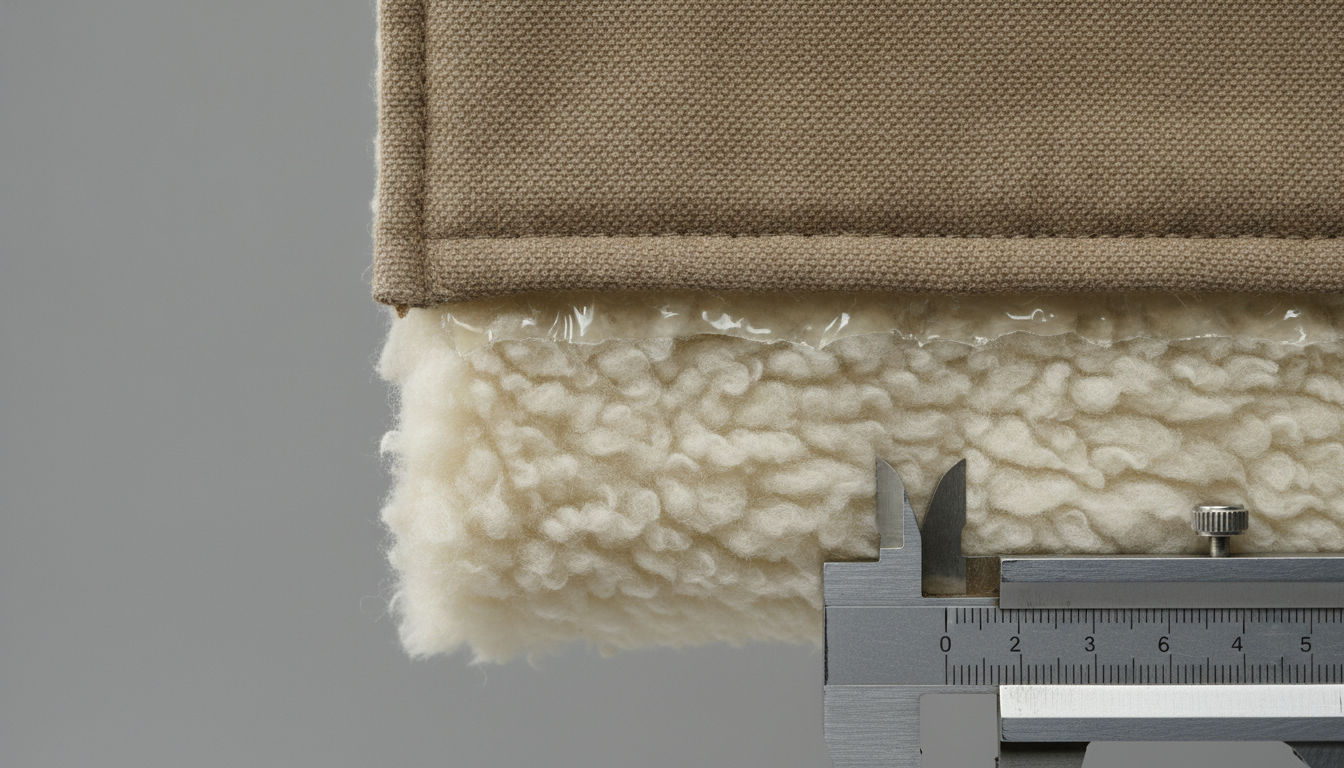
A heavyweight fleece lined workwear jacket manufacturer should offer fabric weights of 260-280 g/m² for the fleece lining, 12-ounce cotton duck or 300D polyester shells, and in-house bonding to prevent lining separation. PTOUTWEAR runs 20 production lines in a 3,000m² Taizhou Sanmen facility with sample MOQ of 1 piece and bulk MOQ of 30 pieces per SKU, delivering samples in 7-10 days and bulk orders in 25-35 days.
📋 Table of Contents
Key Takeaways
- Heavyweight fleece lining in workwear jackets typically ranges from 260 to 280 g/m² fabric weight, balancing warmth with mobility for active jobsite use.
- In-house fleece bonding prevents lining separation during wash cycles, a common failure mode when bonding is subcontracted without lamination QC.
- Shell materials for fleece-lined workwear include 12-ounce cotton duck for abrasion resistance and 300D polyester for water repellency and lighter weight.
- Sample MOQ of 1 piece allows corporate buyers and uniform programs to validate fit and warmth before committing to bulk orders of 30 pieces per SKU.
- ISO 9001 certification and SGS testing documentation provide audit-ready traceability for corporate procurement and school uniform tenders.
- Lead times of 7-10 days for sampling and 25-35 days for bulk production align with seasonal uniform rollouts and winter workwear restocking schedules.
What Defines Heavyweight Fleece Lining in Workwear Jackets?
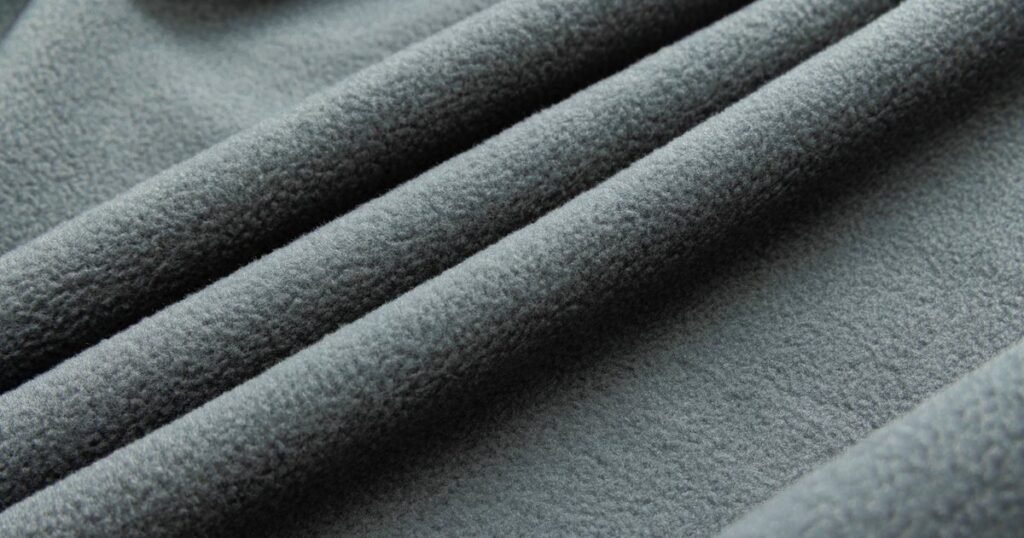
Heavyweight fleece lining starts at 260 g/m² fabric weight and extends to 280 g/m² for maximum warmth. According to cotton ART / Texet GmbH (2026), commercial workwear fleece jackets use 280 g/m² fabric weight with OEKO-TEX Standard 100 certification. Below 260 g/m², the lining qualifies as mid-weight and sacrifices insulation performance in sub-freezing temperatures. Above 280 g/m², bulk increases without proportional warmth gain, restricting movement during bending and lifting tasks.
Sherpa Fleece vs. Polyester Fleece
Sherpa fleece delivers the highest warmth per ounce due to its high-pile structure trapping more air, but adds bulk that limits mobility in tight workspaces. According to Raindrop Chess (2026), sherpa fleece is the warmest per ounce, while 3M Thinsulate offers the best warmth-to-weight ratio. Polyester fleece at 280 g/m² provides a middle ground, offering warmth without the bulk penalty, making it the preferred choice for active trades like construction and HVAC work.
Full-Body vs. Torso-Only Lining
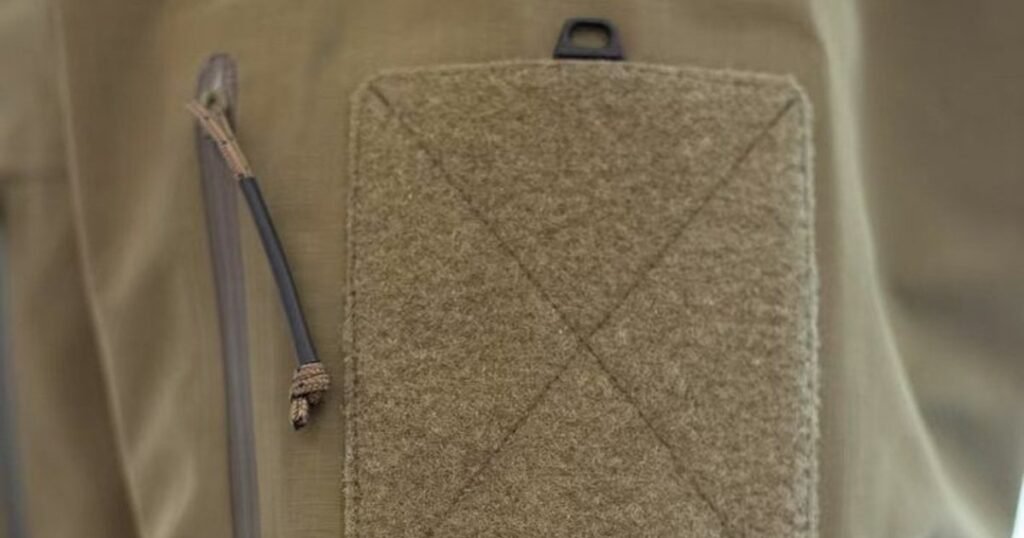
Buyers often report that sleeves are not as warm as the body because many jackets use fleece in the torso but lighter insulation in the arms. According to Carhartt product pages (2026), one workwear listing specifies a 12-ounce cotton duck shell with heavyweight fleece body lining and quilted sleeve insulation. Full-body fleece lining eliminates this warmth imbalance but increases weight by 15-20%, which matters for workers wearing the jacket 8-10 hours daily. Torso-only lining reduces weight and allows arm mobility, but requires quilted sleeve insulation rated to at least 60 g/m² to prevent cold spots.
Breathability Trade-Offs
Some fleece-lined work jackets are warm in static cold but overheat quickly during high-activity work because breathability is limited. Heavyweight fleece lining at 280 g/m² traps heat effectively during stationary outdoor work, but the same insulation causes sweat buildup when workers move between heated indoor spaces and outdoor jobsites. Moisture-wicking polyester fleece with a brushed inner surface pulls sweat away from skin faster than sherpa fleece, reducing the clammy feel during temperature transitions.
How Do You Verify Bonding Quality Before Production?
Bonding quality determines whether the fleece lining stays attached to the shell after 20-30 wash cycles. Subcontracted bonding introduces a risk point because adhesive application happens outside the factory’s direct QC oversight, and inconsistent glue patterns cause delamination at stress points like underarms and hem edges.
In-House Bonding Capability
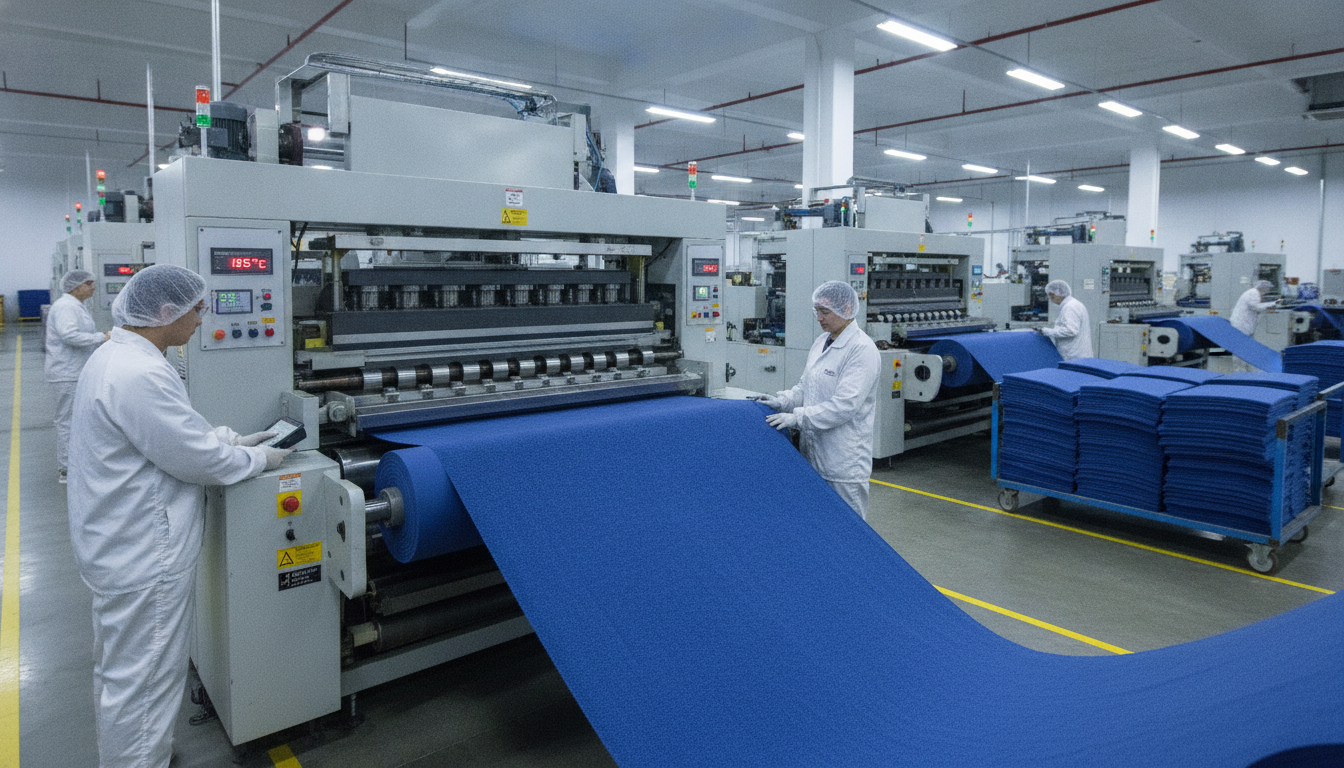
In-house bonding allows the factory to control adhesive type, application temperature, and dwell time under pressure. PTOUTWEAR operates in-house fleece bonding on 20 production lines in a 3,000m² Taizhou Sanmen facility, applying polyurethane adhesive at 140°C with 15-second press time. This eliminates the 3-5 day subcontractor transit delay and ensures every bonded panel passes peel-strength testing before cut-and-sew.
Peel Strength Testing on Samples
Peel strength testing measures the force required to separate the fleece lining from the shell fabric, expressed in Newtons per 25mm width. A passing result is ≥8N/25mm after five wash cycles at 40°C. Request a lab report for the sample before approving bulk production, because a sample that passes but bulk that drifts is the most common bonding failure mode in OEM jacket manufacturing.
In practice: Bonding adhesive that survives the sample wash test but fails at bulk scale happens when the factory switches adhesive suppliers mid-production without re-testing, which is why peel-strength documentation should be requested for both sample and bulk runs.
]
Wash-Cycle Documentation
Wash-cycle documentation specifies the number of cycles the bonded lining withstands before delamination begins. Corporate uniform programs typically require 50-wash durability, while retail workwear targets 30 washes. The factory should provide a wash-cycle report showing peel strength after 10, 20, and 30 cycles, with photographic evidence of any edge lifting or bubble formation.
Shell Fabric Options for Fleece-Lined Workwear
Shell fabric choice determines abrasion resistance, water repellency, and overall jacket weight. According to Carhartt (2026), one current workwear listing specifies a 12-ounce cotton duck shell with heavyweight fleece body lining and quilted sleeve insulation. The shell must withstand daily contact with rough surfaces like concrete, lumber, and metal edges without tearing or pilling.
12-Ounce Cotton Duck
Cotton duck at 12-ounce weight provides the highest abrasion resistance and a broken-in feel that workers prefer for all-day wear. The fabric breathes better than synthetic shells, reducing sweat buildup during high-activity tasks, but absorbs water quickly and takes hours to dry. Canvas-style cotton duck works best for indoor-outdoor trades like carpentry and electrical work, where water exposure is intermittent rather than constant.
300D Polyester with DWR
300-denier polyester with durable water repellent (DWR) finish sheds light rain and snow without adding weight. The synthetic shell dries in 30-45 minutes compared to 3-4 hours for cotton duck, making it the better choice for outdoor trades like landscaping and utilities maintenance. PTOUTWEAR applies PFC-free DWR certified by SGS, meeting corporate sustainability requirements without sacrificing water-shedding performance.
Ripstop Nylon for Weight Reduction
Ripstop nylon at 210-240D reduces jacket weight by 20-25% compared to cotton duck, addressing the complaint that workwear buyers dislike jackets that are warm but too heavy for all-day wear. The crosshatch weave prevents tear propagation from punctures, but the fabric lacks the abrasion resistance of cotton duck and shows wear faster at high-friction points like elbows and lower back.
MOQ and Lead Time Expectations
Minimum order quantities and lead times vary widely across manufacturers, with many requiring 500-1,000 pieces per style for fleece-lined workwear. Understanding the MOQ structure helps buyers avoid tying up cash in excess inventory while still accessing factory pricing.
Sample MOQ and Refund Terms
Sample MOQ of 1 piece allows corporate buyers to validate fit, warmth, and branding before committing to bulk orders. PTOUTWEAR charges a $100 sample fee that is fully refundable against bulk orders of 30 pieces or more, removing the financial barrier to multi-style testing. Buyers testing 3-4 shell and lining combinations can validate the best option for their workforce without spending $400-$500 on non-refundable samples.
Bulk MOQ per SKU
Bulk MOQ of 30 pieces per SKU supports small uniform programs and seasonal workwear restocking without forcing buyers into 500-piece commitments. A corporate buyer outfitting a 50-person team across three size runs (small, medium, large, XL, 2XL) can order 30 pieces in the two most common sizes and 15 pieces in outlier sizes, matching actual demand instead of guessing at distribution. This approach is detailed further on the low MOQ jacket manufacturer page.
Lead Time Breakdown
Lead times of 7-10 days for sampling and 25-35 days for bulk production align with seasonal uniform rollouts. Sampling time includes fabric sourcing, cut-and-sew, and fleece bonding for one piece. Bulk production time covers fabric inspection, cutting, bonding, sewing, QC, and packing for 30-500 pieces. Rush production of 1,000 pieces in 2 weeks is available at a 25% surcharge, useful for emergency uniform replacements or unexpected team expansions.
Sample MOQ: 1 piece. Bulk MOQ: 30 pieces per SKU. Sampling time: 7-10 days. Bulk production: 25-35 days. Rush option: 1,000 pcs in 2 weeks at +25% surcharge.
Certification and Compliance for Workwear Programs
Corporate procurement and school uniform tenders require audit-ready documentation proving the factory meets quality and safety standards. ISO 9001 certification and SGS testing reports provide the traceability that purchasing departments need to satisfy internal compliance and external audit requirements.
ISO 9001 Quality Management
ISO 9001 certification documents the factory’s quality management system, covering incoming fabric inspection, in-process QC checkpoints, and final audit procedures. The certification does not guarantee product quality, but it proves the factory has documented processes for catching defects before shipment. PTOUTWEAR holds ISO 9001 certification, with annual audits by an accredited third-party body, and provides certificate copies for tender submissions.
OEKO-TEX Standard 100 for Fleece Lining
OEKO-TEX Standard 100 certification confirms the fleece lining is free from harmful substances, including formaldehyde, heavy metals, and restricted dyes. According to cotton ART / Texet GmbH (2026), a commercial workwear fleece jacket listing uses 280 g/m² fabric weight and OEKO-TEX Standard 100 certification. School uniform programs and healthcare workwear buyers increasingly require OEKO-TEX documentation to meet duty-of-care standards for daily-wear garments. PTOUTWEAR does not currently hold OEKO-TEX certification but can source certified fleece lining from mills that do, with certificate copies provided at the fabric-approval stage.
SGS Testing for Abrasion and Colorfastness
SGS testing reports document abrasion resistance (measured in cycles to failure), colorfastness to washing (rated 1-5, with 4+ required for workwear), and dimensional stability after five wash cycles. The factory should provide SGS reports for both the shell fabric and the fleece lining, because a shell that passes but lining that shrinks 5% creates fit issues after the first wash. PTOUTWEAR conducts SGS testing on every new fabric combination before sample approval, with reports archived for three years to support warranty claims.
EN ISO 20471 for High-Visibility Workwear
EN ISO 20471 Class 3 certification is required for fleece-lined workwear used in roadwork, utilities, and rail environments where high visibility is mandated by safety regulations. According to cotton ART / Texet GmbH (2026), another workwear fleece jacket listing uses 260 g/m² fleece and EN ISO 20471 Class 3 plus OEKO-TEX Standard 100 certification. The standard specifies minimum areas of fluorescent background material and retroreflective tape, with placement requirements that vary by garment type. Adding high-visibility features to a fleece-lined workwear jacket increases production cost by 15-20% due to the reflective tape and fluorescent fabric, but eliminates the need for workers to layer a separate hi-vis vest over the jacket.
Frequently Asked Questions
What is the warmest material for a work jacket?
Sherpa fleece provides the highest warmth per ounce due to its high-pile structure that traps air, but it adds bulk that restricts movement during active work. 3M Thinsulate offers the best warmth-to-weight ratio, delivering equivalent insulation at half the thickness of sherpa fleece, making it the preferred choice for workers who need mobility. Heavyweight polyester fleece at 280 g/m² balances warmth and mobility, providing sufficient insulation for sub-freezing temperatures without the bulk penalty of sherpa or the cost premium of Thinsulate.
Can workwear jackets be customized with logos?
Workwear jackets can be customized with embroidered logos, screen-printed graphics, or heat-transfer patches. Embroidery works best on cotton duck shells and provides the most durable branding, withstanding 50+ wash cycles without fading or thread breakage. Screen printing is suitable for large back graphics on polyester shells, with plastisol ink offering the best opacity and wash durability. Heat-transfer patches allow full-color logos on fleece lining or shell fabric, with a lifespan of 30-40 washes before edge lifting begins. Detailed customization options are covered on the custom logo service page.
What is the difference between sherpa lining and fleece lining?
Sherpa lining features a high-pile knit structure that mimics wool, with fiber loops 8-12mm tall that trap more air than standard fleece, delivering superior warmth per ounce. Fleece lining uses a brushed polyester knit with 3-5mm pile height, offering less warmth than sherpa but significantly less bulk and better moisture-wicking performance. Sherpa lining is preferred for static outdoor work in extreme cold, while fleece lining suits active trades where workers move frequently between indoor and outdoor environments. Weight difference is substantial: sherpa-lined jackets weigh 15-20% more than fleece-lined equivalents in the same shell fabric and cut.
Ready to source heavyweight fleece lined workwear jackets with 30-piece MOQ and 7-10 day sampling?
Request Your Sample →
Written by Ivan Chen, Sales Engineer at PTOUTWEAR – 13 years in outdoor apparel manufacturing.