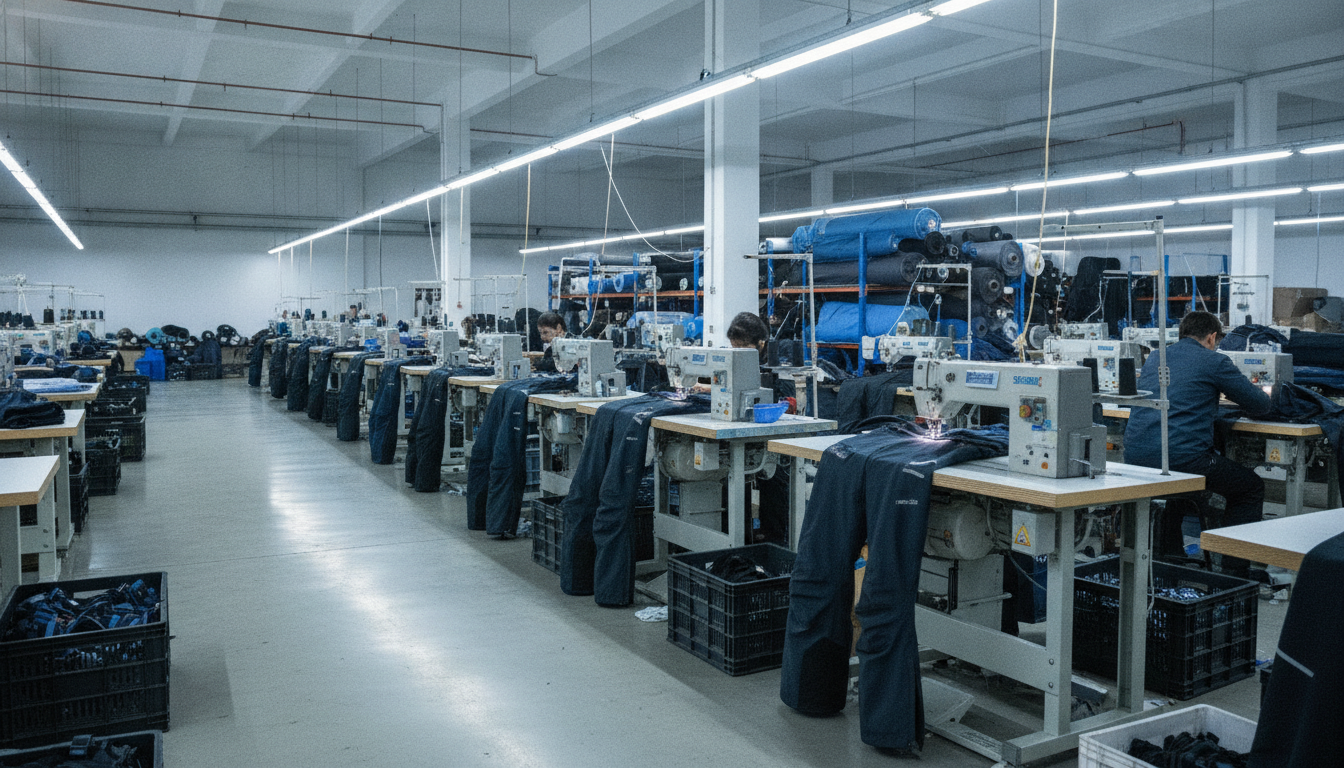
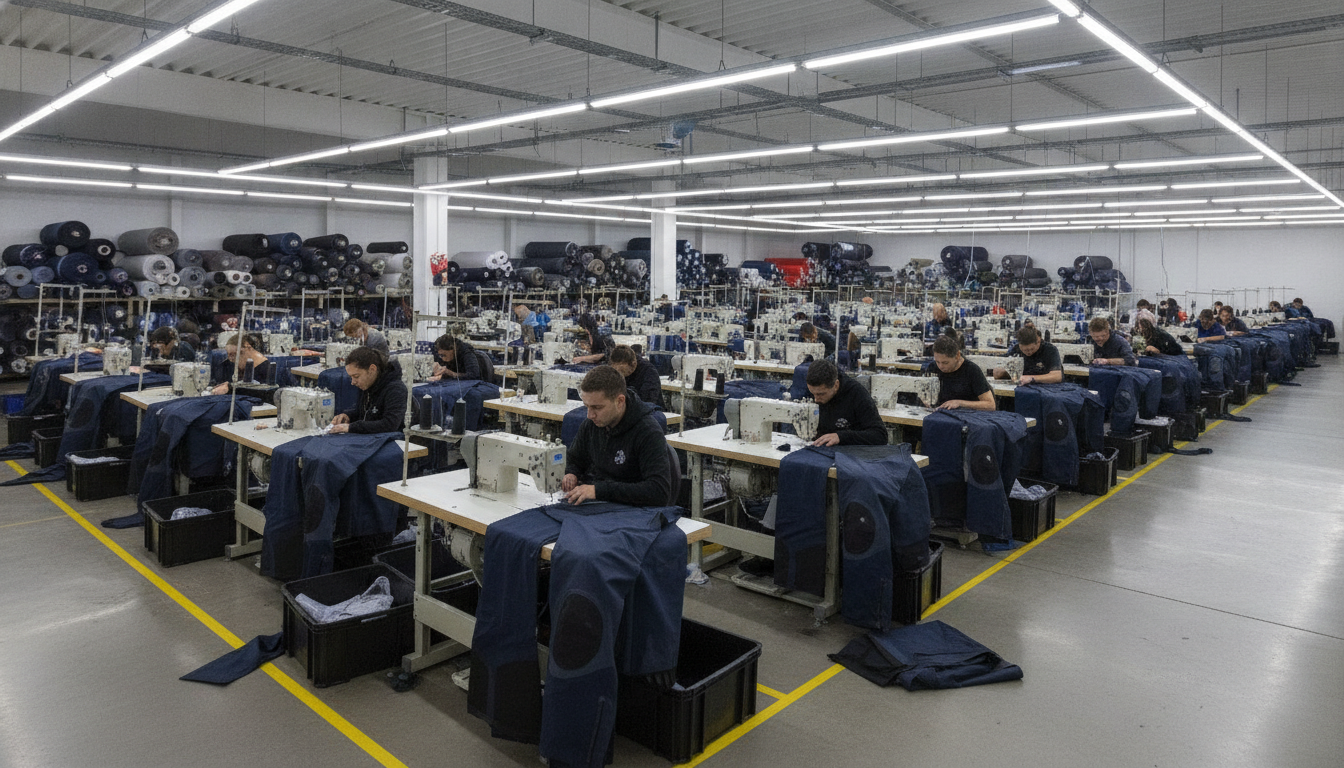
Custom ski pants are manufactured through an OEM process that includes fabric selection, pattern engineering for articulated movement, seam sealing, and brand customization. PTOUTWEAR produces custom ski pants with a 30-piece per SKU minimum order quantity, 7-10 day sampling, and 25-35 day bulk production lead times from our 3,000m² Taizhou Sanmen facility with ISO 9001 and PFC-Free DWR certification.
📋 Table of Contents
Executive Summary
- Manufacturing pathway: Custom ski pants are produced through cut-and-sew OEM, requiring fabric selection, pattern adjustment for articulated knees, seam sealing, and brand customization.
- MOQ and lead time: Bulk production starts at 30 pieces per SKU, with 7-10 day sampling and 25-35 day bulk production cycles.
- Performance specs: Waterproofing is verified through hydrostatic head testing, breathability through MVTR measurement, and seam integrity through wash-cycle testing.
- Fit engineering: Articulated knees, stretch panels, and adjustable waist systems address the movement and fit complaints buyers raise about standard ski pants.
- Use-case flexibility: Custom ski pants serve resort skiing, backcountry touring, corporate team uniforms, and school programs, each requiring different fabric weights and trim packages.
What Custom Ski Pants Include
Custom ski pants differ from private-label ski pants in that every component is specified by the buyer. Private-label means selecting from a factory’s existing patterns and fabrics, then adding your logo. Custom means you control the fabric, the pattern, the trim package, and the decoration method. According to Chisu Sport Academy (2026), OEM ski apparel workflows commonly require 10 discrete steps from concept through reorder, including design, quotation, sample, revision, approval, production, inspection, shipping, and customs/import processing.
Cut-and-Sew vs. Private-Label vs. Alteration-Based Customization
Three pathways exist for buyers entering the custom ski pants market. Cut-and-sew OEM gives full control over fabric, pattern, and trim, but requires a tech pack and carries the highest MOQ. Private-label lets you choose from existing styles and add branding, with lower MOQ but limited pattern flexibility. Alteration-based customization takes a finished garment and adjusts the inseam or waist, solving fit issues for retail buyers but offering no performance or fabric control for brands.
Buyers raising concerns about ski pants being too long or too short often look for alteration services rather than full custom manufacturing. That path works for individual retail purchases but does not address the performance or branding needs of a DTC outdoor brand or a corporate uniform program.
Tech Pack Requirements
A tech pack for OEM jacket manufacturing and ski pants includes fabric specifications with waterproofing and breathability targets, pattern drawings with articulated knee placement, trim callouts for zippers and adjusters, and decoration placement for logos and labels. The more complete the tech pack, the fewer revision cycles required during sampling.
Fabric, Trim, and Decoration Workflow
Fabric selection drives waterproofing, breathability, and durability. Trim selection includes zippers, adjustable waist systems, boot gaiters, and reinforcement patches. Decoration includes embroidery, heat-transfer logos, woven labels, and hang tags. According to Ruiniu Fashion (2026), a custom ski apparel manufacturing guide says OEM development can include fabric selection, pattern adjustment, colors, trims, labels, and packaging according to brand requirements.
Articulated Fit Engineering for Ski Movement
Articulated fit engineering addresses the movement restrictions buyers report in standard ski pants. Rigid straight-cut ski pants limit bending and carving performance because the fabric does not follow the natural bend of the knee during a turn. Articulated knees pre-shape the pattern to match the bent-knee position, reducing fabric tension and improving mobility.
Articulated Knee Construction
Articulated knees are built by adding a curved seam at the front of the knee, creating a three-dimensional shape that matches the leg’s position during skiing. The pattern piece is cut with a slight forward curve, then sewn to the upper and lower leg panels. This construction reduces the pulling sensation buyers experience when flexing into a deep carve or absorbing moguls.
According to BOWINS Garment (2026), a product page for articulated ski pants shows a price range of $290, $320 for a custom-engineered ski pant model, while a comparable premium branded pant is listed at $480, $520. The cost difference reflects the OEM pricing advantage for buyers ordering direct from a factory rather than purchasing through a retail brand.
Stretch Panels and Gussets
Stretch panels at the waist, inner thigh, and calf add flexibility without compromising waterproofing. A four-way stretch fabric insert at the waist allows the pant to expand when the wearer bends forward or sits on a chairlift. Inner-thigh stretch panels reduce chafing and improve stride length during touring or bootpacking.
Gussets at the hem allow the pant leg to open wide enough to pull over ski boots without forcing the zipper. Buyers wanting better fit customization at the waist and hem often specify adjustable waist tabs, drawcords, and zippered hem gussets in their tech packs.
Adjustable Inseam and Growth Features
Parents and buyers raising concerns about children outgrowing ski pants quickly look for adjustable or extendable inseams. An adjustable inseam uses a folded hem with snap buttons, allowing the pant to be lengthened by 2-3 inches as the child grows. This feature is common in school uniform programs and youth team gear, where replacement cost matters more than perfect one-time sizing.
In practice: Adjustable inseam features reduce replacement frequency in school uniform programs by allowing the pant to grow with the child over two seasons, but the feature adds a visible hem fold that some buyers reject for premium retail products.
Waterproofing and Breathability Specs
Waterproofing and breathability specifications for custom ski pants are verified through hydrostatic head testing and moisture vapor transmission rate (MVTR) measurement. Hydrostatic head measures how much water pressure a fabric can withstand before leaking. MVTR measures how much moisture vapor passes through the fabric per square meter per 24 hours.
Hydrostatic Head Testing
Hydrostatic head testing places a fabric sample under a column of water and measures the height at which water begins to penetrate. A fabric rated at 10,000mm can withstand 10,000 millimeters of water pressure before leaking. Resort skiing in wet snow typically requires 10,000mm minimum, while backcountry touring in heavy rain requires 20,000mm or higher.
Testing is performed on both the fabric and the finished garment. A fabric may pass at 15,000mm, but if the seam sealing fails, the finished pant will leak at the seams. Seam sealing is what separates a jacket that survives a wash test from one that delaminates, which is why it gets checked on the sample before bulk is ever cut.
Breathability and MVTR
MVTR measures breathability in grams per square meter per 24 hours (g/m²/24h). A fabric rated at 10,000 g/m²/24h allows 10,000 grams of moisture vapor to pass through one square meter of fabric in 24 hours. Higher MVTR reduces interior condensation during high-output activities like touring or mogul skiing.
Breathability requirements vary by use case. Resort skiing with moderate activity levels performs well at 8,000-10,000 g/m²/24h. Backcountry touring with sustained climbing requires 15,000-20,000 g/m²/24h to prevent sweat buildup inside the pant.
Seam Sealing and Durability
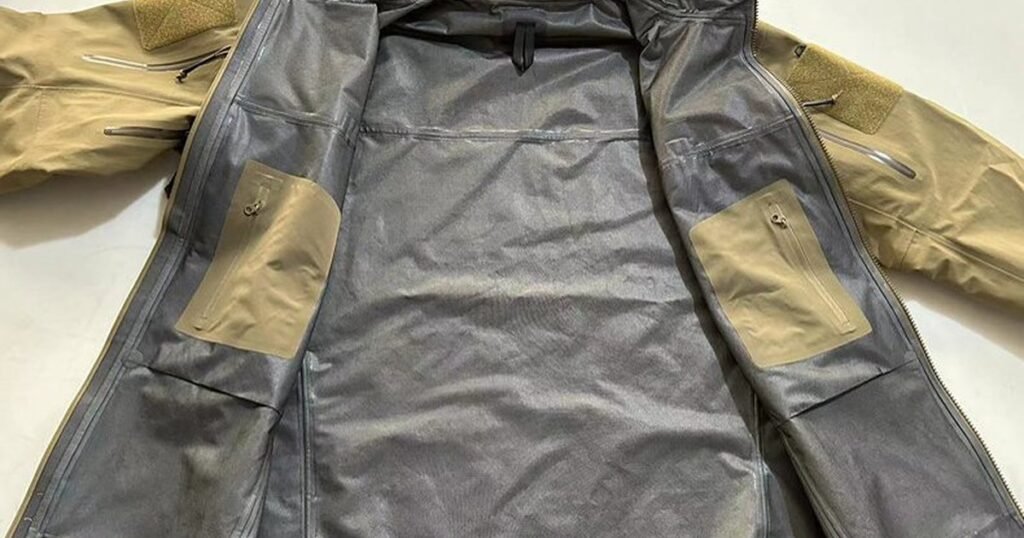
Seam sealing applies waterproof tape over every stitched seam to prevent water from entering through the needle holes. Fully taped seams cover every seam in the garment. Critically taped seams cover only high-exposure areas like the seat, knees, and lower legs. Buyers specifying custom ski pants for wet climates or backcountry use should require fully taped seams in their tech packs.
Durability testing includes abrasion resistance, tear strength, and colorfastness. Abrasion resistance is measured by rubbing the fabric against a standardized surface until it shows wear. Tear strength measures how much force is required to propagate a cut. Colorfastness measures how much the dye bleeds or fades after washing.
MOQ, Sampling, and Production Timeline
Minimum order quantity, sampling cost, and production lead time are the three commercial terms that determine whether a buyer can afford to launch custom ski pants. High MOQ ties up cash before market validation. Slow sampling delays the launch window. Overseas factory communication adds risk to every revision cycle.
Sample MOQ and Cost
Sample MOQ for custom ski pants at PTOUTWEAR is 1 piece, with a $100 sample fee that is refundable against bulk orders. Sample development takes 7-10 days from tech pack approval to finished sample shipment. Buyers ordering samples should expect one to two revision cycles before approving the pattern and fit for bulk production.
Sample cost includes fabric, trim, labor, and pattern development. The $100 fee covers a single colorway in one size. Additional sizes or colorways add $50-$75 per sample. Buyers testing fit across multiple sizes should budget for three samples: small, medium, and large.
Bulk MOQ and Pricing Tiers
Bulk MOQ for custom ski pants at PTOUTWEAR is 30 pieces per SKU. A SKU is defined as one style in one colorway in one size. A buyer ordering three colorways across four sizes would need 30 pieces per colorway-size combination, or 360 pieces total if ordering full size runs across all colors.
Pricing tiers drop as volume increases. A 30-piece order carries a higher per-unit cost than a 300-piece order because setup costs are spread across fewer units. Buyers launching with limited capital should start with a single colorway in two to three core sizes, then expand once sales data validates the product.
Production Lead Time and QA Checkpoints
Bulk production lead time for custom ski pants is 25-35 days from deposit to finished goods shipment. Production includes fabric cutting, sewing, seam sealing, trim attachment, quality inspection, and packing. Rush production is available for orders of 1,000 pieces or more, with a 14-day lead time and a 25% surcharge.
Quality assurance checkpoints occur at fabric inspection, mid-production inspection, and final inspection. Fabric inspection verifies waterproofing and colorfastness before cutting. Mid-production inspection checks seam sealing and trim attachment on the first 10% of the batch. Final inspection tests every garment for loose threads, skipped stitches, and zipper function.
Customization Options: Fabric, Trim, Branding
Customization options for custom ski pants include fabric selection, trim package, and branding method. Fabric selection determines waterproofing, breathability, and hand feel. Trim package includes zippers, adjusters, gaiters, and reinforcement patches. Branding method includes embroidery, heat transfer, woven labels, and hang tags.
Fabric Selection
Fabric selection starts with waterproofing and breathability targets, then moves to weight, hand feel, and stretch. A 2-layer fabric bonds the outer shell to a waterproof membrane. A 3-layer fabric adds an inner lining, creating a single bonded unit that is lighter and more packable. A 2.5-layer fabric uses a protective coating instead of a full lining, reducing weight but offering less durability.
- 2-layer fabric: Outer shell bonded to waterproof membrane, separate mesh lining, best for resort skiing where durability matters more than weight.
- 2.5-layer fabric: Outer shell bonded to waterproof membrane with protective coating, lightest option, best for backcountry touring where packability matters.
- 3-layer fabric: Outer shell, waterproof membrane, and inner lining bonded into one unit, most durable and packable, best for all-day resort or backcountry use.
PFC-free DWR (durable water repellent) is a waterproofing treatment applied to the outer fabric that causes water to bead and roll off instead of soaking in. PTOUTWEAR holds PFC-Free DWR certification, meaning the treatment contains no perfluorinated compounds, which are persistent environmental pollutants. Buyers targeting eco-conscious markets should specify PFC-free DWR in their tech packs.
Trim Package
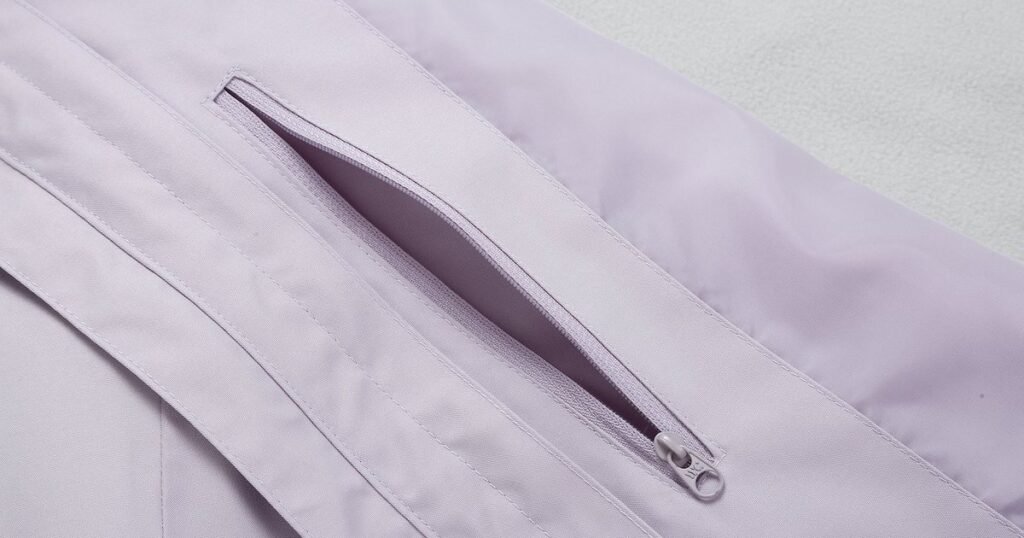
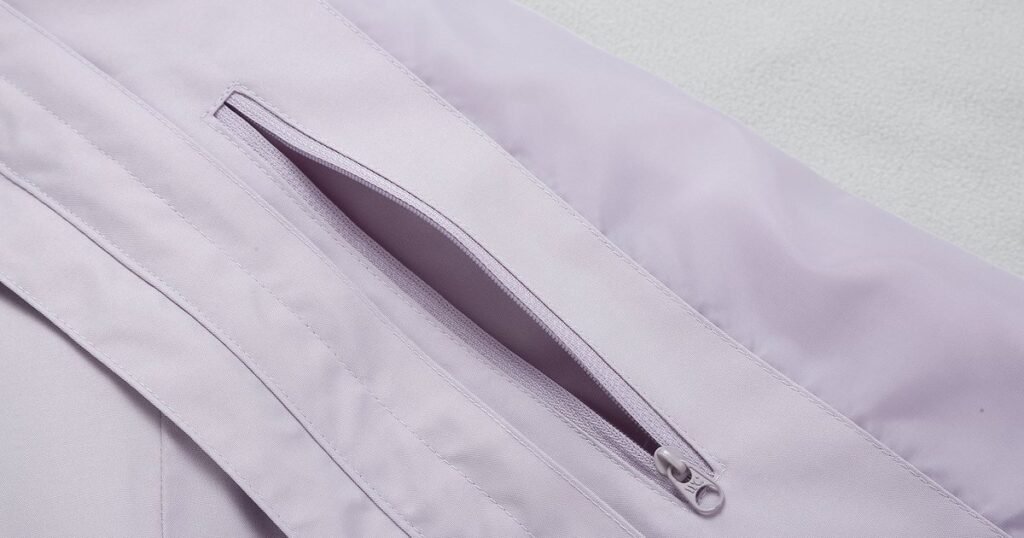
Trim package includes zippers, adjustable waist systems, boot gaiters, reinforcement patches, and pockets. Zipper selection affects durability and waterproofing. A standard coil zipper works for low-stress applications like hand pockets. A waterproof zipper with taped teeth is required for thigh vents and cargo pockets in wet conditions.
- Adjustable waist system: Elastic tabs with Velcro or snap closures at the sides, allows 2-4 inches of adjustment without altering the pattern.
- Boot gaiter: Elastic cuff with gripper elastic or snap closure that seals around the boot, prevents snow from entering the pant leg.
- Reinforcement patches: Cordura or ballistic nylon patches at the inner ankle and seat, protects high-wear areas from ski edges and chairlift abrasion.
- Thigh vents: Zippered openings on the outer thigh, allows heat and moisture to escape during high-output activities like touring or mogul skiing.
According to REI Co-op (2026), product pages highlight features like adjustable suspenders for customized fit and extended boot gaiters that can grow with kids by 2 inches. These features address the fit and growth concerns buyers raise about standard ski pants.
Branding and Decoration
Branding and decoration options for custom ski pants include embroidery, heat-transfer logos, woven labels, printed labels, and hang tags. Embroidery is the most durable method, suitable for logos on the thigh or back pocket. Heat-transfer logos are lighter and work well for large graphics on the leg panel. Woven labels are sewn into the waistband or back pocket, carrying brand name and care instructions.
Buyers ordering custom logo service for corporate or team uniforms should specify logo size, placement, and thread color in their tech packs. Logo placement on the outer thigh offers high visibility for team photos and sponsor recognition. Logo placement on the back pocket is more subtle, suitable for retail products where branding is secondary to design.
Use-Case Segmentation: Resort, Backcountry, Team Uniforms
Custom ski pants serve different use cases, each requiring different fabric weights, trim packages, and branding approaches. Resort skiing prioritizes durability and warmth. Backcountry touring prioritizes breathability and packability. Team uniforms prioritize consistent sizing and repeat ordering. School programs prioritize adjustable fit and replacement planning.
Resort Skiing
Resort skiing in cold, dry climates requires insulated ski pants with 10,000mm waterproofing and critically taped seams. Insulation options include synthetic fill, fleece lining, or removable insulated liner. Synthetic fill offers warmth even when wet, while fleece lining adds comfort without bulk. A removable liner allows the pant to be worn in varying temperatures.
Resort skiing in wet, heavy snow requires shell pants with 15,000mm waterproofing, fully taped seams, and thigh vents. Shell pants have no insulation, allowing the wearer to layer base layers and mid layers underneath. Thigh vents prevent overheating during high-output runs or warm spring conditions.
Backcountry and Touring
Backcountry touring requires lightweight shell pants with 15,000-20,000mm waterproofing, 15,000-20,000 g/m²/24h breathability, and full-length side zippers for ventilation. Weight matters because every ounce carried uphill multiplies over a full day of skinning. Breathability matters because sustained climbing generates more heat and moisture than downhill skiing.
Full-length side zippers allow the pant to be opened from ankle to waist without removing boots or skis, providing maximum ventilation during climbs. Articulated knees and stretch panels reduce fatigue during long approaches. Reinforced cuffs protect against ski-edge cuts during kick turns and boot packs.
Corporate and Team Uniforms
Corporate and team uniforms require consistent sizing across multiple orders, custom logo placement, and repeat-order planning. Ski resorts, ski schools, and corporate ski trips order custom ski pants with embroidered logos on the thigh or back pocket. Consistent sizing ensures that replacements match the original order, even if ordered months or years later.
Buyers managing corporate or team uniform programs should request a fit sample in each size before placing the bulk order. Fit samples allow the buyer to verify inseam length, waist fit, and logo placement across the size range. Buyers should also request fabric swatches to confirm color matching for future reorders.
School Programs
School programs require adjustable fit features, durable construction, and replacement planning. Students outgrow ski pants quickly, so adjustable inseams and waist systems extend the usable life of each pant. Durable construction with reinforced knees and seat reduces replacement frequency. Replacement planning includes ordering extra units in common sizes to cover mid-season growth and damage.
Buyers managing school uniform programs should specify adjustable inseams, reinforced high-wear areas, and dark colors that hide stains. Dark colors reduce the visible wear from daily use, extending the perceived life of the pant even after multiple wash cycles.
Key Takeaways
- Custom ski pants are manufactured through cut-and-sew OEM, requiring fabric selection, articulated pattern engineering, seam sealing, and brand customization, with bulk production starting at 30 pieces per SKU and 7-10 day sampling.
- Articulated knee construction pre-shapes the pattern to match the bent-knee position during skiing, reducing fabric tension and improving mobility, addressing the movement restrictions buyers report in rigid straight-cut ski pants.
- Waterproofing is verified through hydrostatic head testing, breathability through MVTR measurement, and seam integrity through wash-cycle testing, with resort skiing requiring 10,000mm minimum and backcountry touring requiring 20,000mm or higher.
- Sample MOQ is 1 piece with a $100 refundable sample fee, bulk MOQ is 30 pieces per SKU, and bulk production lead time is 25-35 days from deposit to finished goods shipment.
- Fabric selection includes 2-layer, 2.5-layer, and 3-layer constructions, with PFC-free DWR treatment available for buyers targeting eco-conscious markets.
- Use-case segmentation includes resort skiing with insulated or shell options, backcountry touring with lightweight breathable shells, corporate team uniforms with consistent sizing and logo placement, and school programs with adjustable fit and replacement planning.
FAQ
Can you order custom ski pants in mixed sizes within the 30-piece MOQ?
The 30-piece per SKU minimum applies to each colorway-size combination, not to the total order. A buyer ordering one colorway across three sizes would need 30 pieces in small, 30 in medium, and 30 in large, totaling 90 pieces. Buyers launching with limited capital should start with a single colorway in two core sizes, then expand once sales data validates demand across the size range.
What is the difference between critically taped seams and fully taped seams?
Critically taped seams apply waterproof tape only to high-exposure areas like the seat, knees, and lower legs, reducing weight and cost while maintaining waterproofing in the most vulnerable zones. Fully taped seams apply waterproof tape to every stitched seam in the garment, providing maximum waterproofing but adding weight and cost. Buyers specifying custom ski pants for wet climates or backcountry use should require fully taped seams in their tech packs.
How do you verify seam-sealing quality before approving bulk production?
Seam-sealing quality is verified by inspecting the sample under magnification for gaps or bubbles in the tape, then running a wash-cycle test to check for delamination after three to five washes. A seam that passes visual inspection but fails the wash test indicates poor tape adhesion or incorrect heat-press settings. Buyers should request a wash-tested sample before approving bulk production, especially for high-volume orders where a seam-sealing failure would affect hundreds of units.
Ready to develop custom ski pants with articulated fit, seam-sealed waterproofing, and PFC-free DWR?
Request a 1-Piece Sample →
Written by Ivan Chen, Sales Engineer at PTOUTWEAR, 13 years in outdoor apparel manufacturing.