Varsity jackets wholesale orders typically require minimum order quantities between 30 and 100 pieces per design, with bulk production lead times ranging from 15 to 35 days after artwork approval. Customization options include chenille patches, embroidery, screen printing, and material selection across wool-leather, synthetic, and blended constructions.
📋 Table of Contents
- Executive Summary
- What Are Typical Minimum Order Quantities for Varsity Jackets Wholesale?
- How Long Does Bulk Varsity Jacket Production Take?
- What Customization Options Are Available for Wholesale Orders?
- How Does Wholesale Pricing Work for Varsity Jackets?
- Which Materials Should You Choose for Different Climates and Use Cases?
- What Does the Sampling Process Look Like Before Bulk Orders?
- Key Takeaways
- FAQ
Executive Summary
- MOQ range: Most varsity jackets wholesale suppliers set minimums between 30 and 100 pieces per design, though some offer 1-piece sampling before bulk commitment.
- Lead times: Bulk production typically runs 15 to 35 days after artwork approval, with rush options available at premium pricing for urgent team or corporate orders.
- Customization depth: Chenille lettering, embroidered logos, screen-printed graphics, and color blocking across body, sleeves, and trim are standard, with material choices spanning wool-leather, synthetic blends, and performance fabrics.
- Pricing structure: Volume discounts often appear at 50-piece and 100-piece thresholds, with unit costs dropping as order size increases and decoration complexity remains a key variable.
- Sampling workflow: Pre-production samples confirm fit, decoration quality, and material hand before bulk cutting, reducing the risk of sizing inconsistency or decoration failure in final shipments.
What Are Typical Minimum Order Quantities for Varsity Jackets Wholesale?
Minimum order quantities for varsity jackets wholesale vary by supplier, production model, and decoration complexity. Most manufacturers set bulk MOQs between 30 and 100 pieces per design to justify cut-and-sew setup, fabric procurement, and decoration tooling costs. Schools, corporate teams, and resellers ordering single colorways with simple chenille patches often qualify at the lower end of this range, while multi-design orders with complex embroidery or mixed sizing push minimums higher.
Sampling Before Bulk Commitment
Many suppliers offer 1-piece or low-quantity sampling to validate fit, material quality, and decoration before bulk orders. Sample fees typically range from $100 to $200 per piece and are often refundable against bulk orders. This step is critical for buyers who need to confirm sizing consistency, chenille stitch quality, and color matching before committing cash to 50 or 100 units. Sample development timelines run 7 to 14 days depending on decoration complexity and fabric sourcing.
Production MOQ Tiers
Wholesale suppliers structure MOQs around production efficiency and decoration setup. A 30-piece minimum suits single-school orders or small corporate runs, while 50 to 100 pieces unlock better per-unit pricing and broader size-run flexibility. Buyers ordering multiple colorways or mixed decoration methods face higher minimums because each design variation requires separate setup and quality checks.
PTOUTWEAR MOQ: Sample orders start at 1 piece. Bulk production minimum is 30 pieces per SKU, with 7-10 day sampling and 25-35 day bulk lead times from our 3,000m² Taizhou Sanmen facility.
How Long Does Bulk Varsity Jacket Production Take?
Bulk production lead times for varsity jackets wholesale typically span 15 to 35 working days after artwork approval, fabric sourcing, and deposit payment. Lead time variability depends on decoration complexity, material availability, and factory capacity during peak seasons. Schools ordering for fall delivery often place orders in June or July to avoid August-September bottlenecks, while corporate buyers with flexible timelines can off-peak production windows for faster turnaround.
Production Phases and Timing
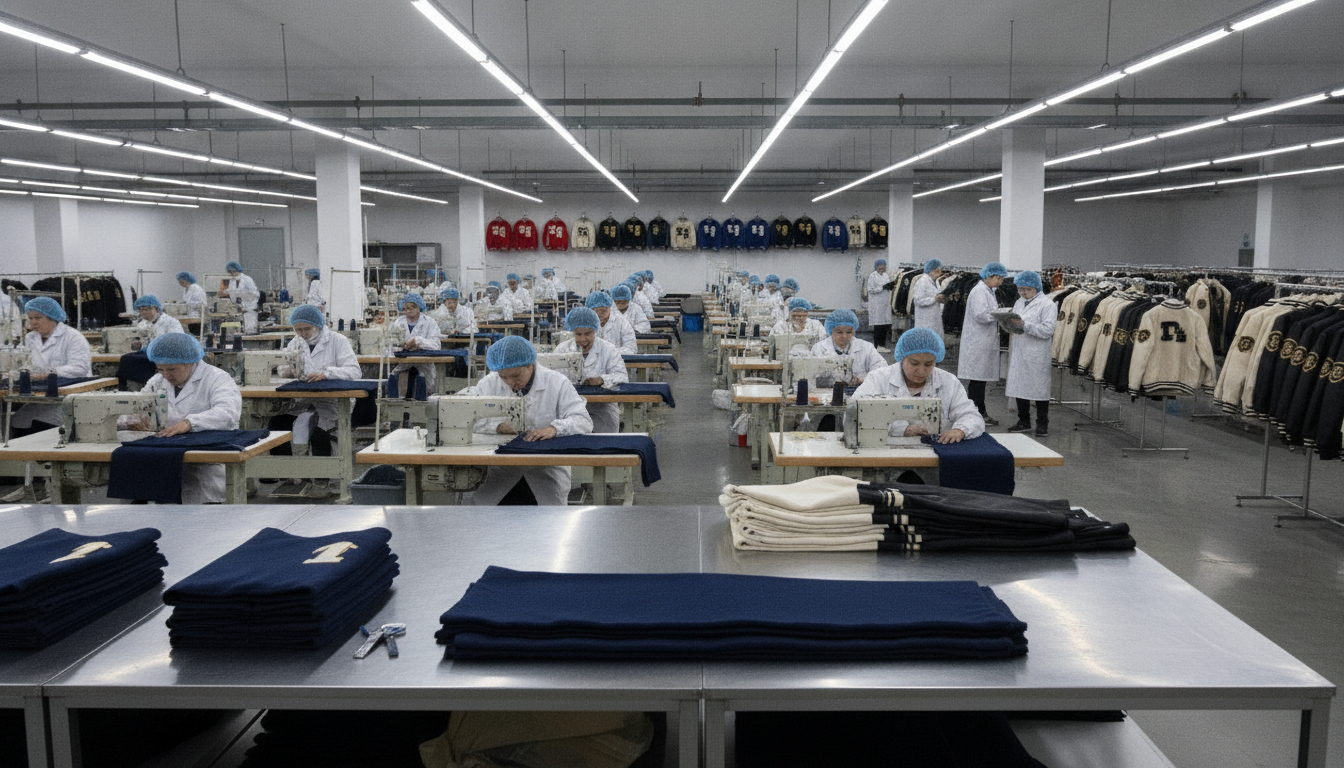
Varsity jacket manufacturing follows a sequential workflow: pattern grading and marker making (1-2 days), fabric cutting (2-3 days), sewing and assembly (8-12 days), decoration application (3-5 days), and final inspection and packing (2-3 days). Decoration complexity drives the longest variable: simple screen-printed logos add minimal time, while multi-color chenille patches with embroidered borders can extend decoration by a week.
Rush Production Options
Some suppliers offer expedited production for urgent team or event orders, compressing standard lead times by 30 to 50 percent at a premium. Rush fees typically add 20 to 30 percent to base pricing and require upfront deposit and artwork finalization before production begins. Buyers should confirm whether rush timelines include decoration, inspection, and shipping or only cover cut-and-sew assembly.
Shipping and Landed Time
Production lead times exclude international shipping, which adds 10 to 30 days depending on method and destination. Air freight delivers in 7 to 10 days but costs two to three times sea freight rates, while ocean shipping takes 20 to 35 days but reduces per-unit landed cost significantly. Buyers should factor customs clearance, which adds 3 to 7 days in most markets, when planning delivery dates for team events or retail launches.
What Customization Options Are Available for Wholesale Orders?
Varsity jackets wholesale customization spans decoration methods, material selection, color blocking, and hardware choices. Schools and corporate buyers prioritize logo placement and lettering, while resellers and streetwear brands layer multiple decoration techniques to differentiate product. Understanding which options affect MOQ, lead time, and unit cost helps buyers balance design ambition with budget and timeline constraints.
Decoration Methods
- Chenille patches: Classic varsity lettering and emblems, available in single or multi-color designs. Chenille adds texture and durability but requires setup tooling, which can increase MOQ for complex multi-letter designs.
- Embroidery: Thread-based logos and text, suitable for chest, sleeve, and back placements. Embroidery works well on wool and synthetic fabrics but may pucker on lightweight linings if not backed properly.
- Screen printing: Ink-based graphics applied to fabric panels before assembly. Screen printing suits large back designs and gradient artwork but fades faster than embroidery under repeated washing.
- Heat transfer: Vinyl or sublimation graphics applied post-assembly. Heat transfer allows full-color photographic designs but durability depends on transfer quality and fabric compatibility.
- Woven labels: Fabric tags sewn into neck or side seam, used for brand identity and care instructions. Woven labels add minimal cost and require separate minimum orders from label suppliers.
Color Blocking and Material Combinations
Traditional varsity jackets pair wool bodies with leather sleeves, but modern wholesale orders often substitute synthetic leather, nylon, or polyester to reduce cost and improve weather resistance. Color blocking options include contrasting sleeves, collar trim, pocket welts, and rib-knit cuffs in team or brand colors. Buyers should confirm whether color blocking affects MOQ, as each material and color combination requires separate cutting and inventory management.
Hardware and Closure Options
Snap buttons, zippers, and toggle closures each carry different cost and durability profiles. Metal snaps offer classic styling but can corrode in humid climates, while YKK zippers add $2 to $4 per unit but deliver smoother operation and longer lifespan. Buyers ordering for outdoor use or frequent washing should specify corrosion-resistant hardware and reinforced zipper tape to avoid early failure.
How Does Wholesale Pricing Work for Varsity Jackets?
Wholesale pricing for varsity jackets follows tiered volume discounts, with unit costs decreasing as order quantity increases. Material selection, decoration complexity, and hardware quality drive the widest price variation, while factory location and certification compliance add secondary cost layers. Buyers should request detailed cost breakdowns to understand which variables offer the most savings potential and which are fixed regardless of order size.
Volume Discount Tiers
Most suppliers structure pricing around 50-piece and 100-piece thresholds. A wool-body synthetic-sleeve jacket with single-color chenille lettering might cost $75 per unit at 30 pieces, $65 at 50 pieces, and $58 at 100 pieces. Decoration setup fees are typically amortized across order quantity, so larger orders absorb these costs more efficiently. Buyers ordering multiple designs should clarify whether volume discounts apply per design or across total order quantity.
Material Cost Drivers
- Wool body fabric: 80/20 wool-polyester blends cost $8 to $12 per meter, adding $15 to $20 per jacket compared to synthetic alternatives. Wool offers superior warmth and classic hand but requires dry cleaning and careful storage.
- Leather sleeves: Genuine leather adds $25 to $40 per jacket over synthetic leather, with durability and patina development justifying the premium for high-end buyers. Synthetic leather costs $8 to $15 per jacket and resists water better than genuine leather.
- Rib-knit trim: Cuffs, collar, and waistband in acrylic or cotton-acrylic blends add $5 to $8 per jacket. Buyers should confirm trim shrinkage rates, as low-quality rib knit can shrink 10 to 15 percent after washing, distorting fit.
- Lining fabric: Polyester satin or quilted linings add $3 to $6 per jacket. Quilted linings improve warmth but increase bulk, affecting packability for travel teams or event staff.
Decoration and Setup Fees
Chenille patches carry one-time digitizing and tooling fees of $50 to $150 per design, while embroidery digitizing runs $30 to $80 depending on stitch count. Screen printing requires film and screen setup at $40 to $100 per color, with multi-color designs multiplying setup costs. Buyers reordering the same design avoid these fees, making repeat orders significantly cheaper than initial runs.
Which Materials Should You Choose for Different Climates and Use Cases?
Material selection for varsity jackets wholesale depends on climate, use intensity, and care requirements. Schools and corporate buyers in warm climates prioritize lightweight synthetic shells with minimal insulation, while cold-weather teams need wool bodies and quilted linings. Resellers targeting streetwear markets balance aesthetic with durability, often choosing synthetic materials that resist fading and require less maintenance than wool-leather combinations.
Wool-Leather Construction
Traditional wool bodies with leather sleeves deliver classic varsity styling and excellent warmth-to-weight ratio. Wool naturally wicks moisture and resists odor, making it suitable for indoor team wear and moderate outdoor use. Leather sleeves develop patina over time but require conditioning to prevent cracking in dry climates. This combination works best for buyers who can enforce dry-cleaning care instructions and who prioritize heritage aesthetic over wash-and-wear convenience.
Synthetic Shell Options
Polyester, nylon, and synthetic-leather shells reduce cost, improve weather resistance, and simplify care. Synthetic materials resist shrinkage, dry quickly after washing, and hold color better than wool under UV exposure. Buyers ordering for outdoor events, frequent washing, or humid climates should specify water-resistant coatings and reinforced stitching at stress points. Synthetic shells lack the breathability of wool, so buyers should add mesh lining or pit zips to prevent overheating during active use.
Blended and Performance Fabrics
Wool-polyester blends (typically 80/20 or 70/30) combine wool’s warmth and hand with polyester’s durability and shape retention. These blends cost 20 to 30 percent less than pure wool and tolerate machine washing better, though they still require gentle cycles and air drying. Performance fabrics like softshell laminates or DWR-treated nylon suit buyers who need weather protection and active breathability, though these materials shift varsity jackets into technical outerwear territory and may require higher MOQs due to specialty fabric sourcing.
What Does the Sampling Process Look Like Before Bulk Orders?
Pre-production sampling confirms fit, material quality, decoration accuracy, and construction durability before bulk cutting begins. Buyers ordering varsity jackets wholesale should budget 7 to 14 days for sampling and plan for at least one revision round to address sizing, color matching, or decoration placement issues. Skipping sampling to save time or cost is the primary cause of bulk order failures, including sizing inconsistency, decoration misalignment, and material substitution.
Sample Request and Specification
Buyers submit detailed specifications including material type, color codes (Pantone or equivalent), decoration artwork, sizing chart, and hardware preferences. Factories respond with material swatches, decoration mockups, and estimated sample lead time. Buyers should request samples in multiple sizes if ordering a wide size run, as fit can vary significantly between small and 3XL due to pattern grading and material stretch characteristics.
Sample Evaluation Checklist
- Fit and sizing: Compare sample measurements against submitted size chart, checking chest, shoulder, sleeve length, and body length. Confirm rib-knit trim does not bind or gap.
- Material hand and weight: Assess fabric drape, surface texture, and weight per square meter. Confirm wool content if specified, and check synthetic leather for flexibility and surface finish.
- Decoration quality: Inspect chenille stitch density, embroidery thread tension, and screen-print edge sharpness. Confirm logo placement matches artwork specifications and that decoration does not pucker or distort fabric.
- Construction details: Check seam allowances, stitching straightness, and reinforcement at stress points (armholes, pocket corners, zipper ends). Confirm hardware operates smoothly and that lining is sewn cleanly without bunching.
- Color accuracy: Compare sample colors against submitted Pantone codes under natural light. Confirm body, sleeve, and trim colors match specifications and that dye lot variation is acceptable.
Revision and Approval
Buyers request revisions based on sample evaluation, specifying exact changes to sizing, materials, or decoration. Factories typically provide one free revision round, with additional revisions billed separately. Once approved, the sample becomes the production standard, and bulk orders are cut to match approved specifications. Buyers should photograph and archive approved samples to resolve any disputes about bulk quality or specification drift.
In practice: Chenille patch placement is what separates a jacket that looks professional from one that reads as amateur, which is why it gets checked on the sample before bulk cutting begins.
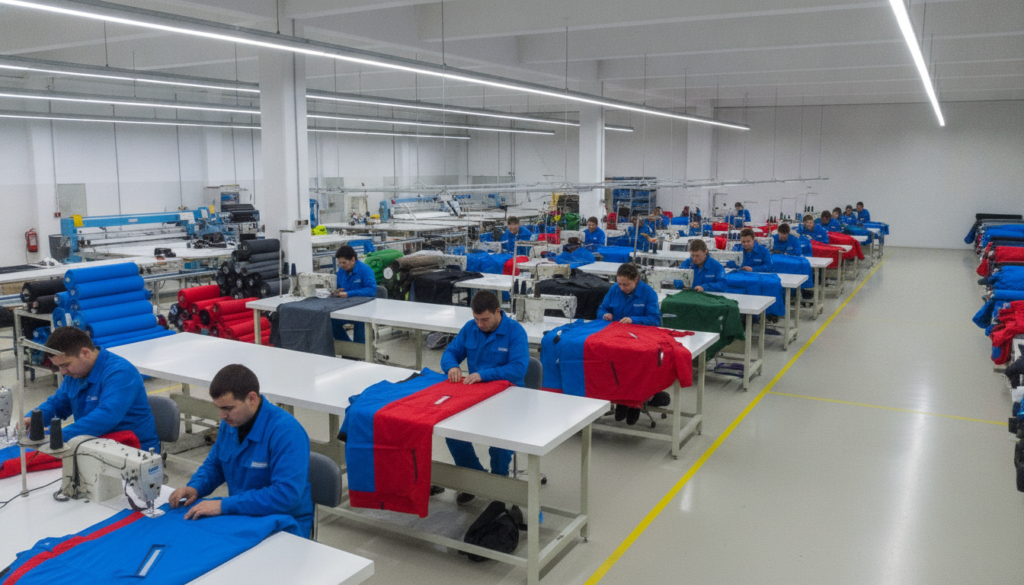
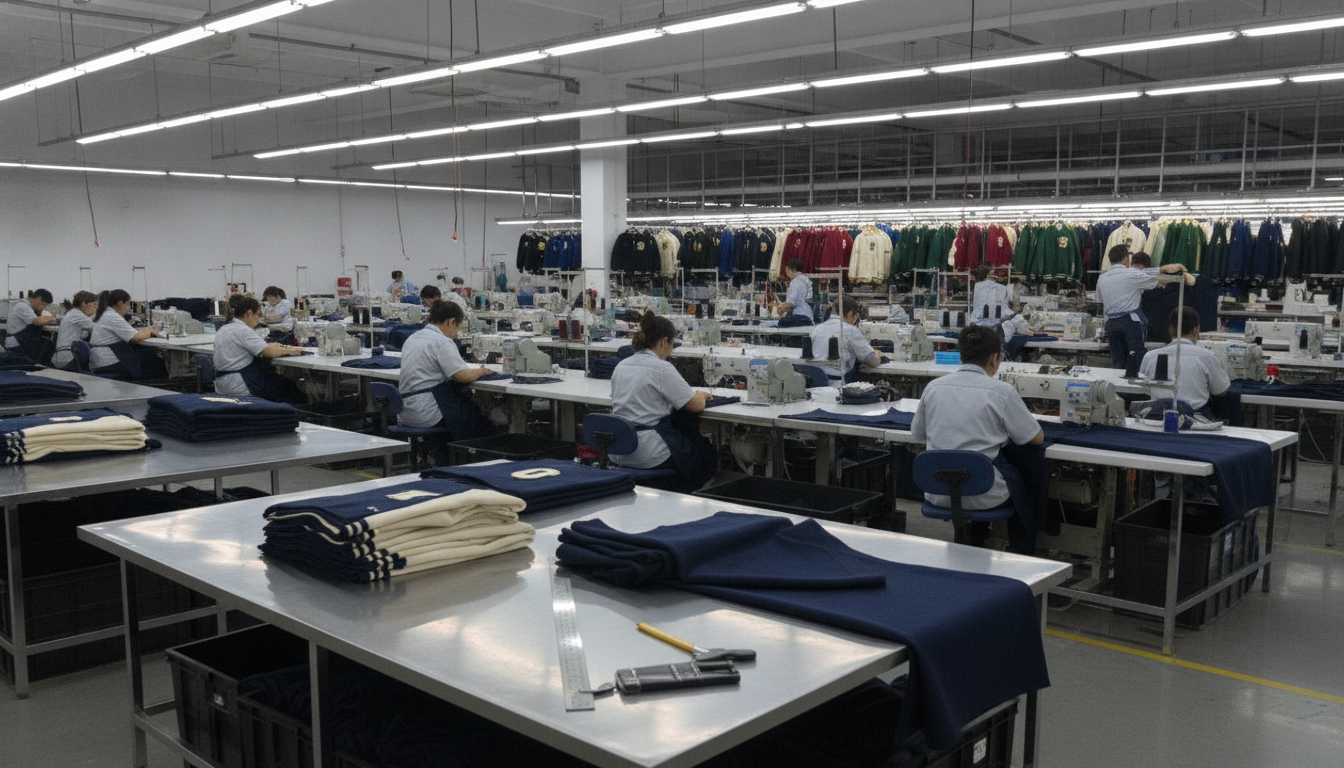
Our 3,000m² Taizhou Sanmen facility runs 20 production lines with in-house cut-and-sew, decoration application, and final QC. We maintain ISO 9001 and SGS certification and use PFC-Free DWR treatments across technical shell fabrics. Low-MOQ production starts at 30 pieces per SKU, with 1-piece sampling available to validate fit and decoration before bulk commitment. Bulk lead times run 25 to 35 days, with DDP shipping options to simplify customs and landed-cost planning.
Key Takeaways
- Varsity jackets wholesale MOQs typically range from 30 to 100 pieces per design, with 1-piece sampling available from select suppliers to validate fit and decoration before bulk orders.
- Bulk production lead times span 15 to 35 working days after artwork approval, with decoration complexity and peak-season capacity driving the widest timing variation.
- Customization options include chenille patches, embroidery, screen printing, color blocking, and hardware selection, each affecting setup costs and per-unit pricing differently.
- Volume discounts typically activate at 50-piece and 100-piece thresholds, with decoration setup fees amortized across order quantity to reduce per-unit impact on larger runs.
- Material selection between wool-leather, synthetic, and blended constructions should account for climate, care requirements, and use intensity to balance cost, durability, and aesthetic goals.
- Pre-production sampling confirms sizing accuracy, decoration quality, and material hand before bulk cutting, reducing the risk of costly bulk-order failures from specification drift or quality inconsistency.
FAQ
Can varsity jackets be customized with individual names and numbers?
Yes, individual names and numbers are standard customization options for team and school orders. Embroidery and heat transfer are the most common methods for personalization, with embroidery offering better durability and heat transfer providing faster turnaround. Buyers should confirm whether individual customization affects MOQ, as some suppliers require minimum quantities per name or number to justify setup. Personalization typically adds $5 to $12 per jacket depending on decoration method, character count, and font complexity. Schools ordering multi-year programs often archive digitized name files to simplify reordering for new team members.
What is the best way to maintain wool-leather varsity jackets?
Wool-leather varsity jackets require dry cleaning for the body and leather conditioning for the sleeves to maintain appearance and prevent material degradation. Buyers should avoid machine washing, as agitation and heat cause wool to shrink and felt, distorting fit and surface texture. Leather sleeves should be conditioned every 6 to 12 months with leather cream or oil to prevent cracking and maintain suppleness, especially in dry climates. Spot cleaning with a damp cloth and mild detergent handles minor stains without full dry cleaning. Buyers ordering for teams or schools should include care instructions with each jacket to reduce premature wear from improper washing.
How do you verify a varsity jacket supplier before placing a bulk order?
Supplier verification starts with requesting factory photos, certification documents, and customer references to confirm production capacity and quality standards. Buyers should ask for ISO 9001 or equivalent quality management certification, BSCI or WRAP social compliance audits, and OEKO-TEX Standard 100 testing for fabric safety if ordering for schools or children. Video calls showing live production lines, fabric storage, and QC processes help confirm the supplier operates a real factory rather than acting as a middleman. Requesting 1-piece samples before bulk orders validates material quality, decoration accuracy, and construction standards. Buyers should verify business registration, export licenses, and trade references through third-party services or chambers of commerce to reduce fraud risk.
Ready to source varsity jackets wholesale with transparent MOQs, verifiable sampling, and factory-direct pricing?
Request Your 1-Piece Sample →
Written by Ivan Chen, Sales Engineer at PTOUTWEAR, 13 years in outdoor apparel manufacturing.