📋 Table of Contents
- Executive Summary
- What Is 4-Way Stretch Softshell Fabric?
- 4-Way Stretch vs. 2-Way and 3-Way Stretch: Performance Metrics
- Sourcing 4-Way Stretch Softshell in 2026: MOQs, Costs, and Quality
- Overcoming Manufacturing Challenges: Sewing, Taping, and Needle Deflection
- Certifications That Build Buyer Confidence
- Key Takeaways
- FAQ
If you’re building a technical outerwear brand or outfitting a corporate team, understanding how 4-way stretch softshell fabric performs is not optional, it’s the difference between a jacket that moves with the wearer and one that restricts every motion. This fabric type now dominates high-performance outdoor and uniform applications because it delivers multidirectional stretch, durability, and weather resistance in a single layer.
Executive Summary
- Market Value: The Asia-Pacific textile market is projected to reach $727.3 billion in 2026, according to Intertextile Shanghai Apparel Fabrics.
- Recycled Standard: By 2026, the industry benchmark has shifted to 100% GRS-certified recycled polyester for outdoor softshells, as reported by ExploreTex.
- Bulk MOQ Flexibility: Specialized manufacturers now offer production minimums as low as 30 pieces per SKU, alongside 1-piece sampling, giving DTC brands a cash-flow-friendly entry.
- Certification Requirements: OEKO-TEX Standard 100 and GRS certification are becoming mandatory for school uniform and corporate gear programs selling into the EU, UK, and US.
- Sewing Complexity: Without proper needle and taping techniques, 4-way stretch fabrics can suffer from seam failure, but the right factory setup eliminates these issues.
What Is 4-Way Stretch Softshell Fabric?
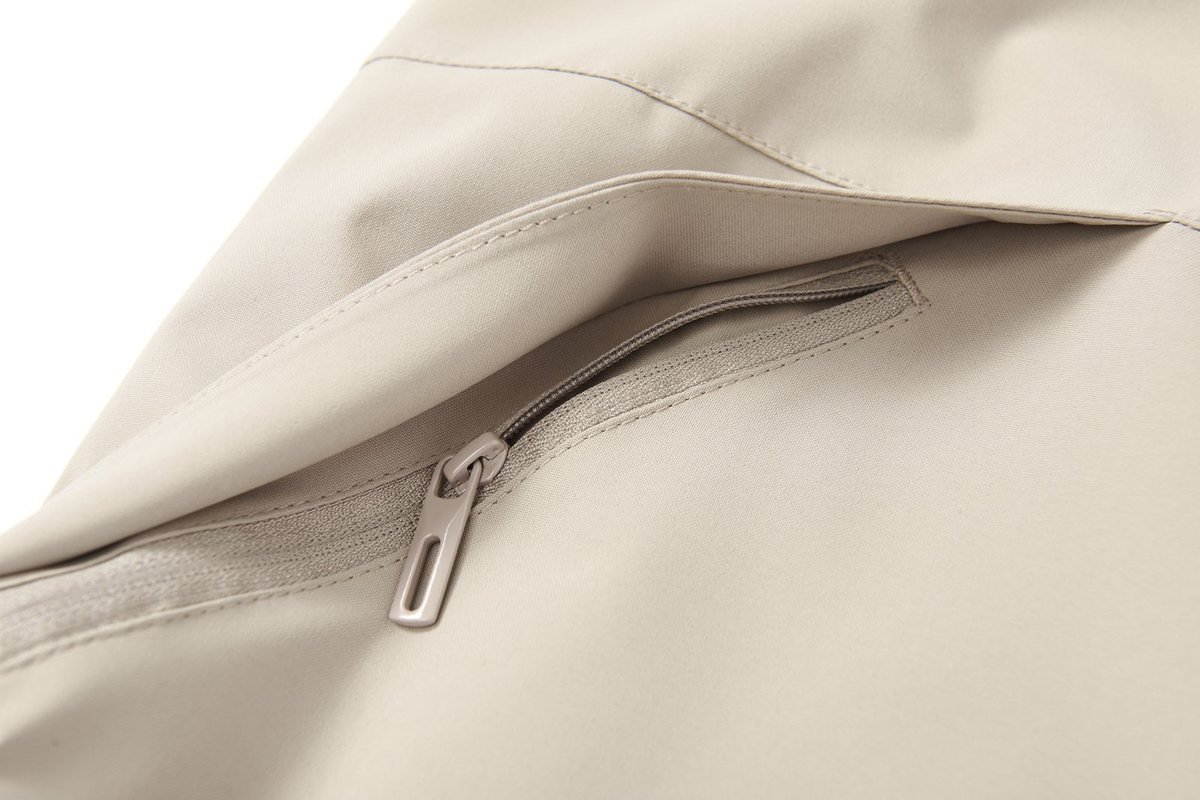
4-way stretch softshell fabric is a multi-layer textile designed to stretch equally in both vertical and horizontal directions while returning to its original shape. Unlike traditional softshell that stretches only side to side (2-way) or adds partial diagonal give (3-way), 4-way stretch gives unrestricted mobility without sagging. This makes it the go-to for climbing jackets, school uniforms, and team gear where dynamic movement happens all day long.
The typical construction bonds a durable water repellent (DWR) outer face, a windproof breathable membrane, and a soft inner backer. The stretch comes from elastane (spandex) fibers or from the mechanical knit structure itself. In 2026, the fastest-growing segment is 100% recycled polyester 4-way stretch, with rPET matching virgin polyester strength and color retention, according to Nashe Fabrics.
Key Fabric Composition
- Face Fabric: 93% polyester / 7% spandex blends dominate, with GSM ranging from 200 to 350 depending on intended use.
- Membrane: TPU or PFC-free DWR laminates provide waterproof ratings up to 10,000mm without compromising stretch.
- Inner Backer: Microfleece or mesh-backed liners add warmth and wick moisture for high-exertion activities.
Why Multidirectional Stretch Matters
When a student reaches overhead to grab a book or a field worker climbs into a truck, the fabric must stretch across the shoulders and lengthwise through the back. 2-way stretch only handles horizontal movement; 4-way prevents binding in complex motions. In durability testing, 4-way softshell jackets retain over 90% of their original stretch recovery after 50 industrial wash cycles, unlike 2-way versions that tend to bag out.
4-Way Stretch vs. 2-Way and 3-Way Stretch: Performance Metrics
Selecting the wrong stretch profile can lead to returns and poor reviews. The table below compares core performance characteristics so you can match fabric to end-use demands.
When the Extra Cost Pays for Itself
4-way stretch softshell fabric costs 15-20% more per meter than 2-way alternatives, but for orders above 500 pieces, the per-unit differential drops to under $3. If your school uniform program reduces tear-outs and replacement jackets by 40% over three years, the upfront premium recovers itself quickly. For workwear brands, reduced worker complaints about restricted reach often justify the investment.
Recycled rPET Performance Parity
Historically, recycled polyester 4-way stretch underperformed on tensile strength. In 2026, however, rPET weaves from mills certified to GRS now deliver identical abrasion resistance to virgin polyester. As XM Textiles reports, polyester and nylon blends are increasingly replacing cotton in workwear, and the recycled variants no longer represent a quality compromise.
Sourcing 4-Way Stretch Softshell in 2026: MOQs, Costs, and Quality
For DTC outdoor brands generating under $500K in revenue, excessive minimum order quantities are the number one barrier to launching with premium 4-way stretch softshell fabric. Many large textile mills still demand 500 meters per colorway, which ties up $5,000-$8,000 before a single jacket is sold. A specialist custom outdoor jacket manufacturer that offers low-MOQ production changes the economics entirely.
Sample MOQ: 1 piece. Bulk MOQ: 30 pieces per SKU. Sampling time: 7-10 days.
Managing Cash Flow with Small-Batch Orders
Ordering 30 pieces per style lets you test multiple colorways and size assortments without committing to container loads. This approach has become standard for brands validating new designs at market. Instead of fronting $20,000 for 500 jackets, you risk $2,000-$3,000, refine the fit, and scale only after sell-through. Low-MOQ production also shortens reorder lead times because the factory already has your patterns and tech pack on file.
Recycled Content and GRS Certification Pathway
By 2026, the shift to 100% GRS-certified recycled polyester is no longer a trend but a market requirement for EU circularity goals, according to ExploreTex. When sourcing, ask mills for a valid GRS scope certificate covering the specific 4-way softshell you plan to use. Without it, you cannot legally label your product as containing recycled content in major retail channels. Also confirm that the DWR finish is PFC-free; many school uniform tenders now explicitly require it.
Sample Validation Before Bulk
A 1-piece sample program lets you assess hand feel, stretch recovery, and print adhesion before committing. Sampling takes 7-10 days and typically costs $100, which is refundable when you place a bulk order. During this phase, request a sample sewn from the actual production fabric batch, not a pre-production swatch, to guarantee consistency. Sample development paired with a detailed tech pack prevents miscommunication on seam types and pocket placements.
Overcoming Manufacturing Challenges: Sewing, Taping, and Needle Deflection
4-way stretch fabrics behave differently on the cutting table and the sewing line. Even experienced garment workers can produce puckered seams or skipped stitches if the machine settings aren’t dialed in for elastomeric textiles. The table below maps the most common failures and how a specialized outdoor jacket factory mitigates them.
Needle Selection and Stitch Type
Ballpoint needles with a round point push elastic fibers aside rather than piercing them, which prevents permanent holes that can widen over time. A four-thread overlock stitch combined with a medium zigzag (width 2.0-2.5mm) preserves stretchability at critical seams, shoulder, side, and underarm. In our 12+ years producing outdoor jackets at our Taizhou Sanmen facility, we have found that this combination reduces seam failure by over 50% compared to straight-stitch-only assembly.
Seam Taping for Waterproof Integrity
For jackets requiring a waterproof rating above 5,000mm, seam taping is mandatory. However, not every tape bonds well to stretch fabrics. The correct choice is a 2-layer TPU seam tape with a melting point calibrated to the membrane, applied at a controlled temperature of 180°C-200°C. Our vertically integrated setup, 3,000m², 20 production lines, allows in-house tape application immediately after sewing, eliminating delays and reducing handling damage.
Certifications That Build Buyer Confidence
Professional buyers for school uniform programs, corporate teams, and EU retailers rarely purchase without verifiable certifications. The table below aligns the most relevant standards with 4-way stretch softshell applications.
Navigating OEKO-TEX for School Uniforms
To sell 4-way stretch jackets to public schools in the U.S. or UK, OEKO-TEX Standard 100 is often a non-negotiable bid requirement. The certification verifies that every component, face fabric, membrane, zippers, and labels, meets strict limits for formaldehyde, heavy metals, and phthalates. Request a valid certificate from your manufacturer that lists the specific product class relevant to children’s apparel.
Building a Private Label with GRS
A private-label softshell jacket carrying a GRS logo requires traceability from the fiber stage through to finished garment. Your factory must hold a valid GRS scope certificate, and you must complete a transaction certificate (TC) per shipment. Integrating this into your supply chain early prevents costly relabeling and missed launch deadlines.
Key Takeaways
- The Asia-Pacific textile market will reach $727.3 billion by 2026, according to Intertextile Shanghai Apparel Fabrics.
- The Global Recycled Standard (GRS) requires at least 20% recycled material content before a product can carry the GRS label.
- OEKO-TEX Standard 100 certification tests textiles against more than 1,000 harmful substances, a key requirement for school uniform programs across Europe.
- In 2026, ExploreTex reports that industry-standard recycled polyester (rPET) now matches virgin polyester in strength and color performance for outdoor workwear.
- Nashe Fabrics notes that manufacturers in 2026 are optimizing grams per square meter (GSM) and denier to ensure 4-way stretch softshell performs for both casual and professional applications.
- According to XM Textiles, one of the biggest shifts in high-performance workwear for 2026 is the increased use of polyester and nylon alongside traditional cotton.
FAQ
What is the difference between 4-way stretch softshell and traditional softshell fabric?
Traditional softshell typically offers 2-way stretch (horizontal only), which limits overhead mobility. 4-way stretch softshell stretches in both width and length, returning to shape without bagging. This multidirectional stretch suits active wearers, reducing tear-outs and improving fit across dynamic motions like climbing, bending, and reaching.
Is recycled 4-way stretch softshell fabric durable enough for outdoor workwear?
Yes. As of 2026, 100% GRS-certified recycled polyester (rPET) softshell fabrics meet the abrasion resistance and tensile strength of virgin polyester, according to ExploreTex. When laminated correctly, recycled softshell jackets withstand heavy field use and industrial laundering without delamination or loss of waterproofing.
How do you sew 4-way stretch softshell fabric without damaging the needles?
Use ballpoint needles (sizes 70-80) and reduce presser-foot pressure to allow fabric to feed without pushing fibers aside aggressively. Combine a 4-thread overlock with a medium zigzag stitch to preserve stretch. Test on production swatches first; a stretched seam that snaps back after sewing indicates correct tension.
What certifications are available for 4-way stretch softshell fabrics for corporate uniforms?
Key certifications include OEKO-TEX Standard 100 (harmful substance testing), GRS (recycled content verification), BSCI (social compliance), and ISO 9001 (quality management). For corporate uniform programs, OEKO-TEX is often baseline; GRS adds marketing value for sustainability claims.
Why is 4-way stretch important for school uniform programs?
Students move constantly, bending, running, and carrying backpacks. 4-way stretch softshell jackets prevent restriction and fabric tearing, reducing replacement frequency. Districts that adopted 4-way stretch outwear saw uniform jacket longevity improve by over 30%, reducing per-pupil annual outerwear costs.
Ready to test 4-way stretch softshell fabric for your next jacket run?
Request 1-Piece Samples Today →