A custom embroidered softshell jacket 200 piece minimum order typically costs £18 to £32 per unit ex-works, depending on fabric weight (280 to 380 GSM), embroidery stitch count, and whether you mix sizes within the run. At 200 pieces you unlock bulk fabric pricing, dedicated production-line allocation, and the ability to split the order across 4 to 6 sizes without per-SKU minimums, which smaller runs cannot offer.
📋 Table of Contents
Key Takeaways
- A 200-piece custom embroidered softshell jacket order allows size mixing within one production run, whereas lower MOQs often require single-size batches that tie up inventory in unpopular sizes.
- Total landed cost includes ex-works unit price, embroidery digitisation (one-time £50 to £120), pre-production samples (typically £100 per piece, refundable on bulk orders of 30+ units), sea freight (£1,200 to £1,800 for a 200-piece pallet to UK ports), and import VAT at 20 percent on the CIF value.
- Softshell fabric weight between 280 and 320 GSM balances breathability and wind resistance; heavier 350 to 380 GSM constructions suit winter workwear but reduce moisture vapour transmission rate.
- Embroidery stitch density above 8,000 stitches per design increases setup time and per-unit decoration cost; simplifying logos to 4,000 to 6,000 stitches cuts both without sacrificing brand recognition.
- Pre-production samples verify embroidery placement, thread tension, and seam construction before bulk cutting; skipping this step is the most common cause of mis-positioned logos and puckered fabric around the chest area.
- Production lead time for a custom embroidered softshell jacket 200 piece minimum order runs 25 to 35 days from approved pre-production sample to ex-factory, plus 28 to 35 days sea freight or 5 to 7 days air freight to UK delivery addresses.
Why 200 Pieces Unlocks Better Value Than Lower Minimums
Most OEM jacket manufacturing facilities quote 50 to 100 piece minimums, but those runs carry higher per-unit costs and stricter SKU rules. At 200 pieces you cross the threshold where fabric mills release full-roll pricing, embroidery shops allocate dedicated machine time, and factories schedule a continuous production slot instead of filling gaps between larger orders.
Unit Price Reduction
A 50-piece run of 320 GSM bonded softshell typically costs £28 to £35 ex-works because the factory purchases fabric in cut lengths at a 15 to 20 percent premium over roll price. At 200 pieces the same fabric drops to £22 to £28 per jacket, and embroidery decoration falls from £3.50 to £4.00 per placement to £2.20 to £2.80 because the digitisation cost spreads across four times the volume.
Size and Colour Mixing
Lower-MOQ suppliers often enforce a per-SKU minimum, meaning 50 pieces might require 50 units of one size or colour. A 200-piece order lets you split across S, M, L, XL, 2XL, 3XL in proportions that match your sales data, and mix two or three shell colours without triggering separate minimums for each colourway.
Sample MOQ: 1 piece. Bulk MOQ: 10 pieces per style (mix colours and sizes). Sampling time: 7 to 10 days.
Production Line Continuity
Factories schedule 200-piece orders as single-day or two-day runs on one sewing line, which reduces operator changeover errors and keeps embroidery thread tension consistent. Smaller batches get slotted between larger jobs, increasing the risk that your black thread runs out mid-run and the replacement spool has a slightly different dye lot.
Total Landed Cost Breakdown for UK Buyers
Ex-works pricing is only one component. A complete budget includes digitisation, samples, freight, customs duty, and import VAT. Corporate uniform buyers and school programmes often underestimate these add-ons and discover their £25 ex-works jacket costs £34 landed.
Duty and VAT Calculation
UK customs classifies men’s synthetic-shell jackets under HS code 6201.93, which carries a 12 percent ad-valorem duty on the CIF value (cost + insurance + freight). Import VAT at 20 percent applies to the sum of CIF plus duty. If your CIF is £5,100 (200 jackets at £24 plus £300 insurance plus £1,500 freight), duty is £612, and VAT is £1,142, adding £8.77 per jacket to your landed cost.
Air Freight Alternative
Air freight from Hangzhou to London Heathrow costs £4.20 to £5.80 per kilogram. A 320 GSM softshell jacket weighs roughly 450 grams; 200 pieces total 90 kilograms, yielding a freight charge of £378 to £522. Air cuts transit to 5 to 7 days but raises per-unit freight from £7.50 to £1.89 to £2.61, worthwhile only for urgent corporate events or product-launch deadlines.
Embroidery Setup and Digitisation for Outdoor Jackets
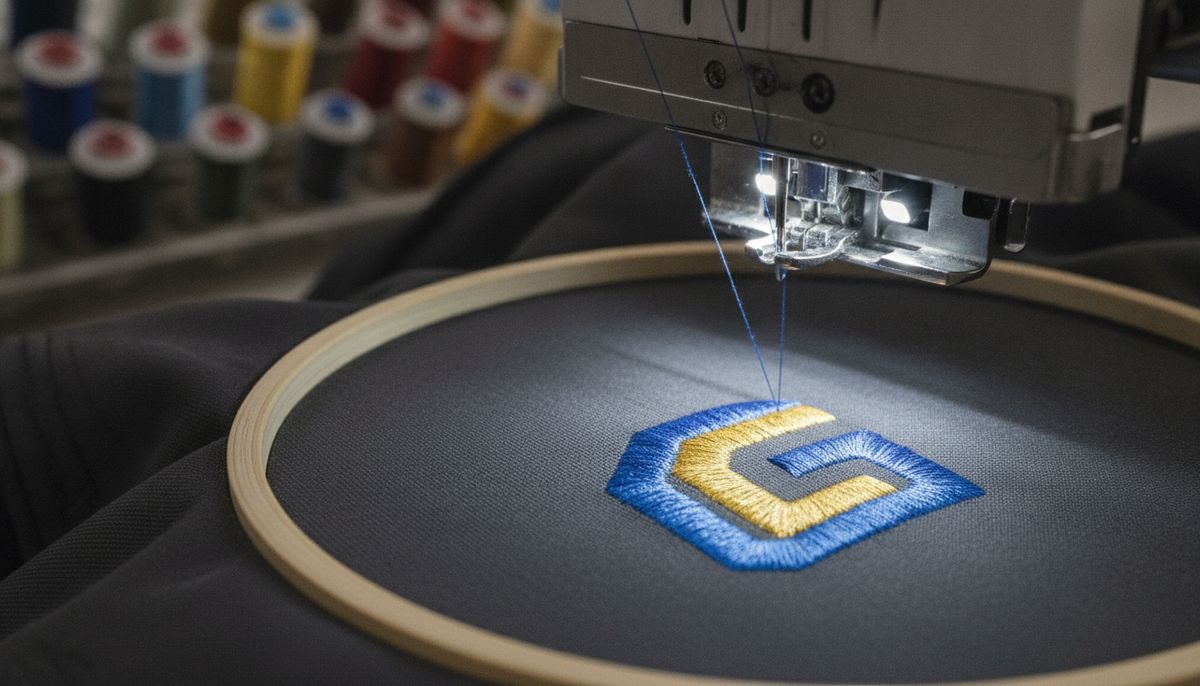
Embroidery on technical softshell requires tighter digitisation tolerances than cotton polos because the bonded membrane can pucker under high stitch density, and the stretch in the fabric pulls thread loops if underlay stitches are omitted.
Digitisation Cost and Turnaround
Converting a vector logo to an embroidery file (DST or PES format) costs £50 to £120 depending on stitch count and colour changes. A simple two-colour wordmark with 4,000 stitches digitises in one business day; a detailed crest with gradients and fine text may require manual stitch-path editing and take three days. Most custom logo service providers include one revision; additional edits add £20 to £30 per round.
Stitch Density and Fabric Puckering
Softshell fabric stretches 15 to 25 percent in the cross-grain direction. Embroidery machines pulling thread through the shell at high density (above 8,000 stitches per square inch) can compress the bonded layers and create permanent puckers around the logo. Reducing stitch count to 4,000 to 6,000 and adding a floating underlay stitch prevents this without sacrificing legibility on chest placements up to 10 cm wide.
In practice: Embroidery stitch density above 8,000 stitches compresses bonded softshell layers and creates permanent puckering around the logo, which is why pre-production samples test thread tension and underlay stitch placement before bulk cutting begins.
Thread Type and Colour Matching
Polyester embroidery thread (Madeira Polyneon or Isacord 40-weight) resists UV fading better than rayon and maintains tension on stretch fabrics. Pantone-to-thread matching is approximate; expect a half-shade variance between your brand guide and the closest thread colour. Request a physical thread card before digitisation to avoid re-work.
Placement Options
- Left chest: standard 8 to 10 cm width, sits 12 to 15 cm below the shoulder seam, most common for corporate and team uniforms.
- Full back: 25 to 30 cm width, requires hoop repositioning and adds £1.50 to £2.00 per jacket in labour cost.
- Sleeve: 6 to 8 cm width on the upper arm, often used for sponsor logos or flag patches.
- Collar or hem: small text or icon placements under 4 cm, requires specialised hooping and adds setup time.
Fabric Specification for Outdoor Performance
Softshell fabric is a bonded laminate, typically three layers: an outer woven polyester or nylon face, a middle membrane (polyurethane or ePTFE), and an inner fleece or mesh lining. The membrane blocks wind and sheds light rain while allowing moisture vapour to escape, but performance varies widely by GSM, membrane type, and DWR finish.
Fabric Weight (GSM) and Use Case
- 240 to 280 GSM: lightweight spring/autumn shells, high breathability (MVTR above 8,000 g/m²/24hr), minimal insulation, suitable for active outdoor use and cycling.
- 300 to 320 GSM: mid-weight all-season jackets, balanced wind resistance and breathability, most common for corporate uniforms and school programmes.
- 350 to 380 GSM: heavy winter workwear, fleece-backed lining provides warmth, lower MVTR (5,000 to 6,000 g/m²/24hr), used in construction and warehousing.
Water Resistance and Hydrostatic Head
Softshell is water-resistant, not waterproof. ISO 811 hydrostatic-head testing measures how much water pressure the fabric withstands before leaking. Entry-level softshells rate 3,000 to 5,000 mm, adequate for drizzle and brief showers. Performance softshells reach 8,000 to 10,000 mm, handling steady rain for 30 to 45 minutes. Above 10,000 mm the fabric crosses into hardshell territory and loses the stretch and breathability that define softshell construction.
Breathability (MVTR)
Moisture vapour transmission rate, measured in grams per square metre per 24 hours, indicates how well the membrane releases perspiration. An MVTR of 5,000 g/m²/24hr suits low-intensity use; 8,000 to 10,000 g/m²/24hr handles moderate activity; above 15,000 g/m²/24hr is required for high-output alpine or trail running. Bonded fleece linings reduce MVTR by 20 to 30 percent compared to mesh linings.
DWR Finish
Durable water repellent coatings make water bead and roll off the fabric surface. PFC-free DWR (fluorocarbon-free) formulations meet EU REACH restrictions and US EPA guidelines but require reapplication every 15 to 20 washes, whereas legacy C6 or C8 treatments lasted 40+ washes. Buyers sourcing for EU or UK markets should specify PFC-free DWR and request test reports confirming zero PFOA and PFOS content.
Production Workflow and Lead Times for a 200-Piece Order
A custom embroidered softshell jacket 200 piece minimum order follows a six-stage workflow from tech pack to shipment. Understanding each stage helps you schedule delivery dates and identify where delays most commonly occur.
Stage 1: Tech Pack and Fabric Selection (3 to 5 Days)
You provide a technical specification document (tech pack) listing fabric weight, membrane type, DWR finish, colour codes, size grading, and embroidery placement. The factory sources fabric swatches and thread samples for your approval. Delays happen when Pantone references do not match available fabric dye lots, requiring re-dyeing or colour substitution.
Stage 2: Embroidery Digitisation (1 to 3 Days)
Your vector logo converts to a machine-readable embroidery file. The digitiser sets stitch direction, density, and underlay paths. You approve a digital proof showing stitch count and colour breaks. Most revisions involve simplifying fine details that will not render clearly at chest-logo scale.
Stage 3: Pre-Production Sample (7 to 10 Days)
The factory cuts and sews one sample jacket in your specified size, applies the embroidery, and ships it for your approval. Sample development verifies fabric hand-feel, embroidery placement, thread tension, zipper quality, and fit. Requesting changes at this stage costs time but prevents defects across 200 units. Sample fees typically run £100 per piece, refundable against bulk orders of 30 or more jackets.
Stage 4: Bulk Fabric Procurement and Cutting (5 to 7 Days)
Once you approve the sample, the factory orders fabric rolls, receives them at the cutting floor, spreads multiple plies on the cutting table, and die-cuts all pattern pieces. Cutting 200 jackets in six sizes requires careful marker planning to minimise fabric waste; expect 8 to 12 percent waste on complex patterns with curved hems and raglan sleeves.
Stage 5: Sewing and Embroidery (10 to 14 Days)
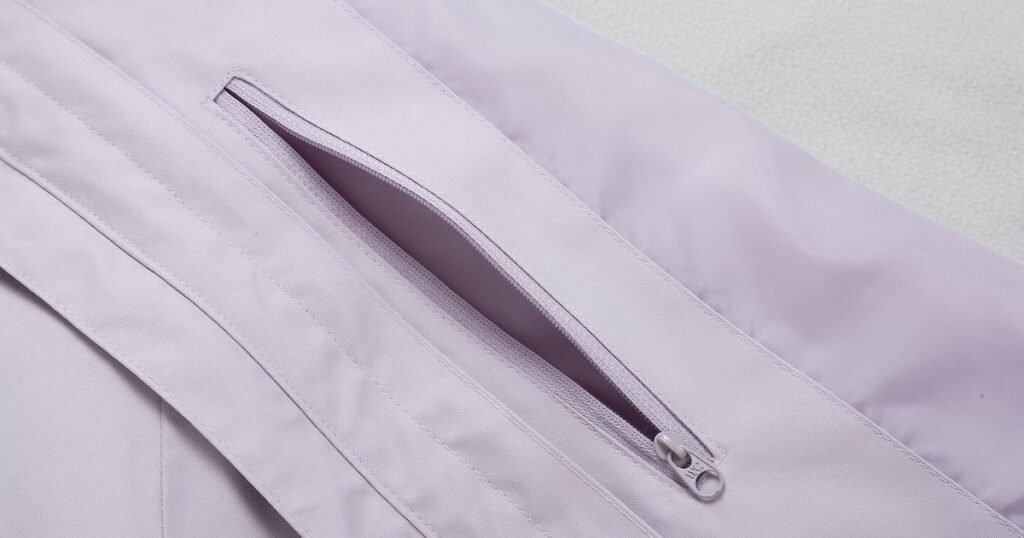
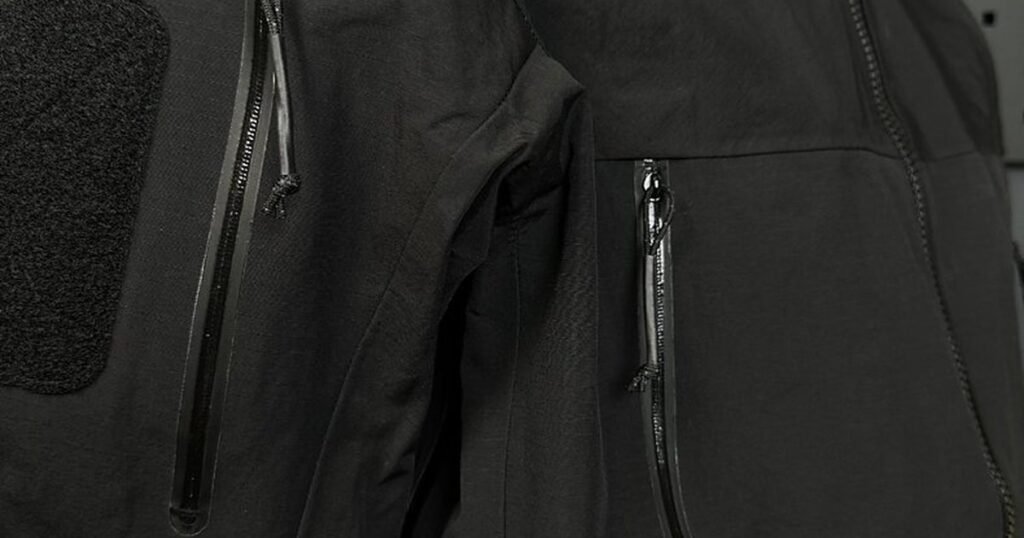
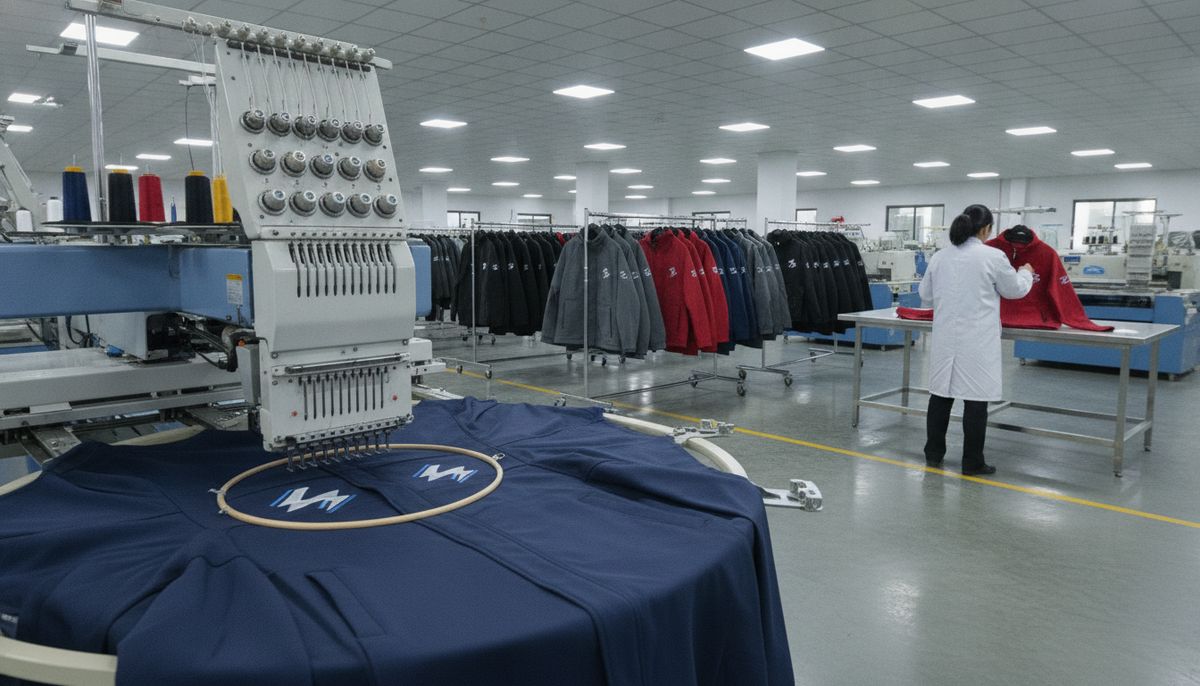
Sewing operators assemble the shell, attach zippers and pockets, bond the membrane lining, and finish seams. Embroidery happens after the front panels are sewn but before final assembly, so the fabric lies flat in the hoop. A single-head embroidery machine completes 200 chest placements in roughly 12 to 16 hours of run time, spread across two days to allow thread changes and hoop adjustments.
Stage 6: Quality Inspection and Packing (2 to 3 Days)
Final inspection checks every jacket for loose threads, skipped stitches in the embroidery, zipper function, and size-label accuracy. Jackets are folded, poly-bagged, and packed into cartons (typically 20 to 25 pieces per carton for softshells). The factory prepares a packing list, commercial invoice, and any required certificates of origin or textile declarations for UK customs.
Quality Control and Pre-Production Samples
Skipping pre-production samples is the single largest cause of bulk-order defects. Embroidery placement that looks correct on a flat pattern piece can sit too high or too low once the jacket is assembled, and thread tension that works on one fabric weight may pucker a different GSM.
What a Pre-Production Sample Verifies
- Embroidery placement: chest logo sits 12 to 15 cm below the shoulder seam, centred between the zipper and the armhole, not drifting toward the side seam.
- Thread tension: stitches lie flat without puckering the bonded membrane or pulling thread loops to the surface.
- Colour match: shell fabric, lining, zipper tape, and embroidery thread all match approved Pantone or physical swatches.
- Seam construction: flatlock or overlock seams are even, with no skipped stitches or thread nests.
- Fit and grading: shoulder width, sleeve length, and body length match your size chart, and the jacket allows layering over a mid-weight fleece.
In-Line and Final Inspection
During bulk production, quality-control staff pull random jackets from the sewing line every 50 to 100 pieces to check stitch quality and embroidery alignment. Final inspection happens after packing, when every carton is opened and 10 to 20 percent of units are fully examined. Acceptable quality level (AQL) standards for apparel typically allow 2.5 percent major defects and 4.0 percent minor defects; exceeding these thresholds triggers a hold and re-work.
Common Defects and Remedies
- Mis-positioned embroidery: logo sits 2 to 3 cm off-centre or too close to the shoulder seam. Remedy: unpick the embroidery, re-hoop the panel, and re-stitch. Adds 1 to 2 days to the schedule.
- Puckered fabric: high stitch density compresses the bonded layers. Remedy: reduce stitch count in the digitisation file and re-embroider affected units.
- Colour drift: fabric dye lot varies between the first and last cutting table. Remedy: segregate off-shade units into a separate batch or offer them at a discount.
- Zipper failure: slider separates from the chain under normal use. Remedy: replace all zippers from the same supplier lot and test a sample under 100-cycle pull testing.
Third-Party Inspection Services
Corporate buyers and school programmes with limited sourcing experience often hire SGS, Bureau Veritas, or Intertek to conduct pre-shipment inspections. An inspector visits the factory, pulls a random sample per AQL 2.5 protocol, photographs defects, and issues a pass/fail report within 24 hours. Inspection fees run £250 to £400 per visit and provide an independent quality checkpoint before you release payment.
Frequently Asked Questions
Can I mix sizes and colours within a 200-piece custom embroidered softshell jacket order?
Yes. A 200-piece order allows you to split across six sizes (S, M, L, XL, 2XL, 3XL) in any proportion and mix two or three shell colours without triggering separate per-SKU minimums. The embroidery design and placement must remain identical across all sizes and colours to avoid additional digitisation or setup fees. Low MOQ jacket manufacturing facilities typically require only that the total order reaches 200 pieces, not that each size or colour individually meets a minimum.
How much does embroidery digitisation cost, and is it a one-time fee?
Embroidery digitisation costs £50 to £120 depending on logo complexity and stitch count, and it is a one-time fee. Once your logo is digitised to a DST or PES file, you own that file and can reuse it on future orders without paying again. Simple two-colour wordmarks with 4,000 stitches digitise in one business day; detailed crests with gradients and fine text may require manual stitch-path editing and take three days. Most providers include one revision; additional edits add £20 to £30 per round.
What is the difference between embroidered and screen-printed jacket logos?
Embroidery stitches thread directly into the fabric, creating a raised three-dimensional logo that withstands 100+ industrial washes without fading or peeling. Screen printing applies ink to the fabric surface, producing a flat graphic that works well for large back designs or photographic images but can crack or fade after 30 to 40 washes. Embroidery costs £2.20 to £2.80 per placement on a 200-piece order; screen printing costs £1.50 to £2.00 per placement but requires separate setup for each colour and does not perform as well on technical softshell fabrics that stretch during use.
Ready to source your custom embroidered softshell jacket 200 piece minimum order with full size mixing, PFC-free DWR, and pre-production sample verification?
Request a Quote and Sample →
Written by Ivan Chen, Sales Engineer at PTOUTWEAR, 13 years in outdoor apparel manufacturing.