📋 Table of Contents
Planning your OEM waterproof jacket branded trims packaging budget means accounting for every cost layer between factory gate and customer doorstep. Brand founders discover that the FOB jacket price represents only 40-55% of total landed cost once you add custom woven labels, metal zipper pulls, printed hangtags, poly-bag inner packaging, retail-ready outer cartons, freight, duties, and compliance testing. A $22 FOB softshell jacket can land at $38-42 per unit delivered to a US warehouse after all branded trims, packaging, and logistics are included.
Executive Summary
- Market size: The jacket market is valued at $19.70 billion in 2026 and is projected to reach $29.62 billion by 2033, according to Fairfield Market Research.
- North America share: North America holds a 38.0% share of the jacket market, according to Fairfield Market Research.
- Hardshell segment: Hardshell jackets hold a 26.8% share of the jacket market, according to Fairfield Market Research.
- Material dominance: Synthetic materials account for 58.7% of the jacket market, according to Fairfield Market Research.
- Packable rain jacket growth: The packable rain jacket market is expected to grow from $1.66 billion in 2025 to $1.8 billion in 2026, according to EIN Presswire market report syndication.
- PFAS-free adoption: By 2026, more than 60% of new technical outerwear SKUs launched in Europe are estimated to carry a verified PFAS-free certification, according to MarketIntelo.
Landed-Cost Components Beyond FOB Price
Most OEM waterproof jacket sourcing conversations start with FOB factory price, but that figure excludes the trims, packaging, and logistics that turn a plain jacket into a retail-ready branded product. Buyers who budget only for the FOB price face cash-flow surprises when the manufacturer invoices for woven labels, custom zipper pulls, hangtags, poly bags, and printed cartons.
FOB Price Scope
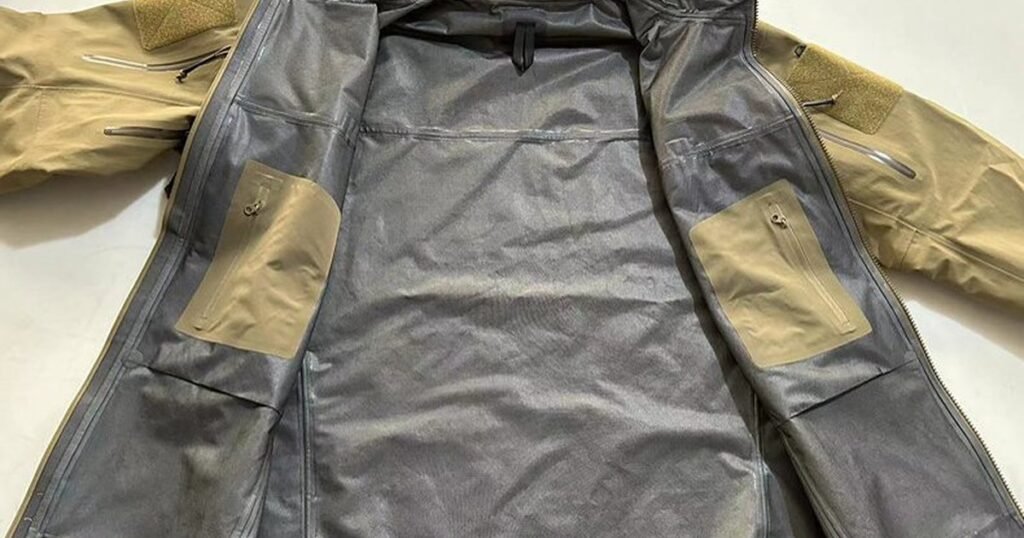
The FOB price covers the jacket shell fabric, lining, membrane or coating, basic trims like standard zippers and snap buttons, cut-and-sew labor, and factory quality control. It does NOT include your logo, custom woven labels, branded metal zipper pulls, printed care labels, hangtags, poly-bag inner packaging, or retail cartons. Factories quote FOB assuming you will add those branded elements separately.
Branded Trims Add-On
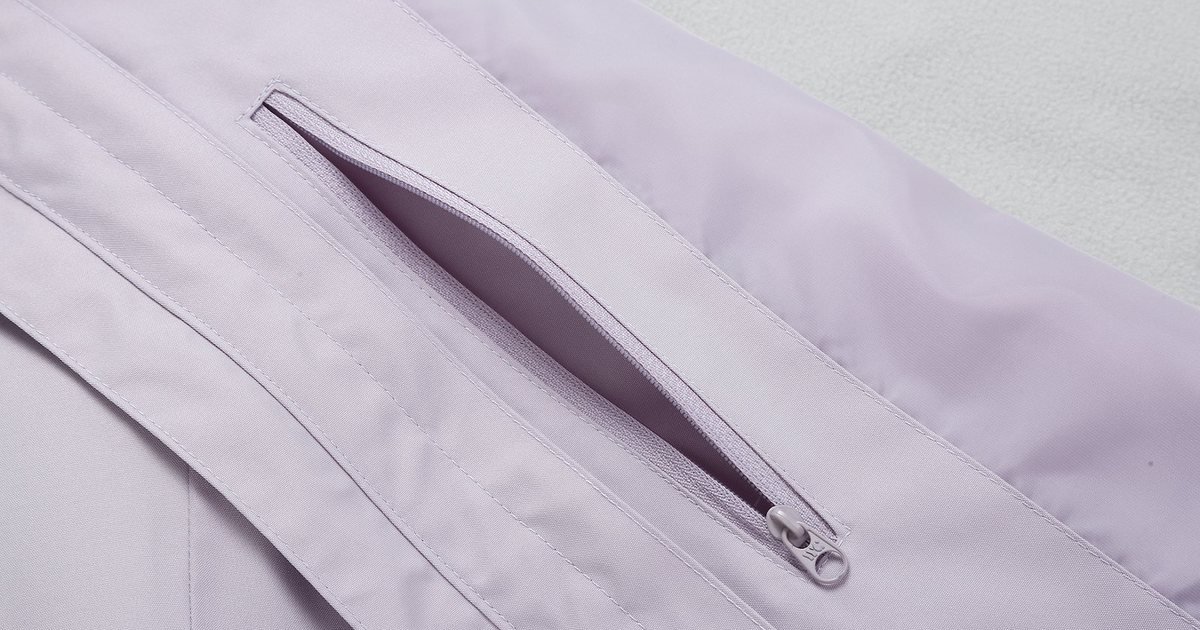
Custom woven neck labels, hem labels, and sleeve labels typically add $0.80-1.50 per jacket depending on label size, weave complexity, and order quantity. Metal zipper pulls with debossed or laser-etched logos add $0.40-0.90 per unit. Printed care labels and size labels add another $0.15-0.25. A full branded-trim package can add $1.50-2.80 per jacket to the FOB cost.
Packaging Material Costs
Poly-bag inner packaging with printed brand artwork costs $0.12-0.25 per unit at 500-piece minimums. Retail-ready folded cartons with full-color printing run $0.60-1.20 per box depending on board weight, print area, and finish. Printed hangtags on coated cardstock with string or safety pin attachment add $0.08-0.18 each. Total packaging material cost typically adds $0.80-1.60 per jacket.
Freight and Duties
Ocean freight from China to the US West Coast averages $1.20-2.80 per jacket depending on shipment volume and container utilization. Air freight runs $6-9 per unit but cuts lead time from 28-35 days to 7-10 days. US import duty on synthetic-shell jackets is 27.7% under HTS 6202.13.40, calculated on FOB value plus international freight. A $22 FOB jacket incurs roughly $6.10 in duty, bringing the landed cost before domestic logistics to approximately $30-32 per unit via ocean freight.
Compliance Testing
CPSIA lead and phthalate testing for children’s outerwear costs $150-350 per style. OEKO-TEX Standard 100 certification for adult technical outerwear runs $1,200-2,400 annually plus $80-150 per test report. California Proposition 65 compliance testing for PFAS and heavy metals adds $200-450 per style. Spread across a 500-unit first order, compliance testing adds $0.50-1.80 per jacket to landed cost.
OEM Waterproof Jacket Branded Trims Packaging Budget Breakdown
Accurate OEM waterproof jacket branded trims packaging budget planning requires separating one-time setup costs from per-unit recurring costs. Brand founders who skip this step underestimate cash requirements for the first order and overestimate margins on reorders.
One-Time Setup Costs
Woven label mold fees run $120-180 per label design. A typical jacket uses three labels: neck label, hem label, and sleeve label, totaling $360-540 in mold fees. Metal zipper-pull mold fees cost $180-350 per design depending on size and detail complexity. Hangtag die-cut and printing plates add $80-150. Poly-bag and carton printing plates cost $120-220 combined. Total one-time setup for a single jacket style with full branded trims and packaging runs $860-1,410.
Per-Unit Recurring Costs
Once molds and plates are paid, recurring per-unit costs drop significantly. Woven labels cost $0.22-0.35 each at 500-piece order quantities, so three labels per jacket add $0.66-1.05. Metal zipper pulls cost $0.40-0.90 per unit. Printed hangtags cost $0.08-0.18. Poly bags with one-color print cost $0.12-0.18. Retail cartons with four-color print cost $0.60-1.20. Total recurring branded-trim and packaging cost per jacket is $1.86-3.51 at moderate order volumes.
Volume Discounts
Trim and packaging suppliers offer steep volume breaks. Woven labels drop to $0.15-0.22 each at 2,000-piece quantities. Metal zipper pulls fall to $0.28-0.55 at 1,000-piece runs. Poly bags and cartons see 15-25% price reduction when you order 2,000+ units. Buyers who consolidate multiple colorways of the same style into a single trim order capture these discounts even if individual SKU quantities are modest.
Artwork Revision Costs
Many buyers underestimate artwork revision costs. Each round of label re-weaving or hangtag reprinting to correct logo placement, font size, or color costs $60-120 in new plate fees plus 3-5 days of lead time. Factories that offer unlimited revisions during sampling typically build $200-400 of revision buffer into the quoted sample price. Our sample development process includes two rounds of trim revisions in the base sample fee, with additional rounds billed at cost.
Setup cost example: A DTC outdoor brand ordering 300 units of a softshell jacket across three colorways pays $860 one-time setup, then $1.86-3.51 per unit recurring for branded trims and packaging, adding $2.73-4.38 per jacket when setup is amortized over the first 300-piece order.
Budget Planning by Buyer Segment
Different buyer segments face different OEM waterproof jacket branded trims packaging budget constraints. A DTC startup prioritizes low minimum order quantities to test the market without tying up cash. A corporate uniform buyer needs consistent sizing and color across multi-year reorders. A school uniform program requires durable construction at the lowest possible per-unit cost.
DTC Outdoor Brand Founders
DTC brands typically start with 100-300 units per style to validate product-market fit before scaling. At this volume, landed cost per jacket runs $32-46 including branded trims, packaging, freight, and duties. Setup costs add $2.90-4.70 per unit when amortized over 300 pieces. Total first-order investment is $10,500-15,200 for 300 jackets delivered to a US fulfillment center. Brand founders often discover that quoted FOB prices balloon once they add custom woven labels, metal zipper pulls, and retail packaging, making the original factory quote misleading.
Our low-MOQ jacket manufacturing service allows DTC brands to order 30 pieces per SKU for bulk production, with 1-piece sample orders available for $100 sample fee refundable against the first bulk order. This structure lets founders validate three colorways with 90 total units instead of locking up cash in 500-1,000 pieces of untested inventory.
Corporate and Team Uniform Buyers
Corporate buyers ordering 200-800 jackets for employee uniforms, sales teams, or event staff prioritize consistent sizing and repeatable color lots across reorders. Team buyers often struggle to get consistent sizing and repeatable color lots across reorders, especially when the manufacturer uses different trims or fabric substitutions between batches. At 500-unit order volumes, landed cost drops to $28-38 per jacket. Setup costs amortize to $1.70-2.80 per unit. Total investment for 500 jackets is $14,850-20,400.
Corporate buyers should specify approved trim suppliers and Pantone color references in the purchase order to prevent substitution. Our production facility maintains a trim library with approved woven label looms, zipper suppliers, and button vendors for repeat corporate accounts, ensuring batch-to-batch consistency across multi-year uniform programs.
School Uniform Programs
School uniform buyers order 300-1,200 jackets annually across multiple sizes, prioritizing durability and cost over fashion-forward styling. At 1,000-unit volumes, landed cost falls to $24-32 per jacket for a basic waterproof windbreaker with screen-printed school logo. Setup costs drop to $0.85-1.40 per unit. Total program cost for 1,000 jackets is $24,850-33,400. School buyers often negotiate two-year contracts with fixed pricing and scheduled delivery windows aligned to the academic calendar.
Small Outdoor Wholesalers
Wholesalers ordering 500-2,000 units per style for distribution to independent outdoor retailers need competitive landed costs to maintain margin while offering retailer keystone pricing. At 1,500-unit volumes, landed cost reaches $22-30 per jacket. Setup costs amortize to $0.57-0.94 per unit. Total investment for 1,500 jackets is $33,855-46,410. Wholesalers typically order 4-6 colorways per style to offer retailers assortment depth, consolidating trim orders to capture volume discounts.
Waterproof Performance Verification Standards
Buyers say custom outdoor jackets often arrive with weak or inconsistent waterproofing, where fabric may repel light rain but fail under prolonged exposure because construction, seam sealing, or membrane quality is not what was implied. Specifying the correct waterproof test method and acceptance criteria in the purchase order prevents this failure mode.
Hydrostatic Head Testing
Hydrostatic head measures the water column height a fabric can withstand before water penetrates. AATCC 127 and ISO 811 are the standard test methods. A 5,000mm hydrostatic head rating means the fabric resists a 5-meter water column. Entry-level waterproof jackets specify 3,000-5,000mm. Mid-range technical shells require 10,000-15,000mm. Premium hardshells demand 20,000mm or higher. Buyers should specify the test method, minimum hydrostatic head value, and whether the rating applies to the shell fabric alone or the finished garment after seam sealing.
Spray Rating
AATCC 22 spray rating evaluates surface water repellency by spraying water onto fabric at a 45-degree angle and observing wetting and penetration. Ratings range from 0 (complete wetting) to 100 (no wetting). A rating of 80 or higher indicates good water repellency suitable for rain jackets. Spray rating tests the durable water repellent (DWR) finish, not the waterproof membrane or coating underneath. DWR performance degrades with washing and wear, so buyers should specify initial spray rating and retention after 20 home launderings per AATCC 135.
Seam Sealing Quality
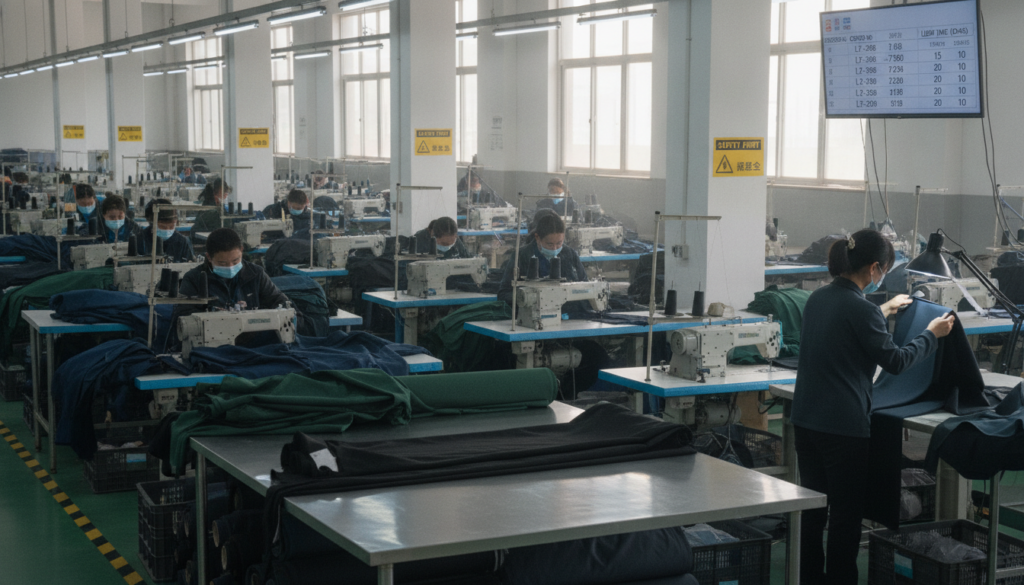
Waterproof fabric is irrelevant if needle holes leak. Seam sealing applies waterproof tape over stitched seams to block water entry through needle penetrations. Buyers should specify seam-sealing method: hot-air tape (most common, suitable for PU and TPU membranes), ultrasonic welding (for high-end seamless construction), or liquid seam sealant (budget option with inconsistent coverage). Our 3,000m² Taizhou Sanmen facility runs dedicated seam-sealing lines with automated tape application and pressure rollers, ensuring consistent seal width and adhesion across 200,000 jackets per year.
Breathability Testing
Waterproof jackets trap body moisture unless the fabric breathes. ASTM E96 measures moisture vapor transmission rate (MVTR) in grams per square meter per 24 hours. Entry-level coated fabrics achieve 3,000-5,000 g/m²/24hr. Mid-range microporous membranes reach 10,000-15,000 g/m²/24hr. Premium hydrophilic membranes exceed 20,000 g/m²/24hr. Buyers should specify both waterproofness and breathability to avoid jackets that keep rain out but leave wearers soaked in condensation.
- Entry-level waterproof: 3,000-5,000mm hydrostatic head, 3,000-5,000 g/m²/24hr MVTR, PU coating, suitable for light rain and low-exertion use
- Mid-range technical: 10,000-15,000mm hydrostatic head, 10,000-15,000 g/m²/24hr MVTR, microporous membrane, suitable for extended rain exposure and moderate activity
- Premium hardshell: 20,000mm+ hydrostatic head, 20,000+ g/m²/24hr MVTR, hydrophilic membrane, suitable for alpine conditions and high-output activity
Procurement Checklist for Branded Trims and Packaging
Buyers report sampling cycles drag on because factories keep missing revisions on logos, placement, fabric color, or packaging artwork, which delays launch schedules and raises development cost. A detailed procurement checklist with artwork specifications, approval workflows, and revision control prevents these delays.
Artwork Preparation
Provide logo files in vector format (AI, EPS, or PDF with outlined fonts) at actual size, not scaled. Specify Pantone color references for woven labels, printed hangtags, and packaging. Raster formats like JPG or PNG cause pixelation when scaled to label or zipper-pull size. Include a tech pack with label placement diagrams showing distance from seams, hems, and necklines in centimeters. Specify label orientation: horizontal, vertical, or angled. Our custom logo service includes tech-pack review and artwork optimization to prevent common placement and scaling errors.
Sample Approval Workflow
Request a physical trim sample before bulk production: woven label strike-off, metal zipper-pull prototype, printed hangtag proof, and poly-bag and carton mockup. Approve each trim component separately in writing with photo documentation. Factories that skip this step and send only a digital proof often deliver bulk trims with incorrect colors, fonts, or dimensions. Build 7-10 days into your timeline for trim sampling and 3-5 days for each revision round.
Revision Control
Assign version numbers to artwork files and maintain a revision log. Each time you modify logo size, label placement, or hangtag copy, increment the version number and document the change. Send the factory only the current version with version number in the filename. This prevents the factory from accidentally using an outdated file. Specify in the purchase order that the factory must confirm artwork version number before cutting trims or printing packaging.
Packaging Specifications
Specify poly-bag thickness in microns (40-60 microns typical for apparel), print color count (one-color, two-color, or four-color process), and whether the bag includes a suffocation warning per CPSC requirements for children’s products. Specify carton board weight in grams per square meter (250-350 gsm typical for retail-ready boxes), inside dimensions, print area, and finish (matte, gloss, or soft-touch lamination). Include carton barcode placement and format (UPC-A, EAN-13, or Code 128).
Quality Control Checkpoints
Inspect trim quality during pre-production sample approval: check woven label weave tightness, color match to Pantone reference, and dimensional accuracy. Inspect metal zipper pulls for sharp edges, debossing depth, and finish consistency. Inspect hangtag print registration, color saturation, and die-cut edge quality. Inspect poly-bag print clarity and seal strength. Inspect carton print alignment, crease accuracy, and structural integrity under stacking load. Small brands complain that waterproof jackets can look technically good on paper but feel bulky, noisy, or uncomfortable for DTC customers, leading to returns and poor reviews, so physical sample validation catches these issues before bulk production.
- Artwork files: vector format (AI, EPS, PDF with outlined fonts), actual size, Pantone color references
- Tech pack: label placement diagrams in centimeters, orientation specifications, seam and hem clearances
- Trim samples: woven label strike-off, zipper-pull prototype, hangtag proof, packaging mockup
- Approval workflow: written approval with photo documentation for each trim component before bulk production
- Revision control: version-numbered artwork files, revision log, factory confirmation of version number
- Packaging specs: poly-bag micron thickness and print colors, carton GSM and inside dimensions, barcode format and placement
- QC checkpoints: pre-production trim inspection for weave quality, color match, dimensional accuracy, and finish consistency
Key Takeaways
- The jacket market is valued at $19.70 billion in 2026 and is projected to reach $29.62 billion by 2033, according to Fairfield Market Research.
- North America holds a 38.0% share of the jacket market, according to Fairfield Market Research.
- Synthetic materials account for 58.7% of the jacket market, according to Fairfield Market Research.
- By 2026, more than 60% of new technical outerwear SKUs launched in Europe are estimated to carry a verified PFAS-free certification, according to MarketIntelo.
- The packable rain jacket market is expected to grow from $1.66 billion in 2025 to $1.8 billion in 2026, according to EIN Presswire market report syndication.
- Outdoor Industry Association research cited in the PFAS-free outerwear report says 68% of outdoor apparel consumers aged 18-45 actively check for sustainability certifications before purchasing technical outerwear.
FAQ
What is the difference between OEM and ODM waterproof jackets?
OEM (Original Equipment Manufacturer) production means the buyer provides detailed design specifications, tech packs, and material selections, and the factory manufactures the jacket to those exact specs. ODM (Original Design Manufacturer) production means the factory offers pre-designed jacket styles from its catalog, and the buyer selects a design and customizes colors, logos, and trims. OEM gives full design control but requires more upfront development work. ODM reduces development time and cost but limits design differentiation.
How much does it cost to make a custom waterproof jacket with branded trims and packaging?
Total landed cost for a custom waterproof jacket with branded woven labels, metal zipper pulls, printed hangtags, poly-bag inner packaging, and retail carton ranges from $27.50 to $44.80 per unit delivered to a US warehouse, depending on fabric quality, order volume, and freight method. This includes FOB factory price of $18-28, branded trims adding $1.50-2.80, packaging materials adding $0.80-1.60, ocean freight adding $1.20-2.80, US import duty adding $5.50-7.80, and compliance testing adding $0.50-1.80 per jacket.
What is the MOQ for private-label waterproof jackets?
Minimum order quantities for private-label waterproof jackets vary by factory. Large-scale manufacturers typically require 500-1,000 pieces per style. Mid-sized factories accept 200-500 pieces per style. Specialized low-MOQ manufacturers like PTOUTWEAR offer 30 pieces per SKU for bulk production and 1-piece sample orders, allowing DTC brands and small buyers to validate designs and test markets without tying up cash in large inventory commitments.
How do I choose a waterproof jacket manufacturer for my brand?
Choose a waterproof jacket manufacturer by evaluating production capacity, minimum order quantities, sampling capabilities, certifications, and quality control processes. Request facility photos showing seam-sealing lines, waterproof testing equipment, and final inspection stations. Ask for client references in your target market segment. Verify certifications like ISO 9001, OEKO-TEX Standard 100, and BSCI. Order a paid sample to evaluate construction quality, waterproof performance, and branded-trim execution before committing to bulk production.
What should be included in a tech pack for custom outdoor jackets?
A complete tech pack for custom outdoor jackets includes front and back flat sketches with callouts for all design details, a bill of materials listing shell fabric, lining, membrane or coating, zippers, snaps, cord locks, and other hardware, a graded size chart with measurements for chest, length, sleeve, and shoulder in each size, construction specifications for seam types and stitch counts, waterproof performance requirements with test methods and acceptance criteria, branded-trim placement diagrams, packaging specifications, and labeling and compliance requirements for the target market.
Planning your first OEM waterproof jacket order with full branded trims and packaging?
Request a detailed cost breakdown →
Written by Ivan Chen, Sales Engineer at PTOUTWEAR – 13 years in outdoor apparel manufacturing.