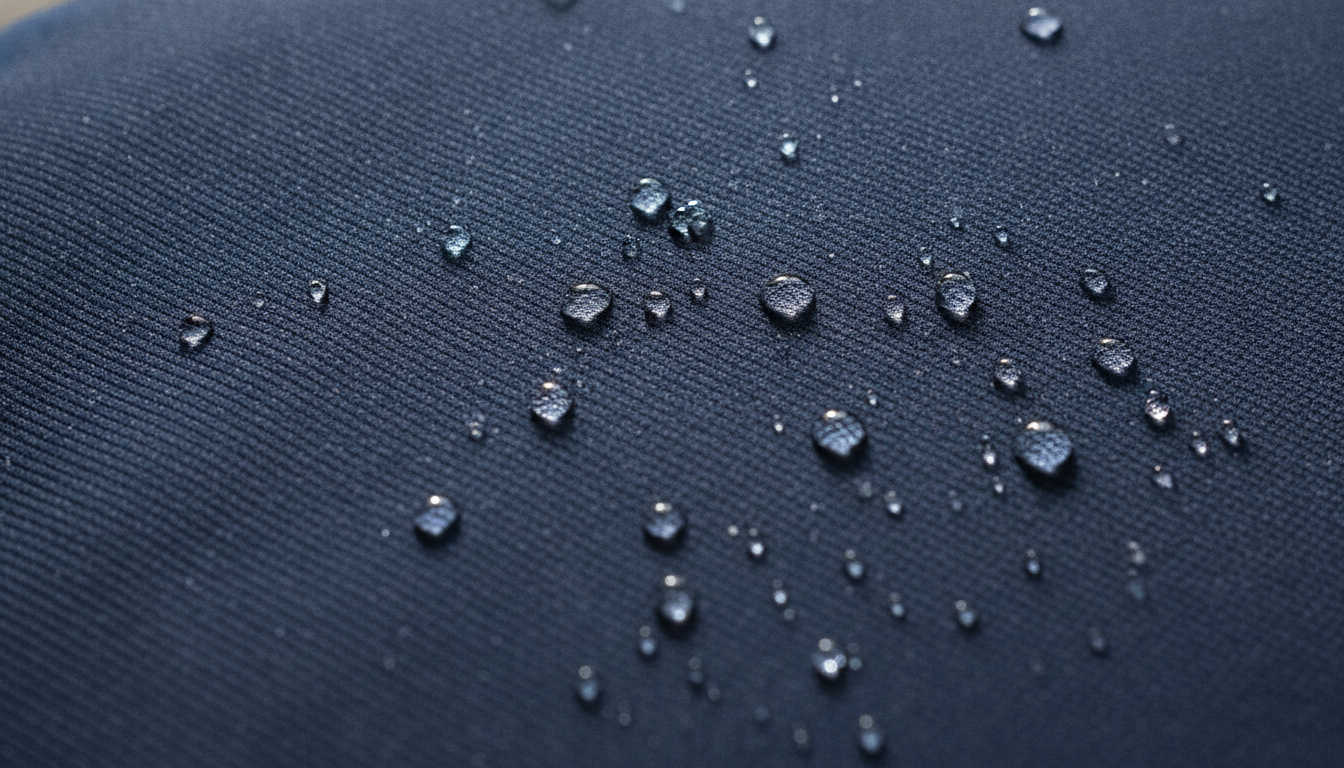
PFC-free DWR is a water-repellent textile finish that uses silicone, wax, polyurethane, or dendrimer chemistry instead of fluorinated compounds (C6 or C8). It provides strong water beading on fresh fabric but typically offers no oil repellency and loses performance faster under abrasion and repeated washing compared to legacy fluorinated finishes. Sample MOQ: 1 piece; bulk MOQ: 30 pieces per SKU; sampling lead time: 7-10 days.
📋 Table of Contents
- Executive Summary
- What Is PFC-Free DWR and How Does It Work?
- How Do C6 and C8 Finishes Differ from PFC-Free DWR?
- Water Beading Performance: Lab vs Real Use
- Why PFC-Free DWR Does Not Repel Oil
- Durability After Washing and Abrasion
- Regulatory Drivers: EU REACH and US PFAS Restrictions
- Sourcing PFC-Free DWR Fabric: MOQ, Lead Time, and QA
- Key Takeaways
- FAQ
Executive Summary
- Chemistry swap: PFC-free DWR replaces fluorinated compounds with silicone, wax, polyurethane, or dendrimer systems, eliminating PFAS but trading oil repellency and long-term durability.
- Water beading: Fresh PFC-free DWR matches C6 and C8 water repellency in initial spray tests, but performance declines faster under real-world abrasion and body-oil contamination.
- Oil repellency: PFC-free finishes provide zero oil or grease resistance, meaning sweat, sunscreen, and cooking oils penetrate the fabric and reduce water repellency more quickly than with fluorinated finishes.
- Regulatory pressure: EU REACH restricts C6 and bans C8; US states are phasing out PFAS in textiles, making PFC-free DWR the compliant choice for brands selling into regulated markets.
- Factory sourcing: Sample MOQ for PFC-free DWR fabric is 1 piece at PTOUTWEAR; bulk MOQ is 30 pieces per SKU; sampling takes 7-10 days; mill certificates and spray-rating lab reports are standard QA documents.
What Is PFC-Free DWR and How Does It Work?
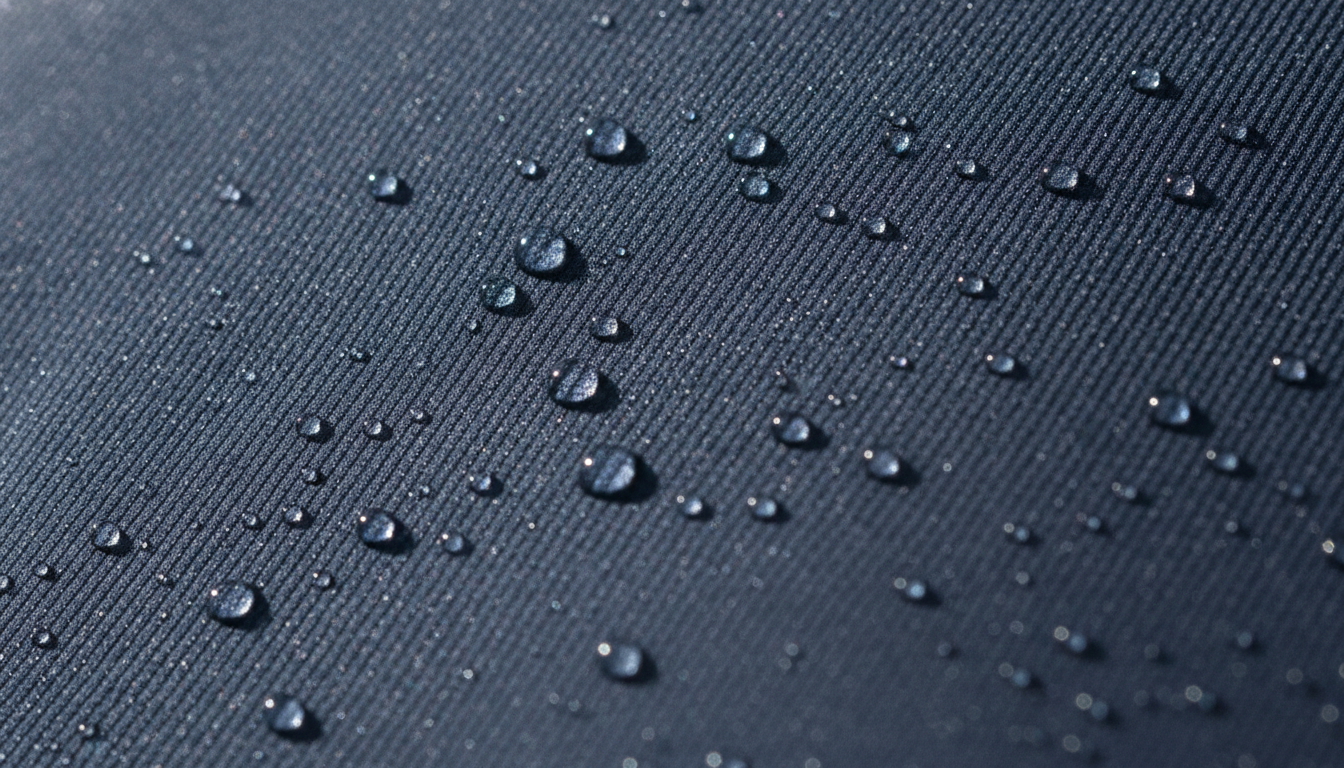
PFC-free DWR is a durable water repellent finish applied to textile surfaces without using per- or polyfluoroalkyl substances. The chemistry relies on silicone polymers, paraffin wax, polyurethane, or dendrimer structures to create a low-surface-energy coating that causes water to bead and roll off. Unlike fluorinated finishes, PFC-free DWR does not lower the surface energy enough to repel oils, so it handles water but not grease or body oils.
Silicone-Based PFC-Free DWR
Silicone finishes form a flexible polymer layer on fiber surfaces. They deliver strong initial water beading and remain soft to the touch, which makes them popular for softshell jackets and activewear. Silicone DWR typically achieves a spray rating of 80-90 when fresh, but it wears off faster than fluorinated finishes under abrasion from pack straps or repeated laundering.
Wax and Paraffin Systems
Wax-based PFC-free DWR uses hydrocarbon chains to repel water. These finishes are common on cotton and cotton-blend outerwear, such as workwear jackets and heritage outdoor styles. Wax DWR requires periodic reproofing and can feel slightly stiff or waxy compared to silicone or fluorinated treatments.
Dendrimer and Polyurethane Alternatives
Dendrimer chemistry uses branched polymer structures to mimic the water-repellent properties of fluorocarbons without fluorine atoms. Polyurethane-based finishes create a thin film that blocks water penetration while maintaining fabric breathability. Both options are newer and less widely tested in high-abrasion outdoor use than silicone or wax systems.
How Do C6 and C8 Finishes Differ from PFC-Free DWR?
C6 and C8 finishes use fluorinated carbon chains to lower surface energy on textile fibers. C8 finishes contain eight-carbon perfluorinated chains, while C6 finishes use six-carbon chains. Both repel water and oil because fluorine atoms create an extremely low-energy surface that resists wetting by polar and non-polar liquids.
C8 DWR: Legacy High-Performance Standard
C8 finishes deliver the strongest water and oil repellency in the textile industry. A fresh C8-treated fabric achieves spray ratings above 95 and retains 80-90% of that performance after 20 home washes. C8 chemistry resists contamination from body oils, sunscreen, and cooking grease, which prolongs effective water repellency in real use. However, C8 compounds are persistent in the environment and bioaccumulative, leading to global bans and phase-outs.
C6 DWR: Transitional Chemistry
C6 finishes were introduced as a safer alternative to C8 after regulatory pressure began in the early 2010s. C6 DWR provides excellent water beading (spray rating 90+) and good oil repellency, though slightly less than C8. Durability is strong, with 70-80% performance retention after 20 washes. C6 chemistry is still fluorinated and still contains PFAS, so it faces increasing restrictions under EU REACH and US state-level PFAS bans.
Why Brands Are Moving to PFC-Free DWR
Regulatory compliance is the primary driver. EU REACH Annex XVII restricts C8 and limits C6 use; California, Maine, and New York have enacted or proposed bans on PFAS in textiles. Brands selling into these markets must switch to PFC-free DWR to avoid import blocks and penalties. Consumer demand for PFAS-free products also pushes outdoor and activewear brands toward fluorine-free finishes, even where regulations do not yet mandate the change.
In practice: A jacket that passes initial water-beading tests can still fail in real use if the DWR finish is contaminated by body oils or loses adhesion under pack-strap abrasion, which is why lab spray ratings alone do not predict field durability.
Water Beading Performance: Lab vs Real Use
Fresh PFC-free DWR matches C6 and C8 finishes in controlled spray tests. A new silicone-based PFC-free finish typically scores 80-90 on the AATCC 22 spray test, which measures how water beads and rolls off a fabric surface. C6 finishes score 90+, and C8 finishes score 95+. The gap is small when the fabric is clean and unworn.
Spray Rating After 10-20 Home Washes
Durability diverges sharply after repeated washing. PFC-free DWR spray ratings often drop to 60-70 after 10 washes and may fall below 50 after 20 washes, depending on the base chemistry and application method. C6 finishes retain 70-80% of their initial rating after 20 washes, and C8 finishes retain 80-90%. Buyers sourcing jackets for corporate uniforms or school programs should plan for more frequent reproofing cycles with PFC-free DWR compared to fluorinated alternatives.
Abrasion and Pack-Strap Wear
Real-world abrasion accelerates DWR failure. Shoulder areas under backpack straps, cuffs, and pocket edges lose water repellency faster than flat fabric panels. PFC-free finishes are more vulnerable to mechanical wear because the silicone or wax layer is thicker and less chemically bonded to the fiber surface than fluorinated finishes. A jacket worn daily with a 10 kg pack may need reproofing every 3-6 months with PFC-free DWR, compared to 6-12 months with C6 or C8.
Why PFC-Free DWR Does Not Repel Oil
Oil repellency requires a surface energy lower than that of non-polar liquids like body oils, cooking grease, and petroleum-based stains. Fluorinated finishes achieve this because fluorine atoms create the lowest surface energy of any element. Silicone, wax, and dendrimer chemistries cannot reach that threshold, so PFC-free DWR fabrics absorb oils even when they still bead water.
Impact on Water Repellency
Once oil penetrates the fabric surface, it contaminates the DWR layer and reduces water beading. Sweat, sunscreen, and cooking oils are common culprits. A jacket that beads water perfectly when new may wet out in high-wear areas after a few days of use if the wearer applies sunscreen or handles oily food. Buyers sourcing jackets for outdoor teamwear or workwear should communicate care instructions clearly to end users, because PFC-free DWR requires more frequent washing and reproofing to maintain performance.
Stain Resistance Trade-Off
PFC-free finishes offer no stain resistance. Coffee, ketchup, grease, and ink penetrate the fabric immediately, whereas C6 and C8 finishes resist these stains long enough for the wearer to wipe them off. This trade-off matters for corporate uniforms, school outerwear, and any application where the jacket will be exposed to food service, maintenance work, or high-traffic public environments.
Durability After Washing and Abrasion
Wash durability is the most significant performance gap between PFC-free DWR and fluorinated finishes. Buyers should request lab reports showing spray ratings after 5, 10, and 20 home washes, tested per AATCC 22 or ISO 4920. A reputable OEM jacket manufacturer will provide these reports as part of pre-production sampling.
Reproofing Frequency
PFC-free DWR jackets need reproofing more often than C6 or C8 jackets. A silicone-based finish may require reproofing every 10-15 washes to maintain acceptable water beading, compared to 20-30 washes for C6. Reproofing products are widely available, but buyers must educate end users on application methods and drying temperatures to restore performance. Brands selling direct-to-consumer should include reproofing instructions with every jacket and consider offering a branded reproofing spray as an upsell.
Abrasion Testing
Martindale abrasion testing measures how many rub cycles a DWR finish withstands before water repellency fails. PFC-free finishes typically fail between 5,000 and 10,000 cycles, while C6 finishes survive 15,000 to 25,000 cycles and C8 finishes exceed 30,000 cycles. High-abrasion applications like hiking with a loaded pack, climbing, or daily commuter cycling favor fluorinated finishes, but buyers must weigh that performance advantage against regulatory risk.
Regulatory Drivers: EU REACH and US PFAS Restrictions
EU REACH Annex XVII restricts the manufacture, import, and sale of textiles containing C8 PFAS. C6 finishes are still permitted but face increasing scrutiny, and a broader PFAS restriction proposal covering all fluorinated compounds is under review. Brands importing jackets into the EU must verify that their DWR finish complies with current REACH limits and should plan for a full transition to PFC-free chemistry within the next 2-3 years.
US State-Level PFAS Bans
California, Maine, New York, and Washington have enacted or proposed legislation banning PFAS in textiles and apparel. These laws typically take effect 2-4 years after passage, giving brands time to reformulate, but enforcement will require third-party lab certification that finished products contain no detectable PFAS. Buyers sourcing jackets for the US market should request SGS or similar lab reports confirming PFC-free status and should verify that the entire garment, not just the outer shell, is PFAS-free.
Membrane vs Coating Confusion
A common compliance pitfall is assuming that a PFC-free DWR coating means the entire jacket is PFAS-free. Many waterproof-breathable membranes, including some expanded PTFE (ePTFE) laminates, still contain fluoropolymers. Buyers must ask the factory whether the membrane itself is PFAS-free, not just the outer DWR treatment. A jacket with PFC-free DWR on a fluorinated membrane does not meet the legal definition of PFAS-free in California or Maine.
Sourcing PFC-Free DWR Fabric: MOQ, Lead Time, and QA
Sample MOQ for PFC-free DWR fabric at PTOUTWEAR is 1 piece, with a $100 sample fee refundable against bulk orders. Bulk MOQ is 30 pieces per SKU. Sampling lead time is 7-10 days; bulk production runs 25-35 days. These parameters suit direct-to-consumer outdoor brands validating new styles and corporate buyers ordering team jackets in multiple colorways.
Mill Certificates and Lab Reports
Request the following documents before approving a bulk order:
- PFC-free certification: SGS or similar third-party lab report confirming no detectable PFAS in the finished fabric
- Spray rating report: AATCC 22 or ISO 4920 test results showing water repellency on fresh fabric and after 5, 10, and 20 washes
- Abrasion resistance: Martindale test results if the jacket will be used in high-abrasion applications
- Hydrostatic head: ISO 811 test confirming waterproofness of the base fabric or laminate, independent of the DWR finish
A low-MOQ jacket manufacturer should provide these reports as standard, not as a special request.
Compatibility with Fabric Types
PFC-free DWR works on polyester, nylon, cotton, and blends, but application methods and durability vary. Polyester and nylon accept silicone-based finishes well and are the most common base fabrics for outdoor jackets. Cotton and cotton-blend fabrics often use wax-based PFC-free DWR, which requires periodic reproofing and may feel stiffer than synthetic options. Buyers should specify the base fabric and intended use when requesting samples, because the factory will recommend the most suitable PFC-free chemistry for that combination.
Cost and Margin Impact
PFC-free DWR application adds 5-10% to fabric cost compared to untreated fabric, roughly in line with C6 finishing. C8 finishes cost slightly more due to restricted supply and compliance overhead. The bigger cost factor is reproofing frequency: if end users must reproof a PFC-free jacket twice as often as a C6 jacket, the total cost of ownership rises even if the initial purchase price is the same. Brands should factor reproofing product cost and customer education effort into their pricing and margin calculations.
Key Takeaways
- PFC-free DWR uses silicone, wax, polyurethane, or dendrimer chemistry to repel water without fluorinated compounds, meeting EU REACH and US PFAS restrictions.
- Fresh PFC-free DWR matches C6 and C8 water beading in lab tests, but it loses performance faster under abrasion and washing, typically requiring reproofing every 10-15 washes.
- PFC-free finishes provide no oil repellency, so body oils, sunscreen, and grease contaminate the DWR layer and reduce water beading more quickly than with fluorinated finishes.
- EU REACH restricts C8 and limits C6 use; US states including California, Maine, and New York are phasing out PFAS in textiles, making PFC-free DWR the compliant choice for regulated markets.
- Sample MOQ for PFC-free DWR jackets is 1 piece at PTOUTWEAR; bulk MOQ is 30 pieces per SKU; sampling takes 7-10 days; buyers should request SGS lab reports, spray-rating data, and abrasion test results before approving bulk orders.
- A PFC-free DWR coating does not guarantee a PFAS-free jacket; buyers must verify that the waterproof-breathable membrane or laminate is also fluorine-free to meet legal definitions in California and Maine.
FAQ
Is PFC-free DWR the same as PFAS-free?
PFC-free DWR means the durable water repellent finish contains no per- or polyfluorinated compounds, which are a subset of PFAS. However, a jacket with PFC-free DWR may still contain PFAS in the waterproof-breathable membrane, seam tape adhesive, or other components. To claim a fully PFAS-free jacket, every material and chemical input must be tested and certified fluorine-free by a third-party lab such as SGS.
Does PFC-free DWR last as long as C6 or C8 finishes?
PFC-free DWR does not last as long as C6 or C8 finishes under repeated washing and abrasion. Spray ratings for PFC-free finishes typically drop to 60-70 after 10 home washes, compared to 80-90 for C6 and 90+ for C8. Real-world durability is further reduced by contamination from body oils and sunscreen, which PFC-free finishes cannot repel. Buyers should plan for reproofing every 10-15 washes with PFC-free DWR, compared to 20-30 washes for fluorinated alternatives.
Can you reproof PFC-free DWR jackets at home?
Yes, PFC-free DWR jackets can be reproofed at home using spray-on or wash-in reproofing products specifically labeled fluorine-free or PFC-free. The jacket should be washed first to remove dirt and oils, then the reproofing product is applied per the manufacturer’s instructions and heat-activated in a tumble dryer at low to medium temperature. Reproofing restores water beading but does not add oil repellency, so the jacket will still absorb body oils and grease between reproofing cycles.
Need PFC-free DWR jackets with verified lab reports and low MOQ for your brand or team program?
Request 1-piece samples →
Written by Ivan Chen, Sales Engineer at PTOUTWEAR, 13 years in outdoor apparel manufacturing.