Custom snow gear manufacturing requires clear technical briefs covering waterproofing, insulation, fit over base layers, and decoration methods that survive cold and abrasion. Sample MOQ starts at 1 piece, bulk production at 30 pieces per SKU, with 7-10 day sampling and 25-35 day production lead times for jackets, ski suits, and snowboard apparel.
📋 Table of Contents
Executive Summary
- Market context: The global ski apparel market was estimated at about USD 1.8 billion in 2024, with technical outerwear demand rising alongside winter sports participation.
- Sample and bulk minimums: Sample MOQ 1 piece, bulk production 30 pieces per SKU, enabling small brands and team buyers to test designs before committing capital.
- Lead times: Sampling 7-10 days, bulk production 25-35 days, with rush options available for urgent team or retail deadlines.
- Technical requirements: Waterproofing measured in millimeters hydrostatic head, breathability in grams per square meter per 24 hours, insulation in grams per square meter fill weight.
- Decoration durability: Heat transfers and screen prints on waterproof shells require specific adhesives and curing to prevent peeling in cold, wet, or abrasive conditions.
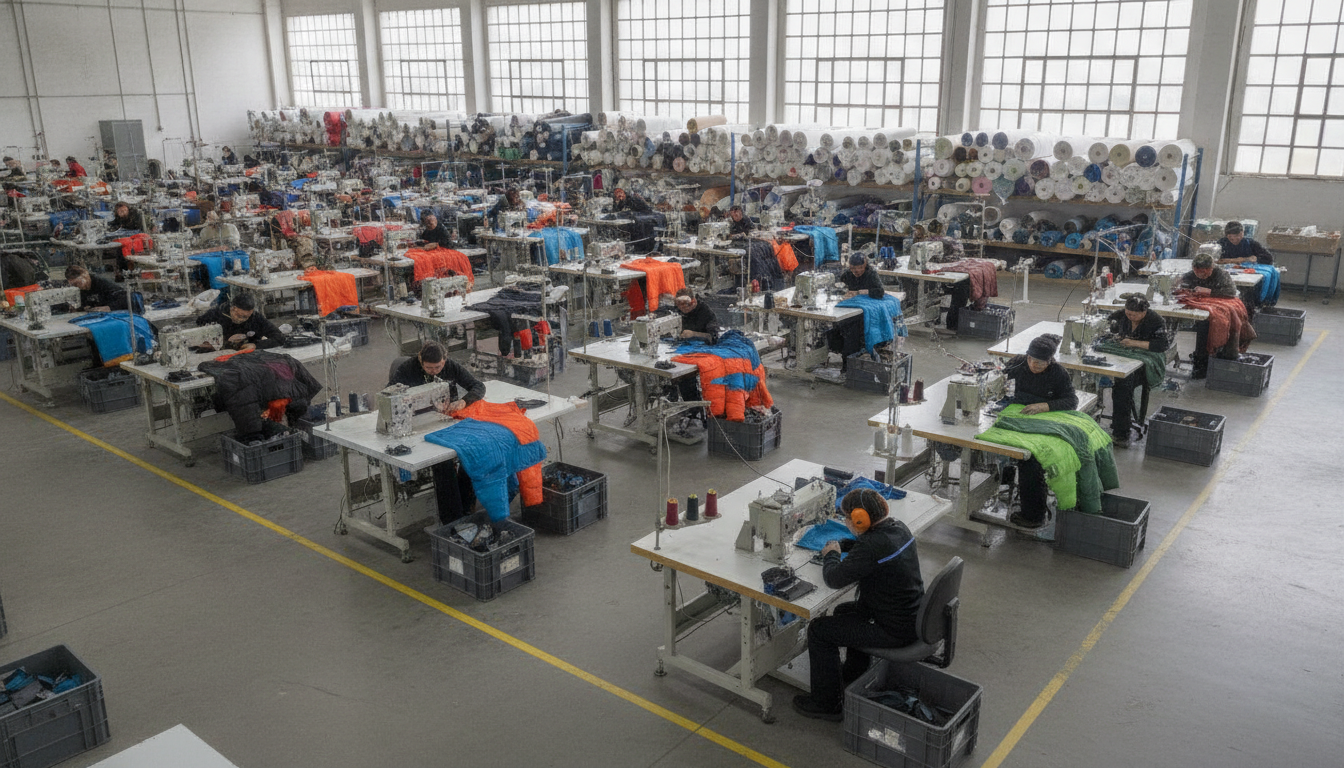
What Custom Snow Gear Covers
Custom snow gear includes ski jackets, snowboard jackets, insulated ski suits, one-piece jumpsuits, snow pants, gloves, and layering shells built to buyer-specified warmth, waterproofing, and branding. Buyers range from outdoor brand founders launching technical lines to corporate teams outfitting ski trips, school programs, and wholesale distributors serving winter sports retailers.
Product Categories
- Ski and snowboard jackets: hardshell or insulated, with helmet-compatible hoods, powder skirts, and pit zips for temperature regulation.
- One-piece ski suits: popular for racing teams and resort staff, requiring articulated knees, reinforced seat panels, and layering room over thermals.
- Insulated mid-layers: synthetic or down-fill vests and jackets worn under shells, specified by fill weight and loft retention after compression.
- Snow pants and bibs: reinforced knees and seat, adjustable waist, boot gaiters, and ventilation zips.
- Gloves and accessories: waterproof-breathable shells with insulation, touchscreen-compatible fingertips, and wrist closures.
Buyer Types
- DTC outdoor brands: founders launching technical winter lines, testing designs with 1-piece samples before committing to inventory.
- Corporate and team buyers: outfitting ski trips, racing teams, or resort staff with branded gear in consistent colorways and sizes.
- School programs: ski clubs and winter sports teams requiring durable, cost-effective gear in youth and adult sizes.
- Wholesale distributors: small outdoor retailers sourcing private-label snow gear to differentiate from national brands.
How to Brief a Manufacturer for Custom Snow Gear
A clear technical brief prevents costly revisions and quality failures. Buyers should specify activity type, warmth target, waterproofing level, fit over base layers, branding placement, and order quantity before requesting samples.
Activity and Use Case
Ski racing, resort skiing, backcountry touring, and snowboarding each demand different shell weights, insulation levels, and articulation. Racing suits prioritize aerodynamics and minimal insulation, while resort jackets need higher warmth and pocket capacity. Backcountry gear emphasizes breathability and weight savings. Snowboard jackets often feature longer cuts and reinforced elbows for falls.
Warmth and Insulation Target
Insulation is measured in grams per square meter (gsm) fill weight. Light insulation (60-100gsm) suits active use and layering; mid-weight (100-200gsm) works for resort skiing; heavy insulation (200-400gsm) targets extreme cold or stationary use. Specify whether insulation is synthetic (polyester) or down (fill power rated in cubic inches per ounce), and whether it must retain loft when wet.
Waterproofing and Breathability
Waterproofing is rated in millimeters hydrostatic head (mm H₂O): 5,000mm resists light snow, 10,000mm handles moderate wet conditions, 20,000mm+ withstands heavy slush and pressure. Breathability is rated in grams of moisture vapor transmitted per square meter per 24 hours (g/m²/24hr): 5,000g suits low activity, 10,000g works for moderate exertion, 20,000g+ enables high-output backcountry use. Buyers often cite waterproof claims that fail in slushy conditions, particularly when seam taping is incomplete or uses the wrong adhesive for the shell fabric.
Fit Over Base Layers and Protective Gear
Snow gear must fit over thermals, mid-layers, helmets, and impact protectors without restricting movement. Buyers frequently report sizing inconsistencies across layers, making it difficult to achieve proper overlap between jackets and pants or accommodate bulky chest protectors. Specify whether the fit is slim (race-cut), regular (resort standard), or relaxed (layering room), and provide body measurements for key size breaks.
Branding and Decoration Placement
Logo placement, size, and decoration method must be defined before sampling. Common locations include left chest, back yoke, sleeves, and hood. Decoration methods (embroidery, screen print, heat transfer, woven labels) each interact differently with waterproof fabrics. Heat transfers and screen prints on coated shells require specific adhesives and curing temperatures to prevent peeling in cold or after washing.
Order Quantity and Delivery Window
Sampling requires 1 piece minimum; bulk production starts at 30 pieces per SKU at OEM jacket manufacturing facilities. Specify delivery date, accounting for 7-10 day sampling, approval time, 25-35 day production, and freight transit. Team and school buyers often report missed delivery windows due to underestimating approval cycles and freight delays.
Waterproofing and Insulation Specifications
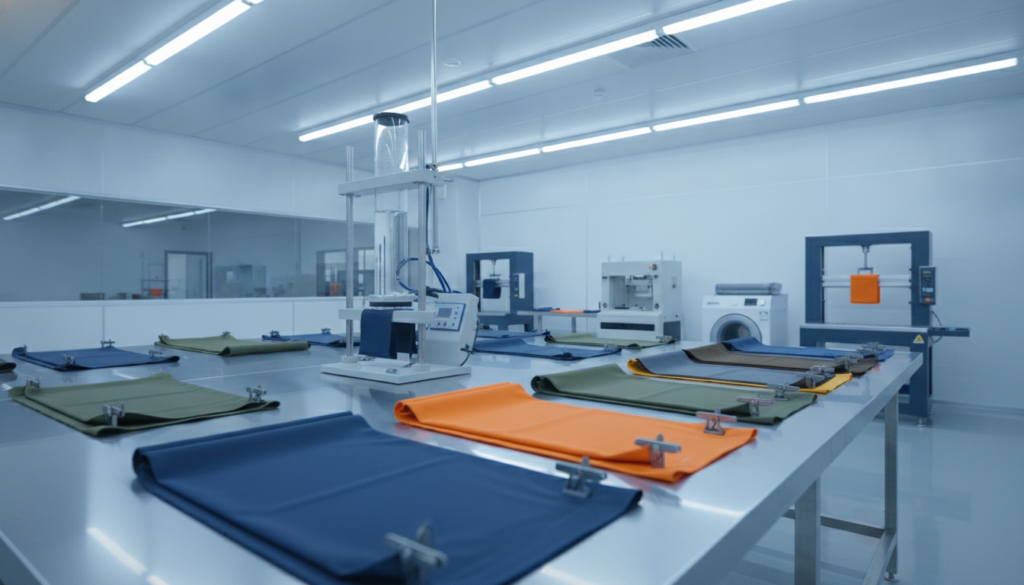
Waterproofing and insulation performance must be measurable and testable. Buyers should request lab test reports for hydrostatic head, breathability, and insulation loft before approving bulk production.
Waterproof Membrane and Coating Options
- Polyurethane (PU) coating: entry-level waterproofing, 5,000-8,000mm hydrostatic head, lower breathability, cost-effective for school programs and team gear.
- Polyester membrane laminate: mid-tier waterproofing, 10,000-15,000mm, moderate breathability, balances cost and performance for resort use.
- ePTFE (expanded polytetrafluoroethylene) membrane: premium waterproofing, 20,000mm+, high breathability, required for backcountry and professional use.
Seam Taping and Leak Prevention
Seam taping bonds waterproof tape over stitched seams to prevent water ingress. Buyers report seam leakage as a common failure mode, particularly when tape adhesive is incompatible with the shell coating or when taping is skipped on shoulder, pocket, or zipper seams. Critical seams (shoulders, hood, front zipper) must be taped on all waterproof shells; fully taped construction covers every seam and is required for wet snow and slush exposure.
In practice: Seam taping is what separates a jacket that survives a wash test from one that delaminates after three cycles, which is why it gets checked on the sample before bulk is ever cut.
Insulation Types and Performance
- Synthetic polyester fill: retains warmth when wet, dries quickly, lower cost, heavier per warmth unit than down, common in school and team gear.
- Down fill: rated by fill power (cubic inches of loft per ounce), 600-fill suits moderate cold, 800-fill provides maximum warmth-to-weight, loses loft when wet unless treated with hydrophobic down.
- Recycled synthetic fill: made from post-consumer polyester, meets sustainability claims, performance equivalent to virgin synthetic at slightly higher cost.
Customization and Decoration Methods
Logo placement and decoration durability are critical for team and corporate buyers. Decoration methods interact differently with waterproof coatings, and adhesion failures are a frequent complaint.
Embroidery
Embroidery stitches thread directly through the shell fabric, creating a raised logo. Durable and professional, but punctures the waterproof membrane unless backed with seam tape or a waterproof patch. Best for non-critical areas (sleeves, back yoke) or over taped seams. Thread count and stitch density affect durability and appearance; specify thread type (polyester or rayon) and backing stabilizer.
Screen Printing
Screen printing applies ink directly to fabric surface. Cost-effective for large logos and multi-color designs, but ink adhesion to coated shells requires specific plastisol or water-based inks and heat curing. Buyers complain that screen prints crack or peel after cold exposure or washing, particularly when curing temperature is too low or ink is incompatible with PU coatings. Request wash-test reports showing print integrity after 10+ cycles.
Heat Transfer and Sublimation
Heat transfer bonds a printed film to fabric using heat and pressure. Suitable for complex graphics and small quantities, but adhesive compatibility with waterproof coatings is critical. Transfers on PU-coated shells often peel in cold or after abrasion. Sublimation dye works only on polyester fabrics and cannot be applied to coated surfaces, limiting use to uncoated panels or linings.
Woven and PVC Labels
Woven labels are sewn onto the garment as patches, avoiding waterproofing concerns. PVC (rubber) labels are heat-pressed or sewn, offering a premium look and excellent durability. Both methods suit small logos and branding on chest, sleeve, or pocket areas without compromising shell integrity.
MOQ, Sampling, and Production Lead Times
Minimum order quantities and lead times determine whether a factory can support small brands, team buyers, or seasonal retail deadlines. Buyers should confirm MOQ flexibility and rush options before committing to a supplier.
Sample MOQ: 1 piece. Bulk MOQ: 30 pieces per SKU. Sampling time: 7-10 days. Bulk production: 25-35 days.
Sample Development Process
Sampling starts with a technical brief covering fabric, insulation, waterproofing, fit, and branding. The factory sources materials, cuts and sews a prototype, and ships within 7-10 days. Sample fees (typically $100-200 per piece) are refundable against bulk orders. Buyers should request photos of fabric swatches, trim options, and color matching before approving the sample build.
Bulk Production Minimums
Bulk production at low-MOQ jacket manufacturers starts at 30 pieces per SKU, enabling small brands and team buyers to test market demand without tying up capital in excess inventory. Higher-volume buyers (500+ pieces) may negotiate lower per-unit pricing, faster lead times, or dedicated production lines. Dropshipping and print-on-demand services offer 1-piece fulfillment for ongoing team or corporate orders.
Production and Freight Lead Times
Bulk production requires 25-35 days (about 4 weeks) from approved sample to finished goods, plus freight transit. Air freight adds 5-7 days and costs $4-8 per kilogram; sea freight adds 25-35 days and costs $0.80-1.50 per kilogram. Buyers should account for customs clearance (2-5 days) and inland delivery (1-3 days). Rush production (1,000 pieces in 2 weeks) is available at a 25% surcharge for urgent retail or team deadlines.
Sampling Cost and Refund Terms
Sample fees cover fabric sourcing, cutting, sewing, and shipping. Fees are refundable against bulk orders, typically applied as a credit toward the first production invoice. Buyers should confirm refund terms in writing before paying sample fees, and request itemized invoices showing fabric cost, labor, and freight separately.
Common Pitfalls and How to Avoid Them
Buyers report recurring quality and communication failures when sourcing custom snow gear. Addressing these risks in the brief and sample-approval stage prevents costly bulk-production failures.
Sizing Inconsistency Across Layers
Snow gear must fit over thermals, mid-layers, and protective gear without restricting movement. Buyers report that jackets and pants sized to the same chart often have mismatched overlap, leaving gaps at the waist or restricting shoulder mobility. Request a fit sample in your most common size, worn over typical base layers, and measure overlap, sleeve length, and torso length before approving the size chart for bulk production.
Decoration Failures on Waterproof Shells
Heat transfers, screen prints, and patches on coated shells frequently peel, crack, or delaminate after cold exposure, washing, or abrasion. This occurs when adhesive or ink is incompatible with the shell coating, or when curing temperature is too low. Request a wash-test report showing decoration integrity after 10 cycles at 40°C, and specify that all decoration must pass a cold-flex test (bending the fabric at -10°C without cracking).
Overstated Waterproofing Claims
Buyers report that garments marketed as waterproof wet out, leak at seams, or fail in slushy conditions. This occurs when hydrostatic head ratings are based on fabric alone (not the finished garment), when seam taping is incomplete, or when DWR (durable water repellent) finish wears off after a few washes. Request a lab test report showing hydrostatic head on the finished garment, confirm that all critical seams are taped, and specify PFC-free DWR with wash-durability data.
Missed Delivery Windows
Team and school buyers often report that orders arrive late, missing seasonal windows or event deadlines. Delays typically stem from underestimating approval cycles (buyers take 1-2 weeks to review samples), freight transit (sea freight adds 25-35 days), or customs clearance (2-5 days). Build a timeline working backward from your delivery date: add 5 days customs clearance, 7 days air freight (or 30 days sea), 30 days production, 10 days sampling, and 7 days for internal approvals. Confirm the factory can meet each milestone in writing before placing the order.
Generic Fabric Substitutions
Buyers complain that factories push generic fabrics instead of confirming the exact warmth, breathability, and insulation level needed for the use case. This occurs when the brief lacks measurable specs (e.g., “warm jacket” instead of “100gsm synthetic insulation, 10,000mm waterproofing”). Specify fabric weight (gsm), waterproofing (mm H₂O), breathability (g/m²/24hr), and insulation type and weight in the initial brief, and request mill certificates or lab test reports before approving the sample.
Key Takeaways
- Custom snow gear manufacturing requires measurable briefs covering waterproofing (mm H₂O), breathability (g/m²/24hr), insulation (gsm), and fit over base layers to prevent quality failures.
- Sample MOQ starts at 1 piece with 7-10 day lead times, enabling small brands and team buyers to validate designs before committing to 30-piece bulk minimums.
- According to Statista (2025), the global ski apparel market was estimated at about USD 1.8 billion in 2024, with technical outerwear demand rising alongside winter sports participation.
- Seam taping prevents water ingress at stitched seams, and adhesive compatibility with shell coatings must be verified on samples to avoid delamination in bulk production.
- Decoration methods (embroidery, screen print, heat transfer) interact differently with waterproof coatings, and wash-test reports showing integrity after 10+ cycles prevent peeling and cracking failures.
- Lead times require 7-10 days sampling, 25-35 days bulk production, plus freight transit (5-7 days air, 25-35 days sea) and customs clearance (2-5 days), with rush options available at a 25% surcharge.
FAQ
What is the minimum order quantity for custom snow gear?
Sample MOQ is 1 piece, allowing buyers to test fit, fabric, and branding before committing to bulk production. Bulk production starts at 30 pieces per SKU, enabling small outdoor brands, corporate teams, and school programs to order without tying up capital in excess inventory. Dropshipping and print-on-demand services offer 1-piece fulfillment for ongoing team or corporate orders, with per-unit pricing higher than bulk rates but no minimum commitment.
How do you verify waterproofing claims on custom snow gear?
Request a lab test report showing hydrostatic head (mm H₂O) on the finished garment, not just the fabric. Waterproofing ratings based on fabric alone do not account for seam leakage, zipper failures, or coating degradation during sewing. Confirm that all critical seams (shoulders, hood, front zipper) are taped with adhesive compatible with the shell coating, and request wash-test data showing waterproofing retention after 10+ cycles. PFC-free DWR finishes should include wash-durability data to prevent early wet-out.
Can custom snow jackets be decorated with logos without compromising waterproofing?
Yes, but decoration method and placement must be specified to avoid puncturing the waterproof membrane. Embroidery requires seam tape or a waterproof patch backing to seal needle holes. Screen printing and heat transfers require adhesives and inks compatible with the shell coating, verified by wash-test and cold-flex reports. Woven and PVC labels sewn onto the garment avoid waterproofing concerns entirely. Request a decorated sample and test it under wet conditions before approving bulk production, and avoid placing decoration over critical seams or high-abrasion areas.
Ready to source custom snow gear with measurable waterproofing, low MOQs, and fast sampling?
Request your 1-piece sample →
Written by Ivan Chen, Sales Engineer at PTOUTWEAR, 13 years in outdoor apparel manufacturing.