A bomber jacket supplier manufactures custom bomber jackets for brands, schools, corporate teams, and wholesalers, offering styles from classic MA-1 nylon to satin reversible and quilted cotton variants. Production minimums range from 30 pieces per SKU at vertically integrated factories to 100+ at trading companies, with sampling lead times of 7-10 days and bulk production completing in 25-35 days.
📋 Table of Contents
Executive Summary
- Supplier types: Vertically integrated factories offer 30-piece minimums and faster sampling, while trading companies typically require 100+ pieces but provide broader style catalogs.
- Lead times: Sampling takes 7-10 days at cut-and-sew facilities; bulk production completes in 25-35 days for standard bomber styles.
- Common failures: Buyers report zipper snagging, inconsistent color matching across reorders, and thin lining that fails to deliver warmth in uniform programs.
- Certification baseline: ISO 9001 and SGS testing confirm process consistency; OEKO-TEX Standard 100 screens textiles against harmful substances for school and corporate programs.
- Customization scope: Embroidery, screen printing, woven patches, and sublimation are standard; full private-label programs include custom hang tags, poly bags, and carton marking.
What Defines a Bomber Jacket Supplier?
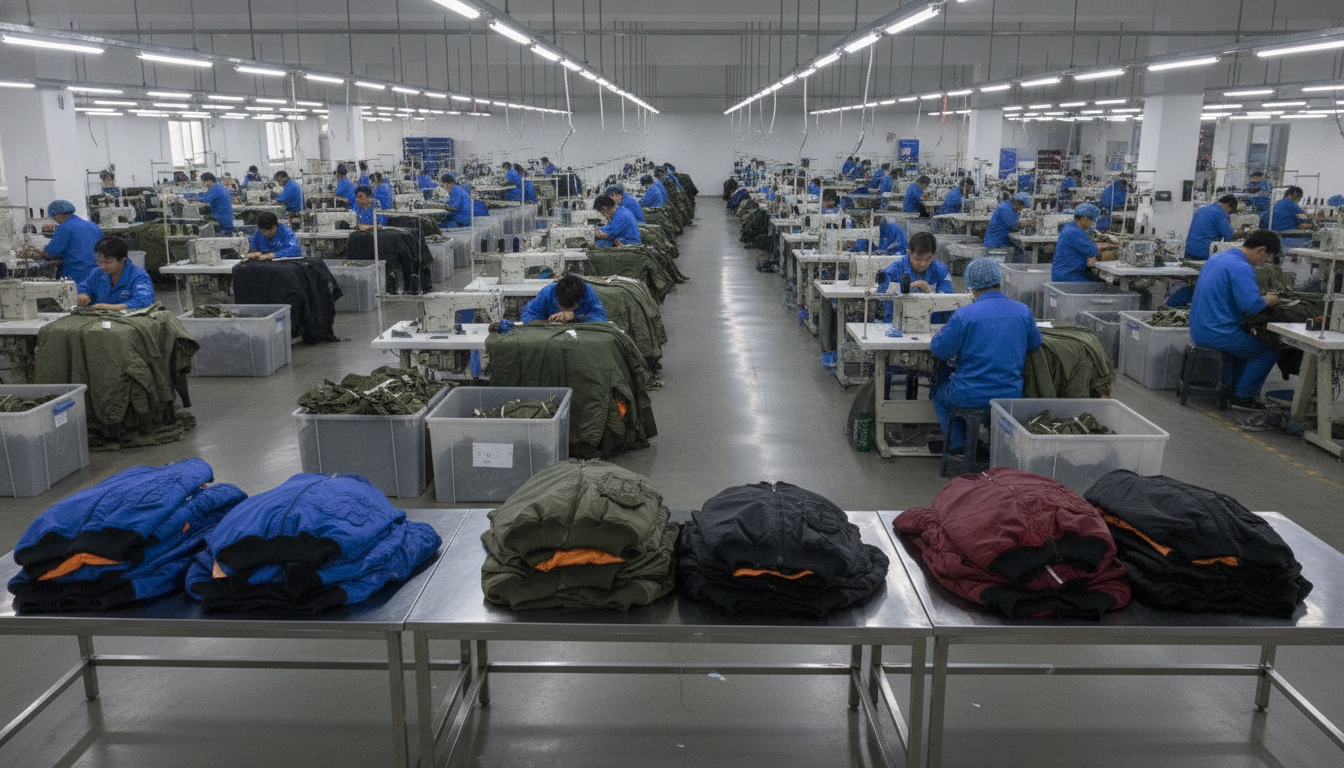
A bomber jacket supplier operates as either a vertically integrated manufacturer or a trading company that sources from multiple cut-and-sew facilities. Vertically integrated suppliers control fabric procurement, cutting, sewing, quality inspection, and packaging under one roof, which shortens lead times and reduces the risk of specification drift between sample and bulk. Trading companies aggregate production capacity across partner factories, offering broader style variety but adding coordination layers that can extend timelines and complicate quality accountability.
Factory-Direct vs. Trading Company
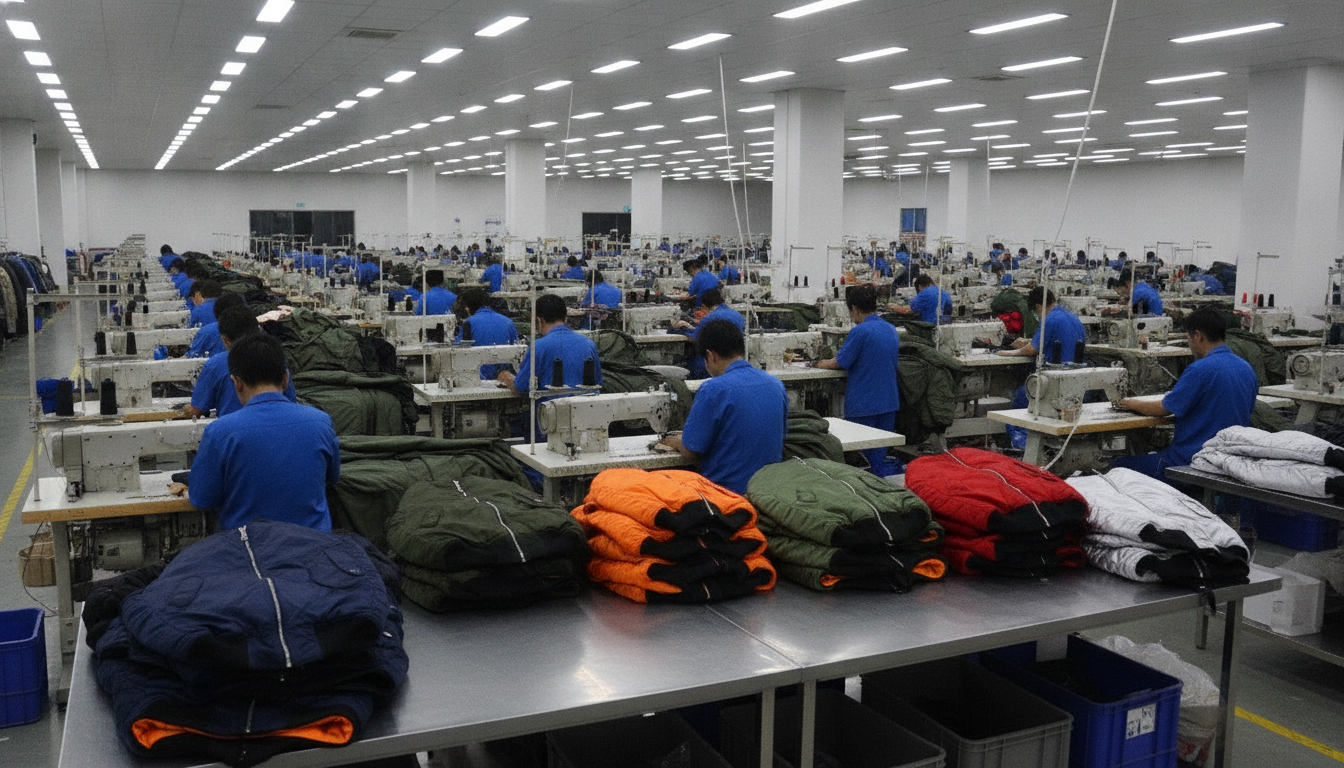
Factory-direct suppliers own their production lines and employ in-house pattern makers, cutters, and quality inspectors. PTOUTWEAR operates a 3,000m² facility in Taizhou Sanmen with 240 workers and 20 production lines, handling softshell, hardshell, rain, ski, insulated, windbreaker, 3-in-1, workwear, and varsity jackets alongside bomber styles. Trading companies, by contrast, maintain design and sales teams but outsource sewing to contract factories, which can introduce variability when reordering or scaling volume.
Geographic Concentration
Most bomber jacket suppliers cluster in Zhejiang, Guangdong, and Fujian provinces in China, where nylon and polyester fabric mills, zipper manufacturers, and garment factories operate within short trucking distance. This proximity reduces fabric lead times and allows suppliers to swap materials quickly when a buyer requests a color change or a different shell weight. Suppliers outside these regions often face longer raw-material transit, which adds 5-7 days to sampling schedules.
Certification and Compliance Infrastructure
Professional suppliers maintain ISO 9001 quality-management systems and commission SGS or Intertek testing for physical performance and chemical safety. OEKO-TEX Standard 100 certification, which screens textiles against harmful substances, is common among suppliers serving school uniform programs and corporate team-gear buyers in the EU and Australia. Suppliers without third-party testing rely on self-inspection, which increases the risk that a bulk shipment fails an importer’s lab test after production is complete.
How Do You Verify a Supplier Before Ordering?
Supplier verification starts with confirming legal registration, production capacity, and recent export history, then moves to physical sample evaluation and factory audit documentation. Buyers who skip verification often discover that the supplier is a shell company with no owned equipment, or that the factory shown in promotional photos belongs to a different entity entirely.
Business License and Export Records
Request a copy of the supplier’s business license and verify the legal entity name matches the company signing the quotation. Cross-check the registered address against the factory location provided; mismatches indicate the supplier is a trading desk, not a manufacturer. Export records, visible through customs databases or third-party platforms, confirm the supplier has shipped similar products to your target market and understands destination-country labeling and packaging requirements.
Sample Evaluation Protocol
Order a pre-production sample with your exact fabric weight, zipper type, and lining specification before committing to bulk. Buyers who approve a sample based on photos alone frequently receive bulk goods with substituted materials or altered construction. Test the sample for zipper durability by cycling the pull 50 times, check seam allowances with a ruler, and wash the garment once to verify colorfastness and lining adhesion.
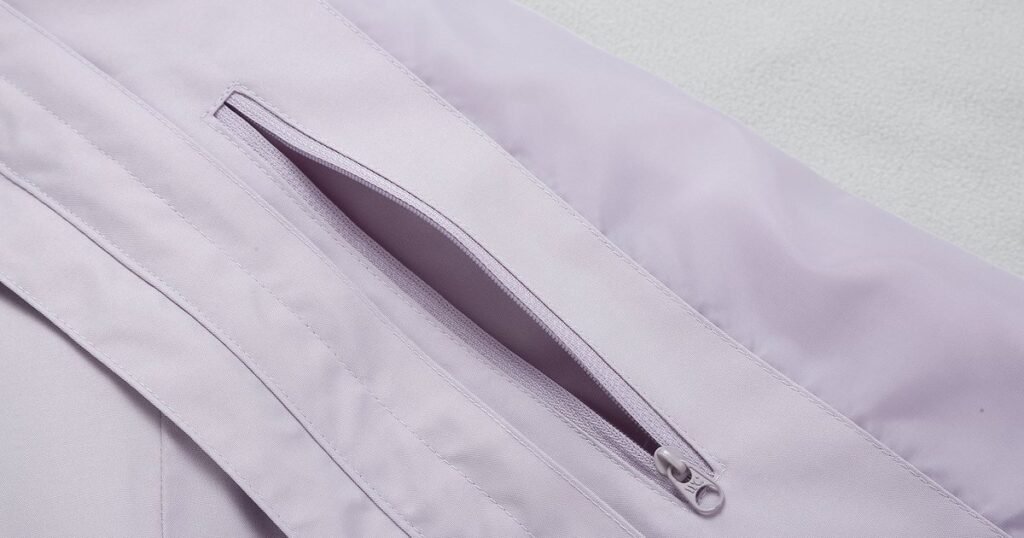
In practice: Seam taping separates a jacket that survives a wash test from one that delaminates, which is why it gets checked on the sample before bulk is ever cut.
Factory Audit and Certification Review
Request copies of ISO 9001 certificates, BSCI social-compliance audits, and recent SGS test reports for similar bomber styles. Verify certificate validity dates and that the certified entity name matches the supplier’s legal registration. Buyers sourcing for school or corporate programs should confirm OEKO-TEX Standard 100 certification covers the shell fabric, lining, and zipper tape, not just the outer shell alone. Suppliers holding these certifications have already passed third-party audits, reducing the likelihood of undisclosed subcontracting or non-compliant materials entering production.
What MOQ and Lead Times Should You Expect?
Minimum order quantities and production timelines vary by supplier type, style complexity, and customization depth. Factory-direct suppliers with owned production lines typically accept lower minimums and deliver faster sampling than trading companies coordinating multiple subcontractors.
Sample MOQ: 1 piece. Bulk MOQ: 30 pieces per SKU. Sampling time: 7-10 days. Bulk production: 25-35 days.
MOQ Structures Across Supplier Types
Vertically integrated factories like PTOUTWEAR set bulk minimums at 30 pieces per SKU because owned cutting tables and sewing lines absorb setup costs across in-house capacity. Trading companies typically require 100-200 pieces per style because they negotiate production slots with contract factories that prioritize larger runs. Buyers testing a new bomber style for a private-label brand or a school uniform pilot program find 30-piece minimums reduce upfront inventory risk and allow faster market validation before scaling.
Sampling and Bulk Lead Times
Pre-production samples take 7-10 days at factories with in-house pattern making and sample rooms; trading companies often need 12-15 days because they queue sample requests through external workshops. Bulk production for standard MA-1 or satin bombers completes in 25-35 days after sample approval, assuming fabric and trims are in stock. Custom fabric orders, such as water-resistant nylon or recycled polyester, add 10-14 days for mill weaving and dyeing. Rush production is available at some suppliers: PTOUTWEAR can deliver 1,000 pieces in 2 weeks at a 25% surcharge when buyers face urgent restocking deadlines.
DDP Shipping and Landed-Cost Transparency
Delivered Duty Paid (DDP) shipping transfers customs clearance and import-duty responsibility to the supplier, simplifying logistics for buyers without freight-forwarding experience. DDP quotes include FOB cost, ocean or air freight, destination-country duties, and last-mile delivery, providing a single landed price that prevents budget surprises. Buyers importing into the US, UK, EU, or Australia should request DDP quotes to compare total cost accurately, especially when evaluating suppliers in different provinces with varying port access and freight rates.
Which Bomber Jacket Styles Are Available?
Bomber jacket suppliers offer multiple silhouettes and fabric combinations, each suited to different end uses. Understanding the construction and performance differences helps buyers match style to application, whether outfitting a sports team, launching a streetwear line, or equipping a corporate uniform program.
MA-1 Classic and Military Heritage
The MA-1 silhouette, originally developed for US Air Force pilots in the 1950s, features a nylon shell, knit collar and cuffs, and a signature orange rescue lining. Modern suppliers reproduce this style with nylon taffeta or ripstop shells in weights from 210T to 400T, paired with polyester mesh or quilted linings. The utility pocket on the left sleeve, originally designed for pencils and maps, remains a defining detail. Buyers sourcing for team jackets or military-inspired streetwear lines prioritize suppliers who can match the authentic rib-knit tension and sleeve-pocket placement.
Satin and Varsity Applications
Satin bombers use polyester satin shells that deliver high sheen and vibrant color saturation, making them popular for school varsity programs and promotional team jackets. The smooth surface accepts large-format embroidery on the back panel without puckering, a common issue with lightweight nylon shells. Buyers ordering satin bombers for school uniforms should specify colorfast dyes and request a wash test on the sample, because budget satin fabrics can bleed or lose sheen after repeated laundering.
Reversible and Quilted Constructions
Reversible bombers bond two fabric layers without a visible lining, allowing wearers to flip the jacket for a second color or pattern. This construction requires precise pattern alignment and edge finishing to prevent fraying, which increases per-unit cost by 15-20% compared to standard lined bombers. Quilted bombers incorporate poly-fill insulation between the shell and lining, with diamond or channel stitching that prevents fill migration. Buyers sourcing quilted styles for cold-weather workwear or corporate outdoor programs should confirm the insulation weight in grams per square meter and verify that quilting lines are evenly spaced to avoid cold spots.
How Do Customization Options Work?
Customization transforms a stock bomber into a branded garment through embroidery, screen printing, woven patches, sublimation, or full private-label programs. Each method has setup costs, minimum quantities, and design constraints that buyers must understand before requesting samples.
Embroidery and Patch Application
Embroidery works best on satin and heavy nylon shells, where the fabric density supports thread tension without puckering. Setup fees range from $30 to $80 per design depending on stitch count; designs under 10,000 stitches keep per-piece embroidery costs below $2. Woven patches offer an alternative for complex logos with fine detail or gradient colors that embroidery cannot reproduce accurately. Patches are sewn or heat-sealed onto the chest, sleeve, or back panel, with setup costs around $50 per design and per-piece application fees of $1.50 to $3. Buyers ordering for school or corporate programs should request a digitized embroidery proof before bulk production to verify logo clarity and placement.
Screen Printing and Sublimation
Screen printing applies ink directly to the shell fabric, delivering bold graphics on chest, back, or sleeve areas. Setup requires one screen per color, with fees of $25 to $40 per screen; designs with 3-4 colors incur $75 to $160 in setup costs. Per-piece printing fees range from $1.50 for single-color chest prints to $4 for full-back multi-color designs. Sublimation transfers dye into polyester fibers, producing photographic-quality graphics that will not crack or peel. Sublimation works only on 100% polyester fabrics, limiting its use to satin and synthetic-shell bombers. Buyers launching limited-edition designs or influencer collaborations favor sublimation for its color depth and durability through repeated washing.
Private-Label Packaging and Branding
Full private-label programs include custom hang tags, woven neck labels, printed poly bags, and carton marking with the buyer’s brand name and SKU codes. Hang-tag setup costs $80 to $150 for die-cutting and printing plates; per-piece hang-tag costs drop to $0.15 to $0.30 at quantities above 500 units. Woven labels require a one-time setup fee of $60 to $100 and cost $0.10 to $0.20 per label in bulk. Buyers building a DTC outdoor brand or launching a wholesale line should budget $200 to $400 in combined setup fees for a complete private-label package, then amortize those costs across initial and reorder volumes.
What Quality Controls Prevent Bulk Failures?
Quality failures in bomber jacket production cluster around zipper durability, color consistency across reorders, and lining adhesion after washing. Structured inspection protocols catch these issues before bulk shipment, reducing the risk of chargebacks, returns, or retailer penalties.
In-Process Inspection Points
Professional suppliers inspect fabric upon receipt from the mill, checking for shade variation, weave defects, and width consistency before cutting begins. Cutting-room inspectors verify pattern alignment and mark any fabric flaws that could affect finished-garment appearance. Sewing-line inspectors check seam allowances, stitch density, and zipper installation at the end of each production shift, pulling random samples for measurement against the approved pre-production sample. Buyers sourcing through OEM jacket manufacturing programs should request photos or videos of in-process inspection to confirm the supplier follows documented procedures rather than relying on final inspection alone.
Final Random Inspection (FRI)
Final random inspection examines a statistically valid sample of finished garments after packing but before shipment. Inspectors pull units according to AQL 2.5 or AQL 4.0 standards, checking for zipper function, rib-knit tension, embroidery placement, color match to approved sample, and packaging accuracy. Defects are classified as critical (unwearable), major (affects function or appearance), or minor (cosmetic). An AQL 2.5 inspection allows 0 critical defects, 4 major defects, and 10 minor defects in a 200-piece lot; exceeding these thresholds triggers rework or shipment hold. Buyers who skip FRI or rely on supplier self-inspection report higher rates of bulk failures, especially when reordering styles months after initial production.
Third-Party Lab Testing
SGS, Intertek, and Bureau Veritas conduct physical and chemical testing on bomber jackets for buyers importing into regulated markets. Physical tests measure zipper durability (cycles to failure), colorfastness to washing and light, seam strength, and abrasion resistance. Chemical tests screen for restricted substances under REACH (EU), CPSIA (US), and AS/NZS standards (Australia). Testing fees range from $300 to $800 per style depending on the number of tests requested. Buyers sourcing for school uniform programs or corporate team-gear contracts should budget for third-party testing on the first production run, then rely on in-process inspection and FRI for reorders once the supplier has demonstrated consistent quality.
Color-Matching Protocols for Reorders
Inconsistent color matching across reorders is a frequent complaint among buyers sourcing team or school uniforms. Fabric dye lots vary slightly between mill runs, and suppliers without color-management systems ship reorders that do not match the original batch. Professional suppliers maintain lab-dip approval records and reference Pantone TPX or TCX codes for each color, then request strike-off samples from the mill before dyeing bulk yardage. Buyers placing reorders should specify that the supplier must match the original lab dip or provide a new strike-off for approval, rather than assuming the mill will reproduce the color from memory or a verbal description.
Key Takeaways
- Vertically integrated factories offer 30-piece bulk minimums and 7-10 day sampling, while trading companies typically require 100+ pieces and 12-15 day sample lead times.
- Pre-production sample evaluation should include 50-cycle zipper testing, seam-allowance measurement, and a wash test to verify lining adhesion and colorfastness before bulk commitment.
- MA-1 classic, satin, reversible, quilted, and cotton canvas bombers each serve distinct applications, from military-inspired streetwear to insulated workwear and school varsity programs.
- Embroidery setup costs $30 to $80 per design with per-piece fees below $2 for logos under 10,000 stitches; screen printing requires $25 to $40 per color with per-piece fees of $1.50 to $4.
- Final random inspection according to AQL 2.5 or AQL 4.0 standards catches bulk defects before shipment, reducing the risk of chargebacks and retailer penalties.
- Color-matching protocols for reorders require lab-dip approval records and Pantone reference codes to prevent shade variation between production runs.
FAQ
Can bomber jackets be customized for school or team uniforms?
Bomber jackets accept embroidery, screen printing, woven patches, and sublimation for school and team branding. Embroidery works best on satin and heavy nylon shells, with setup fees of $30 to $80 per design and per-piece costs below $2 for logos under 10,000 stitches. Screen printing delivers bold graphics on chest or back panels at $1.50 to $4 per piece after one-time screen setup of $25 to $40 per color. Buyers ordering for school uniforms should request a wash test on the sample to verify that embroidery and printing withstand repeated laundering without fading or cracking.
How do I prevent color inconsistency across bomber jacket reorders?
Color inconsistency stems from fabric dye-lot variation between mill runs. Professional suppliers maintain lab-dip approval records and reference Pantone TPX or TCX codes for each color, then request strike-off samples from the mill before dyeing bulk yardage. Buyers placing reorders should specify that the supplier must match the original lab dip or provide a new strike-off for approval, and should request side-by-side photos comparing the new fabric to a swatch from the original production. Suppliers without color-management systems often ship reorders that do not match the first batch, forcing buyers to accept mismatched inventory or delay shipment for re-dyeing.
What certifications should a bomber jacket supplier hold for EU or US markets?
ISO 9001 confirms the supplier operates a documented quality-management system with process controls and corrective-action procedures. OEKO-TEX Standard 100 certification screens textiles against harmful substances, which is required by many school and corporate uniform programs in the EU and Australia. BSCI social-compliance audits verify that the factory meets labor and workplace-safety standards, reducing reputational risk for brands importing into regulated markets. Buyers should request copies of current certificates and verify that the certified entity name matches the supplier’s legal registration, because some trading companies present certificates belonging to their subcontractors rather than their own operations.
Ready to source bomber jackets with 30-piece minimums, 7-10 day sampling, and ISO 9001 + SGS certified production?
Request Your Sample Pack →
Written by Ivan Chen, Sales Engineer at PTOUTWEAR – 13 years in outdoor apparel manufacturing.