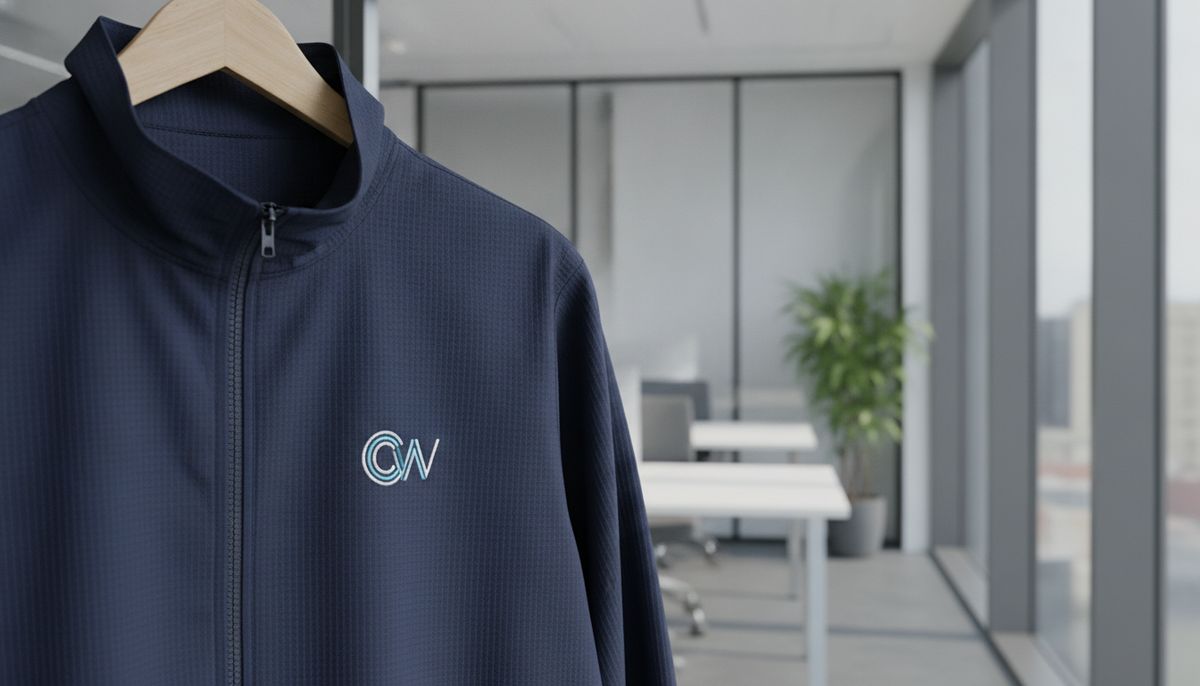
A windbreaker with logo requires three decisions: decoration method (embroidery, screen print, DTF, or woven patch), fabric weight (typically 70-120 gsm ripstop nylon or polyester), and minimum order quantity. Sample MOQ starts at 1 piece with a $100 sample fee (refunded against a first bulk order of 30+ pieces); bulk production MOQ is 10 pieces per style with mixed colours and sizes.
📋 Table of Contents
Executive Summary
- Decoration choice: Embroidery offers the longest lifespan for corporate and school programs, while DTF allows full-colour photo-quality graphics without setup fees.
- Fabric weight: Most branded windbreakers use 70-100 gsm ripstop nylon or polyester; lighter weights suit casual wear, while 100-120 gsm provides better wind resistance for outdoor use.
- Minimum order quantities: Sample MOQ is 1 piece with a $100 sample fee (refunded against a first bulk order of 30+ pieces); bulk production MOQ is 10 pieces per style with mixed colours and sizes.
- Lead times: Sampling takes 7-10 days; bulk production runs 25-35 days, with a rush option delivering 1,000 pieces in 2 weeks at a +25% surcharge.
- Common buyer complaints: Buyers report that some branded windbreakers are too thin for serious weather protection and that boxy cuts make sizing inconsistent for teams ordering in volume.
Which Decoration Method Works Best for a Windbreaker with Logo?
The decoration method determines both the visual quality and the lifespan of the logo. Embroidery, screen printing, DTF, and woven patches each suit different use cases, and the wrong choice leads to peeling, fading, or cracking after a few washes.
Embroidery
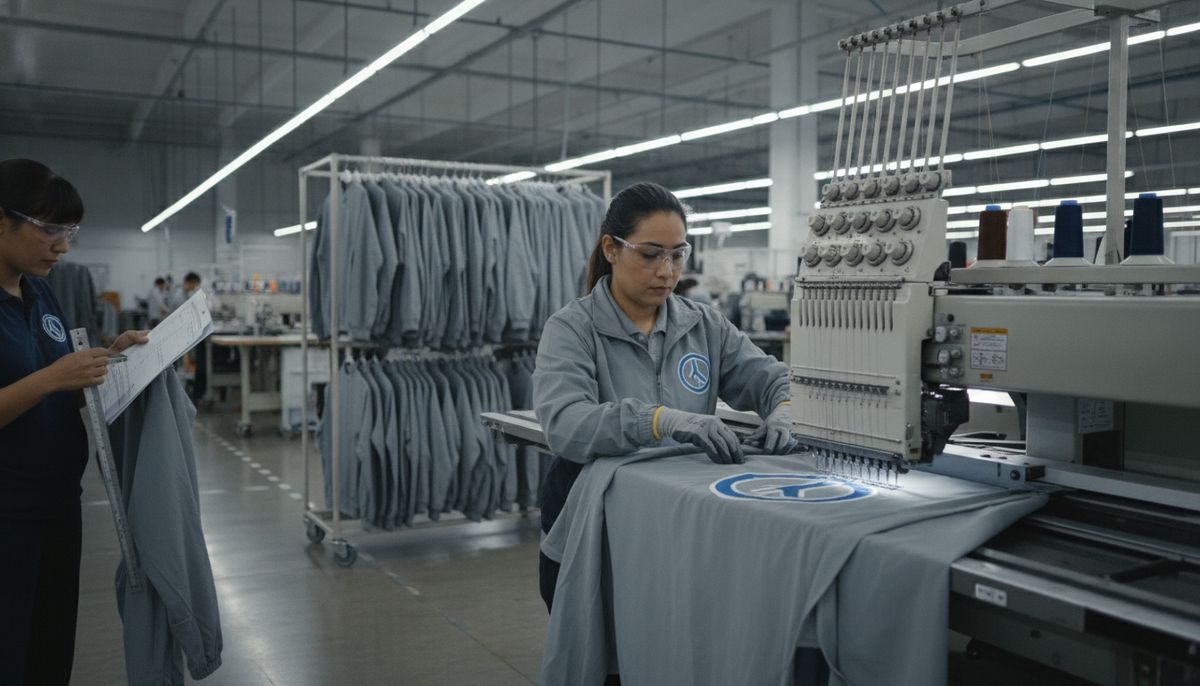
Embroidery stitches the logo directly into the fabric, creating a raised, textured finish. It survives 50+ washes without fading and works best for corporate uniforms, school programs, and premium outdoor brands. Setup requires digitizing the artwork into a stitch file, which costs $50-80 per design. The per-piece embroidery fee ranges from $1.50 to $4.00 depending on stitch count (typically 5,000-15,000 stitches for a chest logo).
Embroidery adds weight and stiffness to lightweight windbreaker fabric. For 70 gsm ripstop nylon, a dense embroidered logo can create puckering or distortion around the stitched area. Buyers ordering embroidered windbreakers should request a pre-production sample to verify that the backing stabilizer matches the fabric weight.
Screen Printing
Screen printing applies ink through a mesh screen, producing a flat, smooth logo. It handles large chest prints and bold graphics better than embroidery, and setup costs $30-50 per screen (one screen per colour). Per-piece printing fees start at $0.80 for single-colour designs and rise to $2.50 for four-colour prints.
Screen print durability depends on the ink type. Plastisol ink sits on the fabric surface and cracks after 20-30 washes, especially on high-flex areas like shoulders and elbows. Water-based ink soaks into the fabric and lasts longer, but it requires heat-curing at 160°C, which can damage heat-sensitive DWR (durable water repellent) coatings. Buyers sourcing windbreakers with screen-printed logos should specify water-based ink and confirm that the factory applies DWR after printing, not before.
DTF (Direct-to-Film)
DTF transfers a printed film onto the fabric using heat and adhesive powder. It reproduces full-colour logos, gradients, and photo-quality graphics without setup fees, making it the most cost-effective option for small runs (under 50 pieces). Per-piece DTF pricing ranges from $1.20 to $3.00 depending on print size.
DTF adhesive creates a slightly rubbery hand-feel and lasts 15-25 washes before edges begin to lift. It works well for event windbreakers and promotional runs where visual impact matters more than long-term durability. DTF is not recommended for school or corporate programs that require 50+ wash cycles.
Woven Patches
Woven patches are sewn or heat-sealed onto the windbreaker, creating a heritage outdoor-brand aesthetic. Setup costs $80-120 per design, and per-piece patch fees range from $1.00 to $2.50. Patches survive indefinitely unless physically removed, and they allow logo changes without re-ordering the entire garment.
Heat-sealed patches peel off after repeated washing. Sewn patches remain permanent but add stitch holes to the fabric, which can compromise waterproofing if the windbreaker uses a laminated membrane. Buyers ordering OEM windbreakers with woven patches should specify sewn attachment and request seam sealing over the stitch holes if water resistance is required.
How Does Fabric Weight Affect Wind Resistance in a Windbreaker with Logo?
Fabric weight, measured in grams per square metre (gsm), determines both wind resistance and packability. Most branded windbreakers use 70-120 gsm ripstop nylon or polyester, with lighter weights suiting casual wear and heavier weights providing better outdoor performance.
70-80 gsm: Lightweight and Packable
70-80 gsm ripstop nylon compresses into a small stuff sack and weighs 150-200 grams for a men’s medium jacket. It blocks light wind but allows air to pass through at speeds above 15 km/h, making it suitable for urban commuting, event giveaways, and promotional windbreakers. Buyers report that 70 gsm windbreakers feel too thin for serious weather protection, treating them as casual layers rather than technical shells.
Embroidery on 70 gsm fabric requires a lightweight tearaway stabilizer to prevent puckering. Screen printing works better than embroidery for this weight class because it adds no stiffness to the fabric.
90-100 gsm: Balanced Performance
90-100 gsm ripstop nylon balances wind resistance and packability. It blocks wind at speeds up to 25 km/h and weighs 220-280 grams for a men’s medium jacket. This weight class suits corporate uniforms, school programs, and outdoor brands targeting recreational hikers and cyclists.
100 gsm fabric accepts embroidery, screen printing, and DTF without distortion. Buyers ordering windbreakers for team sports or outdoor events typically specify 90-100 gsm to ensure the jacket performs in moderate wind without feeling bulky.
110-120 gsm: Maximum Wind Resistance
110-120 gsm ripstop nylon blocks wind at speeds above 30 km/h and provides the best protection for exposed outdoor environments. It weighs 300-350 grams for a men’s medium jacket, which reduces packability but increases durability. This weight class suits ski resort staff uniforms, outdoor guide programs, and brands targeting serious outdoor users.
120 gsm fabric supports all decoration methods, including dense embroidery with 15,000+ stitches. Buyers ordering custom logo windbreakers for outdoor use should specify 110-120 gsm to avoid the thin-fabric complaints common with lighter weights.
Wind resistance test: ASTM D737 measures air permeability in cubic feet per minute (CFM). A reading below 5 CFM indicates good wind resistance; most 70-80 gsm windbreakers test at 8-12 CFM, while 110-120 gsm fabrics test at 3-5 CFM.
What Are the Minimum Order Quantities for a Windbreaker with Logo?
Minimum order quantities vary by production stage. Sample MOQ determines how many pieces you need to order before seeing a physical prototype, while bulk MOQ sets the threshold for production pricing.
Sample MOQ: 1 Piece
Sample MOQ is 1 piece with a $100 sample fee. The fee covers fabric cutting, sewing labour, and logo decoration setup (digitizing for embroidery, screen preparation for printing, or film output for DTF). The sample fee is refunded against a first bulk order of 30+ pieces. Sampling takes 7-10 days from artwork approval to shipment.
Buyers launching a new outdoor brand or testing a design for a corporate program should order 1-piece samples in multiple sizes to verify fit before committing to bulk production. A reported fit issue is a loose or boxy cut, which makes sizing inconsistent for teams or organizations ordering for many wearers. Ordering samples in small, medium, and large sizes reveals whether the pattern runs true to size or requires adjustment.
Bulk Production MOQ: 10 Pieces per Style
Bulk production MOQ is 10 pieces per style, with colours and sizes mixed. A style is defined by the base design (fabric, cut, and construction), so a buyer can order 10 total pieces across three colours and four sizes without exceeding the MOQ. School and corporate uniform programs start at 30 pieces per style per colour to qualify for volume pricing.
Lead time for bulk production is 25-35 days (approximately 4 weeks) from deposit payment to shipment. A rush option delivers 1,000 pieces in 2 weeks at a +25% surcharge, which suits event organizers and corporate buyers with tight deadlines.
Dropshipping and Print-on-Demand: 1-Piece Fulfillment
Dropshipping and print-on-demand programs fulfill orders as small as 1 piece per shipment, allowing DTC brands to test designs without inventory risk. Per-piece pricing for 1-piece fulfillment runs 40-60% higher than bulk pricing due to individual cutting, sewing, and packing labour. Dropshipping suits early-stage outdoor brands validating product-market fit before scaling to bulk orders.
What Is the Landed Cost of a Windbreaker with Logo?
Landed cost includes the factory price, decoration fees, sampling fees, freight, duties, and customs clearance. Buyers who compare only the FOB (free on board) price underestimate total cost by 25-40%.
Factory Price Tiers
Factory pricing drops at three volume thresholds: 50 pieces (small batch), 200 pieces (medium batch), and 500+ pieces (bulk). A 90 gsm ripstop nylon windbreaker costs $12-15 FOB for 50 pieces, $10-13 FOB for 200 pieces, and $8-11 FOB for 500+ pieces. Buyers ordering fewer than 50 pieces pay single-piece or small-batch pricing, which runs 40-60% higher than bulk rates.
Decoration Fees
Decoration fees scale inversely with order volume. Embroidery costs $3.50 per piece for a 1-piece sample, $2.80 per piece for 50 pieces, and $1.80 per piece for 500+ pieces. Screen printing follows a similar curve: $2.00 per piece for 50 pieces, $1.20 per piece for 500 pieces. DTF pricing remains flat at $1.50-2.50 per piece regardless of volume because each transfer is printed individually.
Freight and Duties
DDP (delivered duty paid) shipping to the US West Coast costs $4.20 per piece for a 50-piece order and $1.80 per piece for a 500-piece order. DDP pricing includes ocean freight, US customs clearance, import duty (27.7% for HTS 6201.93 men’s windbreakers), and delivery to the buyer’s warehouse. Buyers who request FOB pricing and arrange their own freight often underestimate clearance fees and inland trucking, which add $300-600 to the total shipment cost.
How Do You Verify Quality Before Bulk Production of a Windbreaker with Logo?
Quality control starts with the pre-production sample and continues through in-line inspection during bulk production. Buyers who skip sampling or rely on factory photos discover defects only after the shipment arrives, when returns and re-orders cost more than the original order.
Pre-Production Sample Inspection
The pre-production sample verifies that the fabric, construction, and logo decoration match the buyer’s specifications. Buyers should check five critical points on the sample:
- Fabric weight and hand-feel: Weigh a 10 cm x 10 cm swatch on a gram scale and multiply by 100 to calculate gsm. A 90 gsm ripstop nylon swatch should weigh 9 grams. Heavier or lighter weights indicate fabric substitution.
- Logo placement and alignment: Measure the distance from the logo centre to the shoulder seam and the bottom hem. Misaligned logos create a lopsided appearance when worn.
- Stitch density and tension: Count stitches per inch (SPI) along the side seam. Ripstop nylon windbreakers should have 10-12 SPI; fewer stitches create weak seams that split under tension.
- DWR coating performance: Spray water on the sample and observe whether droplets bead up and roll off. If water soaks into the fabric, the DWR coating is missing or insufficient.
- Zipper operation and durability: Open and close the front zipper 20 times. If the zipper catches, skips teeth, or separates, request a YKK or SBS zipper upgrade before bulk production.
Buyers ordering low-MOQ windbreakers should request samples in multiple sizes to verify that the pattern grades correctly across the size range. Patagonia product feedback includes a buyer saying they should have sized up, indicating that fit and layering allowance can be a concern. Ordering samples in small, medium, and large reveals whether the chest, sleeve, and body length proportions remain consistent or drift as the pattern scales.
During-Production Inspection
During-production inspection catches defects while the bulk order is still on the sewing line, when corrections cost labour time rather than finished-goods waste. Buyers should request inspection at the 30% completion milestone (after 150 pieces of a 500-piece order). The inspector checks:
- Fabric batch consistency: Compare fabric swatches from the first, middle, and last cutting tables to verify that colour and weight remain consistent across the entire fabric roll.
- Logo decoration alignment: Measure logo placement on 10 random pieces from different sewing operators. Variation greater than 5 mm indicates that the sewing jig is not calibrated correctly.
- Seam strength: Pull a side seam with 10 kg of force (approximately the weight of a full backpack). The seam should not separate or show loose threads.
- DWR durability: Spray water on three random pieces and verify that droplets bead up. If water soaks in, the DWR coating was not applied or was removed during decoration heat-pressing.
Final Random Inspection (FRI)
Final random inspection samples 2.5-4% of the finished order (AQL 2.5 standard) and checks for defects in fabric, stitching, decoration, and packing. Common defects found during FRI include:
- Colour variation: Jackets from different fabric rolls show visible colour differences under natural light.
- Skipped stitches: Side seams or hem stitching have gaps where the needle missed the fabric.
- Logo misalignment: Embroidered or printed logos sit 10+ mm off-centre or tilt at an angle.
- Pilling or snagging: Fabric surface shows fuzzing or pulled threads from rough handling during sewing.
Buyers who discover defects during FRI can request rework (re-sewing seams, re-applying logos) or reject the defective pieces and receive a credit or replacement. Rework adds 5-7 days to the production timeline, so catching defects during the 30% in-line inspection prevents delays and cost overruns.
Key Takeaways
- A windbreaker with logo requires choosing between embroidery (50+ wash lifespan, $50-80 setup, $1.50-4.00 per piece), screen print ($30-50 setup, $0.80-2.50 per piece), DTF (no setup, $1.20-3.00 per piece), or woven patches ($80-120 setup, $1.00-2.50 per piece).
- Fabric weight determines wind resistance: 70-80 gsm suits casual wear and event giveaways, 90-100 gsm balances performance and packability for corporate uniforms, and 110-120 gsm provides maximum wind resistance for outdoor programs.
- Sample MOQ is 1 piece with a $100 sample fee (refunded against a first bulk order of 30+ pieces); bulk production MOQ is 10 pieces per style with mixed colours and sizes.
- Landed cost for a 90 gsm ripstop windbreaker with embroidered logo ranges from $19.00 per piece for 50 pieces to $11.60 per piece for 500 pieces, including factory price, decoration, freight, and US import duty.
- Pre-production sample inspection verifies fabric weight, logo placement, stitch density, DWR coating performance, and zipper operation before bulk production begins.
- During-production inspection at the 30% completion milestone catches fabric batch inconsistencies, logo misalignment, and seam defects while corrections still cost labour time rather than finished-goods waste.
Frequently Asked Questions
Can I order a windbreaker with logo in multiple colours with a 10-piece MOQ?
The 10-piece bulk MOQ applies per style, not per colour. A style is defined by the base design (fabric, cut, and construction), so you can order 10 total pieces across three colours and four sizes without exceeding the MOQ. For example, a 10-piece order could include 3 black medium, 2 navy large, 3 grey small, and 2 red extra-large. School and corporate uniform programs that require colour separation (all employees in one colour) start at 30 pieces per style per colour to qualify for volume pricing.
Does embroidery work on 70 gsm ripstop nylon windbreakers?
Embroidery on 70 gsm ripstop nylon requires a lightweight tearaway stabilizer to prevent puckering and fabric distortion. Dense logos with 10,000+ stitches can create visible stiffness and weight imbalance on lightweight fabric, which buyers notice when wearing the jacket. Screen printing or DTF works better for 70-80 gsm windbreakers because it adds no stiffness to the fabric. Buyers ordering embroidered logos on lightweight windbreakers should request a pre-production sample to verify that the backing stabilizer matches the fabric weight and that the logo does not create puckering around the stitched area.
How long does DWR coating last on a windbreaker with screen-printed logo?
DWR coating lasts 15-25 washes when applied after screen printing, but it degrades faster when the factory applies DWR before printing and then heat-presses the logo at 160°C. Heat-curing screen print ink can damage or remove DWR coatings, which causes water to soak into the fabric instead of beading up and rolling off. Buyers sourcing windbreakers with screen-printed logos should specify that the factory applies DWR after printing, not before, and request a water-spray test on the pre-production sample to verify that droplets bead up correctly. PFC-free DWR coatings (C0 chemistry) require reapplication every 10-15 washes, while fluorocarbon-based DWR lasts 20-30 washes but faces regulatory restrictions in the EU and California.
Ready to source a windbreaker with logo that meets your brand’s specs and budget?
Request 1-piece samples →
Written by Ivan Chen, Sales Engineer at PTOUTWEAR – 13 years in outdoor apparel manufacturing.