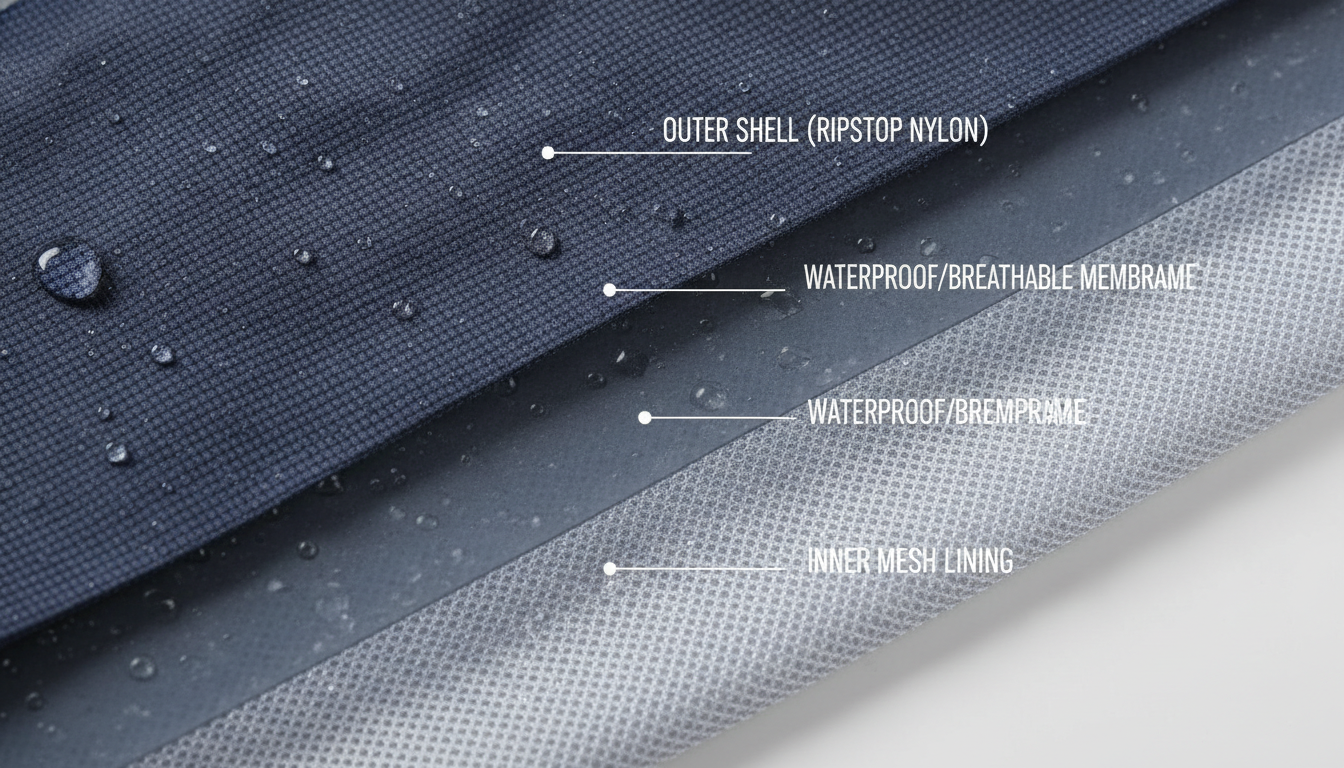
A waterproof breathable membrane is a thin film laminated inside a jacket that blocks liquid water molecules (20 micrometers in diameter) while allowing water vapor molecules (0.0004 micrometers) to escape through microscopic pores or hydrophilic chemistry. The three main membrane families are ePTFE (expanded polytetrafluoroethylene, microporous), polyurethane (PU, non-porous hydrophilic), and PFC-free polyester microporous films; your choice depends on durability requirements, breathability priority, budget, and whether PFC-free certification is mandatory for your buyer.
📋 Table of Contents
- Executive Summary
- How Does a Waterproof Breathable Membrane Block Water While Passing Vapor?
- What Are the Main Membrane Chemistry Types and How Do They Differ?
- How Does Laminate Construction Change Performance and Cost?
- Why Does DWR Matter If the Membrane Is Already Waterproof?
- Which Membrane Should You Specify by Use Case and Budget?
- What Are the Most Common Failure Modes and How Do You Prevent Them?
- Key Takeaways
- FAQ
Executive Summary
- Membrane mechanism: A waterproof breathable membrane uses either microscopic pores or hydrophilic chemistry to block liquid water while allowing water vapor molecules to escape, keeping the wearer dry from both rain and sweat.
- ePTFE vs PU: ePTFE membranes offer superior breathability for high-exertion use but cost more, while PU membranes deliver reliable waterproofing at lower price points suitable for urban and corporate apparel.
- Laminate layers: 2-layer construction separates membrane and lining for easier repair, 2.5-layer adds a protective coating for packability, and 3-layer bonds all components for maximum durability in alpine conditions.
- DWR dependency: The outer fabric’s durable water repellent finish must bead water to prevent wet-out; when DWR fails, the face fabric saturates and breathability drops even though the membrane remains technically waterproof.
- Procurement decision: Specify ePTFE for mountaineering and ski, PU for school uniforms and corporate teams, and PFC-free polyester microporous when EU or US buyers require third-party environmental certification without fluoropolymers.
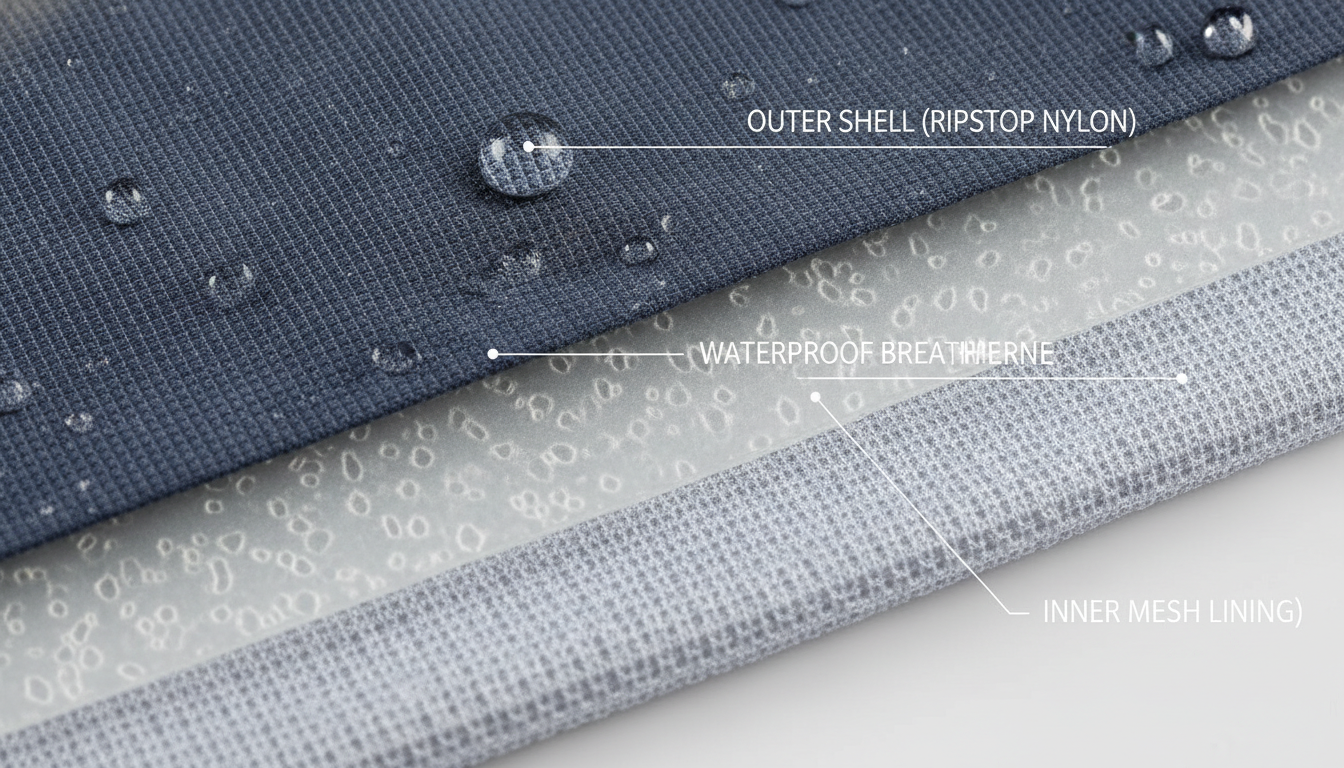
How Does a Waterproof Breathable Membrane Block Water While Passing Vapor?
The waterproof breathable membrane exploits the size difference between liquid water and water vapor. A water droplet measures approximately 20 micrometers in diameter, while a water vapor molecule is about 0.0004 micrometers. Microporous membranes contain billions of pores per square inch that are large enough to let vapor escape but too small for liquid droplets to penetrate. Hydrophilic membranes use solid polymer films with no pores; instead, the polymer absorbs vapor on the inside, transports it through the film via diffusion, and releases it on the outside.
Microporous Membrane Mechanism
According to The North Face (2026), GORE-TEX contains about 9 billion microscopic pores per square inch. Each pore is roughly 700 times larger than a water vapor molecule but 20,000 times smaller than a water droplet, as described by Paddle Round the Pier (2026). This physical barrier prevents rain from soaking through while sweat vapor escapes freely during activity. The pore structure remains stable across temperature ranges, so breathability does not drop in cold weather the way some coated fabrics do.
Hydrophilic Membrane Mechanism
Polyurethane and other hydrophilic membranes work by chemical affinity rather than pore size. The polymer attracts water vapor molecules on the warm, humid interior side of the jacket, absorbs them into the film, and releases them on the cooler, drier exterior. This process depends on a vapor-pressure gradient, so breathability improves when the temperature difference between inside and outside increases. Hydrophilic membranes are less breathable than microporous films during high exertion, but they cost less and resist contamination from body oils and dirt that can clog microporous pores over time.
Why the Size Difference Matters in Real Use
The membrane itself performs consistently in lab tests, but real-world breathability depends on the entire garment system. When the outer fabric wets out and stops beading water, it saturates with liquid. That wet layer blocks air circulation and traps heat, making the jacket feel clammy even though the membrane has not leaked. Buyers frequently report this wet-out sensation during extended rain exposure, especially when the DWR finish has degraded. The membrane still passes vapor, but the saturated face fabric creates a microclimate that feels like the jacket has failed.
In practice: DWR reapplication restores beading and eliminates the clammy feel that buyers mistake for membrane failure, which is why wash-and-retreat instructions belong on every hang tag.
What Are the Main Membrane Chemistry Types and How Do They Differ?
Three membrane families dominate OEM jacket manufacturing: ePTFE, polyurethane, and PFC-free polyester microporous. Each offers distinct tradeoffs in breathability, durability, cost, and environmental compliance. Your choice depends on end-user activity level, retail price point, and whether your buyer requires third-party certification that excludes fluoropolymers.
ePTFE (Expanded Polytetrafluoroethylene)
ePTFE membranes deliver the highest breathability because their pore structure allows rapid vapor transmission without relying on a humidity gradient. GORE-TEX is the best-known example, but non-branded ePTFE films from Asian mills offer similar performance at lower cost. The membrane resists abrasion and maintains waterproofing through hundreds of wash cycles when properly seam-sealed. Fabric cost runs 30 to 50 percent higher than PU alternatives, and the fluoropolymer chemistry disqualifies ePTFE from PFC-free certifications. Specify ePTFE for alpine, ski, mountaineering, and any high-exertion use where breathability cannot be compromised.
Polyurethane (PU) and TPU
Polyurethane membranes are solid films with no pores, so they cannot clog with dirt or body oils. Breathability is lower than ePTFE, typically 5,000 to 10,000 g/m²/24hr MVTR compared to 15,000+ for microporous films, but PU membranes cost less and meet the waterproofing needs of urban commuters, school uniforms, and corporate team gear. Thermoplastic polyurethane (TPU) variants add stretch and improve durability in high-flex areas like elbows and shoulders. PU membranes qualify for OEKO-TEX Standard 100 and other certifications that screen harmful substances, making them a safe choice for children’s uniforms and workwear programs.
PFC-Free Polyester Microporous
According to Kae Hwa industrial (2026), PFC-free waterproof and breathable polyester microporous membranes represent a recent development in response to regulatory pressure in the EU and voluntary PFC elimination by North American outdoor brands. These films replicate the pore structure of ePTFE without fluoropolymer chemistry, delivering breathability between PU and ePTFE while satisfying bluesign and OEKO-TEX requirements. Performance durability over repeated wash cycles is still being validated in the field, but early adopters report satisfactory results for trekking and trail running. Fabric cost sits between PU and ePTFE, and mills typically require 30-piece minimums per colorway.
How Does Laminate Construction Change Performance and Cost?
Laminate construction describes how the membrane, face fabric, and lining are bonded together. The choice affects weight, packability, durability, and repair cost. A 2-layer construction keeps the membrane and lining separate, a 2.5-layer adds a protective coating to the membrane, and a 3-layer construction bonds all components into a single fabric.
2-Layer Construction
In a 2-layer laminate, the membrane is bonded to the face fabric, and a separate mesh or taffeta lining hangs free inside the jacket. This construction is the easiest to sew and repair, and it allows the lining to be replaced without discarding the membrane. The loose lining adds weight and bulk, so 2-layer jackets pack larger than 2.5 or 3-layer alternatives. Specify 2-layer for corporate uniforms, workwear, and any application where repairability and lower sewing complexity matter more than weight.
2.5-Layer Construction
A 2.5-layer laminate bonds the membrane to the face fabric and then applies a thin protective coating or printed pattern on the inside surface of the membrane. The coating protects the membrane from abrasion and body oils without adding a full lining, so the fabric is lighter and more packable than 2-layer. The inside feels slightly tacky or textured, and the coating can degrade over time, especially in high-sweat areas. Specify 2.5-layer for lightweight rain shells, trail running jackets, and any product where pack size and weight are primary buying criteria.
3-Layer Construction
In a 3-layer laminate, the membrane is bonded between the face fabric and a thin tricot or knit lining, creating a single cohesive fabric. This construction is the most durable because the lining shields the membrane from interior abrasion, and the bonded structure resists delamination. The fabric is stiffer and heavier than 2.5-layer but lighter than 2-layer with a loose lining. Seam sealing is critical because every needle hole penetrates all three layers. Specify 3-layer for ski jackets, mountaineering shells, and any product where durability and long-term performance justify higher fabric cost.
Why Does DWR Matter If the Membrane Is Already Waterproof?
The durable water repellent finish on the face fabric does not make the jacket waterproof. The membrane does that. DWR keeps the outer fabric from saturating with water, which preserves breathability and prevents the garment from feeling heavy and clammy. When DWR fails, the face fabric wets out, air cannot circulate, and the jacket traps heat even though the membrane has not leaked a drop.
How DWR Works
DWR is a chemical treatment applied to the face fabric that causes water to bead and roll off rather than soak in. The treatment lowers the surface energy of the fabric fibers, so water droplets maintain high contact angles and do not spread. A fresh DWR finish causes rain to bead into spheres that slide off the jacket with minimal contact. As the finish wears down from abrasion, UV exposure, and washing, water begins to spread across the fabric surface, eventually saturating the weave.
Why Wet-Out Kills Breathability
When the face fabric saturates, it blocks air movement at the surface. The waterproof breathable membrane still passes vapor, but that vapor has nowhere to go because the wet outer layer creates a sealed microclimate. The wearer feels damp and overheated, and many buyers assume the membrane has failed when the actual problem is DWR degradation. Forum discussions and product reviews frequently cite this wet-out sensation as a breathability failure, but reapplying DWR restores normal performance.
PFC vs PFC-Free DWR
Traditional DWR finishes use perfluorinated compounds (PFCs) because they deliver superior water repellency and durability. PFC-based DWR lasts longer between reapplications and maintains beading through more wash cycles. Environmental and health concerns have driven brands to adopt PFC-free DWR chemistries, which use hydrocarbon or silicone-based treatments. PFC-free DWR performs adequately when fresh but requires more frequent reapplication. Our 3,000m² Taizhou Sanmen facility applies both PFC and PFC-free DWR depending on buyer certification requirements, and we validate beading performance on pre-production samples before bulk cutting.
Which Membrane Should You Specify by Use Case and Budget?
Membrane selection depends on end-user activity level, climate, retail price point, and whether environmental certification is mandatory. A school uniform program has different requirements than a mountaineering brand, and specifying the wrong membrane either wastes money or delivers inadequate performance.
High-Exertion Alpine and Ski Use
Specify ePTFE 3-layer construction with a 20,000+ mm hydrostatic head and 15,000+ g/m²/24hr MVTR. The high breathability prevents overheating during ascents, and the durable 3-layer laminate survives abrasion from pack straps and sharp rock. Fabric cost is highest in this category, but the performance justifies the price for buyers who need reliable protection in severe weather. Sample development with 1-piece minimums lets you validate fit and breathability before committing to a 30-piece bulk order.
Urban Commuter and Corporate Team Gear
Specify PU 2-layer construction with a 10,000 mm hydrostatic head and 5,000 to 8,000 g/m²/24hr MVTR. Breathability is adequate for walking and light cycling, and the lower fabric cost keeps retail prices competitive for corporate uniform programs and team apparel. PU membranes meet OEKO-TEX Standard 100 requirements, which many corporate buyers prefer for employee safety. The 2-layer construction simplifies sewing and allows in-house embroidery or screen printing without damaging the membrane.
School Uniforms and Children’s Outerwear
Specify PU 2-layer construction with a 5,000 to 10,000 mm hydrostatic head. Children generate less body heat during recess and outdoor activities than adult athletes, so moderate breathability is sufficient. Durability and washability matter more than weight, and the 2-layer construction withstands repeated machine washing without delamination. PU membranes cost less than ePTFE, which keeps program budgets manageable for schools and uniform suppliers. OEKO-TEX certification screens harmful substances, addressing parent and administrator safety concerns.
EU and US Brands Requiring PFC-Free Certification
Specify PFC-free polyester microporous 2.5-layer or 3-layer construction with a 15,000+ mm hydrostatic head and 10,000+ g/m²/24hr MVTR. These membranes satisfy bluesign and OEKO-TEX requirements without fluoropolymers, meeting regulatory and voluntary PFC elimination commitments. Performance sits between PU and ePTFE, and fabric cost is mid-range. Mills typically require 30-piece minimums per colorway, which aligns with our low-MOQ production capability for emerging brands testing new markets.
Sample MOQ: 1 piece. Bulk MOQ: 30 pieces per SKU. Sampling time: 7-10 days. Bulk production: 25-35 days.
What Are the Most Common Failure Modes and How Do You Prevent Them?
Waterproof breathable jackets fail in predictable ways that have nothing to do with the membrane itself. Wet-out from DWR degradation, delamination from improper washing, and seam-tape failure from contamination account for most field complaints. Preventing these failures requires spec discipline during sampling and clear care instructions on the hang tag.
Wet-Out and DWR Degradation
Buyers report that jackets feel wet and clammy during extended rain exposure even though no water leaks through. The face fabric has saturated because DWR has worn off, blocking air circulation and trapping heat. Reapplying DWR with a spray-on or wash-in treatment restores beading and eliminates the clammy sensation. Specify PFC-free DWR when certification requires it, but inform buyers that reapplication frequency will be higher than with PFC-based finishes. Include washing and DWR maintenance instructions on every hang tag to reduce warranty claims.
Delamination After Washing
Some buyers report that the membrane separates from the face fabric or lining after repeated washing or heavy use. Delamination occurs when the adhesive bond fails, usually because the jacket was washed in hot water, dried on high heat, or exposed to fabric softener. Specify wash-care labels that prohibit fabric softener and high-heat drying, and validate adhesive bond strength on pre-production samples by running a 10-cycle accelerated wash test. Our QC team checks bond integrity on every bulk lot before shipping to catch delamination risk before garments reach end users.
Seam-Tape Failure
Seam tape covers the needle holes where fabric panels are sewn together, preventing water from wicking through the stitching. Tape can peel or delaminate if the seam was contaminated with oil or dirt during sewing, or if the wrong tape chemistry was used for the membrane type. Specify seam-sealing tape that matches the membrane chemistry (PU tape for PU membranes, ePTFE tape for ePTFE membranes), and require the factory to clean seam allowances with isopropyl alcohol before taping. Sampling with 1-piece orders lets you inspect seam-tape adhesion under magnification before committing to bulk production.
In practice: Seam-tape adhesion testing on the pre-production sample catches contamination that would cause peeling in the field, which is why every sample goes through a 24-hour water-spray test before bulk approval.
Breathability Overpromise
Buyers frequently mention that breathability claims feel overstated during long hikes or high-exertion activities, especially when wearing a backpack. The membrane performs as specified in lab tests, but real-world breathability depends on fit, ventilation design, and activity level. A tight-fitting jacket with no pit zips traps more heat than a relaxed fit with underarm vents, even if both use the same membrane. Specify mechanical venting (pit zips, back vents, chest vents) for any jacket intended for aerobic use, and avoid marketing language that promises the jacket will feel dry during maximum exertion. Honest spec communication reduces warranty claims and builds buyer trust.
Key Takeaways
- A waterproof breathable membrane blocks liquid water droplets (20 micrometers) while allowing water vapor molecules (0.0004 micrometers) to escape, using either microscopic pores or hydrophilic polymer chemistry.
- ePTFE membranes deliver the highest breathability for alpine and ski use but cost more and contain fluoropolymers that disqualify them from PFC-free certifications.
- PU membranes offer reliable waterproofing at lower cost, making them suitable for urban commuter jackets, corporate uniforms, and school programs where breathability demands are moderate.
- PFC-free polyester microporous membranes replicate ePTFE pore structure without fluoropolymer chemistry, satisfying EU and US environmental certifications while delivering mid-range breathability.
- DWR finish on the face fabric must bead water to prevent wet-out; when DWR fails, the saturated outer layer blocks air circulation and the jacket feels clammy even though the membrane remains waterproof.
- Laminate construction affects weight and durability: 2-layer is easiest to repair, 2.5-layer is lightest and most packable, and 3-layer is most durable for high-abrasion alpine use.
FAQ
Can you wash a waterproof breathable jacket in a standard washing machine?
Yes, most waterproof breathable jackets can be machine washed on a gentle cycle with cold or warm water, but you must use a technical-fabric detergent that does not contain fabric softener or bleach. Fabric softener leaves a residue that clogs membrane pores and degrades DWR, causing the jacket to wet out. After washing, tumble dry on low heat to reactivate the DWR finish, or hang dry and then apply a spray-on or wash-in DWR treatment if beading has diminished. Always check the care label for membrane-specific instructions, because some PU membranes tolerate higher heat than ePTFE films.
How long does a waterproof breathable membrane last before it needs replacement?
A properly maintained waterproof breathable membrane can last hundreds of wash cycles and many years of field use before the film itself degrades, but most jackets are retired because seam tape fails, DWR wears off permanently, or the face fabric abrades through in high-wear areas. ePTFE membranes are more durable than PU films and resist delamination better over time, but they cost more upfront. Regular DWR reapplication, gentle washing with technical detergent, and avoiding high-heat drying extend membrane life significantly. If seam tape peels or the membrane delaminates from the face fabric, the jacket is no longer waterproof and should be replaced or sent for professional repair.
Does a higher hydrostatic head rating always mean better waterproofing?
A higher hydrostatic head rating indicates the membrane can withstand greater water pressure before leaking, but ratings above 20,000 mm rarely matter in real-world use because rain and snow exert far less pressure than lab test columns. A 10,000 mm rating is sufficient for most outdoor activities, and a 20,000+ mm rating is necessary only for prolonged exposure to driving rain or when sitting on wet ground. What matters more than the membrane rating is seam-tape quality, DWR maintenance, and whether the face fabric wets out. A jacket with a 10,000 mm membrane and excellent seam sealing outperforms a 30,000 mm jacket with poor tape adhesion or degraded DWR.
Need help specifying the right membrane for your jacket line?
Request 1-piece samples and a membrane comparison chart →
Written by Ivan Chen, Sales Engineer at PTOUTWEAR, 13 years in outdoor apparel manufacturing.