A varsity jacket manufacturer produces wool-body letterman jackets with leather or PU sleeves, chenille patches, and rib-knit trim for fashion brands, corporate team programs, and school uniform buyers. PTOUTWEAR offers 1-piece sample MOQ and 30-piece bulk production with 7-10 day sampling and ISO 9001 / SGS / PFC-Free DWR certification from our 3,000m² Taizhou Sanmen facility.
📋 Table of Contents
Executive Summary
- Construction standard: Authentic varsity jackets use wool melton bodies, genuine or synthetic leather sleeves, and rib-knit collars, cuffs, and waistbands.
- Sample accessibility: PTOUTWEAR provides 1-piece sample MOQ with a $100 refundable fee, enabling market validation before bulk commitment.
- Bulk minimums: Production MOQ is 30 pieces per SKU, lower than many competitors requiring 100-piece commitments.
- Customization scope: Chenille patches, direct embroidery, appliqué, screen printing, and private-label neck tags are standard offerings.
- Quality verification: ISO 9001, SGS, and PFC-Free DWR certifications provide third-party validation of production systems and chemical compliance.
What Defines Varsity Jacket Construction?
Varsity jackets follow a specific material and trim formula that distinguishes them from bomber, Harrington, or college-style jackets. Buyers frequently encounter inconsistent terminology when sourcing, making it difficult to identify true varsity construction versus adjacent styles. The core elements are wool melton body fabric, contrasting sleeves in leather or polyurethane, rib-knit trim at collar, cuffs, and waistband, and snap-button or zipper front closures.
Body Fabric: Wool Melton vs. Wool Blends
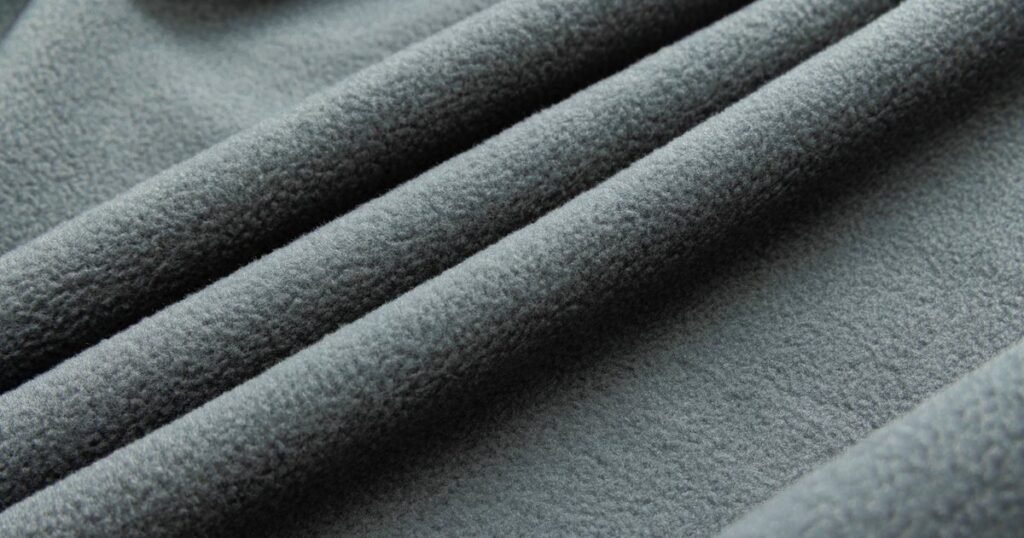
Traditional varsity jackets use 80% wool / 20% nylon melton cloth at 24-32 oz per yard. This dense, felted fabric provides wind resistance and shape retention. Budget alternatives use 50% wool / 50% polyester blends at 18-22 oz, reducing cost but sacrificing some durability. Fully synthetic fleece bodies eliminate wool entirely, targeting price-sensitive school uniform programs. When requesting quotes, specify wool percentage and fabric weight to avoid ambiguity.
Sleeve Material: Leather vs. PU Leather
Genuine cowhide or sheepskin sleeves add durability and premium positioning but increase unit cost by $15-25 per jacket. Polyurethane (PU) leather sleeves offer a similar aesthetic at lower cost and consistent supply, making them the default choice for fashion brands and corporate team orders. PU sleeves also simplify care instructions, as they tolerate machine washing better than natural leather. Our OEM jacket manufacturing process includes abrasion testing for both materials to verify minimum 10,000-cycle durability.
Rib-Knit Trim Specifications
Collar, cuffs, and waistband use 2×2 or 1×1 rib-knit trim in acrylic or cotton-acrylic blends. Stripe patterns (single, double, or triple) are knitted in contrasting colors to match team or brand palettes. Rib-knit quality affects shape retention after repeated wear. Low-grade trim loses elasticity within 20-30 wash cycles, causing cuffs and waistbands to sag. Specify minimum 5% spandex content in rib trim to maintain recovery over 50+ washes.
How to Verify Manufacturer Quality Before Ordering
Quality verification starts before the first sample ships. Buyers raising concerns about inconsistent construction and unclear factory capabilities can use three concrete checks to reduce risk: certification review, physical sample inspection, and production-floor documentation.
Certification and Compliance Documentation
Request copies of ISO 9001, BSCI, or equivalent quality-management certifications. These documents confirm that the factory operates documented QC procedures and worker-safety protocols. For US and EU buyers, ask for OEKO-TEX Standard 100 test reports or SGS chemical-screening results to verify that dyes, finishes, and trims meet restricted-substance limits. PTOUTWEAR holds ISO 9001 and SGS test reports and uses PFC-free DWR; OEKO-TEX and BSCI are pending, not yet held. Factories unwilling to share certification documents or audit reports present elevated compliance risk.
Pre-Production Sample Evaluation
Order a physical sample before committing to bulk production. Inspect stitching density (minimum 12 stitches per inch on seams), patch attachment method (lock-stitch or chain-stitch, not glue), and snap-button pull strength. Check that rib-knit trim lies flat without puckering and that sleeve-to-body seams are reinforced with double-needle topstitching. Factories offering sample development services with revision rounds allow you to refine fit and construction details before bulk orders lock in specifications.
Factory Floor and Capacity Verification
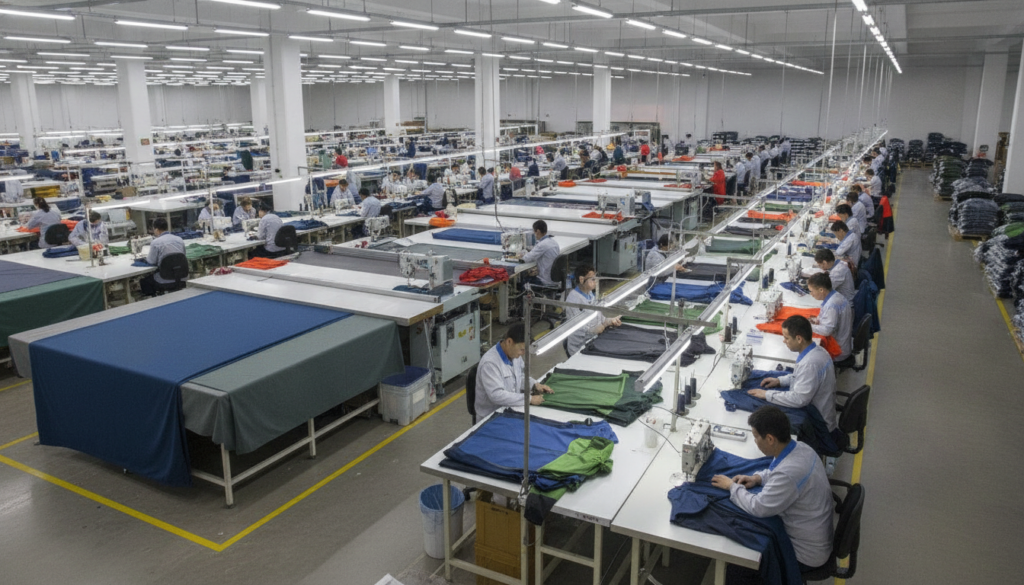
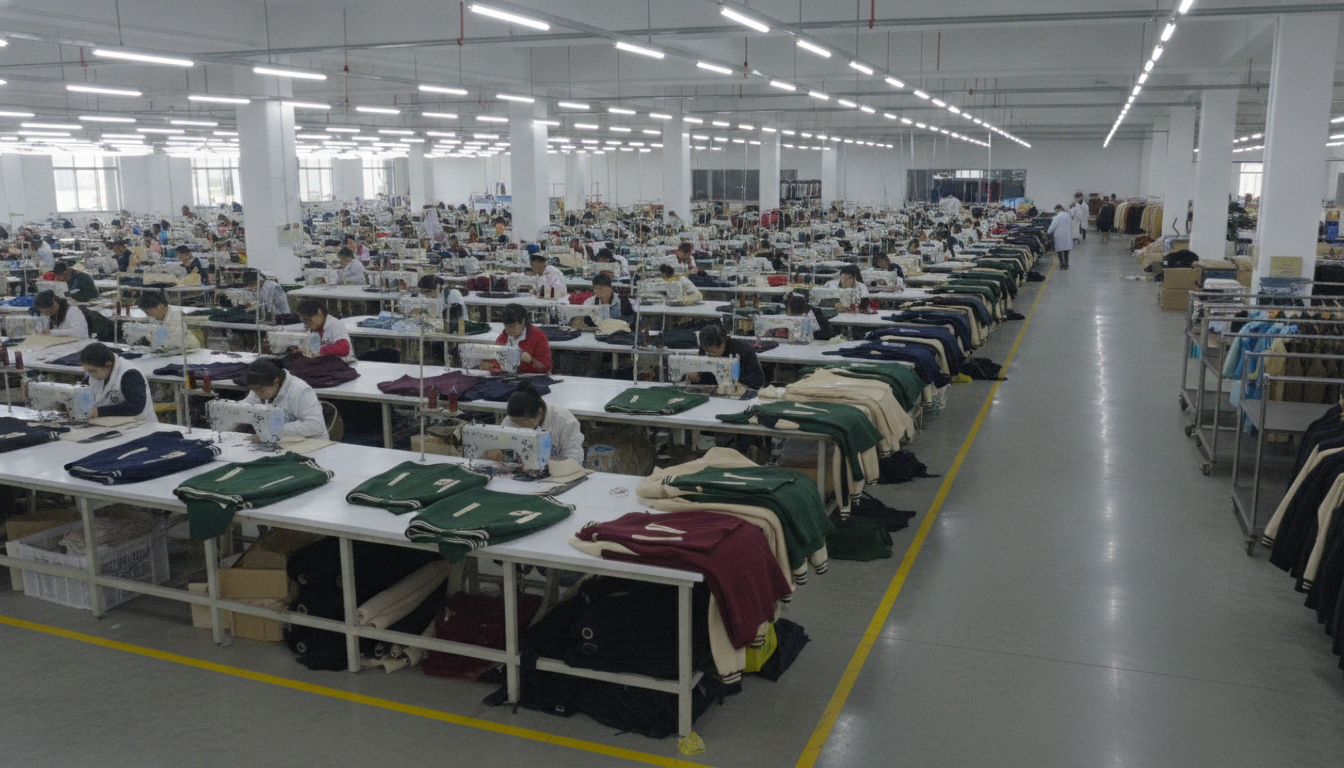
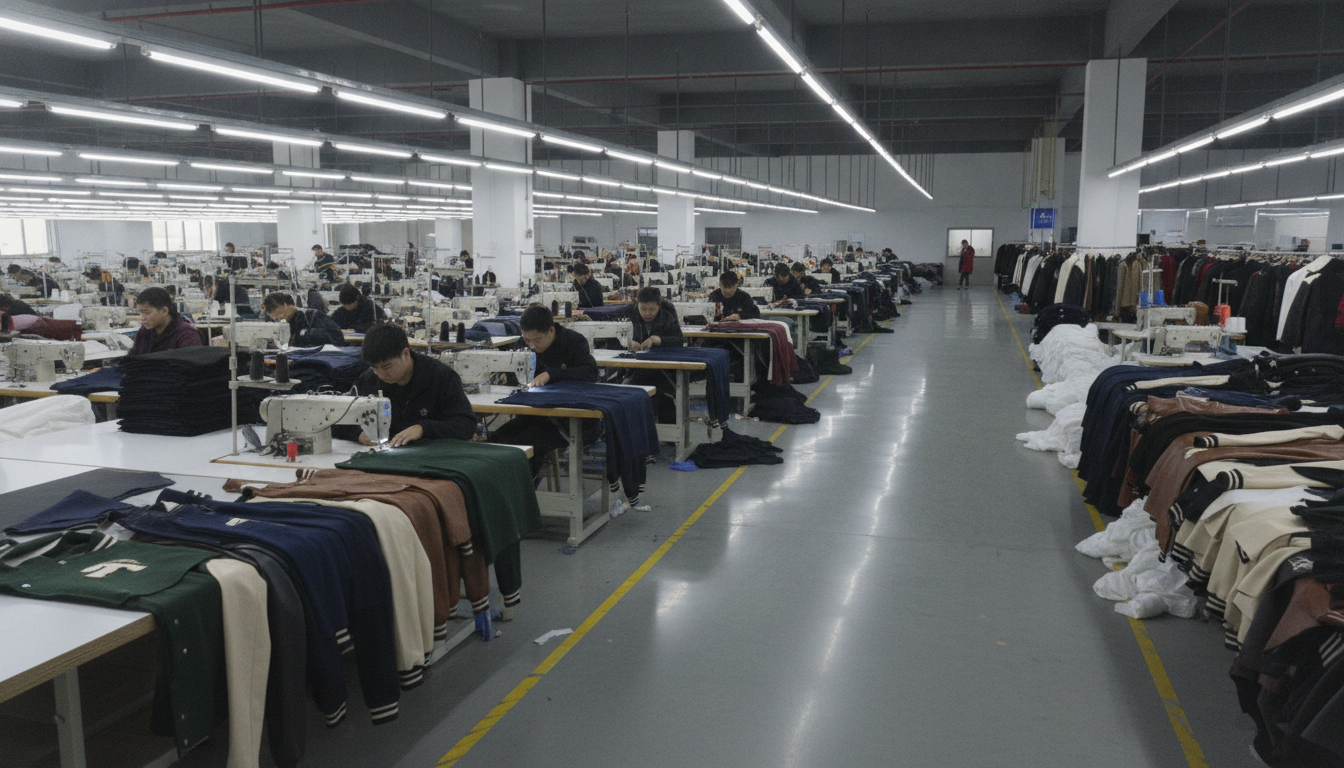
Request photos or video of the production floor showing cut-and-sew lines, pressing equipment, and QC stations. A legitimate varsity jacket manufacturer will have dedicated embroidery machines, chenille-patch sewing stations, and snap-button presses visible in documentation. Ask for annual production capacity in pieces per year. Our 3,000m² facility operates 20 production lines with 240 workers, producing approximately 200,000 jackets annually across softshell, hardshell, rain, ski, insulated, windbreaker, 3-in-1, workwear, and varsity categories. Factories unable to provide capacity figures or facility images may be trading companies rather than direct manufacturers.
MOQ and Pricing Structure for Varsity Jackets
Minimum order quantities and unit pricing vary widely across manufacturers. Understanding the tier structure helps buyers align budgets with production realities and avoid tying up cash in excessive inventory.
Sample MOQ: 1 piece. Bulk MOQ: 30 pieces per SKU. Sampling time: 7-10 days.
Sample vs. Bulk Pricing Tiers
Sample units typically cost $80-150 per piece depending on material selection and customization complexity. This higher per-unit cost reflects setup time for embroidery digitization, pattern grading, and small-lot cutting. Bulk production pricing drops significantly once MOQ thresholds are met. A 30-piece order for wool-body varsity jackets with PU sleeves, chenille patches, and embroidered logos typically ranges from $45-65 per piece FOB. Orders of 100+ pieces can reduce unit cost to $35-50, while 500+ piece orders for school uniform programs may reach $28-40 per piece.
How MOQ Affects Cash Flow for Small Brands
High MOQ requirements lock up working capital before market validation. A 100-piece minimum at $50 per unit requires $5,000 upfront, plus freight and duties. Brands with limited budgets face a choice: tie up cash in inventory risk or delay product launch. PTOUTWEAR’s 30-piece bulk MOQ reduces initial commitment to $1,350-1,950, allowing DTC brands to test colorways and sizing before scaling.
Hidden Costs: Freight, Duties, and Sample Fees
FOB pricing excludes ocean freight ($800-1,500 per container), import duties (16.5% for wool jackets under US HTS 6203.33), and sample fees. Clarify whether sample fees are refundable against bulk orders. PTOUTWEAR refunds the $100 sample fee when bulk production begins, reducing net sample cost to zero for committed buyers. Factor 25-30% on top of FOB unit cost for landed pricing in US, UK, or EU markets.
Customization Capabilities: Patches, Embroidery, and Branding
Customization defines brand differentiation in varsity jacket production. Buyers need clarity on what decoration methods are available, minimum quantities for each, and how customization affects lead times and unit cost.
Chenille Patches: Size, Placement, and Attachment
Chenille patches are the signature decoration element of varsity jackets. These raised, looped-yarn patches typically feature team letters, mascots, or brand logos in 4-8 inch sizes. Patches are sewn onto the chest, back, or sleeves using lock-stitch or satin-stitch borders. Custom chenille patches require digitization and sampling, adding 3-5 days to initial lead time. Minimum patch order is often 50-100 pieces, but some manufacturers include patch setup in bulk jacket MOQ. PTOUTWEAR’s custom logo service covers chenille patch design, digitization, and attachment within the 30-piece bulk minimum.
Direct Embroidery: Thread Count and Placement Limits
Direct embroidery applies logos or text using 6-12 thread colors on chest, sleeves, or back yoke. High-density embroidery (8,000-15,000 stitches) creates crisp detail but requires stable backing to prevent puckering on wool bodies. Embroidery placement on rib-knit trim is not recommended due to stretch distortion. Clarify stitch count limits and color-change fees when requesting quotes. Each additional thread color typically adds $0.50-1.50 per jacket.
Screen Printing and Appliqué Alternatives
Screen printing works for large back graphics or interior lining designs but does not provide the dimensional texture of chenille or embroidery. Appliqué (sewn fabric shapes) offers a middle option, combining flat fabric with satin-stitch borders for a semi-raised effect. Appliqué is faster and cheaper than chenille for simple shapes like stars, stripes, or block letters. Discuss decoration method trade-offs during sampling to balance aesthetic goals with budget constraints.
Private-Label Branding: Neck Tags and Woven Labels
Private-label buyers replace factory tags with custom woven labels, printed neck tags, or heat-transfer branding. Woven labels require minimum 500-1,000 pieces per design, making them viable only for established brands or multi-season programs. Printed satin tags have lower minimums (100-200 pieces) and work well for startups testing brand positioning. Include private-label requirements in initial RFQ to ensure the varsity jacket manufacturer has in-house labeling capabilities or partnerships with label suppliers.
Lead Times and Production Workflow
Lead time planning affects product launch schedules, seasonal inventory, and cash-flow timing. Understanding the production workflow helps buyers set realistic timelines and avoid rush fees.
Sampling Phase: 7-10 Days
Pre-production samples take 7-10 days from pattern confirmation to shipment. This phase includes fabric sourcing, cutting, sewing, and decoration application. Rush sampling (3-5 days) is available for an additional fee but may limit fabric and trim options to in-stock materials. Plan for one revision round if fit or construction adjustments are needed, adding another 7-10 days.
Bulk Production: 25-35 Days
Bulk production begins after sample approval and deposit payment (typically 30-50% of order value). The 25-35 day timeline covers fabric procurement, cutting, sewing, decoration, pressing, and final QC. Orders requiring custom-dyed fabrics or imported trims may extend to 40-45 days. Our 3,000m² Taizhou Sanmen facility with 240 workers and 20 production lines maintains 25-30 day bulk lead times for standard wool-body varsity jackets with in-stock materials.
Shipping and Customs Clearance: 15-30 Days
Ocean freight from China to US West Coast ports takes 15-20 days, East Coast 25-30 days. Add 3-5 days for customs clearance and inland transport. Air freight reduces transit to 5-7 days but increases cost by $8-15 per piece. Total time from deposit to delivery typically ranges 45-70 days for ocean freight, 35-45 days for air. Buyers targeting specific retail windows or corporate event dates should work backward from delivery deadlines to set production start dates.
Inventory Planning for Repeat Orders
Repeat orders bypass sampling and pattern development, reducing lead time to 20-25 days for production plus shipping. Buyers placing seasonal orders (fall team gear, spring school uniforms) should forecast 60-90 days ahead to avoid peak-season capacity constraints. Our low MOQ jacket manufacturing model allows brands to reorder proven SKUs in 30-piece increments, minimizing excess inventory while maintaining stock availability.
Key Takeaways
- Authentic varsity jacket construction requires wool melton bodies, leather or PU sleeves, and rib-knit trim at collar, cuffs, and waistband.
- Sample MOQ of 1 piece with refundable fees enables market validation before bulk commitment, reducing financial risk for small brands.
- Bulk MOQ of 30 pieces per SKU lowers entry barriers compared to 100-piece minimums common among competitors.
- Chenille patches, direct embroidery, and appliqué customization are standard offerings, with decoration costs adding $3-8 per jacket depending on complexity.
- ISO 9001, SGS, and PFC-Free DWR certifications provide third-party validation of quality systems and chemical compliance for US, UK, and EU markets.
- Total lead time from deposit to delivery typically ranges 45-70 days for ocean freight, including 7-10 day sampling, 25-35 day production, and 15-30 day shipping.
FAQ
What is the difference between a varsity jacket and a bomber jacket?
Varsity jackets use wool melton bodies with contrasting leather or PU sleeves, rib-knit trim, and snap-button closures, creating a structured collegiate aesthetic. Bomber jackets use uniform nylon or polyester shell fabric throughout, elastic cuffs and waistband, and zipper fronts, resulting in a streamlined military-inspired silhouette. The material contrast and trim style are the defining structural differences.
Can I order varsity jackets with waterproof shells instead of wool?
Waterproof shells eliminate the wool-body construction that defines varsity jackets, creating a hybrid style closer to a technical bomber or coach jacket. Some manufacturers offer polyester twill or nylon bodies with water-resistant coatings, maintaining the varsity aesthetic while adding weather protection. Clarify fabric weight, waterproof rating, and breathability requirements during sampling to ensure the final product meets performance expectations without losing the varsity visual identity.
How do I verify a factory is not a trading company?
Request factory floor photos showing cut-and-sew lines, embroidery machines, pressing equipment, and QC stations with visible production activity. Ask for business license documentation listing manufacturing scope, not just trading or import-export services. Video calls showing live production runs provide additional verification. Trading companies often lack in-house equipment and rely on third-party subcontractors, increasing quality-control risk and communication delays.
Ready to source varsity jackets with 1-piece sample MOQ and 30-piece bulk minimums?
Request samples and pricing →
Written by Ivan Chen, Sales Engineer at PTOUTWEAR – 13 years in outdoor apparel manufacturing.