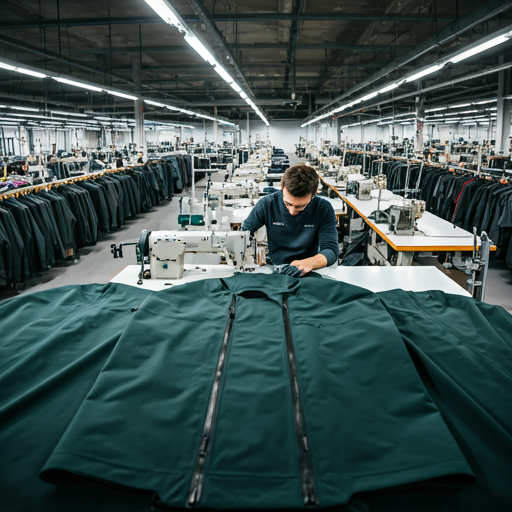
Buyer Guide · Fabric Selection

There Is No Best Shell Fabric —
Only the Right One for Your End Use

A 28,000mm 3-layer laminate on a commuter jacket is money your customer will never feel. A 5,000mm 2-layer on an alpine program is a warranty claim waiting to happen. This is the matrix we walk buyers through before we quote.

30-Piece Low MOQ 1-Piece Sample $100 Fully Refundable
Quote within 1 Business Day · Sample in 7-10 Days

How to Read the Numbers on This Page

Industry Benchmark

Published data from GORE-TEX technical white papers, brand technical manuals (Mountain Equipment, Rab, Arc'teryx) and ISO test standards. Cited where used. These are the fabric brand's and the standards bodies' figures — not measurements of our fabric.

Our Build Spec

What we actually produce and test. Every figure comes from the SGS report on the specific fabric lot we quote you — not from a benchmark, not from an average. Where a cell reads [TEST REPORT PENDING], we have not tested it yet and we will not put a number there.

Step 1 — Start From End Use, Not the Spec Sheet

Answer these four before you look at any number. Your answers put the program in one of three tiers, and everything below is organised by that tier.

1

Exposure Time

minutes / hours / days

Minutes (commute, dash to the car), hours (day hike, spectator, worksite shift), or days (multi-day traverse, expedition). This single answer eliminates two of the three tiers for most programs.

2

Metabolic Output

drives breathability

Low and steady (walking, standing), variable (hiking with a pack), or high and sustained (ski touring, trail running). High output is what makes breathability worth paying for — and what makes pit zips worth their cost.

3

Abrasion Load

drives construction

None, pack straps and harness, or rock and ice tools and hardware. Abrasion is the axis that decides 3L versus 2.5L far more often than waterproofness does.

4

Price Ceiling per Unit

most often left blank

This is the axis most incoming tech packs leave blank, and it is the one that decides the other three. Tell us the ceiling and we will tell you which trade-offs it forces.

Step 2 — The Parameter Matrix

AxisTier 1 — Extreme / ProfessionalTier 2 — Comfort BalanceTier 3 — Urban / Value
Hydrostatic head (ISO 811, mmH₂O)Benchmark >28,000mm (GORE-TEX Pro class) · Our build spec: [TEST REPORT PENDING]Benchmark >20,000mm (Performance class) · Our build spec: [TEST REPORT PENDING]Benchmark 5,000–10,000mm typical retail claim · Our build spec: [TEST REPORT PENDING]
Breathability — RET (ISO 11092, lower is better)Benchmark RET <6Benchmark RET 6–9Benchmark RET 9–13
Breathability — MVTR (g/m²/24h)Benchmark >25,000 quoted for alpine-grade membranesBenchmark >15,000 quoted for performance-gradeBenchmark 5,000–10,000 typical
Laminate construction3L — face + membrane + tricot backer, bonded. Membrane fully protected.3L, or 2.5L where packed weight is the selling point2L with hanging liner, or 2.5L for packability
Fabric weight range130–200 gsm (benchmark band for 3L alpine shells)100–150 gsm80–120 gsm for 2.5L; 2L varies with liner
Seam sealingFully taped, every seam. Wide tape on primary seams, reinforced at shoulder and cuff on alpine specs.Fully tapedCritically taped (shoulder, hood, chest) or fully taped — a real cost decision
Face fabric / abrasionHigh-tenacity nylon, ripstop, higher denier at wear zonesMid-weight polyester or nylonLightweight polyester — softer hand, quieter
DWRPFAS-free DWR (PFC-free DWR held from our mill)PFAS-free DWRPFAS-free DWR
FitsHigh-altitude climbing, polar, sustained storm work3-season hiking, mountain traverse, general outdoor retailRain commute, cycling to work, campus, corporate and team outerwear

Sources for the benchmark column: W.L. Gore & Associates, GORE-TEX ePE Membrane Technology White Paper (2023); Mountain Equipment, GORE-TEX Product Construction & Performance Technical Manual; Outside, "The Definitive Guide to GORE-TEX Technologies 2025"; ISO 811 (hydrostatic head, textiles); ISO 11092:2014 (RET). These are third-party published figures, not measurements of our fabric.

⚠️ Check This Before You Compare Any Two MVTR Numbers

MVTR is measured by several different methods — JIS L 1099 A-1, JIS L 1099 B-1, ISO 15496, ASTM E96 upright and inverted — and they return different numbers for the same fabric. A "20,000g" from one method and a "20,000g" from another are not the same fabric performance. When you compare quotes from two suppliers, ask both for the test method, not only the number. If a supplier cannot tell you the method, the number is decoration.

RET (ISO 11092) is the more comparable of the two, because there is one method behind it. That is why alpine brands quote RET and mass-market listings quote MVTR.

Step 3 — Recommended Build by Tier

No tier is better than another. Each is the correct answer to a different end use.

Tier 1 — Extreme Environment, Professional Protection

altitude · polar · storm work

Build: 3L laminate, high-tenacity face fabric, fully taped with wide tape on primary seams and reinforcement at shoulder and cuff, waterproof zippers, helmet-compatible hood, articulated sleeve.

Why 3L: the membrane is bonded on both sides, so pack straps, harness and rock abrasion never reach it. Longest service life of the three constructions.

Cost consequence: highest fabric cost, highest labour minutes (taping every seam plus reinforcement), and the tightest QC window — this is where taping quality decides your warranty rate.

Our capability: 5 seam-taping machines and 3 waterproof-zipper machines on site. Fully taped construction is not outsourced.

Tier 2 — Low-to-Mid Altitude, Comfort Balance

widest-selling tier

Build: 3L for durability-led programs, 2.5L where packed volume and weight are the selling point. Fully taped either way. Pit zips earn their cost here more than in any other tier, because output is variable.

Why this tier sells widest: most retail buyers of outdoor shells are buying for 3-season hiking and general outdoor use, not for altitude. Over-specifying into Tier 1 adds cost the end customer cannot perceive.

State this explicitly in your tech pack: 2.5L saves weight, packed volume and cost, at the price of abrasion life and next-to-skin feel. Say which one you are optimising for; do not leave the factory to guess.

Tier 3 — Urban Commuter and Value Programs

exposure measured in minutes

Build: 2L with a hanging liner (softest hand, most "normal jacket" feel) or 2.5L for packability. Critically taped or fully taped depending on the price ceiling.

Why the lower number is the right number here: exposure is minutes, not hours. Hand feel, quietness and how the jacket looks over office clothes drive returns and reviews far more than the last 10,000mm of hydrostatic head.

Fluorine-free DWR maintenance matters most in this tier, because urban buyers launder their jackets like normal clothing. Plan the care label accordingly.

Step 4 — The Five Selection Errors We See Most

Taken from tech packs that actually arrive in our inbox.

1

Buying Hydrostatic Head, Ignoring Breathability

A 20,000mm shell with RET 13 will feel wet inside on a two-hour hike, and your end customer will report it as "leaking". They are not wrong about the experience, only about the cause.

2

Comparing MVTR Numbers From Different Test Methods

The most common way two quotes get compared incorrectly. Ask for the method with every number, or you are comparing nothing.

3

Specifying 3L for a Tier 3 Program

Pays for abrasion resistance the end use never applies, and makes the jacket stiffer and noisier. On a commuter jacket that is a downgrade in the customer's experience, not an upgrade.

4

Leaving Seam Sealing Unspecified

"Waterproof" with untaped seams is a rain-resistant jacket. Needle holes break membrane continuity; if the seams are not sealed, the number on the fabric is irrelevant. Write fully taped or critically taped into the tech pack explicitly — and for critically taped, name the seams.

5

Treating DWR as a Permanent Property

DWR is consumable. Its decay is what the end customer experiences first, usually inside the first season. Plan for it in your care label and your customer-service scripts, not only in your spec.

What We Need From You to Quote Against This Matrix

tune

Tier or End Use

The tier, or your four answers from Step 1. If you are unsure, send the end use and we will place it.

science

Target Performance

Hydrostatic head and breathability — with the test method. Plus laminate construction (2L / 2.5L / 3L) and seam sealing level.

request_quote

Commercials

Target FOB price per unit, order quantity, colours, size range and decoration method. MOQ is 30 pieces; single-piece samples are $100, refunded against a bulk order.

We quote fabric against your spec and test the lot. We do not carry one fixed "our fabric" number, because the right fabric changes with the tier. Every performance figure that goes on your spec sheet comes from the SGS report on the lot we run for you. Sample lead time 7–10 days; bulk 25–35 days after deposit.

The Technical Detail Behind Each Axis

Send Us the End Use — We'll Send Back the Spec

MOQ 30 pieces. One-piece sample $100, refunded on your first production order.

Get a Spec Quote

Quote My Spec

Product Types Interested In (Select multiple):

👋 Need OEM/wholesale jackets? Get a factory quote.