A bomber jacket manufacturer produces bomber-style outerwear for brands, retailers, corporate buyers, and school programs through OEM or private-label arrangements. PTOUTWEAR offers 1-piece sample MOQ, 30-piece bulk MOQ per SKU, and 7-10 day sampling from our 3,000m² Taizhou Sanmen facility with ISO 9001 and SGS certification.
📋 Table of Contents
Executive Summary
- Market context: Bomber jackets span fashion, workwear, corporate uniform, and school outerwear categories, creating demand across multiple buyer segments.
- MOQ flexibility: Sample MOQ starts at 1 piece with a refundable fee, bulk production requires 30 pieces per SKU, and dropshipping fulfillment is available for 1-piece orders.
- Fabric scope: Manufacturers offer polyester, nylon, cotton blends, insulated options, and waterproof constructions with PFC-free DWR treatments.
- Customization depth: Buyers can specify lining changes, embroidery placement, zipper hardware, fabric upgrades, and fit adjustments beyond basic logo application.
- Production timeline: Sampling takes 7-10 days, bulk production runs 25-35 days, and rush orders of 1,000 pieces can be completed in 2 weeks at a 25% surcharge.
What Defines Bomber Jacket Manufacturing?
Bomber jacket manufacturing centers on producing short-waisted, zip-front jackets with ribbed cuffs and hem, originally designed for military pilots and now adapted for fashion, workwear, and team uniforms. The style balances a relaxed fit through the body with snug elastic closures at wrists and waist.
Core Construction Elements
A bomber jacket requires specific pattern engineering to achieve the characteristic silhouette. The ribbed waistband and cuffs use knit fabric inserts, typically 2×2 rib or 1×1 rib in polyester-spandex blends, sewn with coverstitch machines to maintain stretch recovery. The front zipper runs from hem to collar, with most manufacturers offering metal, plastic, or reversed-coil options depending on the buyer’s aesthetic and budget.
Shoulder construction differs from technical outerwear. Bomber jackets use set-in sleeves with minimal ease, creating a closer fit that restricts layering compared to raglan or articulated-sleeve designs common in hardshell jackets. Buyers sourcing for outdoor use often request gusseted underarms or action-back pleats to improve range of motion, though these modifications shift the garment away from traditional bomber proportions.
Material Categories
Manufacturers segment bomber jackets by shell fabric weight and performance. Lightweight fashion bombers use 100-150 GSM polyester or nylon taffeta with no insulation, relying on the ribbed closures to trap body heat. Mid-weight options add 60-100 GSM polyester wadding or synthetic down, bringing the total garment weight to 400-600 grams. Heavy-duty workwear bombers specify 200-300 GSM outer shells with quilted linings, targeting durability over packability.
Waterproofing is not standard. Most bomber jackets ship with water-repellent coatings that bead light rain but fail under sustained exposure. Buyers requiring genuine rain protection need to specify a waterproof-breathable membrane laminate or a coated fabric with sealed seams, both of which increase unit cost and shift the garment into technical outerwear pricing tiers.
Market Positioning
Bomber jackets occupy a middle ground between casual fashion and functional outerwear. Fashion brands prioritize color variety, seasonal fabric updates, and trend-driven details like oversized fits or cropped lengths. Corporate and school buyers focus on durability, consistent sizing across reorders, and decoration-friendly fabrics that hold embroidery without puckering. OEM jacket manufacturing workflows must accommodate both priorities, often running fashion-led and utility-led SKUs through separate production lines to maintain quality control on each.
MOQ and Sampling Requirements
Minimum order quantities determine which buyers can access a bomber jacket manufacturer. Sample MOQ and bulk MOQ operate on different scales, with sampling designed for product validation and bulk production structured around cutting-table efficiency.
Sample MOQ: 1 piece. Bulk MOQ: 30 pieces per SKU. Sampling time: 7-10 days.
Sample Development Process
A 1-piece sample allows buyers to validate fit, fabric hand-feel, and construction quality before committing to bulk. The sample fee covers pattern drafting, cutting a single ply, and hand-finishing details that would be machine-automated in production. PTOUTWEAR charges a $100 sample fee, refundable against the first bulk order, and delivers within 7-10 days from tech-pack approval.
Buyers should request samples in the actual production fabric, not a substitute. Some manufacturers offer cheaper sampling in stock fabrics to reduce cost, but this introduces risk when the bulk fabric behaves differently during cutting, sewing, or finishing. A sample in the correct fabric reveals issues like seam slippage, dye migration, or pilling before the cutting room processes hundreds of meters.
Bulk Production Minimums
The 30-piece per SKU minimum reflects cutting-table economics. A single-ply cut of one jacket takes the same labor time as a 30-ply spread, but the per-unit cost drops by a factor of 30 when the cutter can stack and cut multiple layers simultaneously. Buyers requesting smaller runs pay a premium to cover the fixed setup cost across fewer units.
Dropshipping and print-on-demand services operate at 1-piece fulfillment, but these models use pre-cut stock blanks with on-demand decoration, not true made-to-order manufacturing. A buyer wanting custom fabric, unique lining, or fit modifications must meet the 30-piece threshold to justify custom pattern grading and cutting.
Multi-SKU Order Strategies
Brands launching with limited capital can meet the 30-piece minimum by splitting across sizes within one colorway rather than ordering 30 units of a single size. A typical size run for adult unisex bombers is S, M, L, XL, XXL, with a 2-4-6-4-2 ratio (2 smalls, 4 mediums, 6 larges, 4 extra-larges, 2 double-extra-larges) totaling 18 pieces. Doubling that ratio yields 36 pieces, satisfying the MOQ while providing inventory depth in core sizes.
Fabric and Construction Options
Fabric selection determines the bomber jacket’s performance, durability, and price point. Buyers choose from non-insulated shells, insulated constructions, and waterproof laminates depending on end-use requirements.
Shell Fabric Types
Polyester taffeta dominates fashion bomber production due to low cost, wide color availability, and smooth surface finish. Weights range from 100 GSM (lightweight, packable) to 200 GSM (structured, wind-resistant). Nylon taffeta offers better abrasion resistance and a softer hand but costs 15-20% more per meter. Cotton-polyester blends provide natural fiber aesthetics with reduced wrinkling, though they absorb water and dry slowly compared to synthetics.
Insulation Options
Insulated bombers add warmth without the bulk of traditional winter jackets. Polyester wadding in 60-100 GSM weights provides moderate insulation at low cost, suitable for fall and spring wear in temperate climates. Synthetic down (hollow-fiber polyester) offers better warmth-to-weight ratio and maintains loft when wet, though it costs more and requires quilting channels to prevent migration.
Natural down fill is rare in bomber jackets due to the garment’s short length and fashion-forward positioning. Buyers targeting premium outdoor markets sometimes specify 80/20 duck down in 40-60 fill-power ratings, but the short torso length limits the jacket’s effective warmth compared to longer parka or puffer styles.
Waterproofing and DWR Treatments
Water-repellent finishes use durable water repellent (DWR) chemistry applied to the fabric surface. PFC-free DWR formulations avoid perfluorinated compounds, addressing environmental and regulatory concerns in European and North American markets. These treatments cause water to bead and roll off the fabric surface but do not prevent water penetration under pressure or sustained exposure.
True waterproofing requires a laminated or coated construction. Polyurethane (PU) coatings on the fabric reverse provide a waterproof barrier at low cost but reduce breathability and can delaminate after repeated washing. Waterproof-breathable membranes like generic 2-layer or 2.5-layer laminates add significant cost but enable genuine rain protection, shifting the bomber into technical outerwear pricing tiers.
Lining and Interior Finishes
Lining fabric affects comfort, warmth, and garment longevity. Polyester taffeta linings in 60-80 GSM weights provide smooth interior finish and easy on-off wear. Mesh linings improve breathability for active use but offer no insulation. Quilted linings with thin wadding add warmth and visual texture, popular in varsity and team jacket applications.
Buyers can specify custom lining prints, contrast colors, or branded interior labels. Many manufacturers limit lining customization to stock options unless the order exceeds 500 pieces, as custom lining fabric requires separate dyeing and printing runs that are not economical at small scale.
Customization Capabilities
Customization extends beyond logo placement to include fit adjustments, hardware selection, and fabric upgrades. The depth of available customization depends on the manufacturer’s vertical integration and minimum order quantity.
Logo and Branding Methods
Embroidery is the most durable decoration method for bomber jackets, with thread penetrating the fabric to create raised designs that survive commercial washing. Standard embroidery placement includes left chest, right chest, back yoke, and sleeves. Complex designs with gradients or fine detail require digitizing fees and may not reproduce well on textured or stretchy fabrics.
Screen printing offers lower per-unit cost for large, simple designs but sits on the fabric surface rather than penetrating it, making it prone to cracking and fading. Heat-transfer vinyl works for small runs and full-color designs but adds stiffness and can peel after repeated washing. Buyers should request a decorated sample to verify how the chosen method performs on the actual production fabric.
Fit and Pattern Modifications
Standard bomber patterns use athletic fits with narrow shoulders and short torsos. Buyers can request pattern adjustments to lengthen the body, widen the shoulders, or add ease through the chest for layering. Each pattern modification requires new grading across the size range, which manufacturers typically charge as a one-time development fee amortized across the order quantity.
Common fit complaints include torsos that ride up during activity and restrictive shoulder movement. Adding 2-3 cm to the back length and incorporating a bi-swing back pleat addresses both issues without drastically altering the bomber silhouette. Buyers targeting outdoor or workwear markets should test these modifications in the sample stage rather than discovering fit problems after bulk production.
Hardware and Trim Selection
Zipper quality directly impacts garment longevity. YKK zippers cost more but offer consistent performance and easy replacement if a slider fails. Generic zippers reduce unit cost by 10-15% but show higher failure rates in the field. Buyers should specify zipper brand, size (typically #5 for bomber jackets), and finish (antique brass, gunmetal, nickel, matte black) in the tech pack.
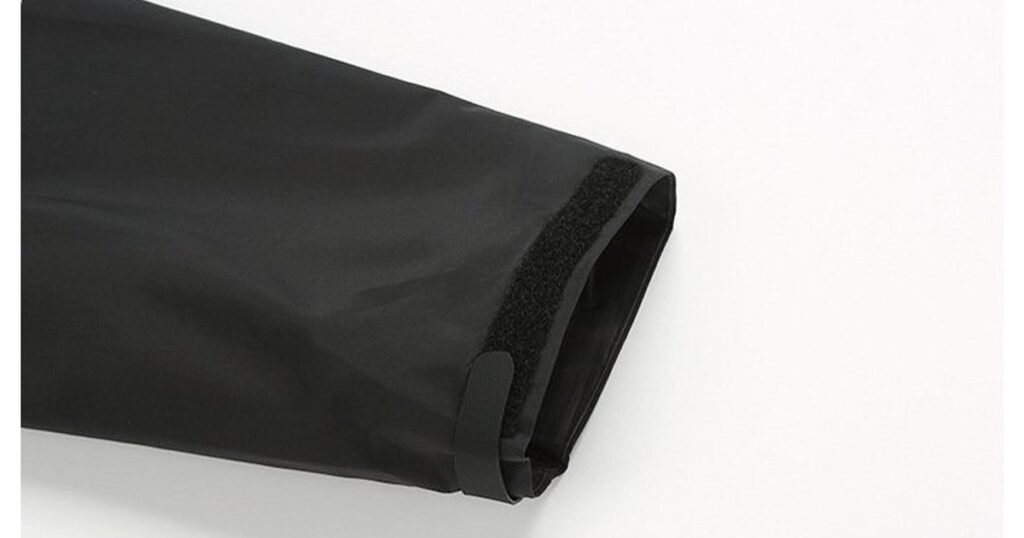
Ribbing at cuffs and hem uses knit fabric inserts, typically acrylic-spandex or polyester-spandex blends in 2×2 or 1×1 rib construction. Standard ribbing is 5-7 cm wide at cuffs and 7-10 cm at the hem. Buyers can specify contrast-color ribbing or striped patterns, though custom knit colors require minimum quantities of 500-1,000 meters depending on the knitting mill’s setup.
Interior and Pocket Features
Interior pockets add functionality but increase labor cost. Welt pockets with zipper closures provide secure storage for phones and wallets, while simple patch pockets reduce sewing time and cost. Buyers should specify pocket placement, size, and closure type in the tech pack, as adding pockets after pattern approval requires rework.
Some manufacturers offer modular customization menus where buyers select from pre-approved options (three zipper finishes, four lining colors, two pocket styles) rather than fully custom specs. This approach reduces development time and maintains quality control by limiting variables, though it constrains design flexibility for buyers wanting unique differentiation.
Quality Control and Certifications
Quality control in bomber jacket manufacturing addresses construction consistency, fabric performance, and compliance with buyer specifications. Certifications provide third-party verification of manufacturing standards and chemical safety.
In-Line and Final Inspection Protocols
In-line inspection catches defects during production before they compound. Inspectors check stitch density (typically 12-14 stitches per inch for structural seams), seam straightness, and pattern alignment at each workstation. Catching a misaligned zipper during assembly costs minutes to correct, while discovering it during final inspection requires complete garment disassembly and rework.
Final inspection uses AQL (Acceptable Quality Limit) sampling standards to determine batch acceptance. AQL 2.5 is common for fashion and promotional wear, allowing 2.5 defects per 100 garments. Workwear and uniform buyers often specify AQL 1.5 or 1.0 for tighter quality control, which increases inspection time and cost but reduces field failures.
Fabric Testing and Performance Verification
Buyers should request fabric test reports before approving bulk production. Colorfastness testing verifies that dyes do not bleed or fade during washing, critical for garments that will be laundered frequently. Abrasion resistance testing (Martindale method) measures how many cycles the fabric withstands before showing wear, important for workwear applications where elbow and shoulder contact is constant.
Water-repellent performance is measured by spray rating, with higher ratings indicating better beading and shedding. A rating of 80 or above is considered good for casual outdoor use, while ratings below 50 show rapid water absorption. Buyers specifying PFC-free DWR should verify the treatment chemistry through supplier documentation, as some manufacturers claim PFC-free status without third-party verification.
Manufacturing and Chemical Safety Certifications
ISO 9001 certification verifies that a manufacturer maintains documented quality management systems. It does not guarantee product quality but indicates consistent processes for handling orders, tracking defects, and managing corrective actions. PTOUTWEAR holds ISO 9001 and SGS certification, with PFC-free DWR verification on request.
OEKO-TEX Standard 100 tests finished textiles for harmful substances, providing assurance that fabrics meet strict limits for chemicals like formaldehyde, heavy metals, and pesticides. BSCI (Business Social Compliance Initiative) audits verify labor practices and working conditions. Both certifications are pending for PTOUTWEAR and not yet held, though buyers can request documentation of current compliance practices.
Sizing Consistency Across Production Runs
Sizing variation between production runs creates reorder problems for corporate and school buyers. A medium jacket from the first order that measures 58 cm chest width should measure the same in the reorder six months later. Manufacturers maintain this consistency through pattern archiving and cut-to-measurement protocols, where each ply is verified against the master pattern before cutting.
Buyers should retain a sample garment from each production run as a physical reference for future orders. When placing a reorder, send the reference sample back to the factory for measurement comparison before cutting begins. This catches pattern drift before it affects the full batch.
Lead Times and Production Capacity
Production timelines determine how quickly buyers can bring product to market. Lead times split into sampling, bulk production, and shipping phases, each with distinct variables and acceleration options.
Sampling Timeline
A 7-10 day sampling window assumes the buyer provides a complete tech pack with fabric specifications, construction details, and trim callouts. Incomplete or ambiguous specs extend sampling time as the factory requests clarifications. Buyers should use standardized tech-pack templates that include measurement charts, construction diagrams, and trim specifications to minimize back-and-forth.
Fabric procurement is the most common sampling delay. If the buyer specifies a custom fabric that the manufacturer does not stock, the factory must order a minimum yardage from the mill, which can add 10-15 days. Using stock fabrics for the first sample, then switching to custom fabric for bulk production, accelerates the validation cycle.
Bulk Production Timeline
Bulk production runs 25-35 days from deposit to ex-factory date. This includes fabric procurement (7-10 days), cutting and sewing (10-14 days), finishing and inspection (3-5 days), and packing (2-3 days). Rush production is available for orders of 1,000 pieces or more, compressing the timeline to 2 weeks at a 25% surcharge.
Production delays most often stem from fabric availability. Mills prioritize large orders, so a 500-meter fabric order for a small jacket run may wait behind a 5,000-meter order for another customer. Buyers with firm delivery deadlines should confirm fabric lead time separately before finalizing the production schedule.
Shipping and Logistics
DDP (Delivered Duty Paid) shipping transfers customs clearance and import duty responsibility to the manufacturer, simplifying logistics for the buyer. Air freight delivers in 5-7 days but costs significantly more than ocean freight, which takes 25-35 days depending on port routing. Buyers should calculate total landed cost (unit price plus freight plus duty) rather than comparing FOB prices alone.
Consolidation services allow small buyers to share container space with other orders, reducing per-unit freight cost. A 30-piece bomber jacket order occupies minimal cubic volume, making solo air freight expensive but shared ocean freight economical if the buyer can tolerate the longer transit time.
Production Capacity and Scalability
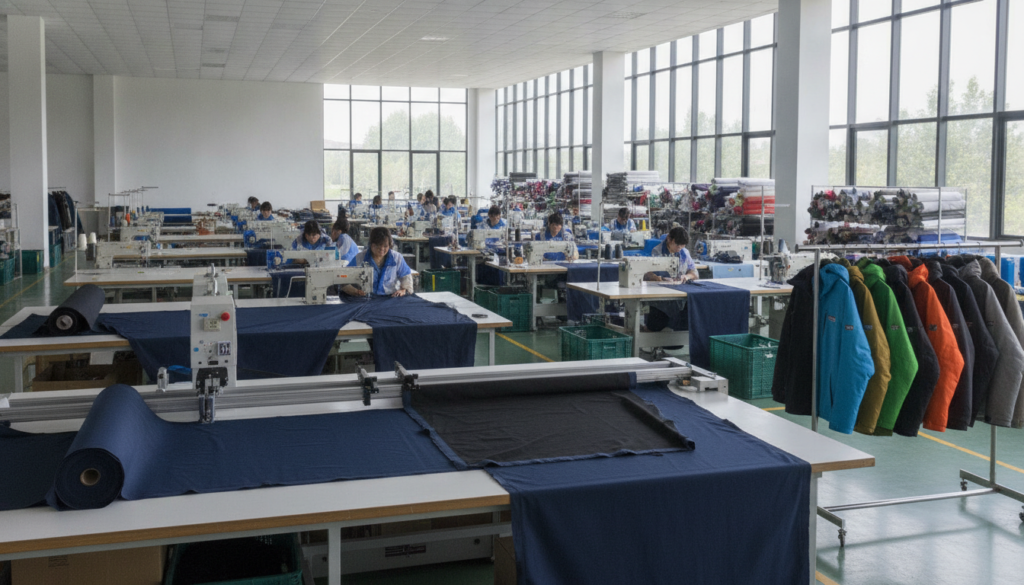
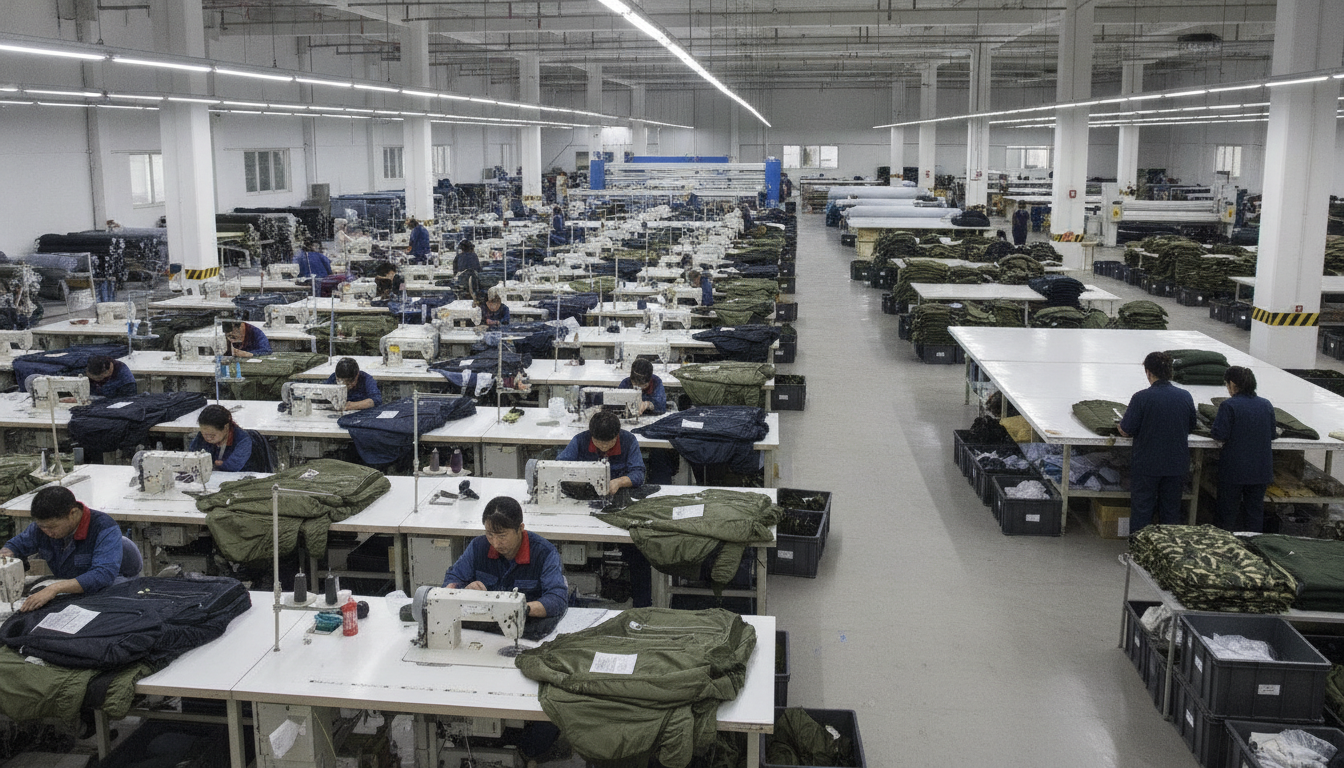
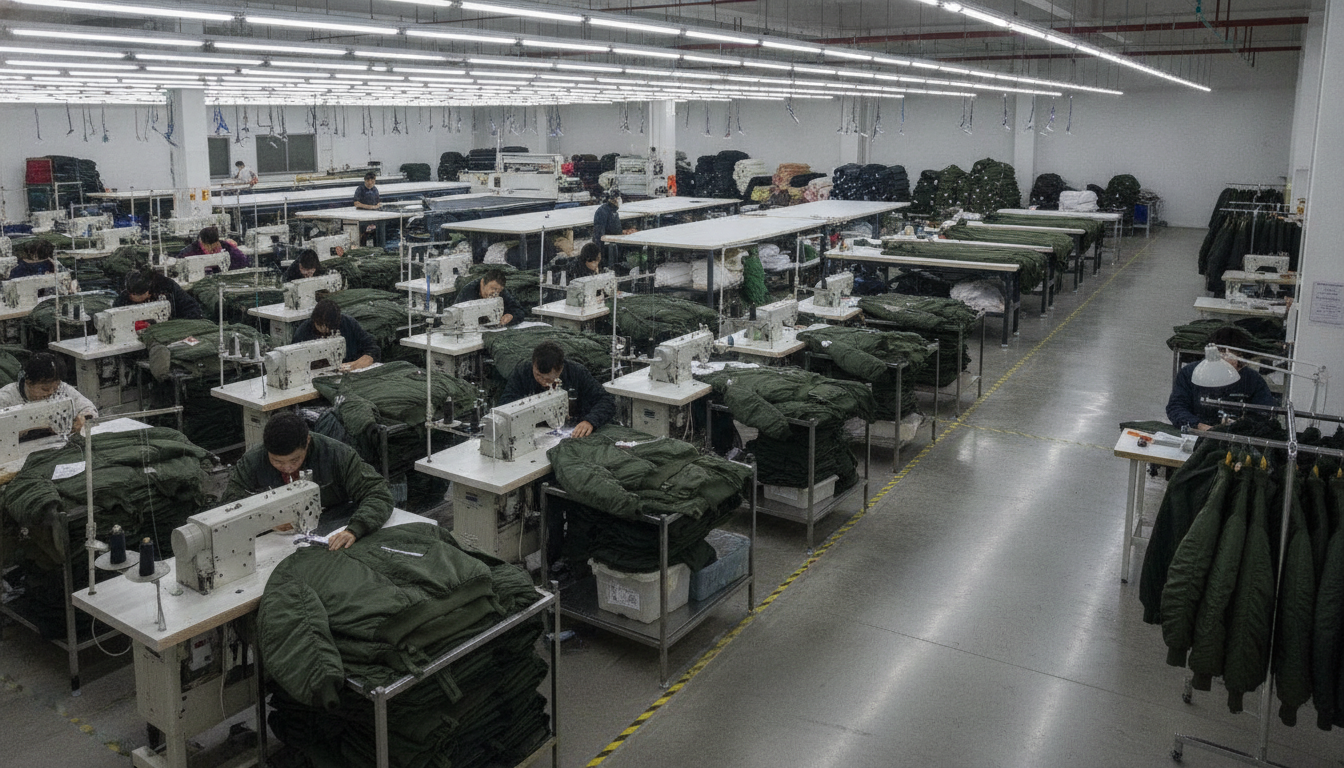
PTOUTWEAR operates a 3,000m² facility in Taizhou Sanmen with 240 workers across 20 production lines, producing approximately 200,000 pieces per year. This capacity supports both small-batch sampling and larger production runs, with the ability to scale individual orders from 30 pieces to several thousand depending on seasonal demand.
Buyers planning seasonal launches should book production slots 60-90 days in advance during peak periods (August-October for fall/winter, February-April for spring/summer). Last-minute orders risk delays as cutting tables and sewing lines fill with scheduled work.
Key Takeaways
- A bomber jacket manufacturer produces short-waisted, zip-front jackets with ribbed cuffs and hem, serving fashion, workwear, corporate uniform, and school outerwear markets through OEM and private-label arrangements.
- Sample MOQ starts at 1 piece to validate fit and construction, while bulk production requires 30 pieces per SKU to justify cutting-table efficiency and pattern grading costs.
- Fabric options range from 100 GSM polyester taffeta for lightweight fashion bombers to 200+ GSM cotton-poly blends for workwear, with insulation, waterproofing, and PFC-free DWR treatments available as upgrades.
- Customization extends beyond logo placement to include fit modifications, lining changes, hardware selection, and interior pocket features, though deep customization requires higher order quantities to justify tooling and setup costs.
- Quality control uses in-line inspection during production and AQL sampling at final inspection, with fabric testing for colorfastness, abrasion resistance, and water-repellent performance available on request.
- Production timelines run 7-10 days for sampling and 25-35 days for bulk, with rush options available for orders of 1,000 pieces or more at a 25% surcharge, and DDP shipping simplifying customs clearance for international buyers.
FAQ
Can bomber jackets be made waterproof or just water-resistant?
Bomber jackets can be made genuinely waterproof using laminated or coated fabrics, though most standard bombers ship with water-repellent DWR treatments that bead light rain but fail under sustained exposure. True waterproofing requires a polyurethane coating or waterproof-breathable membrane, plus sealed seams, which increases unit cost and shifts the garment into technical outerwear pricing. Buyers should specify the required water-column rating (typically 5,000mm minimum for rain protection) and request a spray-test report to verify performance before bulk production.
How do I verify a bomber jacket manufacturer before placing a bulk order?
Request a 1-piece sample in your actual production fabric to validate construction quality, fit, and fabric hand-feel before committing to bulk. Check for consistent stitch density, straight seams, and proper zipper alignment, and test the sample through a wash cycle to verify colorfastness and dimensional stability. Ask for factory photos showing cutting tables, sewing lines, and inspection areas, and request copies of certifications like ISO 9001 or SGS to confirm manufacturing standards. Buyers can also request a video call to tour the facility remotely and verify production capacity claims.
What customization options are available beyond adding a logo?
Buyers can specify lining fabric changes, contrast-color ribbing, custom zipper finishes, interior pocket additions, and fit modifications like lengthened torsos or wider shoulders. Embroidery placement extends beyond standard left-chest positions to include back yokes, sleeves, and interior labels, while fabric upgrades allow switching from polyester taffeta to nylon ripstop or adding insulation layers. Deep customization like unique lining prints or branded hardware typically requires order quantities above 500 pieces to justify setup costs, though custom logo services accommodate smaller runs for standard decoration methods.
Ready to validate your bomber jacket design with a 1-piece sample?
Request samples and tech pack review →
Written by Ivan Chen, Sales Engineer at PTOUTWEAR, 13 years in outdoor apparel manufacturing.