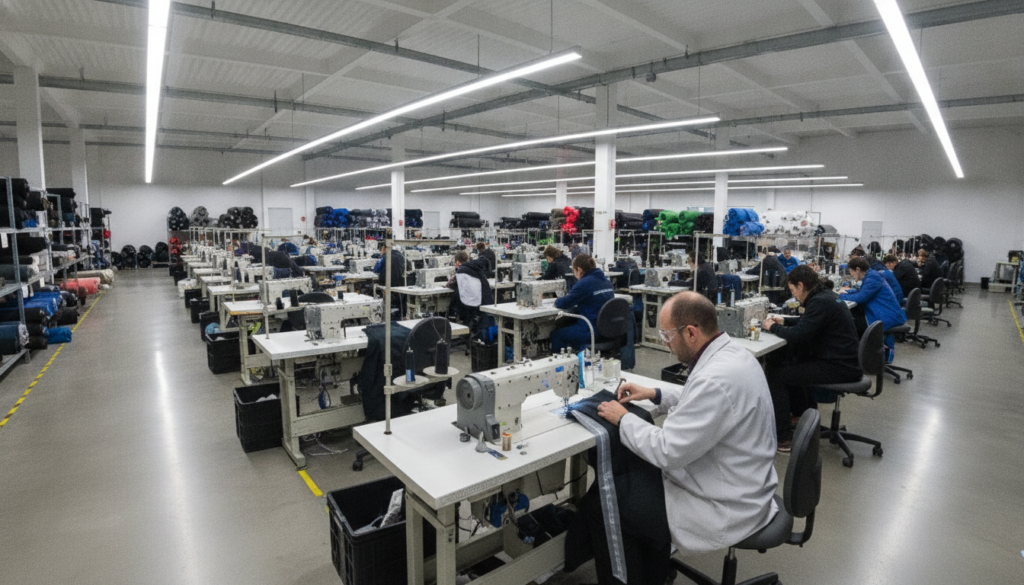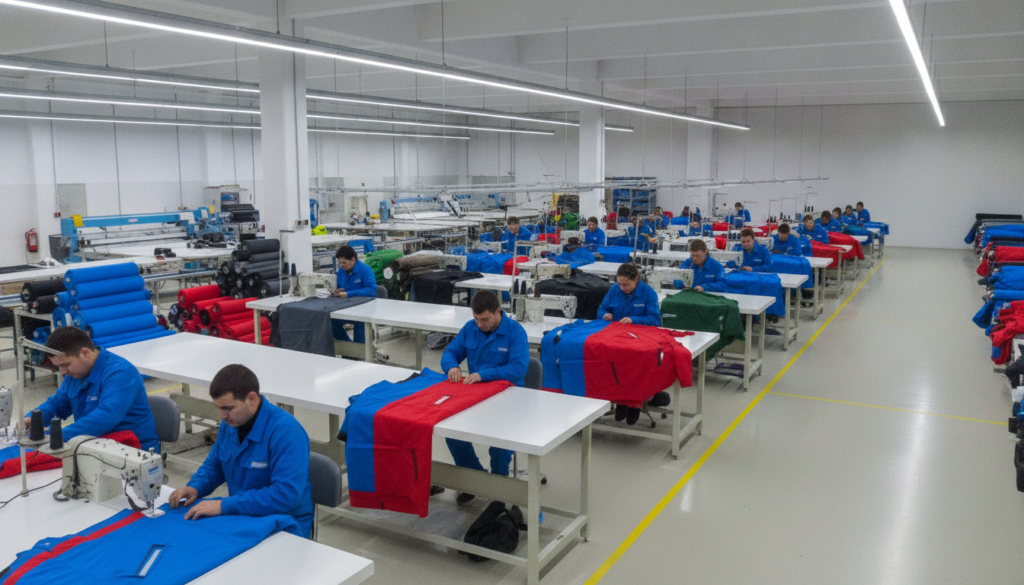
An oem ski jacket factory ykk aquaguard zipper specialist sources YKK AquaGuard coil or vislon zippers directly from authorized YKK distributors, integrates them into hardshell or insulated ski jacket construction, and validates water-entry resistance through hydrostatic-head and seam-tape testing before bulk production. PTOUTWEAR’s 3,000m² Taizhou Sanmen facility stocks YKK AquaGuard components for 1-piece sampling (7-10 days) and 10-piece bulk MOQ, with in-house seam-taping and pre-shipment water-ingress checks.
📋 Table of Contents
- Key Takeaways
- What Is YKK AquaGuard and Why Ski Jackets Need It
- How OEM Factories Source YKK AquaGuard Zippers
- Integration Into Ski Jacket Construction
- Testing and Validation Protocols
- MOQ, Sampling, and Lead Time for Custom Ski Jackets
- Cost Factors for YKK AquaGuard Ski Jacket Production
- Frequently Asked Questions
Key Takeaways
- YKK AquaGuard zippers use a water-repellent polyurethane laminate on the zipper tape, preventing water ingress through the zipper chain even under sustained wet conditions.
- Authorized YKK distributors supply AquaGuard components in coil (lightweight, flexible) and vislon (durable, cold-resistant) configurations, with color-matching available for custom ski jacket programs.
- Effective water resistance depends on both the zipper specification and the seam-tape application along the zipper stitch line, which must be validated through hydrostatic-head testing to match the shell fabric rating.
- Sample MOQ for custom ski jackets with YKK AquaGuard starts at 1 piece, with bulk production MOQ at 10 pieces per style, allowing DTC outdoor brands to validate fit and waterproofing before committing to larger inventory.
- Lead time for ski jacket sampling with AquaGuard zippers runs 7-10 days, and bulk production requires 25-35 days from fabric and trim confirmation to final inspection.
- Cost per jacket increases by approximately 15-25 percent when specifying YKK AquaGuard over standard coil zippers, driven by the laminated tape construction and YKK brand premium.
What Is YKK AquaGuard and Why Ski Jackets Need It
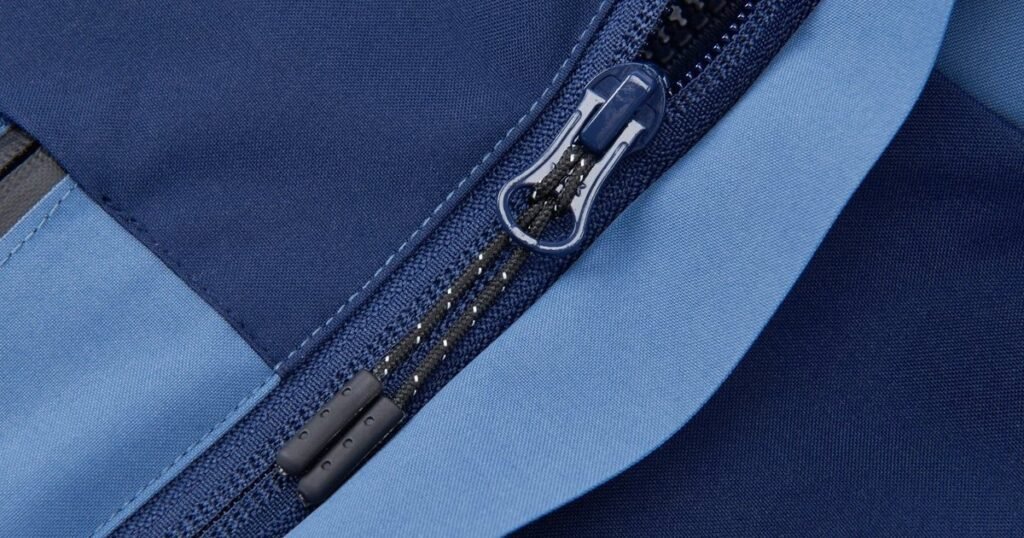
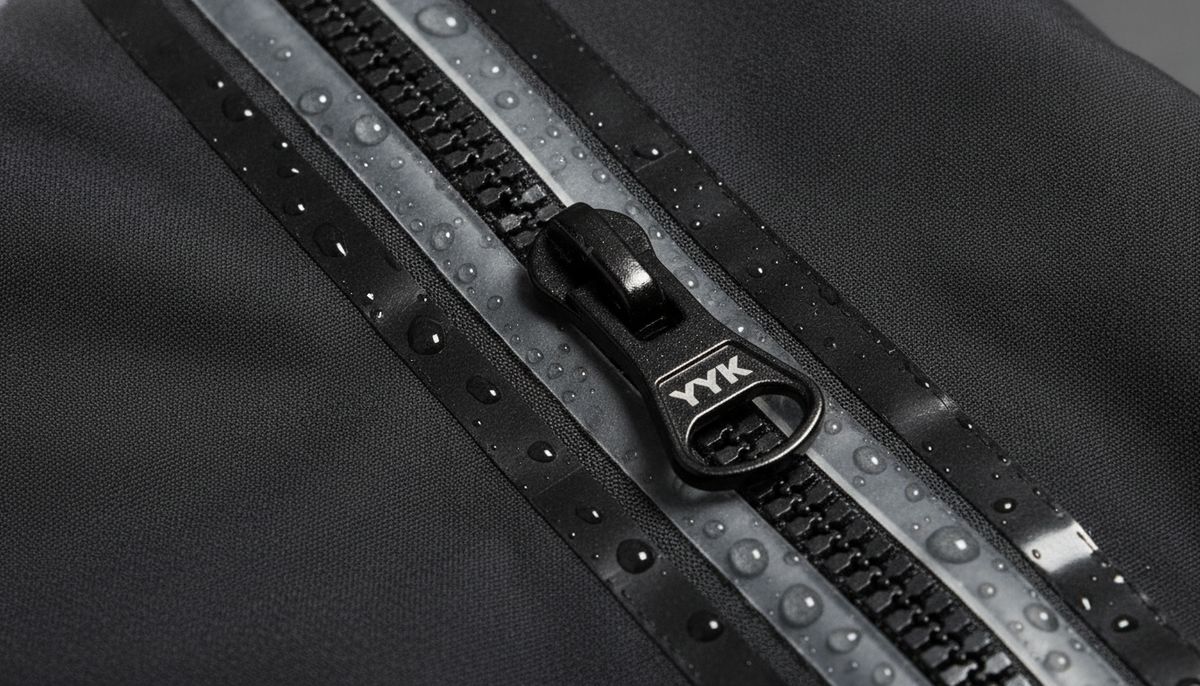
YKK AquaGuard is a water-repellent zipper system that bonds a polyurethane film to the zipper tape, creating a continuous barrier against water penetration. Standard coil zippers allow moisture to seep through the fabric tape and along the stitching line, which compromises waterproofing in hardshell ski jackets. AquaGuard’s laminated construction keeps water out even when the zipper is closed under pressure, such as during wet snowfall or when a skier falls into deep powder.
Coil vs. Vislon AquaGuard
YKK offers AquaGuard in two tooth configurations. Coil AquaGuard uses a continuous nylon spiral, making it lightweight and flexible, ideal for chest pockets and internal ski-pass pockets where bulk must be minimized. Vislon AquaGuard uses molded plastic teeth, which resist cold-induced brittleness and handle higher stress loads, making it the better choice for center-front zippers and pit-zip ventilation on freeride hardshell jackets.
Where AquaGuard Zippers Appear on Ski Jackets
A typical hardshell ski jacket integrates YKK AquaGuard at four to six locations. The center-front closure uses a two-way vislon AquaGuard to allow bottom venting while keeping the chest closed. Chest pockets, hand pockets, and sleeve pockets use coil AquaGuard to protect valuables and electronics from moisture. Pit-zip ventilation zippers also specify AquaGuard to prevent water ingress when the vents are closed during wet conditions. Ski-pass pockets on the sleeve or forearm use a short coil AquaGuard to keep lift tickets dry.
Why Buyers Specify AquaGuard Over Standard Zippers
Outdoor brands targeting backcountry skiers, resort patrol teams, and ski instructors specify AquaGuard because these users spend extended periods in wet snow and need jackets that remain dry through multiple wear cycles without DWR reapplication. Corporate ski-team programs and school alpine racing squads also request AquaGuard to reduce warranty claims from zipper leakage, which is a frequent complaint when standard coil zippers are used on hardshell garments.
How OEM Factories Source YKK AquaGuard Zippers
An OEM jacket manufacturing facility sources YKK AquaGuard components through authorized YKK distributors rather than purchasing directly from YKK Corporation. YKK maintains a network of regional distributors in China, each holding inventory of standard AquaGuard lengths, colors, and tooth sizes. Custom color-matching and branded zipper pulls require a minimum order quantity from the distributor, typically 1,000 to 5,000 linear meters depending on the color and configuration.
Authorized Distributor Network
YKK distributors in Zhejiang and Guangdong provinces stock black, gray, navy, and white AquaGuard tape in both coil and vislon formats. Custom Pantone color-matching is available but adds 10-15 days to the sampling timeline because the distributor must order the custom tape from YKK’s dyeing facility. Factories that maintain long-term relationships with distributors can access faster turnaround on custom colors by consolidating orders across multiple client projects.
Procurement Responsibility and Lead Time
Most oem ski jacket factory ykk aquaguard zipper arrangements place procurement responsibility on the factory, not the buyer. The factory orders the required meterage based on the jacket pattern and the number of zipper placements, then invoices the buyer for the actual YKK component cost plus a handling margin. Buyers who supply their own YKK zippers must coordinate with the factory’s production schedule, because late zipper delivery delays cutting and sewing.
Counterfeit Risk and Verification
Counterfeit YKK zippers are common in lower-tier garment markets, and they lack the polyurethane laminate that defines AquaGuard. Buyers can verify authenticity by requesting the distributor invoice from the factory, which lists the YKK part number and distributor name. Genuine AquaGuard zippers carry a YKK logo on the slider and a smooth, uniform laminate on the tape with no peeling or bubbling.
Integration Into Ski Jacket Construction
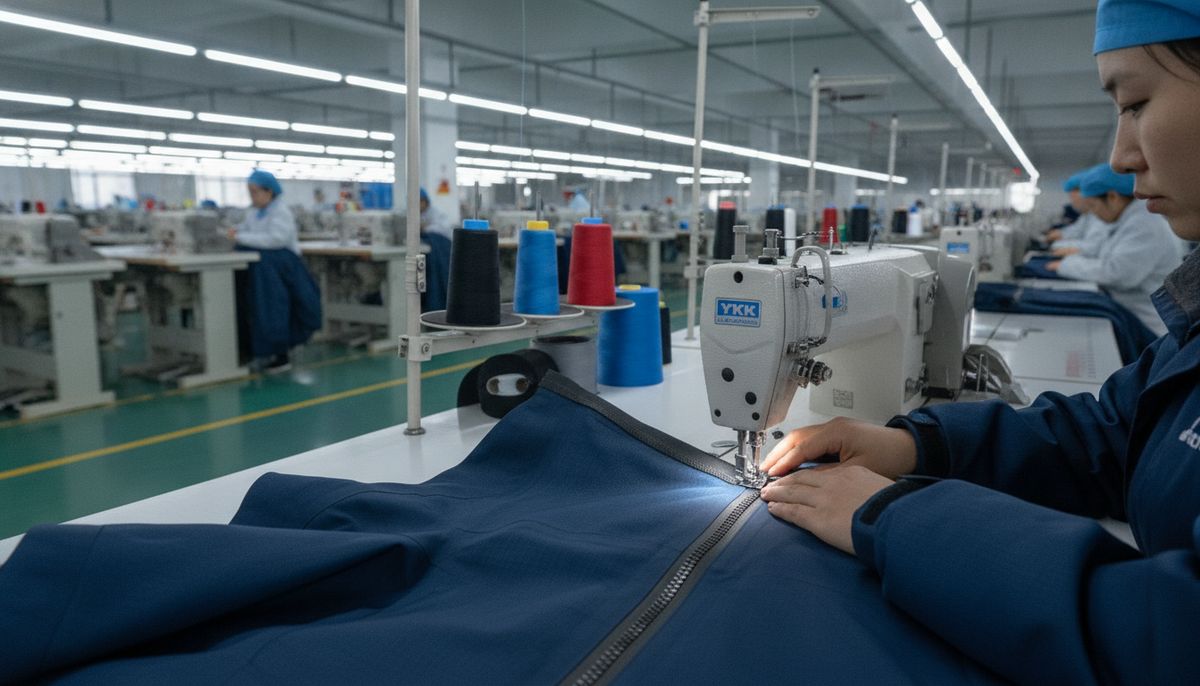
Integrating YKK AquaGuard into a ski jacket requires coordinated cutting, sewing, and seam-taping steps. The zipper tape width and laminate thickness affect how the fabric layers align during assembly, so the pattern must account for the additional bulk compared to standard coil zippers. Seam-tape application along the zipper stitch line is mandatory to prevent water from wicking through the needle holes, which would negate the AquaGuard’s water-repellent properties.
Pattern Adjustment for Laminated Tape
AquaGuard’s polyurethane laminate adds approximately 0.3 to 0.5 millimeters of thickness to the zipper tape compared to unlaminated coil tape. This extra bulk requires the pattern maker to widen the seam allowance by 1 to 2 millimeters along the zipper placement line, ensuring the fabric does not pucker when the zipper is sewn in. Factories that skip this adjustment produce jackets with wavy zipper lines and stressed stitching, both of which increase the risk of seam failure during wear.
Seam-Tape Application
Seam tape is a thermoplastic film that bonds to the fabric under heat and pressure, sealing the needle holes created during zipper installation. The tape width must cover the entire stitch line plus 2 to 3 millimeters on each side to ensure complete water blockage. Factories apply seam tape using a hot-air or hot-wedge machine, which heats the tape to its activation temperature (typically 130 to 150 degrees Celsius) and presses it onto the seam for 2 to 3 seconds. Insufficient heat or pressure results in tape that peels off after the first wash, a failure mode buyers discover only after the jackets are in use.
Zipper Slider and Chin Guard
The zipper slider on a center-front AquaGuard closure must include an auto-lock mechanism to prevent the slider from creeping down during activity. A chin guard, a small fabric flap that covers the top of the zipper, protects the wearer’s skin from contact with the cold metal or plastic slider. The chin guard also prevents snow from entering the jacket through the gap between the slider and the collar, a common complaint among backcountry skiers.
Testing and Validation Protocols
Water-resistance validation for ski jackets with YKK AquaGuard zippers involves three separate tests. Hydrostatic-head testing measures the water column pressure the fabric and zipper assembly can withstand before leakage occurs. Seam-tape adhesion testing checks whether the tape remains bonded after repeated washing and drying cycles. Zipper function testing confirms that the AquaGuard slider operates smoothly under load and does not separate under stress.
Hydrostatic-Head Testing
Hydrostatic-head testing places a fabric sample with a sewn and seam-taped zipper under a column of water, then increases the pressure until water penetrates the material. A hardshell ski jacket typically targets a hydrostatic head of 10,000 to 20,000 millimeters, meaning the fabric and zipper assembly can resist a water column of that height before leaking. If the zipper seam-tape fails before the shell fabric, the jacket does not meet the waterproof specification, regardless of the AquaGuard zipper’s inherent water repellency.
Seam-Tape Adhesion After Washing
Seam tape must remain bonded through at least 20 home-wash cycles to meet durability expectations for ski jackets. The factory conducts a peel test by cutting a sample of the seam-taped zipper, washing it 20 times in a domestic washing machine at 40 degrees Celsius, then pulling the tape away from the fabric to measure the force required to separate it. Tape that peels with less than 2 Newtons of force indicates insufficient bonding during application, which will lead to field failures.
Zipper Function and Stress Testing
YKK specifies a minimum cycle count for AquaGuard zippers based on the tooth size and configuration. A number-5 coil AquaGuard must complete 1,000 open-close cycles without tooth separation or slider breakage. A number-8 vislon AquaGuard used on a center-front closure must handle 1,500 cycles under a 5-kilogram lateral load, simulating the stress a skier places on the zipper when bending or reaching. Factories that skip cycle testing ship jackets with zippers that fail within the first season of use.
In practice: Seam-tape application is what separates a jacket that survives hydrostatic-head testing from one that leaks at the zipper stitch line, which is why the sample must pass a 10,000-millimeter water-column test before bulk production begins.
MOQ, Sampling, and Lead Time for Custom Ski Jackets
Minimum order quantities for custom ski jackets with YKK AquaGuard zippers vary by factory capability and production scale. Low-MOQ jacket manufacturers accommodate DTC outdoor brands and corporate uniform programs that need small initial runs to validate market demand before committing to larger inventory. Sampling timelines depend on fabric availability, YKK component lead time, and the factory’s current production load.
Sample MOQ: 1 piece. Bulk MOQ: 10 pieces per style (mix colors and sizes). Sampling time: 7-10 days. Bulk production: 25-35 days.
Sample Development Process
Sample development starts with a tech pack that specifies the shell fabric, insulation type, YKK AquaGuard zipper placements, seam-tape requirements, and all trim details. The factory orders the YKK components from its distributor, cuts a single jacket, and completes all sewing and seam-taping steps as they would appear in bulk production. The sample undergoes hydrostatic-head testing and a visual inspection before shipping to the buyer for fit and feature approval. Buyers who request multiple colorways or design iterations should expect 7 to 10 days per sample round.
Bulk Production MOQ and Mixing
Bulk production for ski jackets with YKK AquaGuard typically starts at 10 pieces per style, with colors and sizes mixed within that minimum. A buyer ordering a hardshell ski jacket in black and navy can split the 10-piece MOQ as 5 black and 5 navy, or 7 black and 3 navy, as long as the total reaches 10 pieces. School alpine racing programs and corporate ski-team orders often start at 30 pieces per style per color to achieve better per-unit pricing and justify custom Pantone color-matching on the AquaGuard zippers.
Lead Time Breakdown
Lead time from bulk order confirmation to shipment runs 25 to 35 days for standard ski jacket construction. The factory allocates 3 to 5 days for fabric and trim procurement, 10 to 12 days for cutting and sewing, 2 to 3 days for seam-taping and finishing, and 5 to 7 days for final inspection and packing. Rush orders of 1,000 pieces or more can be completed in 2 weeks at a 25 percent surcharge, but this option requires all fabrics and YKK components to be in stock before the order is placed.
Cost Factors for YKK AquaGuard Ski Jacket Production
Cost per jacket for an oem ski jacket factory ykk aquaguard zipper build depends on shell fabric specification, insulation type, the number and length of AquaGuard zippers, seam-tape coverage, and order quantity. YKK AquaGuard components cost 15 to 25 percent more than standard coil zippers due to the laminated tape construction and the YKK brand premium. Seam-taping labor and materials add another 8 to 12 percent to the total garment cost.
YKK AquaGuard Component Pricing
A 60-centimeter coil AquaGuard zipper for a chest pocket costs approximately 1.20 to 1.80 US dollars per unit when ordered in quantities of 500 to 1,000 pieces. A 70-centimeter two-way vislon AquaGuard for a center-front closure runs 3.50 to 5.00 US dollars per unit in the same quantity range. Custom color-matching adds 0.30 to 0.50 US dollars per zipper due to the minimum meterage requirement from the YKK distributor. Buyers who specify branded zipper pulls with logo engraving should budget an additional 0.80 to 1.20 US dollars per pull, with a 1,000-piece minimum order.
Seam-Tape Material and Labor
Seam tape costs 0.15 to 0.25 US dollars per linear meter, and a typical hardshell ski jacket with four AquaGuard zippers requires 3 to 4 meters of tape to cover all stitch lines. Labor for seam-tape application adds 1.50 to 2.50 US dollars per jacket, depending on the factory’s equipment and the operator’s skill level. Factories that use automated seam-taping machines achieve faster throughput and more consistent bonding quality than those relying on manual hot-air guns.
Order Quantity and Per-Unit Cost
Per-unit cost decreases as order quantity increases due to fixed setup costs being spread across more pieces. A 10-piece order of hardshell ski jackets with YKK AquaGuard zippers might cost 95 to 110 US dollars per jacket, while a 500-piece order brings the per-unit cost down to 65 to 75 US dollars. The cost reduction comes primarily from fabric procurement efficiency, reduced cutting waste, and faster sewing line throughput when the same style runs continuously.
Hidden Costs and Buyer Responsibilities
Buyers must account for fabric shrinkage testing, pre-production sample rounds, and potential rework if the first bulk lot fails hydrostatic-head testing. Fabric shrinkage testing costs 50 to 100 US dollars per colorway and ensures the finished jacket dimensions match the approved sample after washing. Pre-production samples, which are cut from the actual bulk fabric rather than stock fabric, cost 100 to 150 US dollars each and are mandatory for orders above 500 pieces. Rework due to seam-tape failure or zipper defects can add 10 to 20 percent to the total project cost if the factory does not catch the issue during in-line inspection.
Frequently Asked Questions
Can an OEM factory manufacture ski jackets with YKK AquaGuard zippers at low MOQ?
Vertically integrated factories with in-house seam-taping equipment can produce ski jackets with YKK AquaGuard zippers starting at 10 pieces per style, mixing colors and sizes within that minimum. Sample development begins at 1 piece, allowing DTC outdoor brands to validate waterproofing and fit before committing to bulk inventory. Factories that lack seam-taping capability or rely on external subcontractors typically impose higher minimums, often 100 to 300 pieces, because outsourcing seam-tape work increases coordination complexity and per-unit cost.
What is the difference between YKK AquaGuard and regular YKK zippers?
YKK AquaGuard zippers feature a polyurethane laminate bonded to the zipper tape, creating a water-repellent barrier that prevents moisture from penetrating through the fabric tape and along the stitch line. Regular YKK coil or vislon zippers use unlaminated cotton or polyester tape, which absorbs water and allows it to wick through to the garment interior. AquaGuard is specified for hardshell ski jackets, rain jackets, and any garment where water ingress through the zipper would compromise the wearer’s comfort or the garment’s waterproof rating.
How much does it cost to produce a custom ski jacket with YKK AquaGuard zippers?
Per-unit cost for a custom hardshell ski jacket with YKK AquaGuard zippers ranges from 95 to 110 US dollars for a 10-piece order, decreasing to 65 to 75 US dollars for a 500-piece order, and further to 55 to 65 US dollars for orders exceeding 1,000 pieces. YKK AquaGuard components contribute 8 to 15 percent of the total garment cost depending on the number and length of zippers specified. Seam-tape material and labor add another 8 to 12 percent, while shell fabric, insulation, and assembly labor make up the remainder.
Need a ski jacket factory that sources genuine YKK AquaGuard, validates waterproofing through hydrostatic-head testing, and ships 1-piece samples in 7-10 days?
Request a sample and tech pack review →
Written by Ivan Chen, Sales Engineer at PTOUTWEAR – 13 years in outdoor apparel manufacturing.