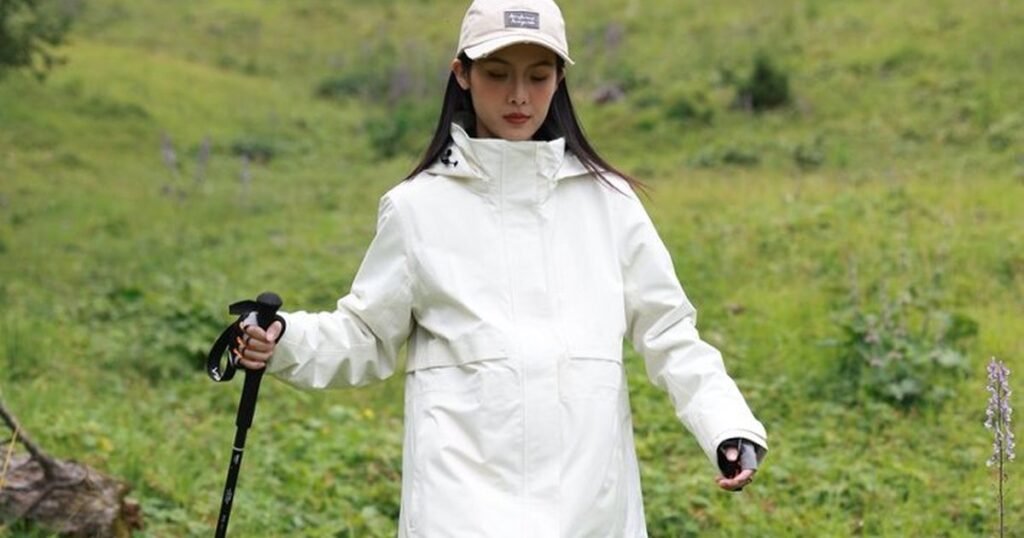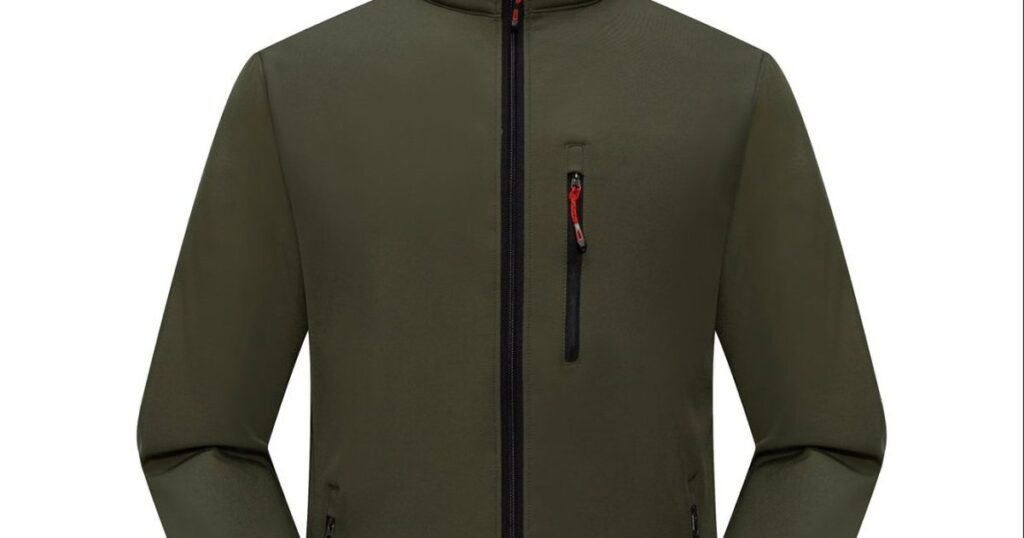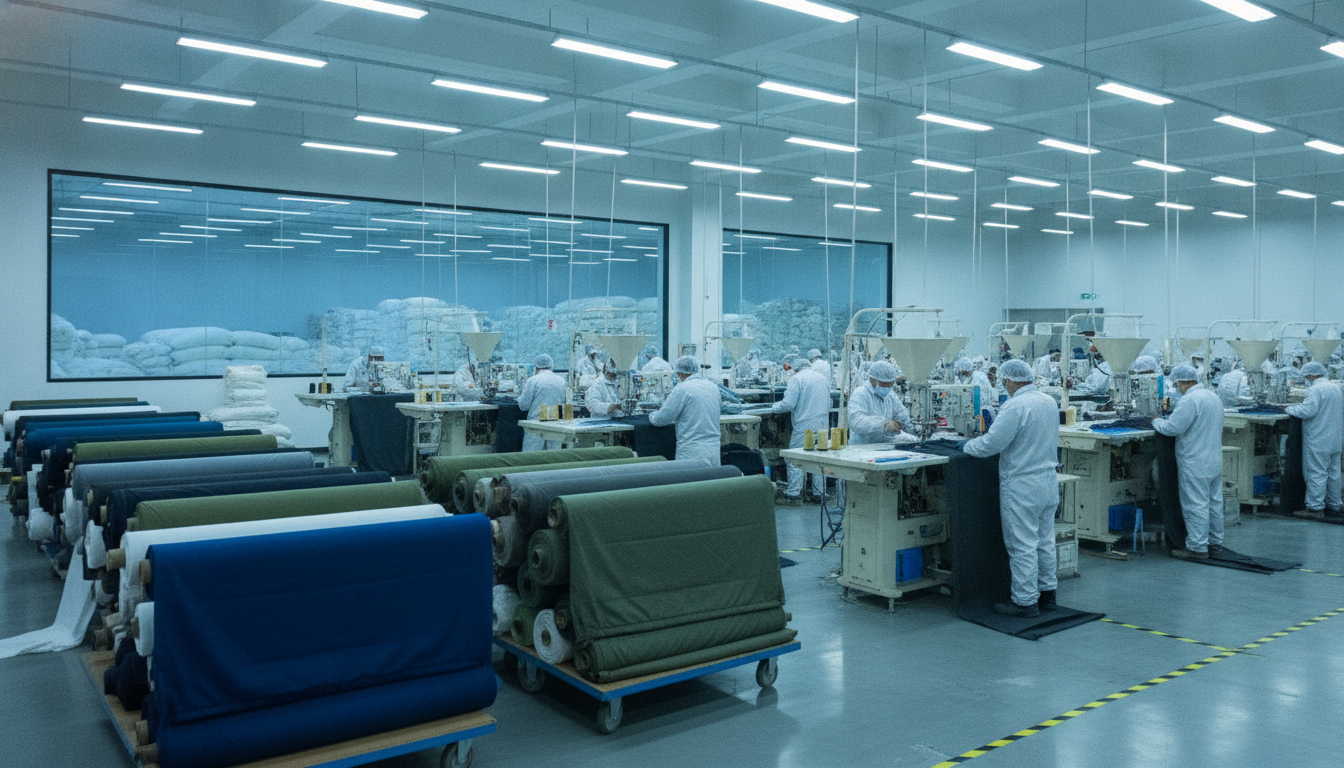
A reliable down jacket manufacturer operates vertically integrated production with in-house fill-power testing, baffle construction, and RDS-certified down traceability. PTOUTWEAR’s Taizhou Sanmen facility runs 20 production lines across 3,000m², offering 1-piece sample MOQ and 30-piece bulk minimum with 7-10 day sampling and 25-35 day production lead times.
📋 Table of Contents
- Executive Summary
- What Makes a Factory Qualified to Produce Down Jackets?
- Fill Power and Down Sourcing: What to Verify Before Ordering
- Construction Methods That Determine Warmth and Durability
- MOQ and Sampling: How to Validate Quality Without Overcommitting
- Compliance and Traceability: RDS, Labeling, and Import Documentation
- Cost Structure: What Drives Down Jacket Unit Pricing
- Key Takeaways
- FAQ
Executive Summary
- Factory qualification: Vertically integrated down jacket production requires in-house baffle sewing, fill-power testing equipment, and climate-controlled down storage to prevent moisture contamination.
- Fill power verification: Reputable manufacturers provide third-party lab reports for every down batch, showing fill power (typically 550-800+), down-to-feather ratio, and turbidity test results.
- Sample-first workflow: Factories offering 1-piece sample MOQ let you validate baffle spacing, fill consistency, and shell fabric DWR performance before committing to bulk orders of 30+ pieces per SKU.
- RDS traceability: Responsible Down Standard certification traces down from farm to finished garment, a requirement for brands selling in EU markets or positioning as sustainable.
- Lead time reality: Sampling takes 7-10 days; bulk production runs 25-35 days, with rush orders possible at premium pricing for urgent seasonal launches.
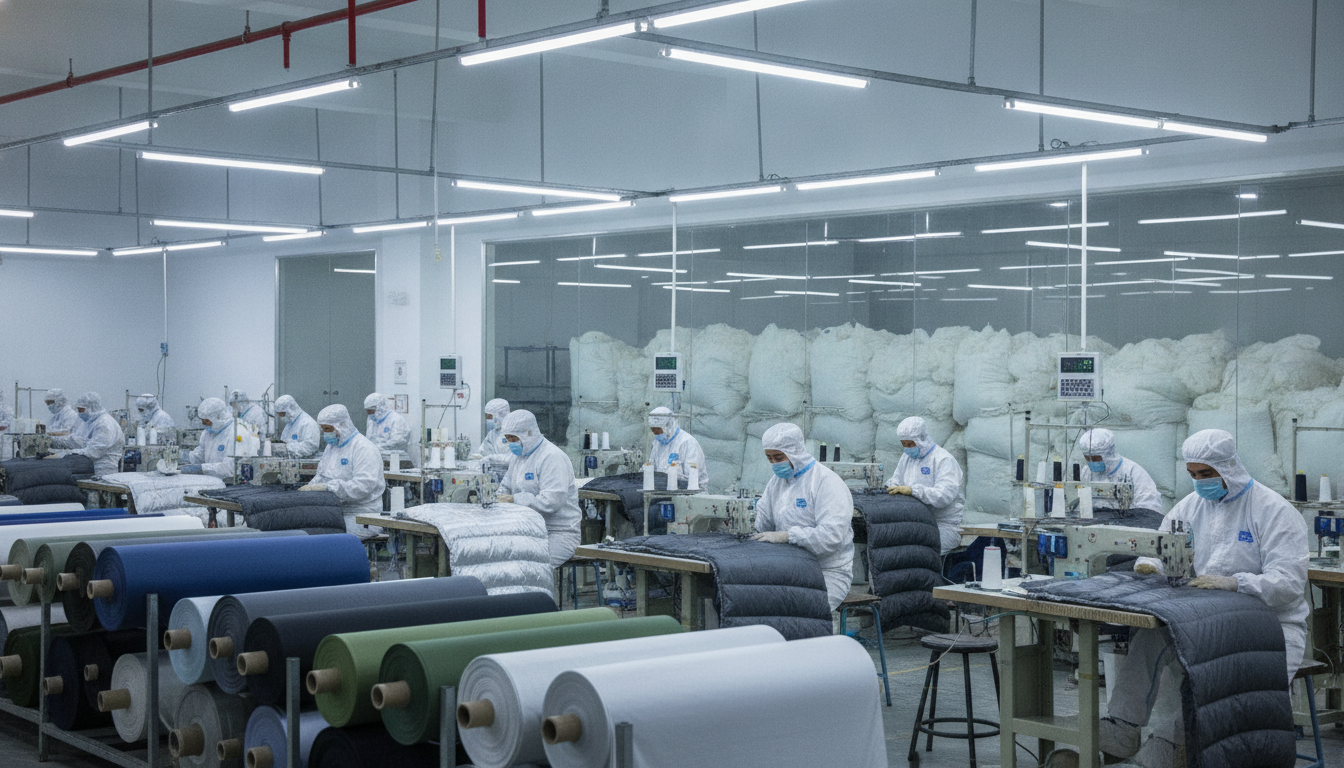
What Makes a Factory Qualified to Produce Down Jackets?
Not every cut-and-sew factory can handle down insulation. Down jacket manufacturing demands specialized equipment and controlled environments that standard apparel facilities lack. Buyers sourcing their first down product often discover this gap when samples arrive with uneven fill distribution or down leaking through shell seams.
Climate-Controlled Down Storage and Handling
Down absorbs moisture rapidly, losing loft and insulation value within hours of exposure to humid air. Qualified manufacturers store down in temperature- and humidity-controlled rooms, typically maintaining 18-22°C and 40-50% relative humidity. The storage area should be separate from cutting and sewing floors to prevent cross-contamination with fabric dust and lint.
In-House Fill-Power Testing Equipment
Fill power measures how much space one ounce of down occupies when fully lofted, expressed in cubic inches. A factory claiming 700-fill down must verify that number with a cylindrical chamber and calibrated weight. Reputable facilities test every incoming down batch and provide the lab report with your sample. Factories that source down from third-party suppliers without re-testing introduce quality risk, because down can degrade during transport or storage.
Baffle Construction Capability
Baffles are internal fabric walls that create chambers holding down in place. Poor baffle construction lets down migrate, creating cold spots at shoulders or underarms. Experienced factories use box-baffle or trapezoidal-baffle patterns depending on jacket style, and they pre-test baffle spacing on sample garments before cutting bulk fabric. PTOUTWEAR’s OEM jacket manufacturing facility runs dedicated baffle-sewing lines with operators trained specifically for down products, separate from hardshell or softshell production.
In practice: Baffle spacing determines whether down stays evenly distributed after repeated compression, which is why it gets locked in during the sample approval stage before any bulk fabric is cut.
Down-Proof Shell Fabric Sourcing
Shell fabric must have a tight weave (typically 300+ thread count) and calendered finish to prevent down from pushing through. Factories working with reputable mills provide fabric specifications showing thread count, weight per square meter, and down-proof test results. Budget manufacturers sometimes substitute looser weaves to cut costs, resulting in down leakage within the first few wears.
Fill Power and Down Sourcing: What to Verify Before Ordering
Fill power is the primary performance specification for any down jacket, but the number alone tells an incomplete story. Two jackets labeled 700-fill can perform very differently depending on down quality, cleanliness, and feather content.
Understanding Fill Power Ranges
Fill power ranges break down into performance tiers:
- 550-600 fill: Entry-level insulation suitable for mild winter conditions (5-10°C) or layering under hardshells. Common in budget outdoor jackets and fashion-forward urban styles.
- 650-750 fill: Mid-range performance for most outdoor use cases, balancing warmth-to-weight with cost. Appropriate for temperatures down to -5°C when combined with proper layering.
- 800+ fill: Premium ultralight insulation for alpine and expedition use. One ounce of 850-fill down provides the same warmth as 1.3 ounces of 650-fill, enabling lighter pack weight for backcountry travel.
Down-to-Feather Ratio
Down clusters provide insulation; feathers add weight without warmth. A 90/10 down-to-feather ratio means 90% down clusters and 10% small feathers by weight. Budget products sometimes use 80/20 or 70/30 ratios, which feel heavier and compress less effectively. Manufacturers should state the ratio on their specification sheet and provide third-party lab verification.
Turbidity and Cleanliness Testing
Turbidity measures how thoroughly down has been washed, expressed in millimeters of light transmission through a water sample containing down. Lower turbidity numbers indicate cleaner down with less dust, oils, and organic residue. Clean down resists odor and maintains loft longer. Reputable suppliers provide turbidity test results alongside fill-power reports.
Duck Down vs. Goose Down
Goose down produces larger clusters and higher fill power (commonly 700-900), while duck down typically peaks at 650-700 fill. Goose down also carries less odor, especially when wet. Duck down costs 20-30% less, making it the standard choice for mid-range jackets. High-end expedition gear almost always uses goose down for maximum warmth-to-weight.
Construction Methods That Determine Warmth and Durability
Construction quality separates jackets that maintain loft through years of use from those that develop cold spots after one season. Buyers evaluating a down jacket manufacturer should request detailed construction specifications during the sampling phase.
Baffle Types and Their Trade-Offs
Three baffle designs dominate down jacket construction:
- Sewn-through baffles: Shell and lining stitched directly together, creating quilted channels. Simplest and cheapest construction, but stitching lines create cold spots where no down sits. Acceptable for mild-weather jackets (above 5°C) or fashion pieces prioritizing appearance over performance.
- Box baffles: Vertical fabric walls connect shell to lining, creating enclosed chambers that prevent down migration. Standard for serious outdoor jackets. Box height (typically 2-4 cm) determines how much down each chamber holds.
- Trapezoidal baffles: Angled walls that widen toward the shell, allowing down to loft more fully. Used in premium expedition jackets where maximum warmth-to-weight matters. Requires more skilled sewing and adds 15-20% to labor cost.
Down Fill Weight vs. Fill Power
Fill weight measures total down quantity in grams. A jacket with 700-fill down and 120g fill weight provides similar warmth to a 600-fill jacket with 140g fill weight, but the higher-fill-power version weighs less and compresses smaller. Manufacturers should specify both numbers. Budget factories sometimes compensate for low fill power by overstuffing jackets, adding weight without improving warmth-to-weight ratio.
Shell Fabric and DWR Treatment
Down loses 90% of its insulation value when wet, making water resistance critical. Shell fabrics fall into three categories:
- Nylon ripstop (20-30D): Lightweight, packable, tears less easily than plain weave. Requires durable water repellent (DWR) coating to shed moisture. Most outdoor down jackets use this construction.
- Polyester taffeta (50-70D): Heavier and more abrasion-resistant. Common in workwear-style down jackets or products targeting durability over weight.
- Pertex Quantum or similar: Premium tightly woven nylon with advanced DWR. Provides best balance of light weight, down-proofing, and water resistance, but adds 30-40% to fabric cost.
DWR performance degrades with washing and UV exposure. Buyers often complain that breathable rain jackets feel clammy after the DWR wets out, a problem that also affects down shells. PTOUTWEAR applies PFC-Free DWR certified by SGS, which maintains water beading through 20+ home washes when care instructions are followed.
Zipper and Hardware Quality
YKK zippers are the industry standard for outdoor gear. Budget manufacturers substitute unbranded zippers that jam or separate under tension. Two-way zippers (opening from top and bottom) add ventilation options and cost roughly $1.50 more per jacket than single-pull versions. Snap closures at collar and hem should use rust-proof hardware; cheaper jackets use painted snaps that corrode after exposure to sweat and rain.
MOQ and Sampling: How to Validate Quality Without Overcommitting
Minimum order quantities trap new brands in a cash-flow dilemma. Ordering 500 pieces ties up $15,000-$25,000 before you know whether the product sells. Sampling first lets you test market demand, but many factories charge $200-$500 per sample and refuse to credit that fee against bulk orders.
Sample MOQ Reality
Traditional garment factories set sample MOQ at 5-10 pieces because cutting and sewing a single unit disrupts production flow. Down jackets compound this problem because filling baffles by hand for one sample takes 45-60 minutes of skilled labor. PTOUTWEAR offers 1-piece sample MOQ with a $100 refundable fee (credited against bulk orders of 30+ pieces), enabling brands to validate fit, fill distribution, and shell fabric performance before committing to inventory.
What to Test During Sampling
A proper sample validation checks five areas:
- Fill consistency: Lay the jacket flat and press down in 6-8 locations across chest, back, and sleeves. Loft should feel uniform. Thin spots indicate poor baffle design or underfilling.
- Down-proofing: Shake the jacket vigorously for 30 seconds, then inspect seams and shell fabric. Any down fibers escaping signal inadequate shell weave or poor seam construction.
- DWR performance: Spray water on shell fabric. Beads should roll off cleanly. If water soaks in (wetting out), the DWR application was insufficient or the fabric weave is too loose.
- Zipper function: Open and close all zippers 20+ times. Snags or jamming indicate low-quality hardware that will fail in the field.
- Baffle integrity: Turn the jacket inside-out (if construction allows) and inspect baffle stitching. Loose threads or skipped stitches let down migrate between chambers.
In practice: Fill-power claims mean nothing without a third-party lab report, which is why serious buyers request the test certificate with the sample before approving bulk production.
Bulk MOQ Considerations
Most down jacket manufacturers set bulk MOQ at 100-300 pieces per style because down purchasing, baffle cutting, and quality control become cost-effective only at scale. Factories offering 30-piece MOQ per SKU enable smaller brands to test multiple colorways or styles without overcommitting. PTOUTWEAR’s 30-piece bulk minimum lets you launch with three colors at 10 pieces each, validating market preference before scaling to larger reorders.
Sample Development Timeline
Realistic sampling timelines break down as follows:
- Tech pack submission to first sample: 7-10 days for standard designs using in-stock fabrics. Custom fabric sourcing adds 15-20 days.
- Revisions: 5-7 days per iteration. Budget 2-3 rounds for fit adjustments, fill weight tuning, and hardware changes.
- Pre-production sample: Final sample matching approved spec, produced 3-5 days before bulk cutting begins. Serves as the quality reference for production team.
Brands planning seasonal launches should initiate sampling 90-120 days before target ship date, accounting for sampling iterations, bulk production (25-35 days), and international shipping (15-30 days depending on method).
Compliance and Traceability: RDS, Labeling, and Import Documentation
Down sourcing carries ethical and regulatory complexity that synthetic insulation avoids. Buyers selling in EU markets or positioning as sustainable must verify traceability from farm to finished garment.
Responsible Down Standard (RDS) Certification
RDS certification, managed by Textile Exchange, traces down to farms that meet animal welfare standards. Certified down cannot come from live-plucked birds or force-fed operations. The certification chain requires:
- Farm audit: Third-party inspector verifies animal welfare practices and records down harvest methods.
- Processor audit: Down washing and sorting facilities maintain chain-of-custody documentation linking each batch to certified farms.
- Manufacturer audit: Garment factories track RDS down separately from non-certified down, with batch numbers recorded on production orders.
RDS adds $2-$4 per jacket in certification fees and administrative overhead. Brands marketing to environmentally conscious consumers find the premium justified, but budget products targeting price-sensitive buyers often skip certification.
Country-of-Origin Labeling
US Federal Trade Commission rules require garments to state where the product was made. For down jackets, this typically means where the shell was cut and sewn, not where the down was sourced. A jacket filled with Hungarian goose down but sewn in China must be labeled “Made in China.” Buyers importing to the US should verify the manufacturer prints compliant labels showing fiber content, care instructions, and country of origin.
Import Documentation for US/UK/EU Markets
Down jacket imports require specific paperwork depending on destination market:
- US imports: Commercial invoice, packing list, bill of lading. Jackets containing down must declare “insulated with down and feathers” on customs forms. No special permits required unless down originates from restricted countries.
- UK/EU imports: Same base documents as US, plus EORI number for the importer. Post-Brexit, UK and EU are separate customs territories requiring separate declarations.
- Australia imports: Biosecurity declaration required for all animal-derived materials, including down. Properly processed and packaged down typically clears without inspection, but documentation must state down was washed and heat-treated.
Manufacturers offering DDP (Delivered Duty Paid) shipping handle customs clearance and import duties, simplifying logistics for buyers unfamiliar with international trade procedures. PTOUTWEAR provides DDP service to major markets, quoting landed cost so buyers face no surprise fees at delivery.
Cost Structure: What Drives Down Jacket Unit Pricing
Down jacket pricing varies widely based on fill power, construction complexity, and order volume. Understanding cost drivers helps buyers set realistic budgets and identify when a quote is genuinely competitive versus suspiciously low.
Material Cost Breakdown
Materials account for 50-65% of total jacket cost:
- Down fill: 550-fill duck down costs $8-$12 per jacket (assuming 100-120g fill weight). 800-fill goose down runs $18-$25 for the same weight. RDS certification adds $2-$4.
- Shell fabric: 20D nylon ripstop with DWR costs $2.50-$4.00 per meter; premium Pertex Quantum runs $6-$9 per meter. A typical jacket uses 1.2-1.5 meters.
- Lining fabric: Nylon taffeta lining adds $1.50-$2.50 per jacket.
- Hardware: YKK zippers, snaps, and elastic cords total $3-$5 per jacket for standard designs. Two-way zippers and premium pullers add $1.50-$2.00.
Labor and Overhead
Labor represents 25-35% of cost. Down jackets require more labor than hardshells because baffle construction and hand-filling add 15-20 minutes per unit compared to synthetic insulation. Factories in Zhejiang province (where PTOUTWEAR operates) charge $8-$12 per jacket for skilled sewing labor, while facilities in lower-cost regions like Anhui or Jiangxi quote $6-$9.
Order Volume Impact
Unit cost drops significantly with volume:
Hidden Costs to Budget For
First-time importers often overlook these expenses:
- Sample fees: $100-$500 per sample depending on factory policy and design complexity. Refundable fees reduce risk.
- Shipping: Air freight costs $4-$7 per kg; sea freight runs $0.80-$1.50 per kg but adds 25-35 days transit time. A 30-piece order weighs approximately 25-30 kg packed.
- Import duties: US duty on down jackets is 4-16% depending on shell fabric and fill content. UK/EU rates run 8-12%. DDP shipping bundles these into the quoted price.
- Quality inspection: Third-party inspection services charge $200-$350 per factory visit. Recommended for first orders or when switching suppliers.
When a Quote Is Too Low
Quotes significantly below market rate signal quality shortcuts. Common cost-cutting tactics include:
- Lower fill power than stated: A factory claiming 700-fill but charging 600-fill prices likely sources lower-grade down and hopes you won’t test it.
- Reduced fill weight: Underfilling by 10-15 grams saves $1-$2 per jacket but creates a noticeably colder product.
- Inferior shell fabric: Substituting 30D fabric for specified 20D, or using plain weave instead of ripstop, cuts $2-$3 per jacket but compromises durability.
- Unbranded hardware: Non-YKK zippers save $1.50-$2.00 per jacket but fail at 5-10x the rate of genuine YKK components.
Buyers should request material certifications (fill-power lab report, fabric mill certificate, YKK zipper authenticity) when evaluating suspiciously low quotes. Legitimate manufacturers provide these documents readily; factories cutting corners deflect or delay.
Key Takeaways
- Qualified down jacket manufacturers maintain climate-controlled down storage, in-house fill-power testing, and dedicated baffle-sewing lines separate from standard apparel production.
- Fill power alone does not determine warmth-down-to-feather ratio, turbidity, and fill weight combine to define real-world insulation performance.
- Baffle construction separates serious outdoor jackets from fashion pieces, with box baffles and trapezoidal baffles preventing down migration and cold spots.
- Sample MOQ of 1 piece lets brands validate fill consistency, DWR performance, and zipper quality before committing to bulk orders of 30+ pieces per SKU.
- Responsible Down Standard certification traces down from farm to garment, required for brands selling in EU markets or marketing sustainability credentials.
- Material costs drive 50-65% of jacket pricing, with 800-fill goose down adding $10-$13 per unit compared to 550-fill duck down at equivalent fill weights.
FAQ
What fill power should I specify for a winter jacket targeting -5°C to -10°C conditions?
A 650-700 fill power jacket with 120-140 grams of fill weight provides adequate insulation for most users in -5°C to -10°C conditions when layered over a base layer and mid-layer fleece. Higher fill power (750-850) lets you reduce fill weight to 100-120 grams while maintaining the same warmth, creating a lighter jacket that compresses smaller for travel. Fill power above 800 typically serves alpine and expedition use rather than everyday winter wear, adding cost without meaningful benefit for moderate cold.
How do I verify a factory actually uses the fill power they claim?
Request a third-party lab report from IDFL (International Down and Feather Laboratory) or a similarly accredited facility showing fill power, down-to-feather ratio, and turbidity results for the specific down batch used in your order. The report should include a batch number that matches documentation from the down supplier. Reputable manufacturers provide this with your pre-production sample. If a factory refuses or delays providing lab reports, assume they cannot verify their fill-power claims and source elsewhere.
What is the typical lead time from order placement to finished goods delivery?
Standard lead time breaks into three phases: bulk production takes 25-35 days from deposit payment to factory completion, quality inspection adds 2-3 days, and international shipping requires 15-30 days by sea or 5-7 days by air. Total timeline runs 45-70 days for sea freight or 35-45 days for air freight. Rush production (1000+ pieces) can compress manufacturing to 14 days at a 25% surcharge, useful for urgent seasonal launches. Sampling before bulk production adds 7-10 days for the first sample plus 5-7 days per revision round.
Ready to source down jackets with verified fill power and 1-piece sample MOQ?
Request Your Sample Today →
Written by Ivan Chen, Sales Engineer at PTOUTWEAR, 13 years in outdoor apparel manufacturing.