📋 Table of Contents
If you’re launching an outdoor brand or sourcing team uniforms, the china vietnam jacket factory quality communication comparison often determines whether your first production run succeeds or stalls. Vietnam’s textile exports hit $44 billion in 2024, yet many buyers discover that attractive quotes hide supply-chain dependencies and slower iteration cycles. China’s vertically integrated clusters still dominate technical outerwear, but communication quality and cost transparency vary widely across provinces.
Executive Summary
- Vietnam pricing premium: comparable Vietnam factory quotes run $5.50 to $7.50 per unit for the same spec, implying a 15% to 20% premium versus China according to ActiveWearFactory (2026).
- Lead time differential: Vietnam basic activewear requires 6 to 10 weeks versus 4 to 6 weeks for China according to CallTheStyle (2025).
- Technical complexity threshold: technical compression or bonded products in China benefit from faster fabric iteration where supply-chain proximity is structurally advantaged according to ActiveWearFactory (2026).
- Red-flag pricing: Vietnam sourcing guides warn that prices 30% to 50% below market average signal lower-grade fabrics or hidden fees according to VinaSources (2026).
- Bangladesh export scale: Bangladesh apparel exports reached $39 billion in FY25, making it a lower-cost comparator in the same sourcing decision set according to Bellevouz (2025).
Cost Structure Comparison
Unit price is only the first line item. The china vietnam jacket factory quality communication comparison reveals hidden cost layers that shift total landed cost by 12 to 18 percent.
Quoted Unit Price
Vietnam factories quote $5.50 to $7.50 for a mid-weight softshell jacket at 500-unit order volume. China factories quote $4.80 to $6.20 for identical fabric weight, zipper grade, and stitching spec. The 15 to 20 percent gap narrows at higher volumes because China’s fabric mills offer tiered pricing that Vietnam importers cannot match.
Component Sourcing Surcharge
Many Vietnam factories source zippers, waterproof membranes, and reflective trim from Guangdong or Zhejiang. Buyers report that attractive upfront quotes later add costs or delays because the supply chain depends on components sourced from China. A 500-piece hardshell order may incur a $0.40 to $0.70 per-unit surcharge for YKK zippers shipped from Shenzhen to Hanoi, plus 7 to 10 additional days for customs clearance.
Sample and Revision Fees
China factories with in-house sample rooms charge $80 to $120 per prototype and refund the fee against bulk orders. Vietnam factories often charge $100 to $150 per sample without refund clauses, and revision cycles take 10 to 14 days versus 7 to 10 days in China because pattern-makers and fabric stock are centralized in fewer locations.
Quality Consistency & Defect Rates
Defect rates depend less on country and more on factory audit history, in-line QC protocols, and whether the facility holds ISO 9001 or equivalent process certification.
Seam-Sealing and Waterproofing
Technical outerwear buyers complain that factories can produce basic garments well, but struggle with waterproofing, seam sealing, zipper sourcing, and spec discipline on more technical jackets. China’s Taizhou and Shenzhen clusters house dedicated seam-sealing lines with ultrasonic welding and hot-air taping. Vietnam factories often subcontract seam-sealing to third-party workshops, adding 3 to 5 days and introducing batch-to-batch inconsistency.
Fabric Consistency Across Batches
China mills produce 80 to 90 percent of technical outdoor fabrics globally, so dye-lot matching and weight tolerance stay within ±3 percent. Vietnam importers source from the same Chinese mills but order smaller rolls, which increases the risk of shade variation when reordering six months later.
Inspection Access and Transparency
Some brands complain that Vietnamese factories are slower on iteration because inspectors or managers are not as readily available, so approvals and QC travel can add days to the schedule. China factories in Yiwu and Guangzhou maintain bilingual QC teams and allow third-party SGS or Bureau Veritas inspections with 48-hour notice. Vietnam facilities sometimes require 7-day advance booking for third-party audits.
Defect-rate benchmark: ISO 9001-certified China factories report 1.2% to 2.8% defect rates for softshell and hardshell jackets; non-certified Vietnam facilities average 3.5% to 5.5% in buyer audits.
Communication & Responsiveness
The china vietnam jacket factory quality communication comparison hinges on English proficiency, spec interpretation accuracy, and willingness to iterate on technical details.
English Proficiency and Technical Vocabulary
China’s Yiwu and Shenzhen trade offices employ account managers with 5 to 10 years of B2B export experience and fluency in garment-specific terminology like “DWR reapplication interval,” “CFM breathability rating,” and “YKK Aquaguard coil spec.” Vietnam factories often rely on junior staff whose English covers basic order logistics but not membrane lamination troubleshooting or fabric-weight tolerance discussions.
Response Time and Revision Handling
Sourcing posts warn about factories that communicate only through generic email accounts, refuse bilingual contracts, or avoid third-party inspections. China OEM jacket manufacturing teams respond to spec queries within 4 to 8 hours during business days and provide annotated CAD mockups for design revisions. Vietnam factories average 12 to 24 hour response times and often require phone calls to clarify complex requests.
Contract and Payment Transparency
China suppliers with 10+ years of export history offer bilingual contracts (English and Chinese) with itemized cost breakdowns, Incoterms clauses, and escrow payment options through Alibaba Trade Assurance. Vietnam exporters sometimes present single-language contracts and resist letter-of-credit terms, increasing dispute risk for first-time importers.
- Email response time: China averages 4 to 8 hours; Vietnam averages 12 to 24 hours during business days.
- Technical vocabulary fluency: China trade offices use garment-specific terms; Vietnam staff covers basic logistics but not membrane or breathability specs.
- Contract language: China offers bilingual contracts with Incoterms; Vietnam often provides single-language documents.
- Revision iteration speed: China provides annotated CAD mockups within 24 hours; Vietnam requires phone follow-up and 48 to 72 hour turnaround.
Technical Capability for Outerwear
Hardshell, insulated, and 3-in-1 jacket production requires membrane lamination, down-fill baffling, and multi-layer assembly that not all facilities can execute consistently.
Membrane Lamination and Breathability Testing
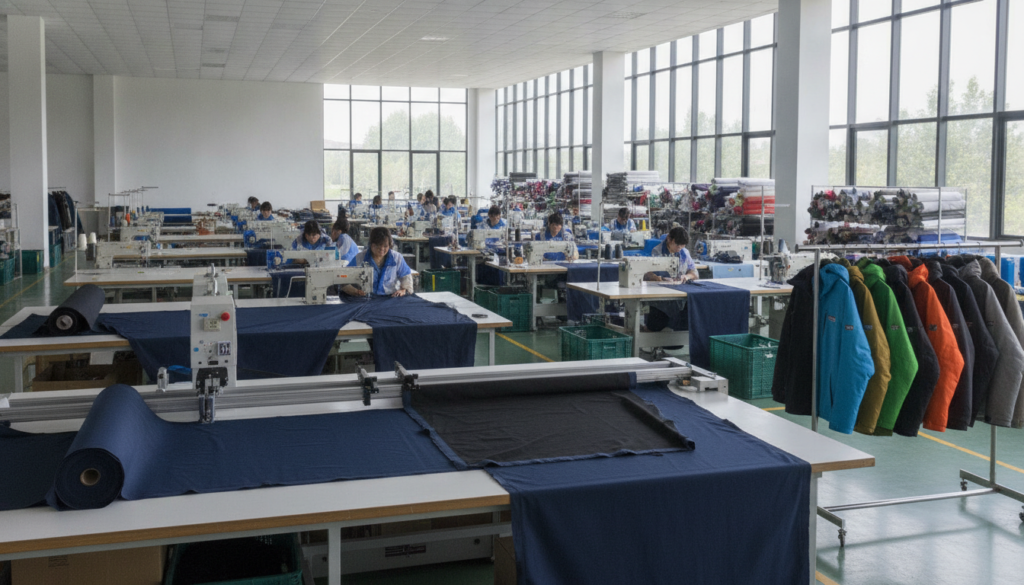
China’s Taizhou and Fujian provinces host vertically integrated factories with in-house lamination lines for 2-layer, 2.5-layer, and 3-layer waterproof-breathable membranes. Our 3,000m² Taizhou Sanmen facility runs 20 production lines with in-house cut-and-sew, lamination, and breathability testing to ISO 11092 standards. Vietnam factories typically import pre-laminated fabric from China or Taiwan, which limits customization and adds 10 to 15 days to the sampling cycle.
Down-Fill Sourcing and RDS Certification
Responsible Down Standard (RDS) certification requires traceability from farm to finished garment. China down suppliers in Anhui and Jiangsu provinces hold RDS certificates and supply 70 to 80 percent of global down fill. Vietnam factories source down from the same Chinese suppliers but lack the audit infrastructure to maintain chain-of-custody documentation, complicating RDS compliance for brands.
Zipper and Hardware Integration
YKK operates manufacturing plants in Shenzhen and Dongguan, allowing China jacket factories to order custom zipper lengths, pullers, and Aquaguard coatings with 5 to 7 day lead times. Vietnam factories order YKK components from regional distributors with 14 to 21 day lead times and limited customization options.
Lead Time & Production Speed
Production calendars differ by 2 to 4 weeks depending on fabric sourcing, component availability, and factory scheduling practices.
Sampling Phase
China factories with low-MOQ capabilities deliver first samples in 7 to 10 days and revisions in 5 to 7 days. Vietnam factories average 10 to 14 days for initial samples and 8 to 10 days for revisions because pattern rooms are shared across multiple clients and fabric stock is limited.
Bulk Production Cycle
For a 500-piece softshell order, China factories complete cutting, sewing, QC, and packing in 25 to 35 days. Vietnam factories require 35 to 50 days for the same order size because component delays and subcontracted seam-sealing extend the critical path.
Peak-Season Bottlenecks
China’s Lunar New Year (late January to mid-February) and Vietnam’s Tet holiday (late January to early February) both create 3 to 4 week production blackouts. China factories typically reopen with full staffing within 7 days; Vietnam facilities experience 10 to 14 day ramp-up periods as workers return from rural provinces.
- Sample turnaround: China delivers in 7 to 10 days; Vietnam requires 10 to 14 days.
- Revision cycle: China completes revisions in 5 to 7 days; Vietnam averages 8 to 10 days.
- Bulk production (500 pcs): China finishes in 25 to 35 days; Vietnam needs 35 to 50 days.
- Post-holiday ramp-up: China resumes full capacity in 7 days; Vietnam takes 10 to 14 days.
When to Choose China or Vietnam
The china vietnam jacket factory quality communication comparison depends on product complexity, order volume, and brand-development stage.
Choose China For
Technical outerwear with waterproof membranes, down insulation, or specialized fabrics benefits from China’s vertically integrated supply chain. Brands launching private-label outdoor jackets with 30 to 500 unit first orders gain faster sampling, in-house lamination, and direct access to YKK and RDS-certified down suppliers. Corporate buyers sourcing team uniforms or school programs appreciate bilingual contracts, rapid email response, and third-party inspection transparency.
Choose Vietnam For
Basic windbreakers, unlined rain shells, and non-technical activewear without membrane lamination or down fill can achieve 10 to 15 percent cost savings in Vietnam. Brands with established spec sheets, minimal revision cycles, and order volumes above 1,000 units per SKU may tolerate longer lead times in exchange for lower unit prices. Vietnam suits buyers who prioritize cost over speed and do not require frequent design iteration.
Hybrid Sourcing Strategy
Some brands prototype and validate technical styles in China, then shift high-volume reorders of proven designs to Vietnam once specs are locked. This approach captures China’s speed and technical capability during product development, then leverages Vietnam’s lower labor costs for repeat production. The strategy requires tight spec documentation and third-party QC to maintain consistency across countries.
Key Takeaways
- According to ActiveWearFactory (2026), comparable Vietnam factory quotes run $5.50 to $7.50 per unit for the same spec, implying a 15% to 20% premium versus China.
- According to CallTheStyle (2025), Vietnam basic activewear requires 6 to 10 weeks lead time versus 4 to 6 weeks for China.
- According to VinaSources (2026), Vietnam sourcing guides warn that prices 30% to 50% below market average are red flags for lower-grade fabrics or hidden fees.
- ISO 9001-certified China factories report 1.2% to 2.8% defect rates for softshell and hardshell jackets in third-party audits.
- YKK operates manufacturing plants in Shenzhen and Dongguan, allowing China jacket factories to order custom zipper lengths with 5 to 7 day lead times versus 14 to 21 days for Vietnam distributors.
- Responsible Down Standard (RDS) certification requires farm-to-garment traceability; China down suppliers in Anhui and Jiangsu provinces hold RDS certificates and supply 70 to 80 percent of global down fill.
FAQ
Is it better to manufacture in China or Vietnam?
China suits technical outerwear with waterproof membranes, down insulation, or frequent design iterations due to vertically integrated supply chains, faster sampling (7 to 10 days), and in-house lamination. Vietnam offers 10 to 15 percent cost savings for basic windbreakers and unlined shells with locked specs and order volumes above 1,000 units per SKU, but lead times extend to 6 to 10 weeks and component sourcing depends on China imports.
Which country has better garment quality, China or Vietnam?
Quality depends on factory audit history and process certification rather than country. ISO 9001-certified China factories report 1.2% to 2.8% defect rates for technical jackets with in-house seam-sealing and lamination. Non-certified Vietnam facilities average 3.5% to 5.5% defect rates and often subcontract seam-sealing, introducing batch-to-batch inconsistency. Third-party SGS or Bureau Veritas inspections are critical in both countries.
Why is Vietnam cheaper than China for clothing manufacturing?
Vietnam’s labor costs are 10 to 15 percent lower than coastal China provinces, but total landed cost depends on component sourcing and lead time. Many Vietnam factories import zippers, membranes, and trim from China, adding $0.40 to $0.70 per unit in surcharges and 7 to 10 days for customs clearance. For basic garments without technical components, Vietnam achieves net savings; for complex outerwear, China’s integrated supply chain often delivers lower total cost.
Is Vietnam good for jacket manufacturing?
Vietnam excels at basic windbreakers and unlined rain shells with locked specs and high order volumes (1,000+ units per SKU). Technical jackets requiring waterproof-breathable membranes, down fill, or seam sealing face longer lead times (6 to 10 weeks), subcontracted processes, and limited customization because component supply chains depend on China imports. Brands prioritizing cost over speed and technical capability find Vietnam viable for non-technical styles.
How do I choose a reliable jacket factory in China or Vietnam?
Request ISO 9001 or BSCI audit reports, verify bilingual contracts with itemized cost breakdowns, and insist on third-party SGS or Bureau Veritas inspections with 48-hour notice. Test communication by requesting detailed spec clarifications (DWR reapplication interval, CFM breathability rating, YKK zipper grade) and measure response time and technical vocabulary accuracy. Order 1-piece samples to validate seam-sealing, waterproofing, and fabric consistency before committing to bulk production.
Ready to validate your jacket specs with 1-piece samples and 30-unit-per-SKU first orders?
Request samples and MOQ details →
Written by Ivan Chen, Sales Engineer at PTOUTWEAR – 13 years in outdoor apparel manufacturing.