📋 Table of Contents
Shipping a full container load of rain jackets from China to Rotterdam sounds straightforward until unexpected terminal handling charges, vague transit windows, and bundled door-to-door quotes obscure your true landed cost. Buyers launching technical outerwear brands or restocking corporate uniform programs discover that Rotterdam port fees, carton-packing inefficiencies, and unclear customs handoff steps can inflate budgets by 15-25% beyond the quoted ocean freight rate. This guide walks through fcl rain jacket export rotterdam port logistics with real cost breakdowns, carton optimization data, and compliance checkpoints that protect your margin before the container leaves Ningbo or Shanghai.
Executive Summary
- Rotterdam gateway share: Rotterdam handles over 14 million TEU annually, making it Europe’s largest container port and a primary distribution hub for Northern and Central European apparel imports.
- Terminal handling charges: Destination THC at Rotterdam typically ranges €120-€180 per 20-foot container and €180-€250 per 40-foot container, fees often excluded from initial freight quotes.
- Carton cube utilization: Standard rain jacket cartons (60×40×35 cm, 12-15 units per carton) achieve 85-92% container cube utilization in a 40-foot HC, yielding approximately 680-720 cartons or 8,160-10,800 jackets per shipment.
- Shanghai-Rotterdam transit: Ocean transit averages 28-35 days port-to-port, with seasonal congestion in Q4 adding 3-7 days to unloading and customs clearance.
- EU textile compliance: REACH regulation restricts over 1,000 chemical substances in apparel; SGS or TÜV test reports for azo dyes, phthalates, and formaldehyde are standard pre-shipment documentation for rain jacket exports to the EU.
- Landed-cost variance: Buyers report final delivered costs 18-28% above quoted FOB price when accounting for freight, insurance, THC, customs duties (12% for HS 6201 outerwear), VAT (19-21% across most EU markets), and inland haulage to distribution centers.
Why Rotterdam for Rain Jacket Imports
Rotterdam’s position as Europe’s busiest container gateway stems from deep-water berths, automated terminals, and direct rail and barge connections to Germany, Belgium, France, and the Netherlands. For apparel importers, this infrastructure translates to shorter inland delivery windows and lower per-kilometer haulage costs compared to secondary ports.
Geographic Coverage and Hinterland Access
Rotterdam serves a hinterland of 500 million consumers within a 500-kilometer radius. Rail shuttles reach Duisburg, Germany in under 24 hours and Lyon, France in 48 hours. Barge services connect directly to Rhine River distribution hubs. Buyers stocking rain jackets for multiple EU markets consolidate inventory at Rotterdam-area warehouses, then forward smaller shipments by truck to regional fulfillment centers, cutting cross-border customs procedures and VAT reclaim complexity.
Container Terminal Capacity and Turnaround
Automated terminals like Maasvlakte II process container discharge and gate-out in 12-18 hours under normal conditions. Apparel cargo classified as general dry goods moves through standard lanes without refrigeration or hazmat holds. However, buyers shipping rain jackets with DWR treatments must declare chemical formulations on the Material Safety Data Sheet to avoid customs inspection delays; non-compliant MSDS documentation can add 2-5 days to clearance.
Competitive Freight Rates from Asia
Shanghai-Rotterdam and Ningbo-Rotterdam lanes attract high vessel frequency, with 8-12 weekly sailings from major Chinese export hubs. Freight forwarders report 40-foot container rates in the €2,200-€3,800 range during off-peak months (February-May, September-October), rising to €4,500-€6,200 in peak season (August-November). Apparel shippers booking 6-8 weeks ahead secure lower rates and guaranteed space, critical for brands launching seasonal collections with fixed retail windows.
FCL Container Loading for Apparel
Maximizing container cube utilization directly impacts per-unit shipping cost. Rain jackets ship in cartons, not hanging garments, so packing density and carton dimensions determine how many pieces fit in a 20-foot or 40-foot container.
Standard Carton Dimensions and Piece Count
Most OEM jacket manufacturing facilities pack rain jackets folded in polybags, then load 12-15 units per carton. A typical export carton measures 60 cm (length) × 40 cm (width) × 35 cm (height), yielding a volume of 0.084 cubic meters. A 40-foot high-cube container offers 76 cubic meters of usable space, accommodating approximately 680-720 cartons when accounting for pallet gaps and load stability. At 12 pieces per carton, this translates to 8,160-8,640 jackets; at 15 pieces per carton, 10,200-10,800 jackets.
Carton-Size Optimization for Cost Efficiency
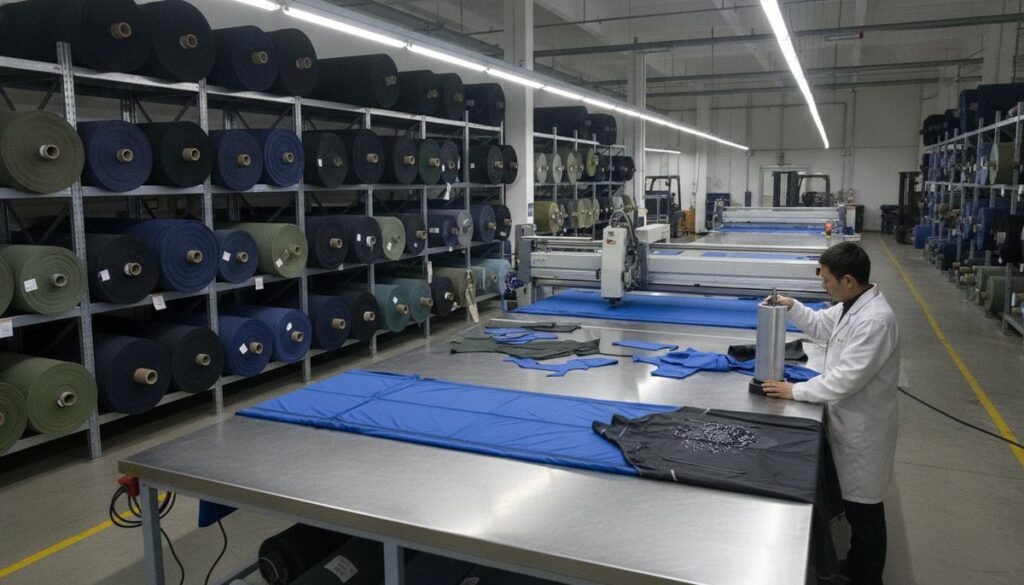
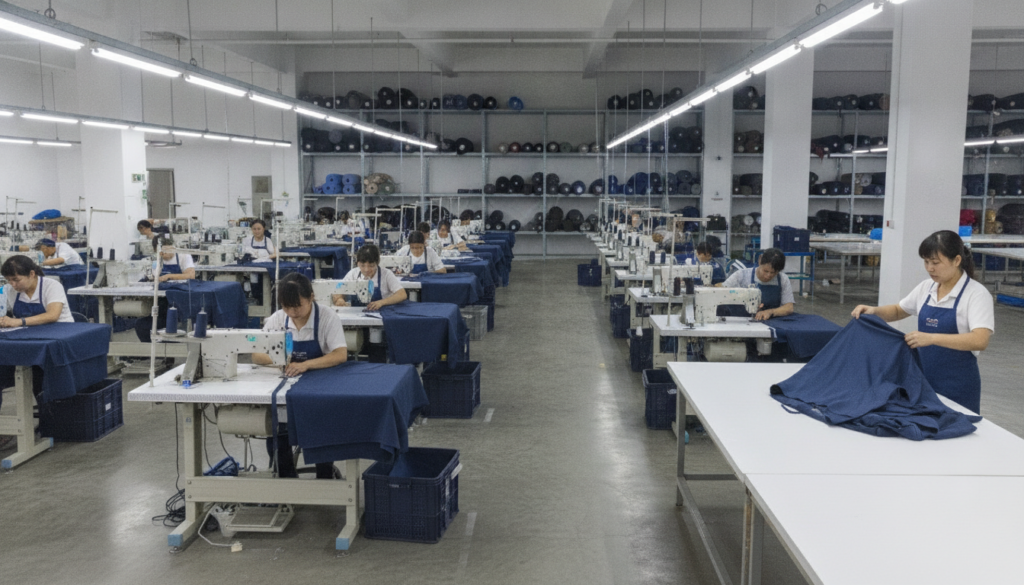
Reducing carton height from 35 cm to 32 cm increases container capacity by approximately 8-10%, adding 50-70 cartons per 40-foot HC. Buyers working with a low-MOQ jacket manufacturer can request custom carton dimensions during the sampling phase. Our 3,000 m² Taizhou Sanmen facility runs in-house cut-and-sew and QC, allowing carton specs to be locked during pre-production so packing trials confirm cube utilization before bulk production begins.
Palletization vs Floor-Loaded Containers
Floor-loading cartons (no pallets) maximizes cube utilization but requires hand-unloading at destination, adding labor cost and time. Palletized loads simplify warehouse handling and reduce damage risk but consume 5-8% more container volume due to pallet height and stacking gaps. Buyers shipping to third-party logistics providers in the Netherlands or Germany typically palletize to meet warehouse receiving standards; brands with direct-to-consumer fulfillment centers often floor-load to maximize piece count and absorb manual unloading costs.
Hidden Costs at Rotterdam Port
Freight quotes often list ocean freight as a single line item, excluding destination charges that appear only in the final invoice. Understanding Rotterdam’s fee structure prevents budget overruns and allows accurate cost comparison across ports.
Terminal Handling Charge (THC)
Terminal handling charges cover container discharge from vessel, movement to the terminal yard, and gate-out to the trucking company. Rotterdam THC ranges €120-€180 for a 20-foot container and €180-€250 for a 40-foot container, billed by the shipping line or freight forwarder. Importers discover this fee is often excluded from initial CIF or CFR quotes, appearing as a separate line item on the destination invoice. Buyers shipping fcl rain jacket export rotterdam port cargo should request an all-in landed quote that includes THC, documentation fees, and customs examination charges to compare true costs across forwarders.
Customs Clearance and Inspection Fees
EU customs brokers charge €75-€150 per customs entry for standard apparel shipments. If Rotterdam customs selects the container for physical inspection, examination fees add €200-€400 depending on container size and inspection depth. Rain jackets with waterproof coatings or recycled-content claims face higher inspection probability; SGS or TÜV test reports for REACH compliance, azo dyes, and phthalates reduce this risk. Customs may also request a certificate of origin to verify preferential duty rates under EU trade agreements, though China does not hold such agreements with the EU for apparel.
Demurrage and Detention Risk
Shipping lines grant 5-7 free days for container pickup after discharge. Beyond this window, demurrage charges accrue at €25-€50 per day for the first week, escalating to €75-€100 per day thereafter. Buyers without pre-arranged trucking or warehouse slots risk demurrage if customs clearance delays or documentation errors extend the pickup window. Detention charges apply if the empty container is not returned within 10-14 days after unloading, adding another €30-€60 per day. Coordinating customs clearance, trucking, and warehouse delivery before the vessel arrives eliminates these penalties.
Inland Haulage to Distribution Centers
Rotterdam to Amsterdam costs €180-€250 for a 40-foot container, Rotterdam to Antwerp €220-€300, and Rotterdam to Duisburg €350-€450. Buyers consolidating inventory at a single EU warehouse before forwarding smaller shipments to retail locations should factor these trucking costs into per-unit landed expense. Rail haulage offers lower rates but requires 2-3 days additional transit and terminal transfers at both ends.
Transit Time Variability and Planning
Ocean transit from Shanghai or Ningbo to Rotterdam averages 28-35 days, but vessel schedule reliability, transshipment stops, and port congestion introduce variability that impacts inventory planning and retail delivery commitments.
Direct vs Transshipment Sailings
Direct sailings from Shanghai to Rotterdam take 28-30 days. Transshipment routes via Singapore, Colombo, or Port Said add 5-10 days and increase the risk of missed connections if the feeder vessel is delayed. Buyers shipping seasonal rain jacket collections with fixed retail launch dates should book direct sailings and build a 7-10 day buffer into the delivery window. Freight forwarders often default to transshipment routes for lower rates; confirm the routing before booking.
Seasonal Congestion and Peak-Season Delays
Q4 container volumes surge as retailers stock for winter and holiday seasons. Rotterdam terminals experience 3-7 day discharge delays in October and November when vessel arrivals exceed berth capacity. Customs clearance also slows during peak periods as broker workloads increase. Brands launching fall or winter rain jacket lines should ship in August or early September to clear customs and deliver to warehouses before the congestion window opens.
Vessel Schedule Reliability Metrics
Shipping lines publish schedule reliability data showing the percentage of sailings arriving within one day of the original ETA. Reliability on Asia-Europe lanes averaged 65-72% in recent years, meaning roughly one-third of shipments arrive 2-5 days late. Buyers relying on just-in-time inventory models face stockout risk if a delayed container misses a retail replenishment cycle. Building safety stock or scheduling shipments 10-14 days ahead of the absolute need-by date mitigates this exposure.
Export Documentation and EU Compliance
Exporting rain jackets to Rotterdam requires a commercial invoice, packing list, bill of lading, and compliance certificates. Missing or incorrect documentation triggers customs holds, inspection fees, and delivery delays.
Commercial Invoice and Harmonized System Code
The commercial invoice must list the HS code (6201.93 for men’s synthetic-fiber rain jackets, 6202.93 for women’s), unit price, total value, and Incoterm. EU customs applies a 12% duty rate to HS 6201 and 6202 outerwear imports from China, calculated on the CIF value. Undervaluing goods to reduce duty liability is a customs violation that can result in fines, cargo seizure, and blacklisting. Buyers should declare the true FOB price plus freight and insurance to ensure clean clearance.
REACH Compliance and Chemical Testing
REACH regulation restricts over 1,000 chemical substances in textiles sold in the EU. Rain jackets with DWR coatings, waterproof membranes, or printed logos must be tested for azo dyes, phthalates, formaldehyde, and heavy metals. SGS or TÜV test reports confirm compliance; our facility holds SGS certification and can provide test reports for PFC-free DWR treatments applied to shell fabrics. Buyers shipping recycled-polyester rain jackets should also request Global Recycled Standard (GRS) documentation if marketing the product’s recycled content, as GRS requires at least 20% recycled material and chain-of-custody verification.
Certificate of Origin and Preferential Duty
China does not hold a free-trade agreement with the EU for apparel, so rain jacket imports from China pay the standard 12% MFN duty. A certificate of origin is still required to prove the goods originate in China and are not transshipped from a sanctioned country. The certificate is issued by the China Council for the Promotion of International Trade (CCPIT) or a local chamber of commerce and must accompany the customs entry.
Packing List and Bill of Lading Accuracy
The packing list must match the commercial invoice line-by-line, showing carton count, piece count per carton, total pieces, gross weight, and net weight. Discrepancies between the packing list and the bill of lading trigger customs queries and potential inspection. The bill of lading should list the consignee (buyer or customs broker), notify party (buyer’s warehouse or logistics provider), and port of discharge (Rotterdam). Buyers arranging door-to-door delivery should confirm the freight forwarder has authority to clear customs on their behalf and holds the necessary EU customs broker license.
Landed Cost Calculation Framework
Calculating true landed cost per unit requires summing FOB price, ocean freight, insurance, destination charges, customs duty, VAT, and inland haulage, then dividing by total piece count. Buyers often underestimate VAT and inland trucking, leading to cash-flow surprises when the final invoice arrives.
Step-by-Step Landed Cost Example
A buyer orders 8,400 rain jackets at $12 FOB per unit, shipped in a 40-foot HC container from Ningbo to Rotterdam. The calculation breaks down as follows:
- FOB cost: 8,400 units × $12 = $100,800
- Ocean freight: $3,200 (40-foot HC, off-peak rate)
- Marine insurance: 0.3% of CIF value ≈ $312
- CIF value: $100,800 + $3,200 + $312 = $104,312
- Customs duty: 12% × $104,312 = $12,517
- Terminal handling charge: €220 ≈ $240
- Customs clearance fee: €120 ≈ $130
- Inland haulage (Rotterdam to Amsterdam): €200 ≈ $220
- VAT (21% Netherlands): 21% × ($104,312 + $12,517) = $24,534
- Total landed cost: $104,312 + $12,517 + $240 + $130 + $220 + $24,534 = $141,953
- Landed cost per unit: $141,953 ÷ 8,400 = $16.90
The FOB price of $12 per jacket becomes $16.90 landed, a 41% increase. Buyers who budget only for FOB plus freight ($12 + $0.38 = $12.38) face a $4.52 per-unit shortfall when the full invoice arrives.
VAT Reclaim and Cash-Flow Impact
VAT is recoverable for EU-registered businesses through quarterly filings, but the upfront cash outlay still impacts working capital. A $24,534 VAT payment on the example shipment ties up cash for 60-90 days until the reclaim processes. Buyers without sufficient cash reserves may need trade finance or a letter of credit to cover the VAT advance. Non-EU businesses cannot reclaim VAT and must treat it as a sunk cost, making the landed price even higher.
Incoterm Selection and Cost Allocation
FOB (Free On Board) places ocean freight, insurance, and destination charges on the buyer. CIF (Cost, Insurance, Freight) includes ocean freight and insurance but still leaves THC, customs, and inland haulage to the buyer. DDP (Delivered Duty Paid) covers all costs to the buyer’s warehouse, simplifying budgeting but often at a premium markup. Buyers comparing quotes across suppliers should normalize all quotes to the same Incoterm to ensure apples-to-apples comparison. Our sample development team provides FOB quotes by default but can arrange CIF or DDP terms through our Yiwu trade office for buyers preferring bundled logistics.
Sample MOQ: 1 piece. Bulk MOQ: 30 pieces per SKU. Sampling time: 7-10 days.
Currency Fluctuation and Hedging
Ocean freight is quoted in USD, but EU customs duty and VAT are calculated in EUR. Exchange-rate movements between booking and payment can shift landed costs by 2-5%. Buyers placing orders 60-90 days before shipment should consider forward contracts or currency options to lock in the EUR/USD rate and eliminate this variability. Freight forwarders and customs brokers typically invoice in EUR, so buyers holding USD revenue face conversion risk at multiple points in the supply chain.
Duty Drawback and Re-Export Scenarios
Buyers importing rain jackets to Rotterdam for re-export to non-EU markets (UK post-Brexit, Norway, Switzerland) can claim duty drawback or use bonded warehouse procedures to defer or eliminate customs duty. This requires advance registration with Dutch customs and detailed record-keeping. Brands distributing across both EU and non-EU markets should consult a customs specialist to structure the import and re-export flow for maximum duty efficiency.
Key Takeaways
- Rotterdam handles over 14 million TEU annually, making it Europe’s largest container port and a primary distribution hub for Northern and Central European apparel imports.
- Terminal handling charges at Rotterdam typically range €120-€180 per 20-foot container and €180-€250 per 40-foot container, fees often excluded from initial freight quotes.
- Standard rain jacket cartons measuring 60×40×35 cm and holding 12-15 units achieve 85-92% container cube utilization in a 40-foot HC, yielding approximately 680-720 cartons or 8,160-10,800 jackets per shipment.
- Ocean transit from Shanghai or Ningbo to Rotterdam averages 28-35 days port-to-port, with seasonal congestion in Q4 adding 3-7 days to unloading and customs clearance.
- REACH regulation restricts over 1,000 chemical substances in apparel; SGS or TÜV test reports for azo dyes, phthalates, and formaldehyde are standard pre-shipment documentation for rain jacket exports to the EU.
- Landed costs for rain jackets imported to Rotterdam typically run 18-28% above quoted FOB price when accounting for freight, insurance, THC, customs duties at 12% for HS 6201 outerwear, VAT at 19-21% across most EU markets, and inland haulage to distribution centers.
FAQ
What is FCL shipping to Rotterdam?
FCL (Full Container Load) shipping to Rotterdam means the buyer books an entire 20-foot or 40-foot container for their cargo, rather than sharing space with other shippers in LCL (Less than Container Load) consolidation. For rain jacket imports, FCL offers lower per-unit freight cost, faster transit, and reduced handling risk compared to LCL, making it the preferred method for orders exceeding 3,000-4,000 units. The container is loaded at the supplier’s factory, sealed, and transported directly to Rotterdam without intermediate unpacking.
How long does sea freight take to Rotterdam?
Sea freight from Shanghai or Ningbo to Rotterdam takes 28-35 days on direct sailings, with transshipment routes adding 5-10 days. Vessel schedule reliability on Asia-Europe lanes averages 65-72%, meaning roughly one-third of shipments arrive 2-5 days beyond the original ETA. Seasonal congestion in Q4 can extend discharge and customs clearance by another 3-7 days. Buyers should build a 10-14 day buffer into delivery windows to account for transit variability and avoid stockouts.
What charges apply at Rotterdam port for FCL?
Rotterdam port charges for FCL shipments include terminal handling charges (€120-€180 for 20-foot, €180-€250 for 40-foot), customs clearance fees (€75-€150 per entry), and potential inspection fees (€200-€400 if selected for physical examination). Demurrage accrues at €25-€50 per day after the free 5-7 day pickup window, escalating to €75-€100 per day in week two. Detention charges apply if the empty container is not returned within 10-14 days. Buyers should request an all-in landed quote to capture these destination fees upfront.
Is Rotterdam better than Antwerp for container shipping?
Rotterdam handles higher container volumes and offers more frequent direct sailings from Asia, resulting in better vessel schedule options and slightly lower freight rates during off-peak periods. Antwerp provides competitive rates for cargo destined to Belgium, Northern France, and Western Germany, with lower inland haulage costs to those regions. For buyers distributing across multiple EU markets, Rotterdam’s superior rail and barge connections to the Rhine corridor and deeper hinterland penetration often justify the choice, despite similar port fees at both gateways.
What documents are needed to export apparel to Rotterdam?
Exporting apparel to Rotterdam requires a commercial invoice with HS code (6201.93 or 6202.93 for rain jackets), packing list matching the invoice, bill of lading naming the consignee and notify party, certificate of origin issued by CCPIT or a local chamber of commerce, and REACH compliance test reports (SGS or TÜV) for azo dyes, phthalates, and formaldehyde. If claiming recycled content, Global Recycled Standard (GRS) documentation is also required. Missing or incorrect documents trigger customs holds and inspection fees.
Written by Ivan Chen, Sales Engineer at PTOUTWEAR – 13 years in outdoor apparel manufacturing.
Ready to ship your first FCL rain jacket order to Rotterdam with zero hidden fees?
Request a Landed-Cost Quote →