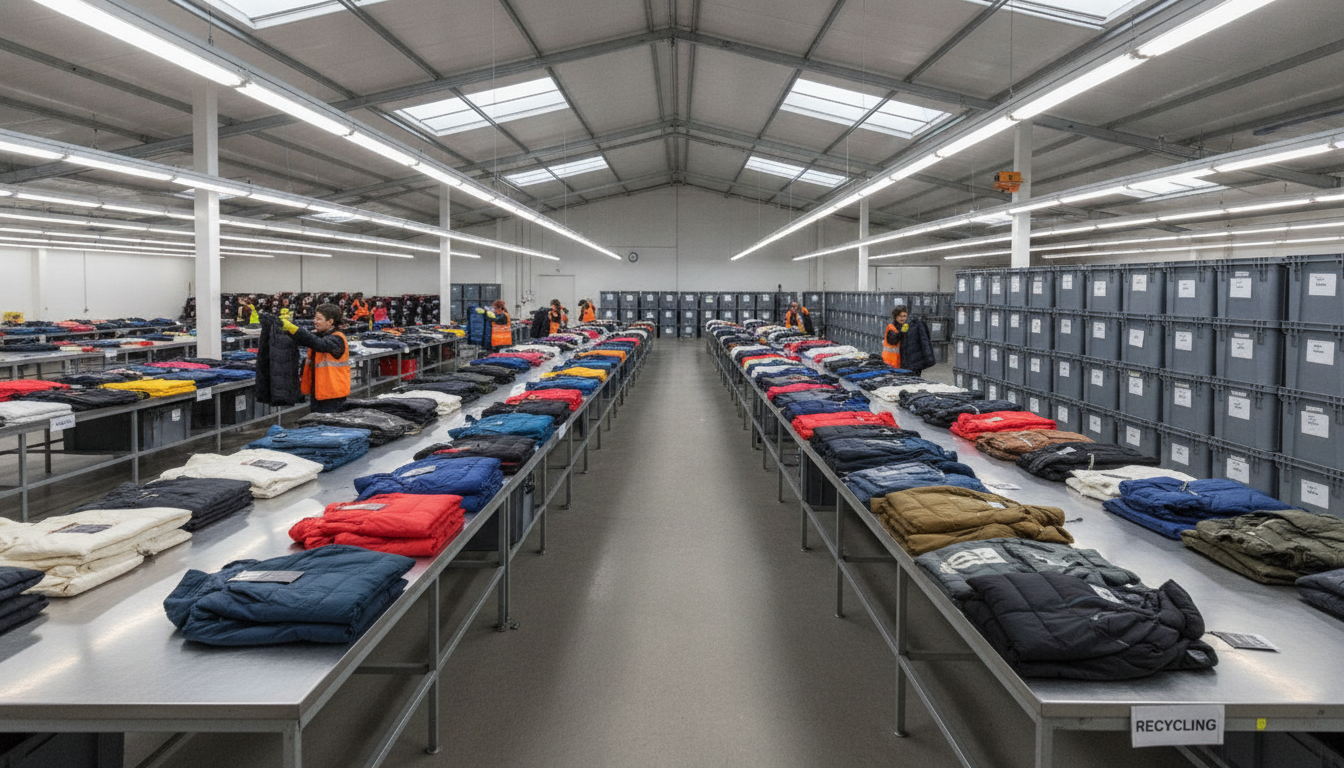
A circular economy outdoor jacket take-back program OEM is a vertically integrated manufacturing partnership that designs, produces, and facilitates the end-of-life collection, repair, resale, or recycling of technical outerwear, enabling brands to close the product loop without building their own reverse logistics. Factory-side implementation requires design-for-disassembly material specs, low-MOQ flexibility for pilot batches (30 pieces per SKU at PTOUTWEAR), PFC-free DWR coatings that survive multiple wash cycles, and documented sorting and destruction protocols. Buyers in Europe face stricter Extended Producer Responsibility (EPR) requirements than those in the US or Australia, making OEM circularity infrastructure a procurement advantage rather than a marketing add-on.
📋 Table of Contents
Executive Summary
- Circular take-back programs are full lifecycle systems: Design, repair, resale, and recycling must be planned at the material-selection and pattern-cutting stage, not bolted on after production.
- Reverse logistics cost: Collection, sorting, cleaning, and routing returned garments add operational overhead that brands must budget for alongside manufacturing MOQs.
- Europe leads EPR enforcement: Germany, France, and the Netherlands require documented end-of-life handling; OEMs that cannot show sorting and destruction protocols create compliance risk for buyers.
- Low-MOQ pilot flexibility matters: Testing a take-back program with 30 pieces per SKU allows brands to validate collection rates and refurbishment economics before scaling.
- Material design drives recyclability: Mono-material shells, mechanical fasteners instead of adhesives, and PFC-free DWR coatings simplify disassembly and fiber recovery.
What Circular Take-Back Means for OEM Outerwear
A take-back program is a reverse supply chain where a brand collects used jackets from customers, sorts them by condition, and routes them to repair, resale, or recycling partners. For an OEM, this means designing garments that can be disassembled, specifying materials that retain value after use, and documenting the chain of custody from factory to end-of-life processor. Buyers want proof that returned items are actually repaired, resold, or recycled instead of just accumulated in a warehouse, which is why factory-level transparency on sorting and destruction protocols has become a procurement requirement.
Why Brands Choose OEM Circular Programs
Brands launching take-back programs face a choice: build internal reverse logistics or partner with an OEM jacket manufacturer that already handles collection, sorting, and material recovery. Internal programs require warehouse space, sorting labor, and relationships with textile recyclers. OEM programs bundle these services into the manufacturing contract, reducing the buyer’s operational lift. PTOUTWEAR’s 3,000m² Taizhou Sanmen facility includes dedicated space for returned-goods intake and quality-grading, which allows brands to test circularity economics at 30-piece pilot scale before committing to full rollout.
Full Lifecycle vs. Marketing-Only Programs
Many programs accept returns but remain vague on what happens after collection. A full lifecycle system documents every step: intake, condition grading (A-grade for resale, B-grade for repair, C-grade for fiber recycling, D-grade for landfill diversion), partner handoff, and certificate of destruction or recycling. Buyers in regulated markets need this paper trail to satisfy Extended Producer Responsibility audits. Marketing-only programs that lack documented sorting and routing create compliance exposure.
Regional Eligibility and Multi-Brand Compatibility
Programs that only accept branded items or only operate in select regions limit scalability for multi-brand, multi-market buyers. OEM programs designed for wholesalers and uniform providers must handle unbranded or co-branded jackets and operate across the buyer’s full distribution footprint. PTOUTWEAR’s Yiwu trade office coordinates European return logistics through third-party consolidators, enabling brands selling in Germany, France, and the UK to run a single take-back flow rather than three parallel programs.
]
Design-for-Circularity Material Specs
Circular design starts with material selection. Jackets built from blended fabrics (polyester-cotton, nylon-spandex) are harder to recycle because fiber separation is labor-intensive and often uneconomical. Mono-material shells (100% polyester, 100% nylon) simplify mechanical recycling and chemical fiber recovery. PFC-free DWR coatings that survive multiple wash cycles extend garment life and reduce the need for reapplication, which lowers the total cost of ownership for resale inventory.
Mono-Material Shell Construction
A 100% polyester ripstop shell can be mechanically shredded and re-spun into new fiber without chemical processing. Blended fabrics require chemical separation or downcycling into insulation fill. Buyers specifying circular programs should request mono-material outer shells and avoid elastane or spandex content unless the garment is designed for athletic fit and the resale market will tolerate higher recycling costs.
Mechanical Fasteners Over Adhesives
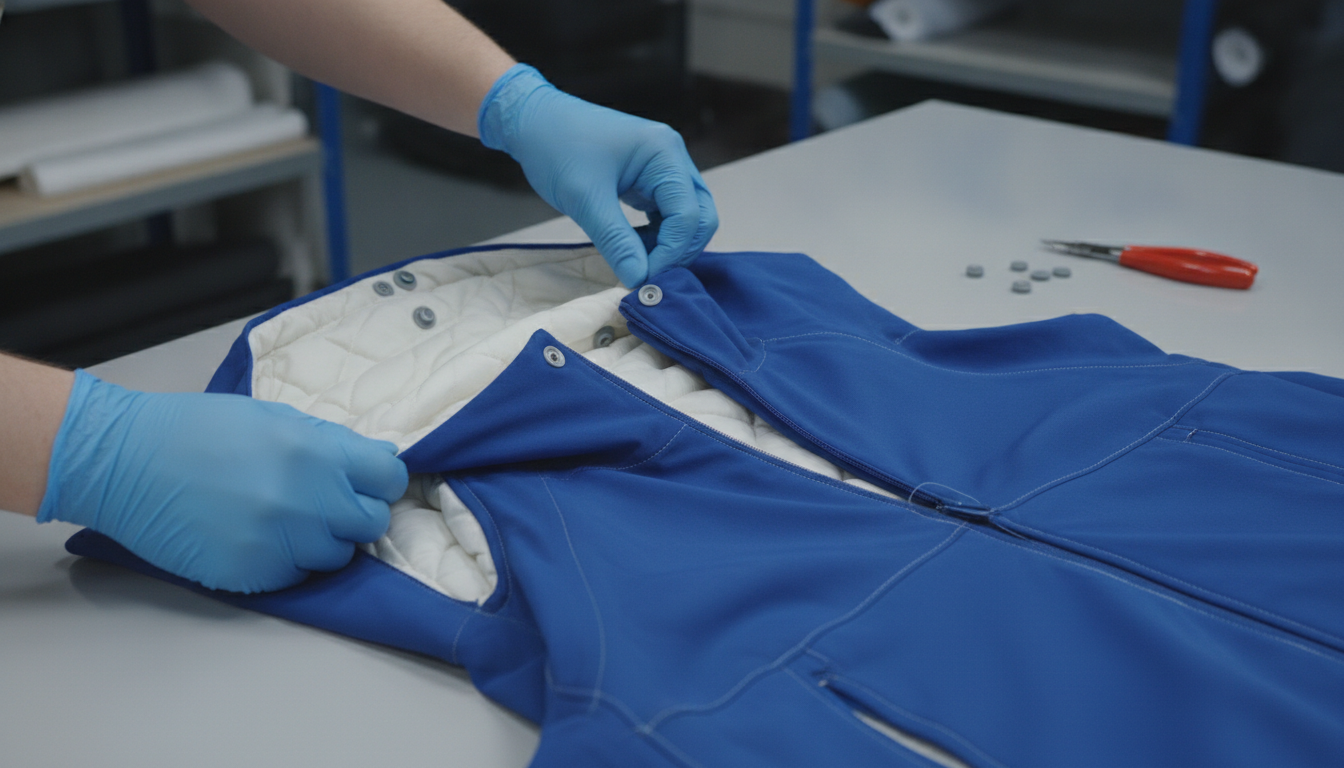
Adhesive-bonded seam tape, glued zippers, and heat-fused pockets make disassembly difficult. Mechanical fasteners (stitched seams, snap-in liners, removable hoods) allow repair technicians to replace damaged components without destroying the garment. PTOUTWEAR’s sample development process includes a disassembly test where the sample is taken apart and reassembled to verify that no adhesive bonds prevent component replacement.
PFC-Free DWR and Wash Durability
PFC-free DWR coatings degrade faster than fluorinated chemistries, which means jackets returned after heavy use may have lost water repellency. Brands running resale programs need to budget for DWR reapplication or disclose reduced performance. PTOUTWEAR applies SGS-certified PFC-free DWR that survives 20+ home washes at 40°C, which extends the usable life of resale inventory and reduces the refurbishment cost per unit.
Sample MOQ: 1 piece. Bulk MOQ: 30 pieces per SKU. Sampling time: 7-10 days. Bulk lead time: 25-35 days.
Reverse Logistics: Collection and Sorting
Collection logistics determine whether a take-back program is economically viable. Store drop-off programs work for brands with retail footprints but create geographic barriers for online-only or wholesale buyers. Mail-in return flows reduce friction but add shipping costs that must be recovered through resale or offset by customer incentives. Sorting is the operational bottleneck: every returned jacket must be graded by condition, cleaned if necessary, and routed to the correct end-of-life channel.
Store Drop-Off vs. Mail-In Returns
Store drop-off requires physical locations and trained staff to inspect garments at intake. Mail-in returns eliminate the store requirement but shift inspection labor to a central warehouse. Brands running hybrid models allow customers to choose their return method, which increases participation rates but complicates logistics planning. PTOUTWEAR’s Yiwu office coordinates with European consolidators that offer both store-based collection points and prepaid mail-in labels, giving buyers flexibility to test both models at pilot scale.
Condition Grading and Routing
Grading standards determine whether a jacket enters resale, repair, recycling, or landfill diversion. A-grade items (minimal wear, functional zippers, intact DWR) go to resale platforms. B-grade items (repairable damage, missing buttons, faded color) go to repair workshops. C-grade items (torn fabric, broken zippers, delaminated seams) go to fiber recyclers. D-grade items (contaminated, mildewed, unsalvageable) go to waste-to-energy or landfill diversion. Brands must document the percentage of returns in each grade to satisfy EPR audits and calculate unit economics.
Cleaning and Refurbishment Costs
Returned jackets often arrive unwashed or stained, which adds cleaning costs before resale. Industrial washing and DWR reapplication can cost $8-$12 per jacket, which erodes resale margins if the garment sells for $40-$60. Brands must decide whether to require customers to wash items before return (which reduces participation) or absorb the cleaning cost (which reduces profitability). PTOUTWEAR’s partner network includes textile processors in Poland and Germany that offer bulk cleaning at €6-€9 per jacket for orders above 100 units.
Unit Economics: Take-Back Costs Per Jacket
Take-back programs carry operational costs that buyers must budget alongside manufacturing MOQs. Collection, sorting, cleaning, and routing add $10-$20 per jacket in overhead. Resale recovery depends on garment condition and market demand: A-grade jackets may sell for 40-60% of original retail, B-grade for 20-30%, and C-grade fiber recovery may only offset recycling costs. Buyers need to model these economics at pilot scale before committing to full rollout.
Collection and Sorting Labor
Sorting labor is the largest variable cost. A trained inspector can grade 30-40 jackets per hour, which translates to $0.50-$1.00 per jacket in labor at European wage rates. Automated sorting (RFID tags, barcode scanning) reduces labor but requires upfront investment in tagging infrastructure. Brands launching pilots at 30-piece MOQs typically use manual sorting to validate grading standards before investing in automation.
Resale Recovery vs. Recycling Revenue
Resale platforms charge 20-30% commission on sold items, which reduces net recovery. A jacket that retails for $120 new may resell for $50-$70 (A-grade), yielding $35-$50 after commission and cleaning costs. Fiber recycling generates minimal revenue: polyester fiber recovery pays $0.10-$0.30 per kilogram, which translates to $0.05-$0.15 per 500-gram jacket. Brands must accept that recycling is a cost center, not a revenue stream, and budget accordingly.
Customer Incentives and Participation Rates
Store-credit incentives (€10-€20 per returned jacket) drive participation but reduce net recovery. A brand offering €15 credit on a jacket that resells for €50 nets €35 before sorting and cleaning costs. Participation rates vary: brands report 5-15% of sold units returned in the first year, rising to 20-30% after three years as customers become aware of the program. Low participation in year one means high fixed costs per returned jacket, which is why pilot programs at low MOQ scale are critical for validating economics before scaling.
Compliance: EPR Requirements in Europe
Extended Producer Responsibility (EPR) laws in Europe require brands to fund the collection, sorting, and recycling of textiles they place on the market. Germany, France, and the Netherlands have implemented EPR schemes for apparel, with fines for non-compliance ranging from €10,000 to €50,000 per violation. Brands sourcing from OEMs must verify that the manufacturer can document end-of-life handling and provide certificates of destruction or recycling for returned goods.
Germany: VerpackG and Textile EPR
Germany’s Packaging Act (VerpackG) requires brands to register with a take-back scheme and report annual textile volumes. Starting in 2025, brands must demonstrate that a minimum percentage of sold textiles are collected and recycled. OEMs that cannot provide sorting and recycling documentation create compliance risk for buyers, who remain legally liable even if the manufacturer handles logistics.
France: AGEC Law and Eco-Modulation
France’s AGEC law (Anti-Waste for a Circular Economy) mandates eco-modulation fees based on garment recyclability. Jackets designed with mono-material shells and mechanical fasteners qualify for lower fees; blended fabrics and adhesive construction incur higher fees. Buyers must request design-for-circularity documentation from OEMs to calculate accurate eco-modulation costs and avoid penalties.
Netherlands: Producer Responsibility for Textiles
The Netherlands requires brands to join a collective take-back scheme or operate an individual program with documented collection and recycling rates. Brands selling fewer than 10,000 units annually can join collective schemes; larger brands must demonstrate individual compliance. OEMs serving both small and large buyers need flexible take-back infrastructure that supports both collective and individual program models.
OEM Implementation Roadmap
Launching a circular economy outdoor jacket take-back program OEM partnership requires a phased approach: pilot design, logistics validation, compliance documentation, and scaled rollout. Brands should start with a 30-piece pilot to test collection rates, sorting economics, and resale recovery before committing to full production. OEMs must provide design-for-circularity material specs, documented sorting protocols, and certificates of recycling or destruction to satisfy buyer compliance requirements.
Phase 1: Pilot Design and Material Selection
Request 1-piece samples with mono-material shells, mechanical fasteners, and PFC-free DWR to validate disassembly and wash durability. Test the sample through a simulated take-back cycle: wash 10 times, inspect for DWR retention, disassemble to verify component replaceability, and document labor hours required. PTOUTWEAR’s sample development process includes a disassembly test report that quantifies the time and tools needed to replace zippers, liners, and hoods.
Phase 2: Reverse Logistics Setup
Coordinate with the OEM’s trade office to establish collection points and sorting protocols. Specify grading standards (A/B/C/D), cleaning requirements, and routing rules. Request a trial run with 10-20 returned jackets to validate sorting labor costs and identify operational bottlenecks. PTOUTWEAR’s Yiwu office can coordinate with European consolidators to set up prepaid mail-in labels and store drop-off points in Germany, France, and the UK.
Phase 3: Compliance Documentation
Request certificates of recycling or destruction for C-grade and D-grade items. Verify that the OEM’s recycling partners hold ISO 14001 or equivalent environmental management certifications. Document the percentage of returned jackets in each grade and the end-of-life route for each category. This documentation is required for EPR audits in Germany, France, and the Netherlands.
Phase 4: Scaled Rollout and Customer Communication
Launch the program with clear eligibility rules: accepted brands, condition requirements, and return methods. Communicate the program through product hang tags, website landing pages, and email campaigns. Track participation rates and adjust customer incentives (store credit, discount codes) to hit target collection volumes. Brands typically see 5-15% participation in year one, which scales to 20-30% by year three as awareness grows.
- Design validation: 1-piece sample with disassembly test, 7-10 day turnaround
- Pilot production: 30 pieces per SKU, 25-35 day lead time
- Logistics trial: 10-20 returned jackets, manual sorting to validate labor costs
- Compliance audit: Certificates of recycling, ISO 14001 verification, EPR reporting templates
- Scaled rollout: Customer communication, participation tracking, quarterly economics review
Key Takeaways
- A circular economy outdoor jacket take-back program OEM partnership integrates design, production, and reverse logistics to close the product loop without requiring brands to build internal collection and sorting infrastructure.
- Design-for-circularity starts with material selection: mono-material shells, mechanical fasteners, and PFC-free DWR coatings simplify disassembly and extend garment life for resale inventory.
- Reverse logistics costs include collection shipping, sorting labor, cleaning, and resale platform commissions, adding overhead that brands must budget alongside manufacturing MOQs.
- Europe’s EPR laws in Germany, France, and the Netherlands require documented end-of-life handling, making OEM compliance infrastructure a procurement advantage for regulated markets.
- Pilot programs at 30-piece MOQs allow brands to validate collection rates, sorting economics, and resale recovery before scaling to full production and multi-market rollout.
- OEMs must provide certificates of recycling or destruction for returned jackets to satisfy buyer compliance requirements and reduce legal exposure under Extended Producer Responsibility schemes.
Frequently Asked Questions
What is the minimum order quantity for a circular take-back pilot program?
PTOUTWEAR’s bulk MOQ is 30 pieces per SKU, which allows brands to test collection rates, sorting economics, and resale recovery at pilot scale before committing to full production. Sample MOQ is 1 piece with a $100 sample fee refundable against bulk orders. Sampling takes 7-10 days, and bulk production lead time is 25-35 days. Lower MOQs reduce cash tied up in untested inventory and allow brands to validate program economics with real returned jackets before scaling to multi-market rollout.
How do you verify that an OEM can handle reverse logistics and recycling?
Request documented sorting protocols, grading standards (A/B/C/D condition tiers), and certificates of recycling or destruction from the OEM’s partner network. Verify that recycling partners hold ISO 14001 environmental management certification and can provide chain-of-custody documentation for fiber recovery. Run a trial with 10-20 returned jackets to validate sorting labor costs, cleaning turnaround, and routing accuracy before launching the full program. OEMs that cannot provide this documentation create compliance risk under Europe’s EPR laws.
What material specs make a jacket easier to recycle?
Mono-material shells (100% polyester or 100% nylon) simplify mechanical recycling because they do not require chemical fiber separation. Stitched seams instead of adhesive bonding allow component replacement without destroying the garment. PFC-free DWR coatings that survive 20+ wash cycles extend garment life and reduce refurbishment costs for resale inventory. Snap-in liners and removable hoods enable repair technicians to replace damaged components, which increases the percentage of returned jackets that qualify for resale rather than fiber recycling.
Ready to launch a take-back program with design-for-circularity material specs and documented reverse logistics?
Request 1-Piece Circular Design Sample →
Written by Ivan Chen, Sales Engineer at PTOUTWEAR, 13 years in outdoor apparel manufacturing.