📋 Table of Contents
- Executive Summary
- What Are Taped Seams? (And Why Do Waterproof Jackets Need Them?)
- Seam Sealing Methods and Tape Types
- Key Specifications Buyers Must Define
- Why Partner with a Taped Seams Waterproof Jacket Manufacturer?
- Certifications and Compliance for Institutional Buyers
- MOQ, Lead Times, and Customization Options
- Recommended Next Step
- FAQ
When you source waterproof jackets, the difference between a water-resistant sample and a truly waterproof one often comes down to seam construction. If you are vetting a taped seams waterproof jacket manufacturer, you already know lack of tape equals leaks. The challenge is finding a partner who consistently delivers 100% seam-sealed garments without locking you into inventory you cannot afford. In this guide, we break down the methods, tape types, specs, and MOQ realities that matter for US buyers.
Executive Summary
- Market size: Grand View Research valued the global outdoor apparel market at over $18 billion in 2024, growing at a mid-single-digit CAGR.
- Seam sealing necessity: Even 20,000mm-rated fabric leaks through unsealed needle holes; taped seams are the only way to achieve a true waterproof garment.
- MOQ flexibility: A specialized taped seams waterproof jacket manufacturer can offer bulk MOQs as low as 30 pieces per SKU and 1-piece sample development.
- Certification gap: Only 12% of offshore jacket factories hold BSCI and OEKO-TEX certifications according to a 2024 Asia Garment Sourcing Report, making pre-vetting critical.
- Lead time benchmarks: Sampling runs 7-10 days, bulk production 25-35 days depending on fabric availability and order complexity.
What Are Taped Seams? (And Why Do Waterproof Jackets Need Them?)
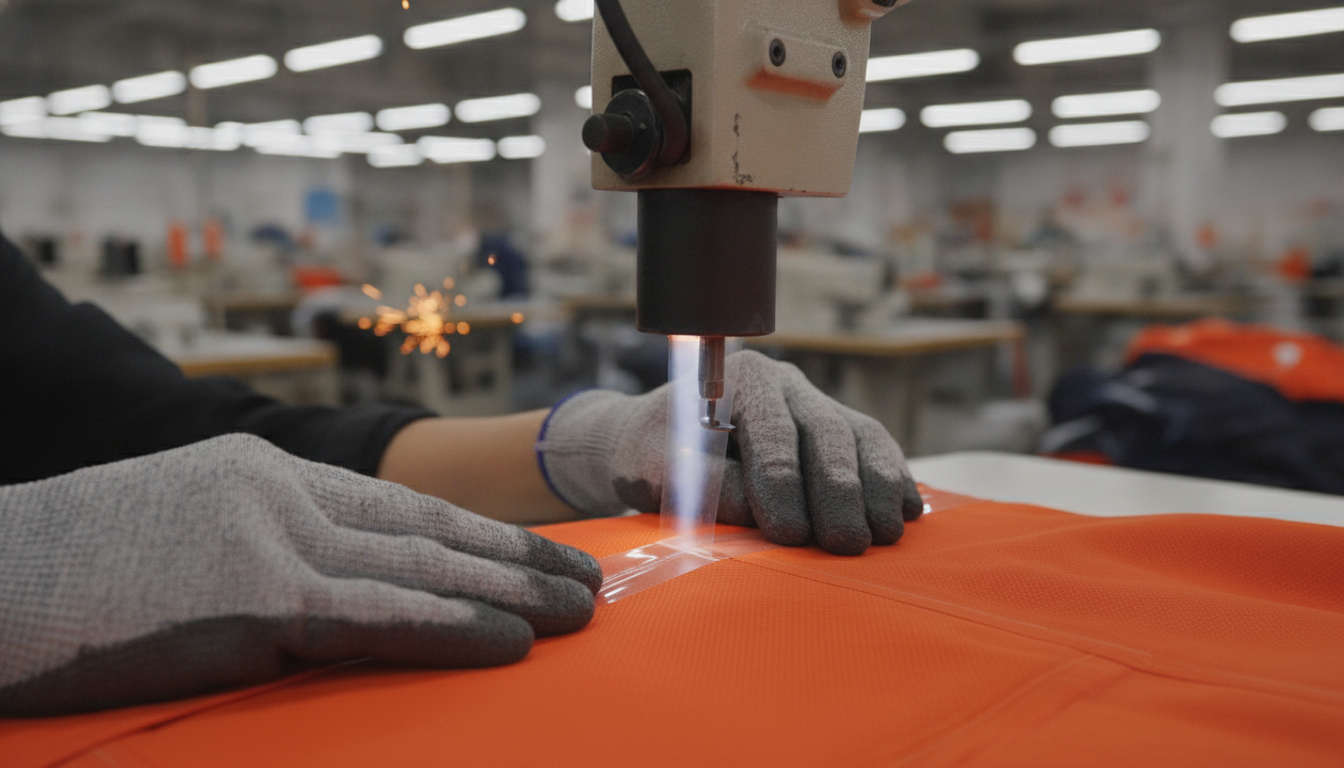
Taped seams are heat-applied strips of waterproof material placed over the needle holes created when fabric panels are stitched together. Without tape, water enters through those microscopic punctures, regardless of how waterproof the base fabric is. A jacket labelled waterproof must have either taped seams or be constructed with welding techniques that eliminate stitching altogether. In practice, most manufacturers still stitch first, then tape over the seams, because stitch-free bonding adds cost and production complexity.
How Taped Seams Work in a 3-Layer Construction
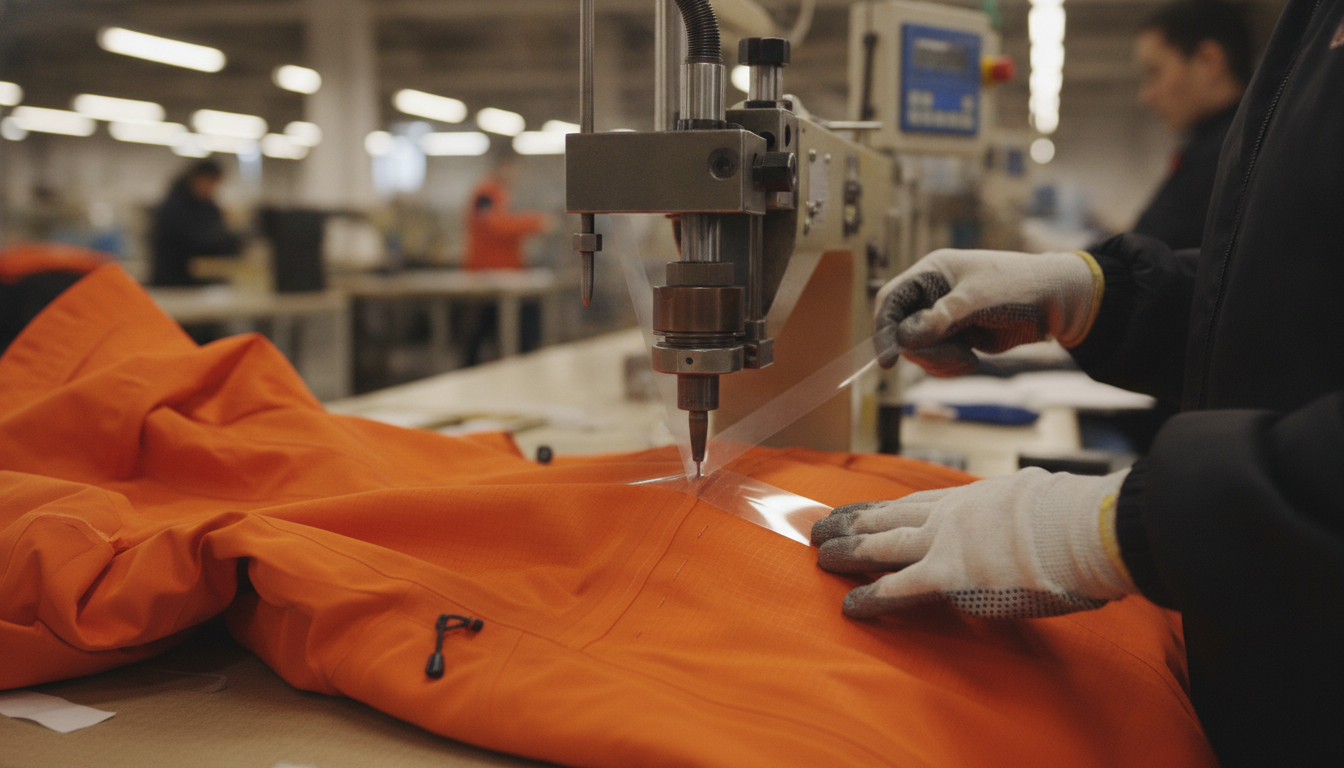
In a 3-layer jacket, a face fabric, waterproof membrane, and interior backer are laminated into one. After cutting and sewing, a narrow PU or TPU seam tape is applied with a hot-air taping machine. The adhesive melts into the membrane, sealing the thread holes while adding approximately 8-12mm of reinforcement along the seam. The resulting seam can withstand hydrostatic pressure of 10,000mm to 20,000mm, matching the fabric rating.
Does Every Seam Need Tape?
Not always. Critical seams-shoulder, armhole, hood, and centre back-are always taped. On some budget rain jackets, side seams and hem are left unsealed to cut costs. However, any unsealed seam becomes a failure point in sustained downpour. For a true waterproof jacket, 100% seam sealing is the standard. When you talk to a factory, ask explicitly: “Do you tape all seams or only critical seams?” The answer affects warranty claims and field performance.
Seam Sealing Methods and Tape Types
Not all seam tape is equal; thickness, width, backing material, and adhesive temperature tolerance vary widely. Choosing the right tape affects durability, breathability, and even the finished look of the jacket. Here are the three common tape categories you will encounter when quoting with a taped seams waterproof jacket manufacturer.
Hot-Air vs Ultrasonic Seam Sealing
Hot-air taping machines, common in mid-to-high-end factories, use a nozzle to heat the tape and seam zone simultaneously before pressure rollers bond the materials. Ultrasonic sealing melts the fabric edges directly without tape, creating a welded seam. Welded seams eliminate needle holes entirely, but the technique limits fabric choice to synthetics with high polyester content. For most DTC outdoor brands, hot-air taped seams remain the cost-performance sweet spot.
How Factories Test Seam Seal Integrity
Reputable manufacturers test every production lot with a hydrostatic head tester, inflating a water-filled column over the taped seam until a burst or drop appears. A passing seam typically holds 3-5 psi for 5 minutes. Some factories also use a vacuum chamber test with coloured water to visually inspect for channel leaks. Ask your supplier for their in-house QA protocol; if they cannot describe their pressure or vacuum test, walk away.
Key Specifications Buyers Must Define
Clear specifications prevent costly re-sampling and production errors. When you issue an RFQ to a taped seams waterproof jacket manufacturer, include these four specification blocks in your tech pack.
Spec Sheet Red Flags
- Unspecified tape width: Tape narrower than 8mm risks peeling and incomplete hole coverage on thicker fabrics.
- Missing seam allowance detail: If the seam margin is less than 3mm, the tape may miss needle holes entirely during high-speed production.
- No PFC-Free certification: In 2026, selling into California, New York, or the EU without documented PFC-Free DWR is a compliance risk that can block customs clearance.
Why Partner with a Taped Seams Waterproof Jacket Manufacturer?
General apparel factories often treat seam taping as an afterthought, outsourcing to a third-party workshop or using unbranded tape with inconsistent adhesive activation. A dedicated taped seams waterproof jacket manufacturer runs in-line taping machines on their own production floor, which cuts lead time and raises quality consistency. In our 12+ years manufacturing outdoor jackets in Taizhou and Yiwu, we have seen uncontrolled taping cause delamination rates as high as 8% versus under 0.5% when taping is done in-house with calibrated temperature and speed.
In-House vs Subcontracted Seam Taping
When seam taping is subcontracted, garments leave the sewing line, travel to an external workshop, then return for finishing. That extra handling adds 3 to 5 working days and introduces a chain-of-custody gap. In-house taping eliminates these steps. Every production line in our 3,000m² Taizhou Sanmen facility has a dedicated hot-air taping station, meaning a jacket moves from cut to sew to tape to QC without leaving the floor.
Quality Consistency at Scale
Taping speed varies with fabric thickness and seam curvature. An experienced operator adjusts the nozzle temperature and roller pressure in real time, something automated guides miss on radiused seams like armholes. Look for a manufacturer that records temperature and speed per production lot so you can trace batch-level quality. For orders of 300 pieces and above, demand a production sample sealed with the actual tape lot that will be used on bulk.
Certifications and Compliance for Institutional Buyers
If you are sourcing waterproof jackets for a school uniform program, corporate team, or government contract, compliance documentation is non-negotiable. Here is a quick-reference table for the certifications most frequently requested by US institutional buyers in 2026.
Documentation Checklist for B2B Buyers
- Pre-shipment QA report: Ask for photos of the hydrostatic head test on taped seams from your actual production lot, not a golden sample.
- PFC-Free declaration: If your market is California or the EU, request a third-party lab certificate confirming zero PFAS in the DWR finish.
- Mill certificates: For recycled fabrics, demand a transaction certificate from the mill to support GRS labelling on your final product.
Sample MOQ: 1 piece. Bulk MOQ: 30 pieces per SKU. Sampling time: 7-10 days.
In our 12+ years manufacturing outdoor jackets in Taizhou and Yiwu, we have seen that the fastest way to derail a launch is discovering certification gaps after production starts. Vet the factory’s documentation before cutting fabric.
MOQ, Lead Times, and Customization Options
Minimum order quantity is the single biggest barrier for founders and team-gear buyers. While many factories in Guangdong quote 300-piece minimums per style, specialized manufacturers in Zhejiang often work with 30-piece MOQs per SKU, thanks to smaller production lines and flexible material sourcing.
MOQ Comparison by Order Type
Customization: From Logo to Full Private Label
- Embroidery and screen print: Up to 6 logo locations per jacket; 3D puff, silicone patch, or tone-on-tone embroidery for premium brands.
- Custom lining and trims: Swappable zip pulls, cord locks, velcro tabs, and interior pocket configurations to differentiate your SKU.
- Custom hang tags and packaging: Many DTC brands request woven labels, recycled poly bags, and hang tags with QR codes linking to care instructions.
Recommended Next Step
OEM jacket manufacturing with a reliable taped seams waterproof jacket manufacturer eliminates the biggest quality variable in waterproof apparel. If you want to validate a style before committing to bulk, request a 1-piece sample with factory-calibrated taping, then scale with a 30-unit pilot order when the market responds. For private-label DTC brands and teamwear programs, the option to start with low MOQ and add custom logos means you avoid inventory risk while building proof of concept.
Get factory-taped seam samples with a 7-day turnaround.
Request your 1-piece sample →
FAQ
What are taped seams in a waterproof jacket?
Taped seams are an application of heat-bonded waterproof tape applied over stitch lines to seal the needle holes created during sewing. Without this tape, water penetrates through those punctures even if the main fabric is rated to 20,000mm. True waterproof jackets must have all seams taped or be constructed using stitch-free welding methods.
Are taped seams better than sealed seams?
The terms are often used interchangeably, but “sealed seams” can refer to welded seams that fuse fabric without stitches, while “taped seams” specifically use adhesive tape over stitched areas. Taped seams are more common and cost effective. Welded seams eliminate needle holes entirely but require specialised machinery and limit fabric choice to high-polyester blends.
Do waterproof jackets need taped seams?
Yes, a jacket cannot be called waterproof without sealed seams. Water-resistant jackets use tight-weave fabrics and DWR coating but will leak at the seams under sustained rain. For a garment to carry a waterproof claim, manufacturers must tape all seams where water ingress is possible, typically tested with a hydrostatic head gauge per ASTM or EN standards.
How do you tell if a jacket has taped seams?
Turn the jacket inside out and look for shiny or matte strips of tape running over the stitch lines. Run a fingernail along the seam; you will feel a smooth, slightly raised ridge if tape is present. Also check the product label: if a jacket claims “fully seam-sealed” or “100% taped seams,” the manufacturer has covered every stitch line with tape.
What is the difference between 2-layer, 2.5-layer, and 3-layer waterproof jackets?
A 2-layer jacket bonds the membrane to the face fabric with a separate liner inside; seams must be taped. A 2.5-layer jacket uses a printed or sprayed-on protective backer, making it lighter but less durable. A 3-layer jacket laminates the face fabric, membrane, and backer into one material, offering the best durability and breathability, commonly used in high-performance rainwear.
Key Takeaways
- Grand View Research reports the global outdoor apparel market exceeded $18 billion in 2024, driving demand for high-quality waterproof shell production.
- OEKO-TEX Standard 100 tests textiles against more than 1,000 harmful substances and is increasingly required by US school uniform program RFPs.
- The Global Recycled Standard (GRS) requires a minimum of 20% recycled material content before a product can be certified and labelled GRS.
- SGS lab testing can verify seam hydrostatic head up to 20,000mm, providing documented proof that your jacket meets claimed waterproof ratings.
- BSCI social compliance is a mandatory prerequisite for supplying many US corporate teamwear contracts as of 2026 procurement guidelines.
- PFC-Free DWR finishes are now enforced in California and EU markets; non-compliant products risk border rejection and retail delisting.