
To verify GRS certification outdoor jacket factory audit records, request the factory’s current Scope Certificate, check the certificate number and holder name against the Textile Exchange public registry, confirm the certificate covers outdoor jackets and relevant processes (cutting, sewing, lamination, finishing), validate the expiry date, and request an order-specific Transaction Certificate that ties certified recycled material to your shipment.
📋 Table of Contents
- Key Takeaways
- What Does GRS Certification Cover for Outdoor Jackets?
- How Do You Locate and Validate a Factory’s GRS Scope Certificate?
- How Do You Verify the Production Site Matches the Certified Entity?
- What Is a Transaction Certificate and Why Does Your Order Need One?
- What Audit Evidence Should You Request Before Production?
- What Are the Red Flags Small Buyers Should Watch For?
- Frequently Asked Questions
Key Takeaways
- GRS consumer-facing product labeling requires at least 50% recycled content, while certification itself generally requires at least 20% recycled content, according to Textile Exchange (2026).
- A GRS Scope Certificate is generally valid for one year and requires ongoing surveillance or renewal auditing, according to Textile Exchange (2026).
- GRS chain-of-custody verification follows certified material through the supply chain and uses Transaction Certificates to connect certified inputs with specific shipments, according to Textile Exchange (2026).
- Typical factory audits take approximately 1-3 days on site, depending on facility scope and complexity, according to Lihaishiye (2026).
- GRS covers recycled-content claims together with chain of custody, social, environmental and chemical-processing requirements at applicable certified sites, according to Textile Exchange (2026).
- A GRS Scope Certificate lists the legal entity, production site address, certification body, certificate number, expiry date and covered product categories, all of which must match your supplier’s actual facility and order scope.
What Does GRS Certification Cover for Outdoor Jackets?
GRS certification validates recycled-content claims, chain-of-custody traceability, and selected social, environmental and chemical requirements at certified production sites. For outdoor jackets, the scope must explicitly cover the processes your factory performs: fabric cutting, sewing, lamination (if waterproof-breathable membranes are applied), coating application, seam sealing, and final assembly. A certificate that covers only knitting or weaving does not validate a finished hardshell jacket.
Recycled Content and Labeling Thresholds
According to Textile Exchange (2026), GRS consumer-facing product labeling requires at least 50% recycled content, while certification itself generally requires at least 20% recycled content. If your jacket shell uses 30% recycled polyester and 70% virgin nylon, the fabric can be GRS-certified, but the finished jacket cannot carry a consumer-facing GRS label unless the blended average across all components (shell, lining, insulation, trims) reaches 50%.
Chain of Custody and Transaction Certificates
According to Textile Exchange (2026), GRS chain-of-custody verification follows certified material through the supply chain and uses Transaction Certificates to connect certified inputs with specific shipments. Every supplier in the chain (fiber recycler, spinner, weaver, dyer, jacket manufacturer) must hold a valid GRS Scope Certificate and issue a Transaction Certificate for each batch of certified material they sell. If your jacket factory buys GRS-certified fabric but cannot provide a Transaction Certificate from the fabric mill, the chain is broken and your finished jacket is not GRS-compliant.
Social, Environmental and Chemical Requirements
GRS audits evaluate wastewater treatment, energy use, chemical management, worker health and safety, and freedom of association. For technical outdoor jackets, the chemical module is critical: waterproof coatings, DWR treatments and lamination adhesives must comply with GRS Restricted Substances List limits. A factory that uses PFC-based DWR on a GRS-certified jacket fails the chemical module, even if the recycled-content percentage is correct.
How Do You Locate and Validate a Factory’s GRS Scope Certificate?
Request the factory’s current GRS Scope Certificate as a PDF. The certificate must state the legal entity name, production site address, certification body, certificate number, issue date, expiry date, and covered product categories. Cross-check every field against the Textile Exchange public registry to confirm authenticity.
Step 1: Request the Scope Certificate PDF
Ask your supplier for the complete Scope Certificate, not a summary or a logo. The certificate is a multi-page document issued by an accredited certification body (Control Union, ECOCERT, ICEA, NSF, SCS Global Services, or another Textile Exchange-approved body). If the supplier sends only a logo or a one-page summary, request the full certificate before proceeding.
Step 2: Check the Textile Exchange Public Registry
Visit the Textile Exchange certificate database and search by certificate number, company name, or facility address. The registry entry must match the PDF certificate exactly: same legal entity, same address, same scope, same expiry date. A mismatch indicates the certificate belongs to a different facility, a trading company rather than the production site, or an expired audit.
Step 3: Verify the Scope Covers Your Product
The Scope Certificate lists product categories and processes. For outdoor jackets, confirm the scope includes “outerwear”, “jackets”, or “apparel” and explicitly covers the processes your order requires: cutting, sewing, and (if applicable) lamination, coating, or seam sealing. A certificate that covers only “knitted fabrics” or “woven fabrics” does not validate a finished jacket unless the factory also holds a separate certificate for cut-and-sew operations.
Step 4: Confirm the Expiry Date
According to Textile Exchange (2026), a GRS Scope Certificate is generally valid for one year and requires ongoing surveillance or renewal auditing. Check the expiry date on both the PDF and the registry entry. If the certificate expired more than 30 days ago, the factory is no longer certified and cannot issue Transaction Certificates for new orders. Request proof of renewal or a new audit report before placing your order.
.
How Do You Verify the Production Site Matches the Certified Entity?
The legal entity name on the GRS Scope Certificate must match the factory that will physically cut, sew and finish your jackets. Many buyers discover too late that the certificate belongs to a trading company, a parent holding company, or a different facility in the same city.
Legal Entity vs. Trading Company
If the Scope Certificate lists “ABC Trading Co., Ltd.” but your purchase order and factory address reference “XYZ Garment Factory”, the certificate does not cover your production site. GRS certification is site-specific: the certificate holder must be the entity that performs the certified processes. A trading company can broker GRS-certified products, but only if the actual manufacturer holds a valid Scope Certificate and issues a Transaction Certificate for each shipment.
Subcontractor Approval
GRS standards require certified facilities to declare and gain approval for any subcontractors that handle certified material. If your jacket factory subcontracts lamination or seam sealing to a third-party specialist, that subcontractor must also hold GRS certification and appear on the factory’s approved subcontractor list. Request a copy of the subcontractor approval letter from the certification body before production starts.
Multi-Site Operations
Large manufacturers may operate multiple facilities under one corporate parent. Each production site requires its own GRS Scope Certificate. If the certificate lists “Building A, 123 Industrial Road, Taizhou” but your jackets will be sewn in “Building B, 456 Export Avenue, Ningbo”, the second site is not covered. Confirm the certificate address matches the facility where your order will be produced, or request a separate certificate for the second site.
What Is a Transaction Certificate and Why Does Your Order Need One?
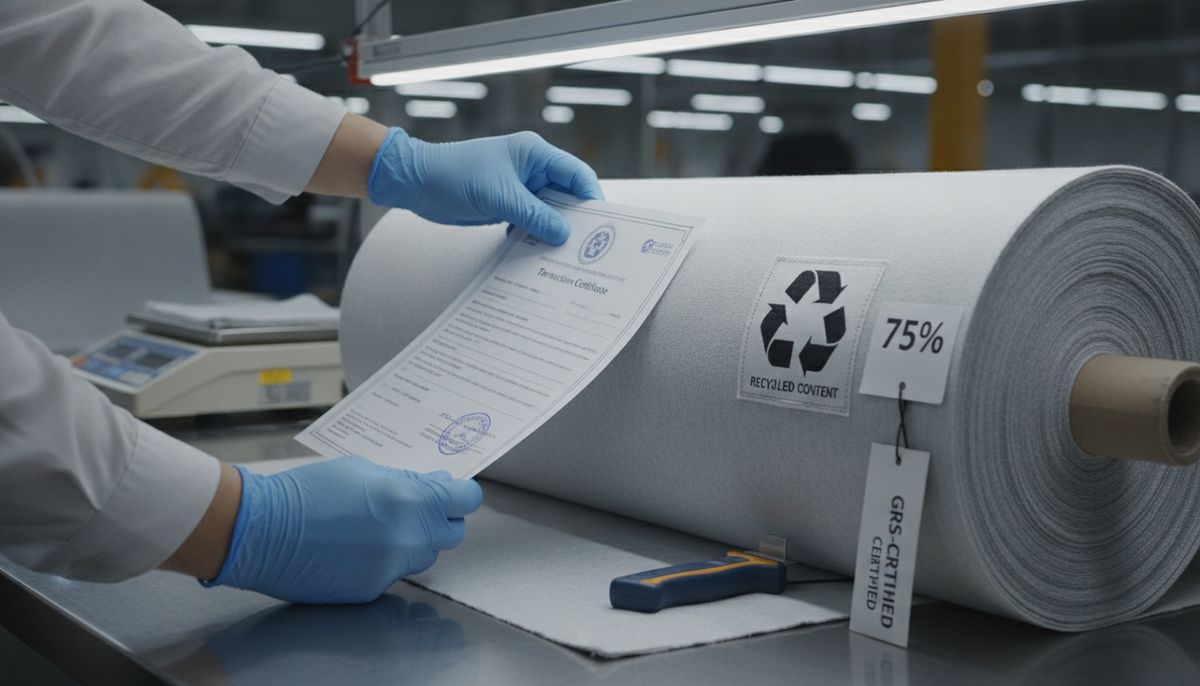
A Transaction Certificate (TC) is an order-specific document that ties certified recycled material to a particular shipment. Without a TC, you cannot prove your finished jackets contain GRS-certified recycled content, even if the factory holds a valid Scope Certificate.
How Transaction Certificates Work
According to Textile Exchange (2026), GRS chain-of-custody verification uses Transaction Certificates to connect certified inputs with specific shipments. When your jacket factory buys GRS-certified recycled polyester fabric, the fabric mill issues a TC stating the fabric grade, recycled-content percentage, quantity shipped, and the factory’s GRS certificate number. When your factory ships finished jackets to you, they issue a new TC referencing the incoming fabric TC, the jacket style, the recycled-content percentage in the finished product, and your order quantity. Each TC creates an auditable link in the chain.
What a Transaction Certificate Must Include
A valid TC lists the seller’s GRS certificate number, the buyer’s GRS certificate number (if the buyer is also certified), the product description, the recycled-content percentage by weight, the material composition, the quantity shipped, the TC number, and the date of issue. If any field is missing or the recycled percentage does not match your agreed specification, the TC is incomplete and your shipment cannot be labeled GRS-certified.
Requesting a Draft TC Before Production
Ask your factory to provide a draft TC during the pre-production meeting, showing the incoming fabric TC number, the calculated recycled percentage for your jacket style, and the planned shipment quantity. This draft lets you verify the chain of custody before bulk cutting starts. If the factory cannot produce a draft TC or cannot name the fabric supplier’s TC number, the recycled-content claim is not traceable and your order will not qualify for GRS labeling.
What Audit Evidence Should You Request Before Production?
A complete audit evidence pack includes the Scope Certificate, the most recent audit report summary, incoming Transaction Certificates for all certified materials, bills of materials showing recycled-content calculations, mass-balance records, restricted-substances test reports, and corrective-action records from the last audit. This pack lets you verify the factory’s GRS compliance independently, without relying solely on their word.
Audit Report Summary
According to Lihaishiye (2026), typical factory audits take approximately 1-3 days on site, depending on facility scope and complexity. Request a copy of the audit report summary (not the full confidential report, which certification bodies do not release to third parties). The summary should state the audit date, the certification body, the scope of the audit, any non-conformances found, and the corrective actions taken. If the summary lists open non-conformances related to chemical management or chain-of-custody documentation, ask for proof that those issues have been closed before your order enters production.
Bills of Materials and Recycled-Content Calculations
For a hardshell jacket with a recycled polyester shell, virgin nylon lining, recycled polyester insulation, and virgin polyester zippers and trims, the factory must calculate the blended recycled percentage by weight. Request the bill of materials showing each component’s weight and recycled content, plus the formula used to reach the final percentage. If the factory claims 60% recycled content but the calculation shows only 48%, the labeling claim is false and the order cannot carry a GRS label.
Mass-Balance Records
GRS requires certified facilities to maintain mass-balance records proving that the quantity of certified material purchased matches the quantity of certified product shipped, accounting for normal production waste. Request a sample mass-balance report from a recent production run to confirm the factory tracks inputs and outputs accurately. If the factory cannot produce mass-balance records or the records show large unexplained discrepancies, the chain-of-custody system is weak and your order’s recycled-content claim is at risk.
Restricted-Substances Test Reports
GRS Restricted Substances List limits apply to dyes, finishes, coatings and adhesives used in certified products. Request test reports for the waterproof coating, DWR treatment, and lamination adhesive your jacket will use, showing compliance with GRS chemical limits. If the factory cannot provide test reports or the reports are older than 12 months, the chemical compliance is not verified and your jackets may fail a buyer’s own testing.
What Are the Red Flags Small Buyers Should Watch For?
Small buyers ordering 100-500 jackets face higher risk than large brands because factories prioritize volume customers and may cut corners on documentation for smaller orders. during the verify GRS certification outdoor jacket factory audit process.
Recycled-Content Percentage That Changes Between Sample and Bulk
If the factory quotes 70% recycled content for your sample but later revises the bulk-order percentage to 55%, the factory likely switched to a cheaper, lower-recycled fabric to protect margin on a small order. Demand a locked recycled-content specification in your purchase order and request a draft Transaction Certificate before cutting starts, showing the exact percentage your bulk order will achieve.
Mixed Certified and Non-Certified Production on the Same Line
GRS allows certified and non-certified production in the same facility, but the factory must segregate certified material and maintain separate records. If the factory runs your GRS-certified jackets on the same cutting table and sewing line as non-certified products without a clear handover and cleaning protocol, cross-contamination risk is high. Ask how the factory segregates certified batches and request photos of the segregation system (color-coded bins, separate storage areas, batch tags).
Expired Certificate Presented as Current
Some factories present an expired GRS Scope Certificate and claim “renewal is in progress” or “the new certificate will arrive next month.” An expired certificate means the factory is not currently certified and cannot issue valid Transaction Certificates. Do not accept promises of future renewal. Either wait until the renewed certificate appears in the Textile Exchange registry, or source from a factory with a current certificate.
Subcontractor Not Listed on Approved Subcontractor Register
If your jacket requires lamination or seam sealing and the factory subcontracts that work to a specialist, the subcontractor must hold GRS certification and appear on the factory’s approved subcontractor list. If the factory admits they subcontract but cannot provide the subcontractor’s certificate number or approval letter, the chain of custody is broken and your jackets are not GRS-compliant.
Inability to Issue an Order-Specific Transaction Certificate
The clearest red flag is a factory that holds a valid Scope Certificate but cannot or will not issue a Transaction Certificate for your order. This indicates the factory’s internal chain-of-custody system is weak, they are not purchasing certified fabric for your order, or they do not understand GRS requirements. Without a TC, your jackets cannot be labeled or sold as GRS-certified, regardless of the factory’s Scope Certificate status.
PTOUTWEAR GRS Status: PTOUTWEAR holds ISO 9001, SGS, and PFC-Free DWR certifications. GRS certification is pending, not yet held. For buyers requiring GRS-certified outdoor jackets today, we recommend verifying current certificate status in the Textile Exchange registry and requesting a complete audit evidence pack before production. Our OEM jacket manufacturing service includes full documentation support for ISO 9001 and PFC-Free DWR compliance.
Frequently Asked Questions
How do I verify a GRS certificate is real and not forged?
Cross-check the certificate number, legal entity name, facility address, and expiry date against the Textile Exchange public certificate database. The registry is the single source of truth for valid GRS certificates. If the certificate PDF shows details that do not match the registry entry, or if the certificate number does not appear in the database at all, the certificate is either forged, expired, or belongs to a different facility. Contact the certification body listed on the certificate directly to confirm authenticity if any field does not match.
What is the difference between a GRS Scope Certificate and a Transaction Certificate?
A GRS Scope Certificate proves a facility is certified and lists the product categories and processes covered by the certification. It is valid for one year and applies to the facility as a whole. A Transaction Certificate is order-specific and ties a particular shipment of certified material or finished product to the chain of custody. Every shipment of GRS-certified goods requires a new Transaction Certificate linking it to the certified inputs. You need both: the Scope Certificate confirms the factory is certified, and the Transaction Certificate proves your specific order contains certified recycled content.
Can a factory with an expired GRS certificate still produce GRS-certified jackets?
No. Once a GRS Scope Certificate expires, the factory is no longer certified and cannot issue Transaction Certificates for new orders. Any jackets produced after the expiry date cannot be labeled or sold as GRS-certified, even if the factory claims a renewal audit is scheduled or in progress. Do not place an order with a factory holding an expired certificate unless the renewed certificate has been issued and appears in the Textile Exchange registry. Accepting a promise of future renewal exposes you to the risk of receiving non-compliant product that cannot carry GRS labeling.
How do I verify the recycled-content percentage claimed by the factory is accurate?
Request the bill of materials showing each component’s weight and recycled content, plus the calculation formula used to reach the final blended percentage. Cross-check the incoming Transaction Certificates from fabric and trim suppliers to confirm the recycled percentages they claim. Verify the calculation adds up correctly by weight. If the factory claims 60% recycled content but the bill of materials shows only 48%, the labeling claim is false. For high-stakes orders, consider hiring an independent lab to test a finished sample and verify the recycled-content percentage through fiber analysis.
Does GRS certification cover the entire jacket or only the fabric?
GRS certification covers the entire supply chain from fiber recycling through finished product. For a jacket to be GRS-certified, every facility that handles the certified material (fiber recycler, spinner, weaver, dyer, jacket manufacturer) must hold a valid GRS Scope Certificate and issue Transaction Certificates linking each step. If only the fabric mill is certified but the jacket factory is not, the finished jacket cannot carry a GRS label. The recycled-content percentage is calculated across all components (shell, lining, insulation, trims) by weight, not just the outer fabric. A jacket with recycled shell fabric but virgin lining and trims may have a lower blended recycled percentage than the shell fabric alone.
Need help verifying GRS certification for your outdoor jacket order?
Request a Factory Audit Checklist →
Written by Ivan Chen, Sales Engineer at PTOUTWEAR – 13 years in outdoor apparel manufacturing.