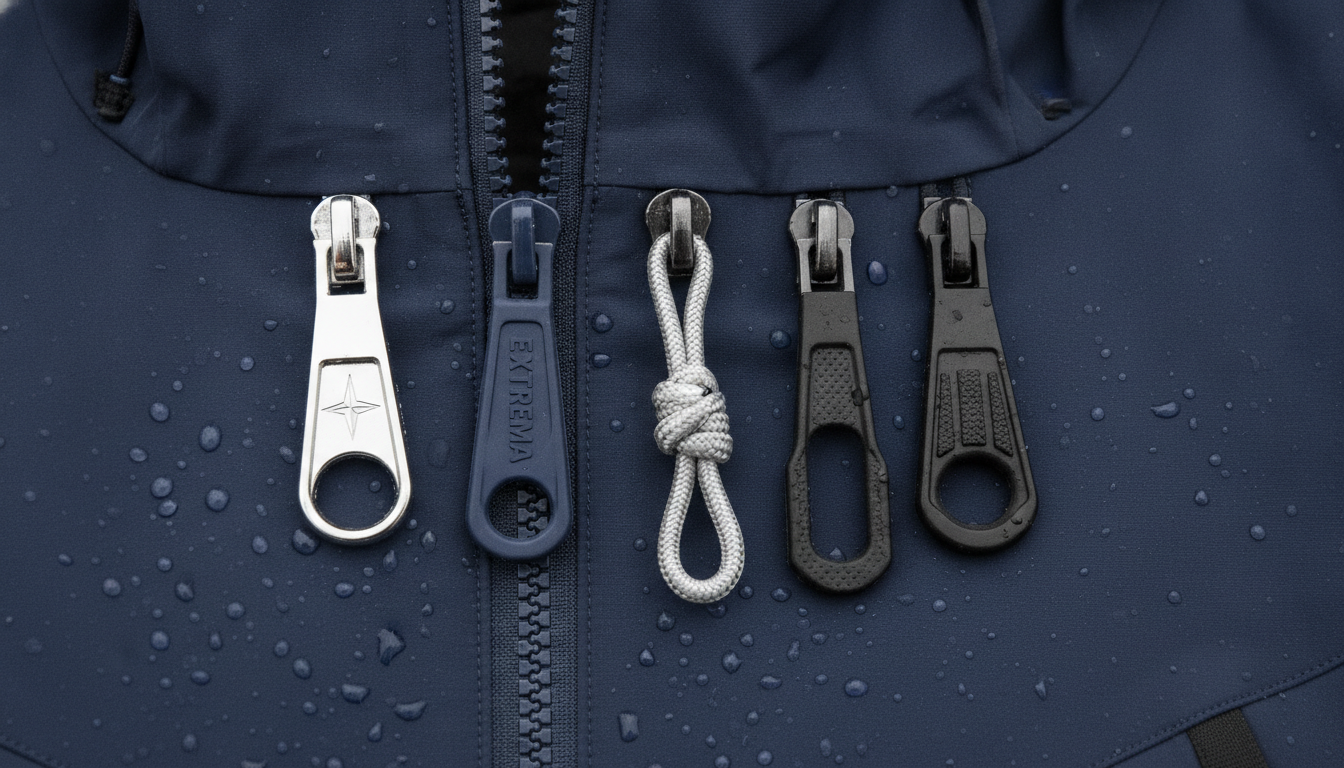
Ski jacket manufacturer custom zipper pull options include metal, molded rubber, paracord, and reflective pulls, each offering different branding methods (embossing, engraving, injection molding, screen printing), cold-weather performance, and minimum order quantities. Most manufacturers require 500-1,000 pieces per custom pull design for tooling, though stock pulls can be customized at lower volumes. PTOUTWEAR offers 1-piece sample MOQ and 10-piece bulk MOQ per jacket style, with stock zipper pulls customizable via laser engraving or screen printing at no tooling charge for orders above 30 pieces.
📋 Table of Contents
Executive Summary
- Material choice drives performance: Metal pulls offer premium branding but can crack in extreme cold; molded rubber and paracord pulls remain flexible below -20°C and work with gloved hands.
- Branding methods vary by material: Metal accepts laser engraving and embossing; molded rubber uses injection-molded logos; paracord and webbing pulls take screen printing or woven labels.
- Cold-weather testing is critical: Ski jacket pulls must pass cold-crack testing at -30°C and retain pull-force above 15 kgf after 1,000 cycles to meet technical outerwear standards.
- Tooling minimums differ by customization: Fully custom molded pulls require 500-1,000 piece minimums to cover injection mold costs; stock pulls with laser engraving or screen printing start at 100-300 pieces.
- Attachment method affects durability: Bartack stitching on webbing loops outlasts metal split rings in high-abrasion environments; manufacturers should specify thread type and stitch count for uniform programs.
Custom Zipper Pull Material Options
Material selection determines cold-weather flexibility, branding surface, and cost. Each option suits different jacket tiers and end-use scenarios.
Metal Pulls (Zinc Alloy, Aluminum, Stainless Steel)
Metal zipper pulls deliver premium aesthetics and accept fine-detail engraving. Zinc alloy is the most common choice for mid-tier ski jackets, offering good weight-to-strength ratio at $0.15-$0.30 per pull in 1,000-piece orders. Aluminum pulls weigh 30-40% less than zinc but cost $0.25-$0.50 per unit. Stainless steel is reserved for expedition-grade outerwear where corrosion resistance matters, running $0.60-$1.20 per pull.
Metal pulls face two cold-weather risks. First, bare metal conducts cold, making them uncomfortable to grip with bare hands below -10°C. Second, zinc alloy can cold-crack at temperatures below -25°C if the alloy contains high lead content. Buyers should request OEKO-TEX 100 compliance to ensure the alloy meets restricted-substance limits. Anodized aluminum and powder-coated finishes add a thin insulation layer and improve grip, but the coating can chip after 500-800 zipper cycles in high-abrasion areas like chest pockets.
Molded Rubber and TPU Pulls
Molded rubber and thermoplastic polyurethane (TPU) pulls remain flexible to -30°C and offer the largest branding surface. TPU accepts injection-molded logos in 2D or 3D relief, making it the go-to choice for DTC ski brands that want bold visual identity. Tooling costs for a custom mold run $800-$2,500 depending on complexity, with per-unit costs of $0.20-$0.45 in 1,000-piece orders.
Rubber pulls are glove-friendly because the material provides grip even when wet. However, molded pulls add 8-12 grams per unit compared to paracord alternatives, which matters on ultralight touring jackets. Buyers should specify Shore A hardness (60-70A is typical for ski pulls) and UV-stabilized compounds to prevent brittleness after one season of sun exposure at altitude.
Paracord and Webbing Pulls
Paracord pulls cost $0.08-$0.18 per unit and require no tooling, making them the lowest-entry option for emerging brands. A 10 cm length of 550 paracord (7-strand core, 250 kg tensile strength) provides ample grip surface for gloved hands. Webbing pulls use 15-25 mm nylon or polyester tape, which accepts screen-printed logos or heat-transferred labels.
Paracord pulls excel in high-abrasion environments because the braided sheath self-repairs minor snags. The tradeoff is visual consistency: hand-tied knots and heat-sealed ends vary slightly unit-to-unit, which some premium brands reject. Reflective paracord (woven with 3M Scotchlite yarn) adds visibility for backcountry and night skiing, running $0.25-$0.40 per pull.
Branding Methods for Ski Jacket Pulls
Branding method must match pull material and survive the jacket’s intended use environment. Each technique has distinct durability and cost profiles.
Laser Engraving on Metal
Laser engraving removes a thin surface layer to create permanent contrast. It works on anodized aluminum, stainless steel, and powder-coated zinc alloy. Setup cost is $50-$150 per design, with no per-unit charge above 100 pieces. Engraved logos resist fading through 1,000+ wash cycles, but fine details below 1.5 mm line width fill with dirt in field use.
Engraving depth should be 0.15-0.25 mm for outdoor pulls. Shallower engraving wears smooth after repeated glove contact; deeper cuts create stress points that can crack on thin-wall pulls. Buyers should request a pre-production sample to verify legibility on the actual pull size, not a flat proof.
Embossing and Debossing on Metal and Leather
Embossing raises a logo in relief; debossing presses it below the surface. Both require a steel die ($200-$600 tooling) and a stamping press. Embossed pulls offer strong tactile branding but add 0.5-0.8 mm thickness, which can interfere with zipper-slider clearance on #3 and #5 coil zippers. Debossing avoids the clearance issue and works well on leather pulls, which are sometimes used on heritage-style ski jackets.
Embossed details should be 2 mm minimum width to survive the stamping force without tearing thin-wall pulls. Debossed logos fill with wax and dirt over time; buyers targeting multi-season use should specify a contrasting paint fill during production.
Injection Molding for Rubber and TPU
Injection molding integrates the logo into the pull during manufacturing, making it the most durable branding method. The mold cavity includes raised or recessed logo features, and molten TPU fills the entire shape in one shot. Tooling costs $800-$2,500 and supports 10,000-50,000 cycles before wear.
Molded logos can be 2D (flat surface) or 3D (raised relief up to 3 mm). Two-color molding (overmolding a contrasting TPU layer) adds $0.10-$0.20 per pull and creates sharp brand contrast. Buyers should provide vector artwork in STEP or IGES format; raster images require manual vectorization, adding 3-5 days to sampling time.
Screen Printing on Paracord and Webbing
Screen printing applies ink to the surface of paracord or webbing pulls. Setup cost is $80-$200 per color, with per-unit costs of $0.05-$0.12 for single-color prints in 500-piece runs. Prints survive 20-30 industrial wash cycles before noticeable fading, making this method suitable for seasonal team uniforms but marginal for multi-year corporate programs.
Ink adhesion depends on fabric pre-treatment. Nylon webbing requires a plasma or flame treatment to open the fiber surface; untreated prints peel after 10-15 washes. Buyers should specify plastisol ink (better wash durability) over water-based ink (softer hand feel, faster fade) for ski outerwear.
Cold-Weather Performance Requirements
Ski jacket pulls operate in conditions that would fail general-apparel hardware. Cold-crack resistance, wet-grip retention, and pull-force durability are the three testable benchmarks.
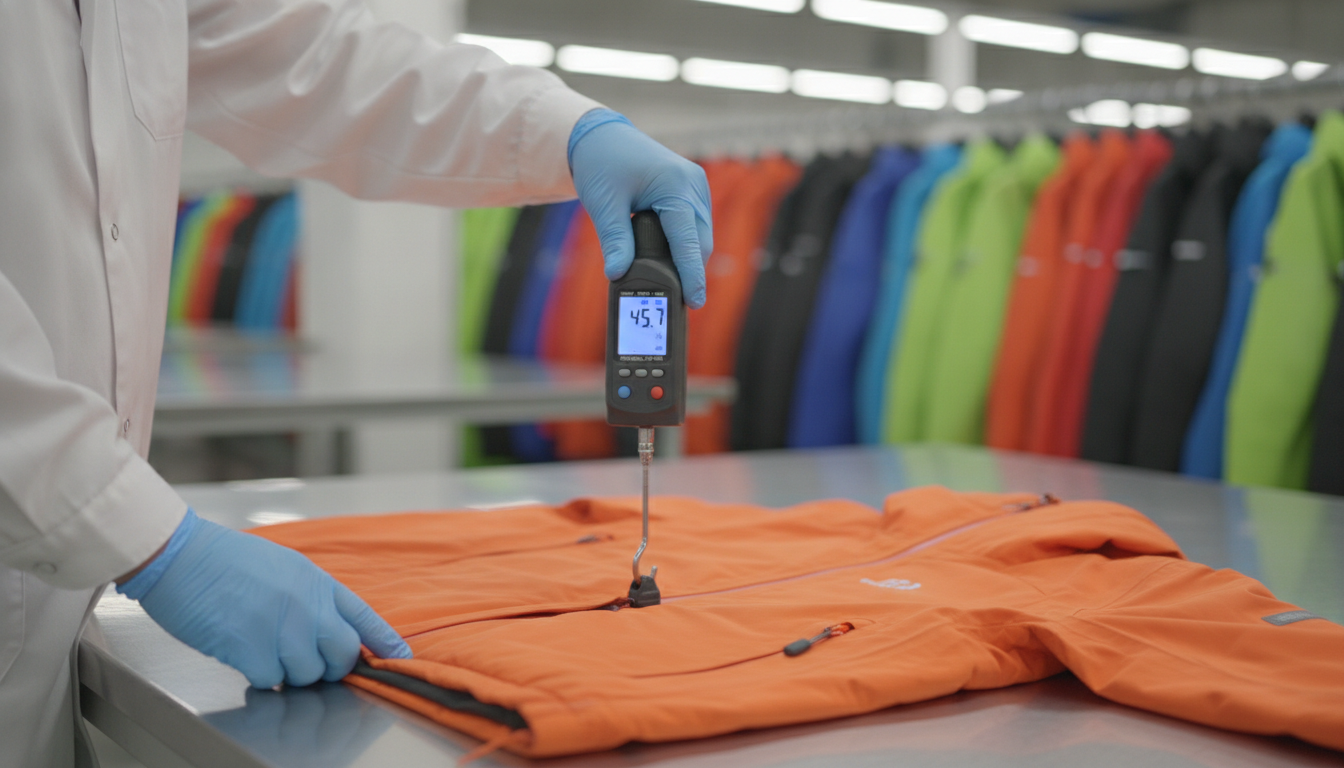
Cold-Crack Testing
Cold-crack testing exposes pulls to -30°C for 4 hours, then subjects them to a 90-degree bend. Pulls that crack or show surface fractures fail. This test catches zinc-alloy pulls with excessive lead content and TPU compounds not UV-stabilized. OEKO-TEX STANDARD 100 screens for more than 1,000 regulated and non-regulated harmful substances in tested products, providing a baseline for material safety but not a performance guarantee.
Paracord and webbing pulls rarely fail cold-crack tests because woven fibers flex rather than fracture. Metal and molded pulls require material certificates showing cold-impact resistance. Buyers sourcing for Canadian or Scandinavian markets should specify -40°C testing to cover extreme-use scenarios.
Wet-Grip Retention
Wet-grip testing saturates the pull in water, then measures pull force required to operate the zipper with a gloved hand. A pass requires no more than 20% increase in pull force compared to dry conditions. Smooth metal pulls often fail this test; knurled or anodized finishes improve wet grip by 30-50%.
Molded rubber pulls with textured surfaces (diamond knurl, cross-hatch) provide the best wet-grip performance, but the texture traps dirt. Buyers should request pulls with open-channel textures that self-clean during use. Paracord pulls absorb water and can freeze stiff below -15°C if not treated with a durable water repellent (DWR) finish during manufacturing.
Pull-Force Durability
Pull-force testing cycles the zipper 1,000 times, then measures the force required to open and close. Pulls should maintain 15 kgf minimum pull strength and show no visible deformation. Split-ring attachments (the small metal loop connecting pull to slider) are the most common failure point, opening after 600-800 cycles under high load.
Bartack-stitched webbing loops outlast split rings in high-cycle applications. A 10 mm bartack with size-69 bonded nylon thread survives 3,000+ cycles. Buyers specifying uniform programs should request bartack stitch count (minimum 18 stitches) and thread type in the pull specification to ensure replacement parts match original durability.
In practice: A ski jacket that passed initial cold-crack testing at -30°C but failed after 500 zipper cycles shows why buyers must specify both cold-temperature AND pull-force testing in the same protocol, not as separate checks.
MOQ and Tooling Costs
Minimum order quantities and tooling costs vary by customization level. Buyers can choose between fully custom pulls (highest tooling, highest MOQ) and stock pulls with added branding (low tooling, lower MOQ).
Stock Pulls with Added Branding
Stock metal and rubber pulls are available in standard shapes (teardrop, rectangular, oval) and accept laser engraving or screen printing at low setup costs. This approach works for brands validating a design before committing to custom tooling. Lead time is 10-15 days for engraved stock pulls, versus 25-35 days for fully custom molded pulls.
Stock pulls limit branding area to the flat surface, typically 15 x 8 mm on metal pulls and 20 x 12 mm on rubber pulls. Complex logos with fine details below 1.5 mm may not reproduce clearly. Buyers should request a digital proof showing the logo scaled to actual pull size before approving the order.
Fully Custom Molded Pulls
Fully custom molded pulls offer unlimited shape and branding options but require injection-mold tooling. Tooling cost is a one-time expense amortized over the MOQ. A $1,200 mold cost spread over 1,000 pieces adds $1.20 per pull to the first order; reorders using the same mold pay only the per-unit manufacturing cost.
Mold design takes 5-7 days and requires 3D CAD files or physical samples. Buyers should specify pull dimensions, logo placement, and any functional features (thumb grips, lanyard holes) in the initial brief. Design changes after mold fabrication require a new mold, restarting the tooling cost.
Paracord and Webbing Pulls (No Tooling)
Paracord pulls require no tooling and can be produced in quantities as low as 50 pieces. This makes them the fastest path to market for emerging brands. Lead time is 7-10 days for unbranded pulls, 12-18 days for screen-printed webbing pulls.
The tradeoff is limited branding precision. Screen printing on paracord is restricted to one or two colors, and fine details blur on the curved surface. Woven labels sewn onto webbing pulls offer better logo clarity but add $0.15-$0.25 per pull and require 300-500 piece minimums for the label itself.
How Manufacturers Attach Custom Pulls
Attachment method determines pull lifespan and replacement ease. Split rings, bartack stitching, and direct-molded sliders are the three standard approaches.
Split Ring Attachment
Split rings are the default attachment for metal and molded pulls. A small metal loop (5-8 mm diameter) threads through the slider hole and clamps onto the pull. Split rings allow quick pull replacement in the field, which matters for uniform programs where pulls take heavy abuse.
Split rings fail when the gap spreads under repeated load. Stainless steel rings outlast zinc-plated steel by 2-3x in saltwater or high-humidity environments. Ring diameter should match slider hole size: 5 mm rings for #3 coil zippers, 6-7 mm for #5 coil, 8 mm for #8 and #10 metal-tooth zippers. Oversized rings bind in the slider; undersized rings pull through the hole.
Bartack Stitching on Webbing Loops
Bartack stitching sews a webbing loop directly through the slider hole, eliminating the split-ring failure point. A 10 mm bartack with 18-22 stitches using size-69 bonded nylon thread survives 3,000+ zipper cycles. Bartack attachment is permanent; damaged pulls require cutting the thread and re-sewing.
Webbing width should be 10-15 mm to provide adequate stitch base without blocking the slider channel. Buyers specifying bartack attachment should request thread color matching the jacket shell to maintain clean aesthetics. Black and navy thread are stock; custom thread colors require 500-meter minimum orders and add 5-7 days to lead time.
Direct-Molded Pulls on Sliders
Some manufacturers mold the pull directly onto the zipper slider during slider assembly, creating a one-piece unit. This approach is common on high-volume ski jackets where pull replacement is not expected. Direct-molded pulls eliminate the split-ring and bartack labor cost, reducing per-unit cost by $0.08-$0.15.
The tradeoff is inflexibility. Damaged pulls require replacing the entire slider, which is a factory operation, not a field repair. Direct-molded pulls also lock the buyer into a single zipper supplier, because slider dimensions vary slightly between YKK, SBS, and regional suppliers.
Key Takeaways
- Metal pulls offer premium aesthetics and fine-detail engraving but require cold-crack testing below -25°C to ensure zinc-alloy formulations do not fracture in extreme cold.
- Molded rubber and TPU pulls remain flexible to -30°C and accept injection-molded logos, making them the preferred choice for DTC ski brands prioritizing bold visual identity and glove-friendly operation.
- Paracord pulls cost $0.08-$0.18 per unit with no tooling, providing the lowest-entry option for emerging brands, though visual consistency varies slightly unit-to-unit compared to molded alternatives.
- Laser engraving on stock metal pulls requires $50-$150 setup and starts at 100-300 piece minimums, while fully custom molded pulls require $800-$2,500 tooling and 500-1,000 piece minimums to cover injection mold costs.
- Bartack-stitched webbing loops outlast split-ring attachments in high-cycle applications, surviving 3,000+ zipper operations when sewn with size-69 bonded nylon thread and 18-22 stitch count.
- Cold-weather performance testing should combine temperature exposure at -30°C with pull-force durability testing over 1,000 cycles, as pulls that pass static cold-crack tests can still fail under repeated mechanical load.
Frequently Asked Questions
Can you mix different zipper pull types on the same jacket?
Yes, many ski jackets use different pull types by zipper function. Main front zippers often use molded rubber pulls for glove-friendly operation and bold branding, while pit-zip and pocket zippers use smaller paracord or metal pulls to reduce bulk and weight. The key is ensuring all pulls meet the same cold-crack and pull-force testing standards regardless of material. Buyers should specify pull type by zipper location in the tech pack to avoid factory substitutions during production.
What is the lead time difference between stock and custom zipper pulls?
Stock metal or rubber pulls with laser engraving or screen printing ship in 10-15 days after artwork approval. Fully custom molded pulls require 5-7 days for mold design, 12-18 days for mold fabrication, and 7-10 days for production, totaling 25-35 days. Buyers working on tight seasonal deadlines should use stock pulls for initial production runs, then transition to custom molded pulls for reorders once the mold is complete. Rush tooling is available at some factories for a 25-40% surcharge, cutting mold fabrication to 7-10 days.
How do you specify zipper pull requirements in a tech pack?
A complete zipper pull specification includes material type (zinc alloy, TPU, paracord), dimensions (length, width, thickness), branding method (laser engraving, injection molding, screen printing), attachment method (split ring, bartack, direct-molded), and performance requirements (cold-crack temperature, pull-force minimum, wash-cycle durability). Buyers should also specify color (Pantone code or physical sample), surface finish (matte, gloss, anodized), and any functional features like lanyard holes or reflective elements. Including a reference photo of a similar pull from an existing product helps factories understand the intended aesthetic and quality level.
Need ski jacket manufacturer custom zipper pull options that survive cold-weather testing and meet your branding requirements?
Request 1-Piece Samples →
Written by Ivan Chen, Sales Engineer at PTOUTWEAR, 13 years in outdoor apparel manufacturing.