A 15000mm waterproof rating jacket supplier China produces outerwear that withstands 15,000 millimeters of water column pressure before leaking, measured by ISO 811 or AATCC 127 hydrostatic head testing. This rating suits moderate-to-heavy rain, ski jackets, and outdoor workwear. PTOUTWEAR manufactures 15000mm jackets with 30-piece bulk MOQ and 1-piece sample MOQ, seam-taped construction, and PFC-free DWR finishing in our 3,000m² Taizhou Sanmen facility.
📋 Table of Contents
Executive Summary
- Waterproof rating: 15000mm hydrostatic head means the fabric withstands 15 meters of water pressure, suitable for sustained rain and snow.
- Test methods: ISO 811 and AATCC 127 are the two standard hydrostatic head tests; results can vary by fabric state and washing history.
- Breathability pairing: Suppliers commonly pair 15000mm waterproofing with 10,000 to 20,000 g/m²/24h MVTR to balance moisture protection and sweat vapor escape.
- Seam integrity: A jacket can pass the hydrostatic test but still leak at seams, zippers, or cuffs without full seam taping and quality DWR finishing.
- Sampling and MOQ: PTOUTWEAR offers 1-piece sample MOQ and 30-piece bulk MOQ, enabling low-risk validation before committing to larger orders.

What Does a 15000mm Waterproof Rating Mean?
A 15000mm waterproof rating measures how much water pressure the fabric can resist before moisture penetrates. The test places a column of water on the fabric; 15,000mm means the material holds back a 15-meter column. According to Ruiniu Jackets (2026), 15,000mm fabrics are commonly grouped with 5,000mm, 10,000mm, and 20,000mm ratings in sourcing guides for waterproof jackets. This mid-to-high rating suits moderate-to-heavy rain, ski outerwear, and outdoor workwear where prolonged exposure is expected.
ISO 811 and AATCC 127 Test Standards
ISO 811 and AATCC 127 define the hydrostatic head test procedure. Both measure millimeters of water column the fabric resists, but test conditions differ slightly. ISO 811 applies constant increasing pressure; AATCC 127 uses a similar method with different specimen clamping. According to JY Tianyun (2026), a China jacket manufacturing page states hydrostatic head targets above 10,000mm as a common benchmark and references ISO 811 / AATCC 127 testing. Buyers should confirm which standard the supplier uses and whether the rating applies to fabric before or after washing.
When 15000mm Is Enough
According to Accio (2026), a spring waterproof jacket marketplace page says buyers should look for at least 10,000mm and 20,000mm or higher for serious rain. A 15000mm jacket sits between these thresholds. It handles sustained rain, light snow, and moderate outdoor work. For extreme alpine conditions or multi-day expeditions in heavy precipitation, 20,000mm or higher may be necessary. For urban commuting, light hiking, or team uniforms worn intermittently outdoors, 15000mm provides a strong margin without the cost premium of ultra-high ratings.
Why Buyers Choose China Suppliers for 15000mm Jackets
China concentrates the global supply chain for technical fabrics, membrane lamination, and seam-sealing equipment. According to SupplySpark (2026), a work-jacket directory says it lists 776 jacket and outerwear manufacturers, concentrated in Hangzhou, Guangzhou, and Dongguan. This density creates competitive pricing, shorter lead times, and access to specialized membrane suppliers like those producing TPU and PU laminates rated at 15000mm or higher.
Cost Advantage
Labor and overhead costs in China remain lower than in North America or Western Europe. A OEM jacket manufacturing facility in Zhejiang can produce a seam-taped 15000mm hardshell jacket at 30-40% lower unit cost than comparable European production. This margin allows DTC outdoor brand founders and small wholesalers to price competitively while maintaining healthy margins.
Technical Fabric Ecosystem
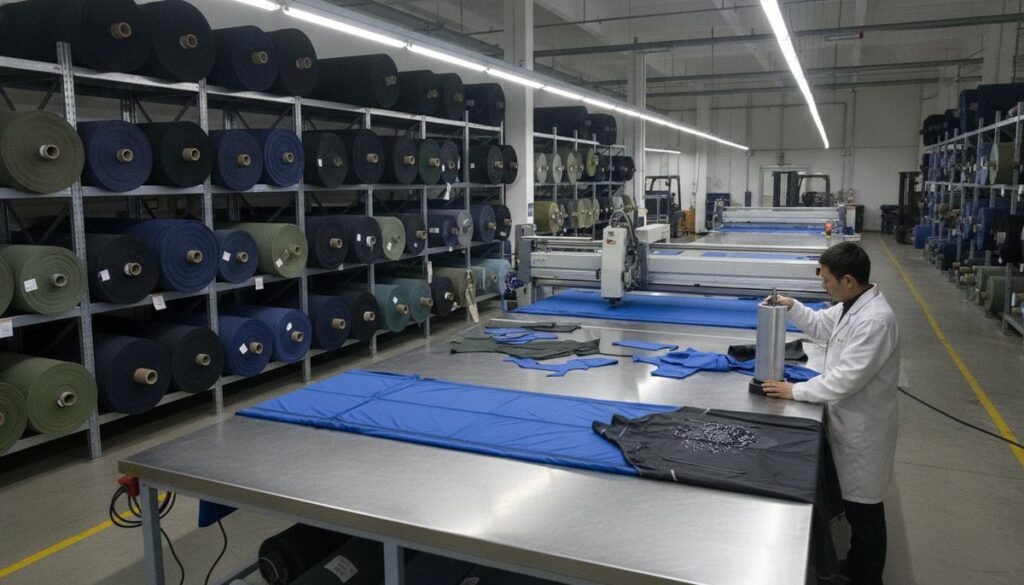
Membrane suppliers, woven-fabric mills, and lamination plants cluster in Jiangsu, Zhejiang, and Guangdong provinces. A jacket manufacturer in Taizhou can source 15000mm TPU-laminated nylon within a two-hour drive, reducing lead time and freight cost. Vertical integration is common: PTOUTWEAR’s 3,000m² facility in Taizhou Sanmen runs 20 production lines with in-house cut-and-sew, seam taping, and QC, enabling tighter quality control than multi-tier outsourcing.
MOQ Flexibility
Many European and North American contract manufacturers impose 500-piece or 1,000-piece minimums per style. According to Made-in-China (2026), some Chinese outerwear listings market 15,000mm waterproofing alongside 20,000g breathability for snow jackets, signaling that suppliers actively serve the mid-volume and custom-order market. PTOUTWEAR’s 30-piece bulk MOQ per SKU allows a DTC founder to validate three colorways with 90 total units, not 1,500.
How Do You Verify a Supplier’s 15000mm Waterproof Claims?
Waterproof ratings can be misleading if the test was conducted on unwashed fabric or if the DWR coating degrades quickly. According to Ruiniu Jackets (2026), the page explains what 15,000mm means, warns against judging by the headline number alone, and tells buyers to verify test method and whether the claim applies before or after washing. Buyers should request third-party lab reports, inspect sample garments after washing, and confirm seam-taping coverage.
Request ISO 811 or AATCC 127 Lab Reports
Ask the supplier for an SGS, Intertek, or Bureau Veritas test report showing hydrostatic head results. The report should state fabric composition, test method (ISO 811 or AATCC 127), and whether the specimen was washed before testing. A report dated within the past 12 months and listing the exact fabric construction (e.g., 75D nylon with TPU membrane) is more credible than a generic certificate.
Order Pre-Production Samples
A 1-piece sample allows you to conduct field testing before committing to bulk. Wear the jacket in moderate rain for 30 minutes, then inspect the interior for moisture. Check seams, zipper tape, and cuff closures. Buyers frequently report that some jackets labeled waterproof are only rain-resistant in light showers and leak at seams, zippers, or cuffs during sustained rain. PTOUTWEAR’s sample development service ships samples in 7-10 days with full seam taping and the same DWR finish used in bulk production.
Verify Seam-Taping Coverage
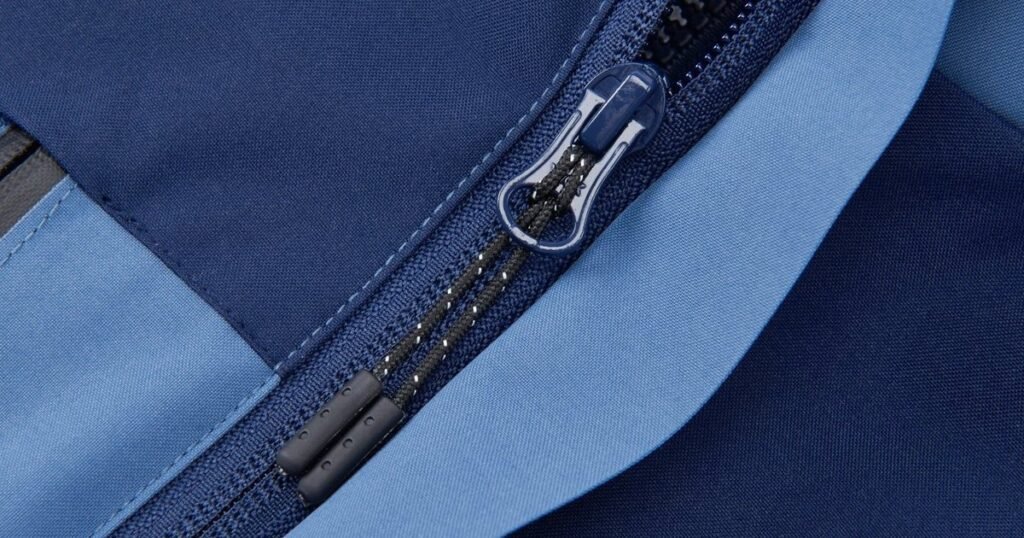
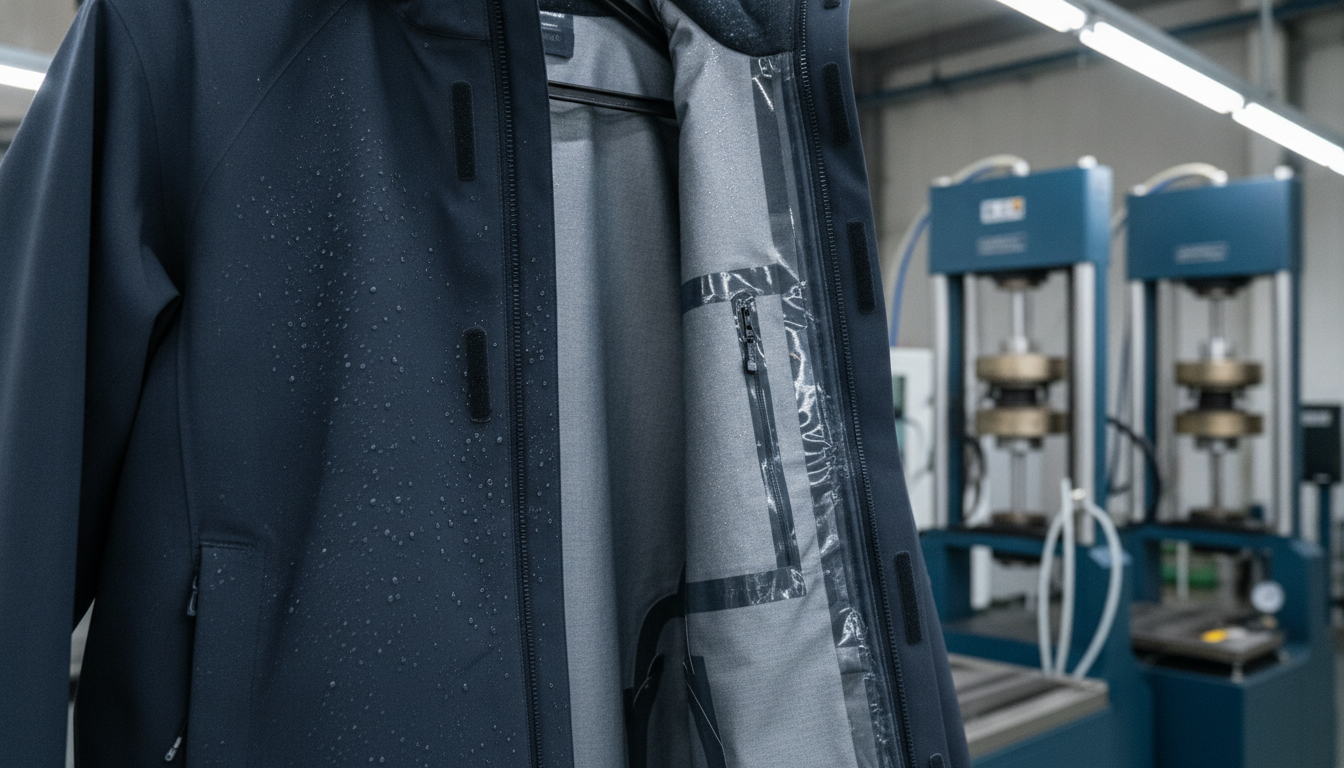
A jacket can pass the hydrostatic test on flat fabric but still leak at stitched seams. Full seam taping covers every needle hole with waterproof tape applied by heat press. Critical seam taping covers shoulder, underarm, and pocket seams. Partial taping leaves zipper plackets and hem seams untaped, which is acceptable for light rain but not for 15000mm-rated performance. Confirm taping coverage in the tech pack and inspect the sample garment inside-out.
In practice: Seam taping is what separates a jacket that survives a wash test from one that delaminates after three cycles, which is why full-seam coverage is verified on the pre-production sample before bulk is cut.
Matching Breathability to Waterproofing in a 15000mm Jacket
Waterproofing alone does not define comfort. A jacket that keeps rain out but traps sweat inside creates a clammy microclimate. According to Accio (2026), one supplier marketplace page recommends at least 10,000mm waterproofing and 5,000+ g/m²/24hr breathability for all-weather adventure jackets. For a 15000mm jacket, pairing with 10,000 to 20,000 g/m²/24h MVTR (moisture vapor transmission rate) balances protection and breathability.
MVTR Measurement Standards
MVTR is measured in grams of water vapor passing through one square meter of fabric in 24 hours. ASTM E96 (upright cup method) and JIS L1099 (inverted cup method) are common test standards. A 15000mm jacket with 10,000 g/m²/24h MVTR suits moderate-activity use like hiking or urban commuting. A 20,000 g/m²/24h rating is better for high-output activities like ski touring or trail running.
Membrane and Coating Options
Suppliers use different technologies to achieve 15000mm waterproofing:
- TPU (thermoplastic polyurethane) membrane: durable, elastic, and recyclable; commonly laminated to nylon or polyester face fabric.
- PU (polyurethane) coating: less expensive than TPU, applied as a liquid layer; can degrade faster under UV and abrasion.
- ePTFE (expanded polytetrafluoroethylene): high breathability and durability, but more expensive and often restricted by brand licensing.
PTOUTWEAR primarily uses TPU membrane lamination for 15000mm jackets, paired with PFC-free DWR finishing to maintain face-fabric water repellency without fluorochemicals.
DWR and Long-Term Performance
Buyers often say a jacket can be labeled waterproof but still wet out because the face fabric or DWR fails first, so the headline mm rating alone is misleading. DWR (durable water repellent) causes water to bead and roll off the face fabric. Without DWR, the outer layer saturates, reducing breathability and making the jacket feel heavy. PFC-free DWR formulations use silicone or wax-based chemistry and require reapplication every 10-20 washes. Confirm the supplier’s DWR type and provide care-label instructions to end users.
MOQ and Sampling Requirements for a 15000mm Waterproof Rating Jacket Supplier China
Minimum order quantities and sampling costs directly impact cash flow for DTC founders and small wholesalers. High MOQs tie up capital in untested inventory; slow sampling delays market validation. PTOUTWEAR’s 1-piece sample MOQ and 30-piece bulk MOQ address both pain points.
Sample MOQ and Lead Time
PTOUTWEAR offers a 1-piece sample MOQ with a $100 sample fee, refundable against bulk orders. Sampling lead time is 7-10 days from tech-pack approval. This allows a brand founder to validate fit, fabric hand-feel, and waterproof performance in real-world conditions before committing to 30 or 300 pieces. Buyers can request multiple colorways or minor spec changes across samples without triggering a new setup fee.
Bulk Production MOQ
Bulk MOQ is 30 pieces per SKU. A three-color jacket program requires 90 total units (30 black, 30 navy, 30 charcoal). Production lead time is 25-35 days after sample approval and deposit. For urgent orders, a 1,000-piece rush option delivers in 2 weeks at a +25% surcharge. This structure suits school uniform programs, corporate team orders, and DTC brands testing a new product line without overcommitting inventory.
Cost Breakdown
Exact FOB pricing depends on fabric choice (TPU vs. PU membrane), DWR type (PFC-free vs. standard), seam-taping coverage (full vs. critical), and trim specifications (YKK AquaGuard zippers, reflective piping, custom embroidery). Request a detailed quote with a tech pack for accurate costing.
Landed Cost Considerations
FOB price is only part of total landed cost. Add freight (sea or air), duties, customs brokerage, and inspection fees. For a 100-piece order shipping from Ningbo to Los Angeles, sea freight adds approximately $2-4 per unit; air freight adds $8-12 per unit. U.S. import duty on synthetic-fiber jackets (HTS 6201.93) is 27.7% of FOB value. Factor in a 2-5% reject rate and potential returns when modeling margins. DDP (delivered duty paid) shipping is available through PTOUTWEAR’s low-MOQ jacket manufacturing service, simplifying cost forecasting.
Key Takeaways
- A 15000mm waterproof rating means the fabric withstands 15 meters of water column pressure before leaking, tested by ISO 811 or AATCC 127 standards.
- China suppliers offer competitive pricing, technical fabric access, and flexible MOQs; PTOUTWEAR’s 30-piece bulk MOQ enables low-risk market testing.
- Verify waterproof claims by requesting third-party lab reports, ordering pre-production samples, and confirming full seam-taping coverage before bulk production.
- Pair 15000mm waterproofing with 10,000 to 20,000 g/m²/24h MVTR breathability to balance moisture protection and sweat vapor escape for active outdoor use.
- DWR finishing is critical; without it, the face fabric saturates and reduces breathability even if the membrane remains waterproof.
- Total landed cost includes FOB price, freight, duties, customs brokerage, inspection, and a reject allowance; DDP shipping simplifies forecasting for first-time importers.
Frequently Asked Questions
Is 15000mm waterproof good enough for skiing?
Yes, 15000mm waterproofing is sufficient for most recreational skiing and snowboarding. It handles moderate snowfall and wet conditions. For backcountry skiing or multi-day expeditions in heavy precipitation, 20,000mm or higher provides an extra margin. Pair the waterproof rating with at least 10,000 g/m²/24h breathability to prevent sweat buildup during high-output activity. Confirm full seam taping and a durable DWR finish to maintain performance over multiple seasons.
How do I maintain the waterproof rating after washing?
Wash the jacket in cold water on a gentle cycle with a technical-fabric detergent that does not contain fabric softener or bleach. Tumble dry on low heat to reactivate the DWR coating. After 10-20 washes, reapply a spray-on or wash-in DWR treatment to restore water beading on the face fabric. The membrane itself retains its 15000mm rating, but without DWR the outer layer saturates and reduces breathability. Store the jacket in a cool, dry place away from direct sunlight to prevent UV degradation of the membrane and coating.
What is the difference between 10000mm and 15000mm waterproof jackets?
A 10000mm jacket withstands 10 meters of water pressure; a 15000mm jacket withstands 15 meters. The 50% higher rating means the 15000mm fabric resists heavier rain and prolonged exposure before moisture penetrates. For light rain or short outdoor periods, 10000mm is adequate. For sustained rain, snow, or outdoor workwear worn all day, 15000mm provides a stronger margin. Cost difference is typically 10-20% higher FOB for the upgraded membrane and lamination process. Both ratings require full seam taping and quality DWR to deliver real-world waterproof performance.
Ready to source 15000mm waterproof jackets with verified testing, 30-piece MOQ, and 7-10 day sampling?
Request Your Sample Today →
Written by Ivan Chen, Sales Engineer at PTOUTWEAR – 13 years in outdoor apparel manufacturing.