A recycled nylon hardshell jacket GRS supplier must hold a valid Global Recycled Standard scope certificate covering nylon textile manufacturing, provide transaction certificates for every batch, and demonstrate chain-of-custody documentation linking post-consumer or post-industrial nylon waste to the finished shell fabric. GRS certification requires at least 20% recycled content by weight, though most technical hardshells use 50-100% recycled nylon to meet brand sustainability claims and waterproofing performance standards.
📋 Table of Contents
- Executive Summary
- What GRS Certification Requires for Recycled Nylon Hardshells
- How to Verify a Supplier’s GRS Scope Certificate
- Recycled Nylon vs Recycled Polyester for Hardshell Jackets
- Waterproofing and Durability in Recycled Nylon Shells
- MOQ, Sampling Fees, and Lead Times
- Key Takeaways
- Frequently Asked Questions
Executive Summary
- GRS scope certificates: A recycled nylon hardshell jacket GRS supplier must hold a valid scope certificate covering nylon textile manufacturing and provide transaction certificates for every production batch, traceable to post-consumer or post-industrial feedstock.
- Recycled-content threshold: GRS requires at least 20% recycled material by weight, though most technical hardshells specify 50-100% recycled nylon to meet brand sustainability targets and maintain waterproofing integrity.
- Waterproofing performance: Buyers report that DWR coatings on recycled nylon shells deteriorate under backpack-strap friction and steady rain, making hydrostatic-head ratings and seam-tape specifications critical screening criteria.
- MOQ and sampling: PTOUTWEAR offers 1-piece sample MOQ with a $100 fee refunded against bulk orders of 30+ pieces, and 10-piece bulk MOQ per style with mixed colours and sizes, enabling small DTC brands to validate technical performance before committing capital.
- Lead times: Sampling typically requires 7-10 days, bulk production 25-35 days, with rush options available for 1,000-piece orders at a 25% surcharge.
What GRS Certification Requires for Recycled Nylon Hardshells
The Global Recycled Standard is a product standard that verifies recycled content, chain of custody, social compliance, and chemical restrictions across the textile supply chain. For a recycled nylon hardshell jacket GRS supplier to issue a GRS-labeled product, the factory must hold a valid scope certificate and provide a transaction certificate for each batch.
Recycled-Content Threshold and Feedstock Documentation
GRS mandates at least 20% recycled material by weight before a product can carry the GRS claim. Most technical hardshells use 50-100% recycled nylon to meet brand sustainability messaging and maintain shell performance. The recycled nylon feedstock originates from post-consumer waste such as discarded fishing nets, carpet fibers, or industrial scrap nylon from textile manufacturing. The supplier must document the source, weight, and processing of this feedstock through every stage of the supply chain.
Chain-of-Custody Traceability
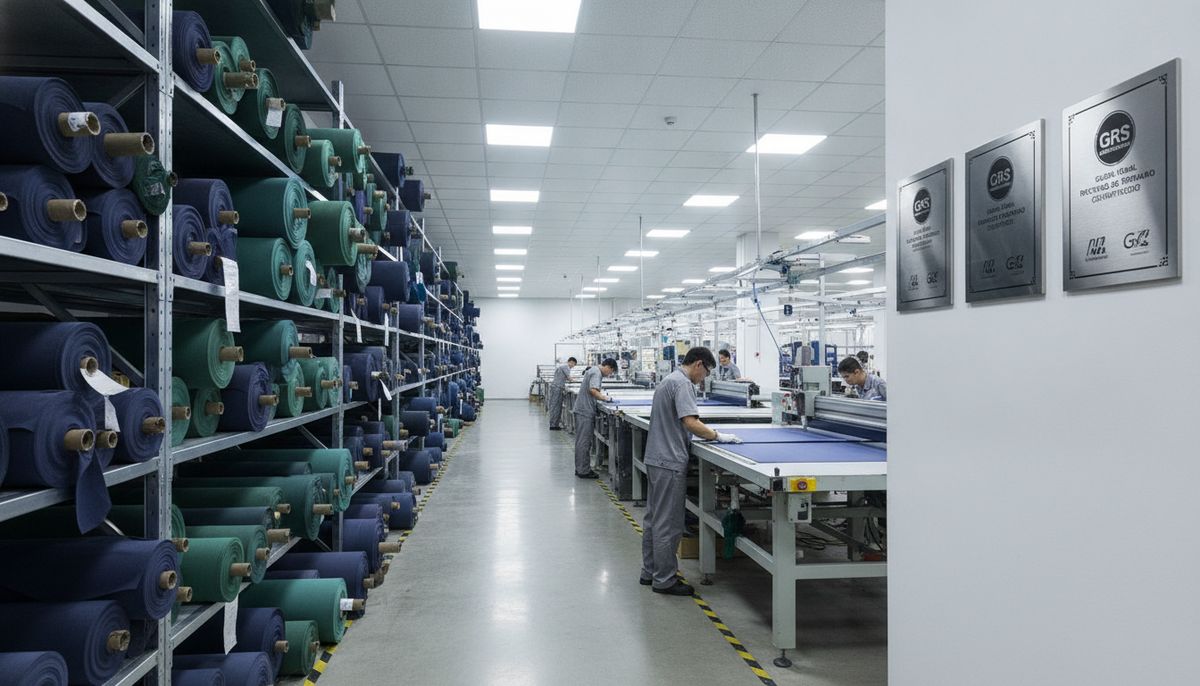
Every entity in the supply chain that processes, handles, or trades the recycled nylon must hold its own GRS scope certificate. A typical hardshell supply chain includes the nylon recycler, the yarn spinner, the fabric weaver or knitter, the dyehouse, the lamination facility, and the cut-and-sew factory. If any link lacks GRS certification, the chain breaks and the finished jacket cannot carry a GRS label. Buyers should request a full chain-of-custody map showing each certified entity and their scope certificate numbers.
Transaction Certificates for Every Batch
A transaction certificate is a document issued by the GRS-certified supplier for each production batch, specifying the recycled-content percentage, the GRS scope certificate number, and the product description. This certificate is what enables the buyer to make a GRS claim on their finished product. Without a transaction certificate, the buyer has no proof that the specific batch they received meets GRS standards, even if the supplier holds a scope certificate.
GRS requires at least 20% recycled content by weight. Most technical hardshells specify 50-100% recycled nylon to meet brand sustainability targets and maintain waterproofing integrity.
How to Verify a Supplier’s GRS Scope Certificate
Requesting a PDF copy of a GRS certificate is insufficient because certificates can be forged or expired. The only reliable verification method is to search the supplier’s legal entity name and certificate number on the official GRS database maintained by Textile Exchange.
Step 1: Request the Legal Entity Name and Certificate Number
Ask the supplier for their exact legal entity name as it appears on their business license, their GRS scope certificate number, and the certification body that issued the certificate. The legal name must match the entity listed on the certificate; a trading company cannot use a factory’s certificate unless both entities are explicitly listed.
Step 2: Search the Textile Exchange GRS Database
Visit the Textile Exchange GRS public database and enter the supplier’s legal name or certificate number. The database displays the certificate status, issue date, expiry date, and the specific product categories covered by the scope. Verify that “nylon textile” or “apparel cut-and-sew” appears in the scope, because a certificate covering only yarn spinning does not authorize the factory to produce finished jackets.
Step 3: Confirm the Certificate Covers Nylon and Apparel
GRS scope certificates are product-specific. A factory certified for recycled polyester fleece cannot automatically claim GRS certification for recycled nylon hardshells unless their scope explicitly includes nylon textiles and apparel manufacturing. Check the product-category field in the database entry to confirm coverage.
Step 4: Verify the Certification Body’s Accreditation
GRS certificates must be issued by an accredited certification body approved by Textile Exchange. Common accredited bodies include Control Union, ICEA, and Ecocert. If the certification body name on the certificate is unfamiliar, cross-check it against the Textile Exchange list of approved certifiers to rule out fraudulent certificates.
In practice: A supplier provided a GRS certificate PDF that looked legitimate, but the certificate number returned no results in the Textile Exchange database because the certification body listed was not an accredited GRS certifier, revealing the document was fabricated.
Recycled Nylon vs Recycled Polyester for Hardshell Jackets
Both recycled nylon and recycled polyester are used in hardshell jackets, but they differ in abrasion resistance, weight, waterproofing compatibility, and feedstock availability. Understanding these differences helps buyers specify the correct material for their target use case and price point.
When to Specify Recycled Nylon
Recycled nylon is the better choice for technical hardshells intended for hiking, backpacking, or alpine use where abrasion resistance and weight matter. The material resists tearing and snagging better than recycled polyester, which buyers frequently cite as a failure mode in lightweight shells exposed to thorny vegetation or rough rock contact. Recycled nylon also accepts DWR coatings more evenly, reducing the risk of uneven water beading that leads to wet-out.
When to Specify Recycled Polyester
Recycled polyester is more cost-effective for urban rain jackets, corporate uniforms, or school outerwear where abrasion resistance is less critical and price sensitivity is higher. The feedstock is more abundant because post-consumer PET bottles are widely collected, which lowers material cost and improves supply-chain stability. Recycled polyester also dries faster than nylon, which matters for commuter jackets worn in stop-and-go rain.
Waterproofing and Durability in Recycled Nylon Shells
Waterproofing performance in a recycled nylon hardshell depends on three factors: the shell fabric’s hydrostatic-head rating, the membrane or laminate construction, and the DWR finish. Buyers report that DWR deterioration is the most common failure mode, especially on shoulder areas exposed to backpack straps.
Hydrostatic-Head Rating and What It Measures
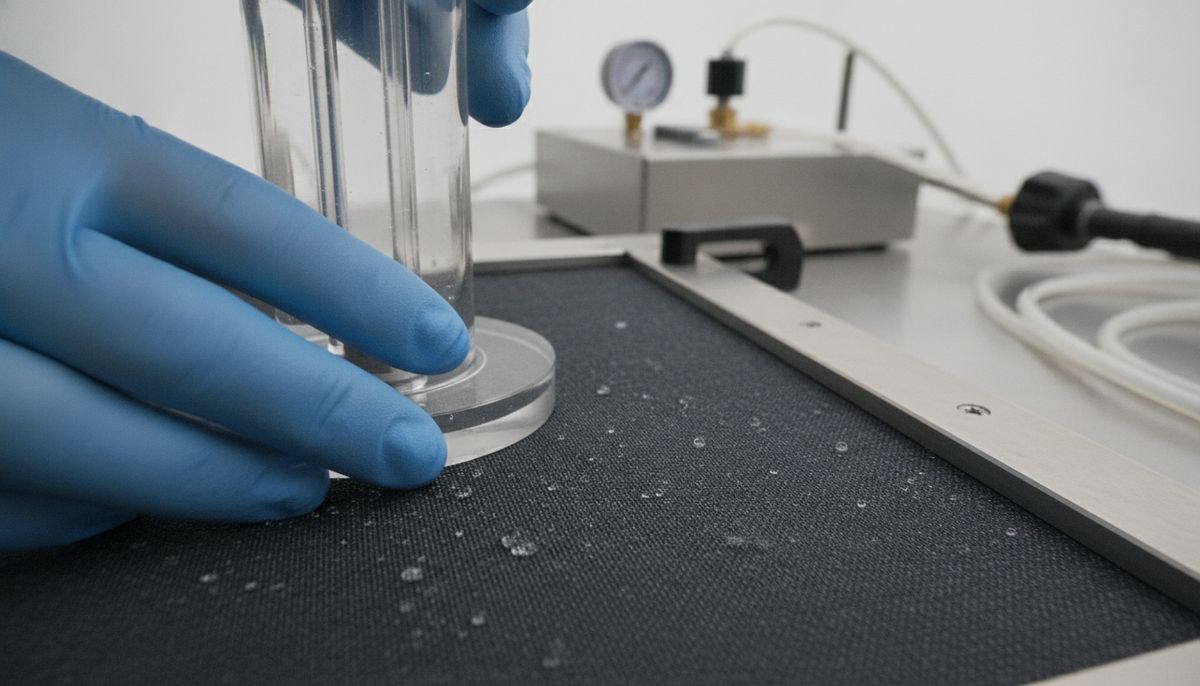
Hydrostatic head measures how much water pressure a fabric can withstand before water penetrates through the shell. The test applies a column of water to the fabric surface and records the height in millimeters at which three drops of water pass through. A rating of 10,000 mm means the fabric can withstand a 10-meter column of water before leaking. Most technical hardshells specify 10,000-20,000 mm for the shell fabric and 10,000 mm minimum for the membrane or laminate.
Three-Layer vs Two-Layer Construction
Three-layer construction bonds the shell fabric, waterproof membrane, and inner lining into a single composite, which improves durability and reduces delamination risk. Two-layer construction uses a separate hanging liner, which is lighter and less expensive but more prone to membrane damage from internal abrasion. Most buyers specify three-layer for hardshells intended for multi-day use and two-layer for lightweight packable rain jackets.
DWR Durability and Reapplication
DWR is a surface treatment that causes water to bead and roll off the shell fabric rather than soaking in. Buyers report that DWR performance deteriorates quickly on shoulder areas exposed to backpack straps, with water resistance beginning to fail after 30 miles of hiking in some cases. The DWR coating wears off through friction, dirt accumulation, and repeated washing. PFAS-free DWR formulations are now standard for GRS-certified products, but they require more frequent reapplication than legacy PFAS-based treatments.
Buyers can extend DWR life by washing the jacket with technical-fabric detergent, tumble-drying on low heat to reactivate the coating, and applying a spray-on DWR refresher every 20-30 wears. Factories should provide care instructions that specify PFAS-free DWR maintenance to prevent buyer complaints about premature wet-out.
Seam-Tape Specifications
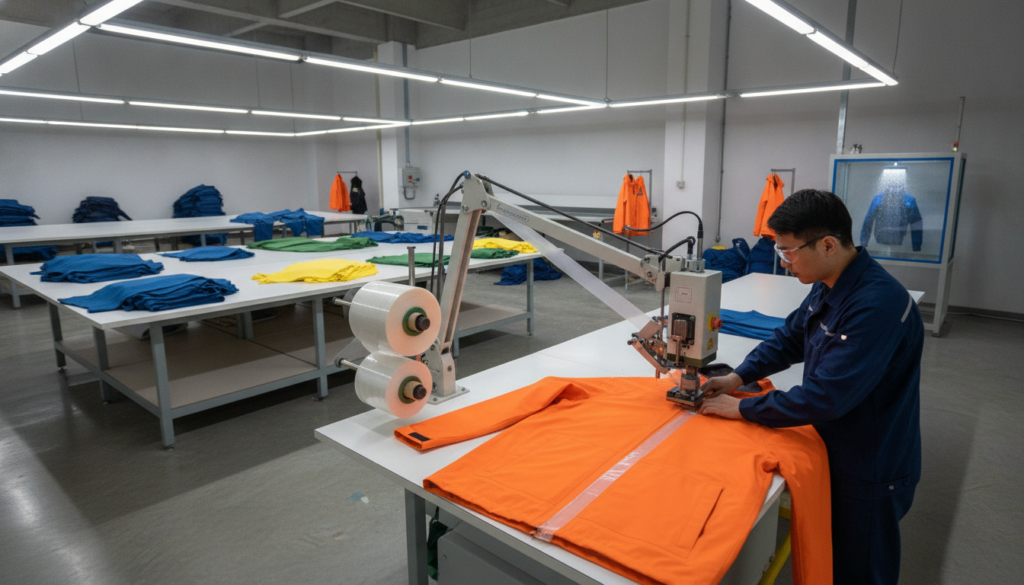
Seam taping is what prevents water from penetrating through needle holes created during cut-and-sew. The tape is a thermoplastic film applied to the seam allowance on the inside of the jacket using heat and pressure. Buyers should specify seam-tape width (typically 20-22 mm), adhesive type (PU or TPU), and peel strength (minimum 8 N/cm). Inadequate seam taping is a common cause of leaks in jackets that pass initial waterproofing tests but fail after washing or field use.
In practice: Seam taping is what separates a jacket that survives a wash test from one that delaminates after three cycles, which is why buyers request a pre-production sample with seam-tape peel-strength data before committing to bulk production.
MOQ, Sampling Fees, and Lead Times
Minimum order quantities, sampling costs, and production lead times vary widely among recycled nylon hardshell jacket GRS suppliers. Small DTC brands and corporate buyers need suppliers that offer low-MOQ production and fast sampling to validate technical performance before committing capital to bulk orders.
Sample MOQ and Fees
PTOUTWEAR offers 1-piece sample MOQ with a $100 sample fee that is refunded against a first bulk order of 30+ pieces. The sample includes the specified recycled nylon shell fabric, waterproof membrane or laminate, seam taping, and DWR finish, enabling buyers to conduct wash tests, hydrostatic-head tests, and field trials before placing a bulk order. Sampling lead time is 7-10 days from artwork approval and fabric confirmation.
Bulk MOQ and Colour Mixing
Bulk MOQ is 10 pieces per style, with colours and sizes mixed within that minimum. This low-MOQ structure enables small outdoor brands to test multiple colorways and validate market demand without tying up $10,000-$15,000 in inventory. School and corporate uniform programs start at 30 pieces per style per colour to ensure consistent dye-lot matching across the order.
Production Lead Times
Standard bulk production requires 25-35 days from deposit and final artwork approval. This timeline includes fabric procurement, cutting, sewing, seam taping, quality inspection, and packing. Rush production is available for orders of 1,000 pieces or more, with a 2-week lead time at a 25% surcharge. DDP shipping to the US, UK, EU, Canada, and Australia is available, with the factory handling customs clearance and final delivery.
Payment Terms and Deposit Structure
Standard payment terms are 30% deposit at order confirmation, 70% balance before shipment. The deposit secures fabric procurement and production scheduling. Buyers can request third-party inspection before final payment to verify seam-tape quality, waterproofing performance, and construction accuracy. Our 3,000m² Taizhou Sanmen facility runs 20 production lines with in-house cut-and-sew and quality control, enabling faster turnaround and tighter quality oversight than suppliers that outsource cutting or assembly.
Key Takeaways
- A recycled nylon hardshell jacket GRS supplier must hold a valid scope certificate covering nylon textile manufacturing and provide transaction certificates for every production batch, traceable through the full chain of custody from feedstock to finished garment.
- GRS certification requires at least 20% recycled content by weight, though most technical hardshells specify 50-100% recycled nylon to meet brand sustainability claims and maintain waterproofing integrity.
- Verify GRS certificates by searching the supplier’s legal entity name and certificate number on the Textile Exchange public database, confirming that the scope covers nylon textiles and apparel cut-and-sew, not just yarn or fabric production.
- Recycled nylon offers superior abrasion resistance and lighter weight compared to recycled polyester, making it the better choice for technical hardshells intended for hiking and backpacking, while recycled polyester is more cost-effective for urban rain jackets and corporate uniforms.
- DWR deterioration under backpack-strap friction is the most common waterproofing failure mode, requiring buyers to specify hydrostatic-head ratings, three-layer construction, seam-tape peel strength, and PFAS-free DWR maintenance instructions to prevent field complaints.
- Low-MOQ suppliers like PTOUTWEAR enable small DTC brands to validate technical performance with 1-piece samples and 10-piece bulk orders, reducing capital risk and inventory commitment during market-entry phases.
Frequently Asked Questions
What is the difference between a GRS scope certificate and a transaction certificate?
A GRS scope certificate is issued to a factory or supplier and certifies that the entity has the systems, processes, and documentation in place to handle recycled materials according to GRS standards. It does not certify any specific product or batch. A transaction certificate is issued for each production batch and certifies that the specific batch of products meets GRS recycled-content requirements and chain-of-custody traceability. Buyers need the transaction certificate to make a GRS claim on their finished product, even if the supplier holds a valid scope certificate.
How do I verify whether a recycled nylon hardshell jacket supplier is GRS certified?
Request the supplier’s legal entity name and GRS scope certificate number, then search the Textile Exchange GRS public database to verify the certificate status, expiry date, and product scope. Confirm that the scope explicitly covers nylon textiles and apparel manufacturing, not just yarn or fabric production. Check that the certification body listed is an accredited GRS certifier approved by Textile Exchange. If the certificate number returns no results or the certification body is not on the approved list, the certificate is likely fraudulent.
Are recycled nylon jackets waterproof?
Recycled nylon shell fabric alone is not waterproof. Waterproofing comes from a laminated or coated membrane bonded to the shell fabric, combined with a DWR finish that causes water to bead on the surface. The shell fabric provides abrasion resistance and structure, while the membrane blocks water penetration. Buyers should specify hydrostatic-head ratings of 10,000-20,000 mm for the shell and membrane, three-layer construction to prevent delamination, and seam taping on all seams to block water entry through needle holes. DWR coatings wear off over time and require reapplication to maintain water-repellent performance.
Need a recycled nylon hardshell jacket GRS supplier with verified certificates, 10-piece MOQ, and 7-day sampling?
Request GRS Documentation and Samples →
Written by Ivan Chen, Sales Engineer at PTOUTWEAR, 13 years in outdoor apparel manufacturing.