DWR (durable water repellent) chemistry is graded by fluorocarbon chain length: C8 (legacy, 8-carbon, best repellency but contains banned PFOA), C6 (6-carbon, transitional, lower toxicity), and C0 (fluorine-free / PFC-free, the modern compliant standard). The industry has moved decisively to C0 because C8 is banned and PFAS regulations now target C6 too. C0 repels water without the persistent “forever chemicals,” at the cost of slightly less oil-repellency and durability.
For B2B buyers selling to the EU and US, DWR chemistry is now a compliance issue, not just a performance one. As a factory finishing fabrics with PFC-free DWR, we get this question on every brief. Here’s the current state of play in 2026. (For the plain-language overview, see PFC-free DWR explained.)
DWR in One Sentence
DWR is a surface finish that makes water bead and roll off fabric — graded C0/C6/C8 by fluorocarbon chemistry, with C0 (fluorine-free) now the compliant industry standard.
What DWR Does
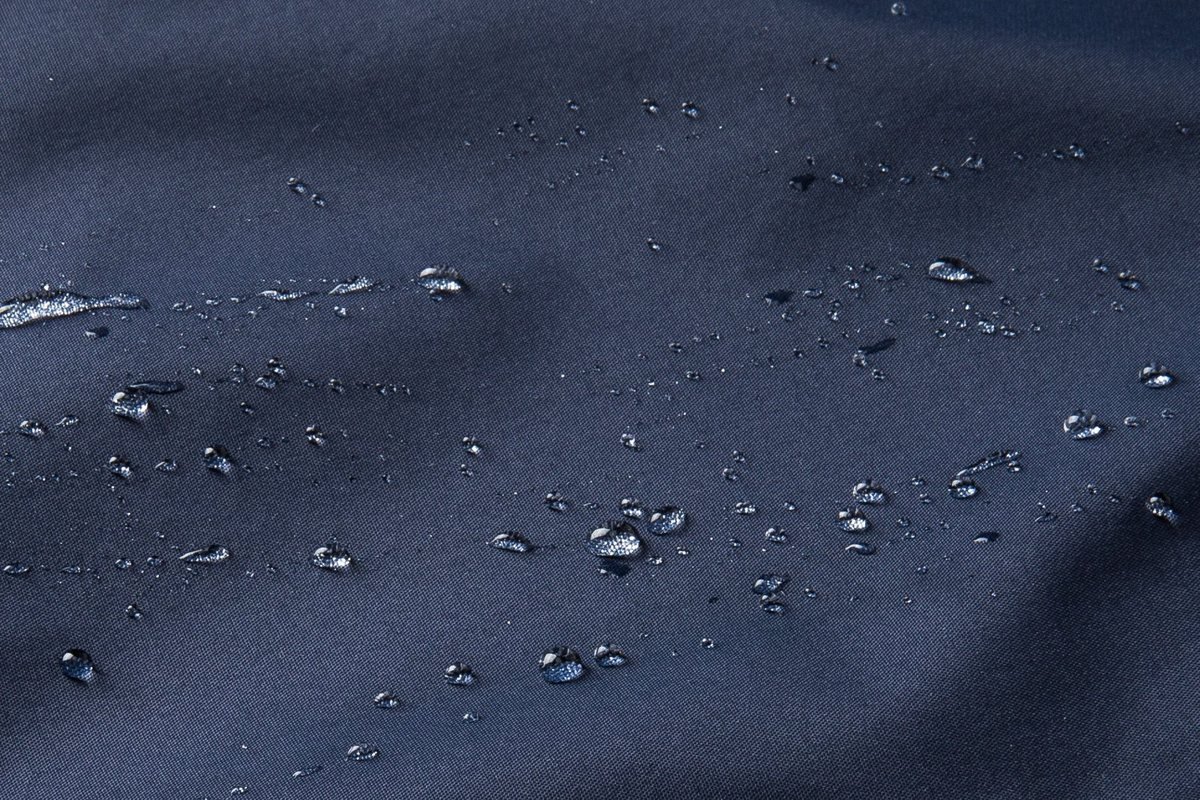
DWR coats the face fabric’s fibers so water beads up and rolls off instead of soaking in (“wetting out”). It does not make fabric waterproof — that’s the membrane’s job (see ISO 811 testing). DWR keeps the face dry so the fabric stays breathable and doesn’t feel cold and heavy.
The Three Chemistries
C8 — Legacy (banned)
8-carbon fluorocarbon. Best water and oil repellency, longest durability — but breaks down into PFOA, a persistent, bioaccumulative toxin now banned globally (EU, US).
- ❌ Contains/forms PFOA — prohibited
- Do not spec — included here for context only
C6 — Transitional
6-carbon fluorocarbon. Lower toxicity than C8, good repellency — but still a PFAS (“forever chemical”) increasingly restricted.
- ⚠️ Still a PFAS — being phased out under tightening PFAS rules
- Good oil-repellency, decent durability
- Avoid for new EU/US programs
C0 — PFC-Free (current standard)
Fluorine-free chemistry (often silicone- or paraffin-based). No PFAS at all — the compliant modern choice.
- ✅ PFC/PFAS-free, regulation-proof
- ✅ Good water repellency
- ❌ Weaker oil/stain repellency
- ❌ Needs more frequent reapplication (lower durability)
- Pairs with bluesign / ZDHC chemical-management programs
Side-by-Side Comparison
| Property | C8 | C6 | C0 (PFC-free) |
|---|---|---|---|
| Water repellency | Best | Very good | Good |
| Oil/stain repellency | Best | Good | Weak |
| Durability | Highest | High | Lower |
| PFAS content | Yes (PFOA) | Yes | None |
| Regulatory status | Banned | Restricted | Compliant |
| Spec for new programs? | No | No | Yes |
Why C0 Is Now the Default
PFAS regulations have tightened fast: C8/PFOA is banned, and broad PFAS restrictions (EU REACH, US state laws) now sweep in C6. By 2026, C0 is the only safe choice for new EU/US apparel programs — major brands have already transitioned. The trade-off (less oil-repellency, more frequent reapplication) is accepted as the cost of compliance.
Specifying DWR as a B2B Buyer
In your brief: require C0 / PFC-free / fluorine-free DWR, confirm it meets your target markets’ PFAS rules, and consider pairing with bluesign or ZDHC chemical management for retailer compliance. Set realistic durability expectations — C0 needs reapplication (wash-in or spray) over the garment’s life, and your care label should say so.
Frequently Asked Questions
What is C0 DWR?
C0 DWR is a fluorine-free (PFC-free) durable water repellent finish. It uses silicone- or paraffin-based chemistry instead of fluorocarbons, so it contains no PFAS “forever chemicals.” It’s the compliant modern standard, with good water repellency but weaker oil-repellency and durability than older C6/C8 finishes.
What’s the difference between C6 and C8 DWR?
Both are fluorocarbon DWRs, but C8 (8-carbon) forms PFOA, a banned toxin, while C6 (6-carbon) has lower toxicity. C8 is prohibited; C6 is being phased out under broader PFAS regulations. Neither should be spec’d for new EU or US apparel programs — use C0 instead.
Is C0 DWR as good as C8?
For water repellency, C0 is close and good enough for most apparel. C8 had better oil/stain repellency and durability, but it’s banned. C0’s main trade-offs are weaker oil-repellency and needing more frequent reapplication — accepted as the cost of being PFAS-free and compliant.
Does PTOUTWEAR offer PFC-free DWR?
Yes. PTOUTWEAR finishes fabrics with C0 / PFC-free DWR for compliant water-repellent jackets, from a 30-piece MOQ with 1-piece sampling so you can test the beading and hand-feel on a real sample.
Spec Compliant DWR for Your Markets
In 2026, DWR is a compliance decision: C8 is banned, C6 is being restricted, and C0 (PFC-free) is the only safe choice for new EU/US programs. At PTOUTWEAR we finish custom hardshell jackets with PFC-free C0 DWR from 30-piece MOQ with 1-piece sampling. Our certifications team can supply compliant DWR with the chemical-management documentation your retailers require.