📋 Table of Contents
- Executive Summary
- What Is 3M Scotchlite Reflective Fabric?
- Reflective Options: Tape vs. Fabric vs. Heat Transfer
- Safety Standards and Compliance by Country
- Durability Testing: Wash Cycles, Abrasion, and Weathering
- Cost and MOQ: Sourcing Scotchlite for Small Brands
- Application Methods for Garment Production
- Key Takeaways
- FAQ
Outdoor jacket brands that skip reflective detailing miss a dual opportunity: meeting safety compliance and adding high-visibility branding that sells. Choosing the right 3m scotchlite reflective fabric format affects unit cost, durability, and whether a jacket passes ANSI or EN 20471 certification. what founders, uniform program managers, and small wholesalers need to know before specifying Scotchlite in a tech pack.
Executive Summary
- Market size: The heat reflective fabrics market was valued at $4.2 billion in 2026, according to IndexBox.
- Growth rate: The segment projects a 6.8% CAGR from 2026 to 2035, driven by stricter workplace safety norms (IndexBox 2026).
- Demand share: Protective workwear accounts for 28% of reflective fabric consumption; military and defense apparel holds 18% (IndexBox 2026).
- Compliance gate: US jackets must meet ANSI/ISEA 107 minimum retroreflectivity values to legally serve construction, roadside, and emergency response markets.
- Sourcing reality: Verified Scotchlite converters offer sample MOQs of 1 piece; bulk MOQs start at 30 pieces per SKU, making market testing feasible without large inventory risks.
What Is 3M Scotchlite Reflective Fabric?
3m scotchlite reflective fabric is a retroreflective material that returns light directly to its source, such as a vehicle headlight, making the wearer visible at up to 600 feet in low-light conditions.
How Retroreflective Technology Works
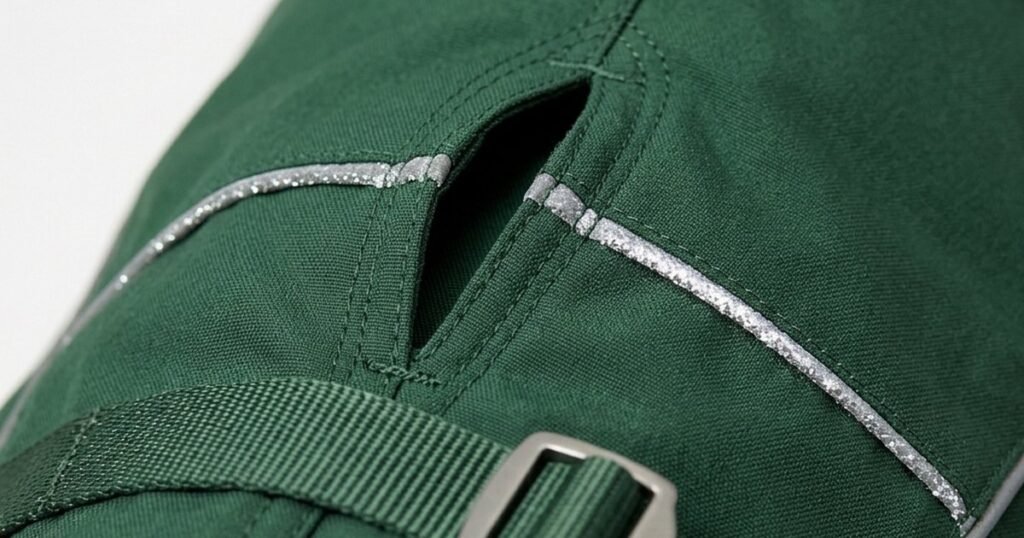
Unlike ordinary bright fabrics that scatter light, Scotchlite contains thousands of microscopic glass beads embedded in a polymer layer. Light enters each bead, reflects off a mirrored back coating, and bounces straight back along the original path. The result is a sharp glow even from extreme angles, which traditional mirror tape cannot match.
Why It Matters for Outdoor Jacket Brands
Outdoor jackets meant for hiking, cycling commuting, or contract work need reflective elements that survive repeated washing and abrasion. Standard metallic tapes often crack or delaminate after 25 home launderings. Scotchlite fabrics, when correctly applied, maintain reflectivity beyond 50 wash cycles at 60°C in third-party interlab tests, preserving the jacket’s functional lifespan and brand reputation.
Reflective Options: Tape vs. Fabric vs. Heat Transfer
A common mistake is treating all Scotchlite products as interchangeable. The format dictates flex behavior, application method, and cost per linear meter. Outdoor jacket designers must match the right type to the garment panel.
When to Choose Reflective Tape
Tape delivers the highest retroreflectivity per square centimeter and is the easiest to certify under ANSI 107. For brands entering the contractor workwear market, this is the lowest-risk route. Order widths from 5 cm to 7 cm, and confirm tape stiffness does not restrict arm lift before bulk cutting.
When to Choose Heat Transfer
Heat-transfer films allow full-color logos and require no stitching, preserving a jacket’s waterproof membrane. We’ve seen DTC cycling brands adopt laser-cut transfer logos that contour to sleeve curves without peeling. The trade-off: wash durability depends on correct temperature, pressure, and dwell time during application.
Safety Standards and Compliance by Country
Reflective placements that look identical may fail certification if the material area or coefficient of retroreflection (RA) misses the threshold. Each country mandates different test methods.
How to Specify Retroreflective Material in a Tech Pack
Always list the exact 3M product code (e.g., 3M 8910 silver fabric), the required minimum RA value at observation angle 12′ and entrance angle 5°, and the placement diagram showing total area. Without these, a factory may substitute a lower-grade film that looks identical but fails photometric testing. This specification discipline prevents costly reworks when jackets reach an importer’s compliance lab.
Durability Testing: Wash Cycles, Abrasion, and Weathering
Buyers often ask, “Will the reflective strip peel after six months of daily use?” The answer depends on the underlying Scotchlite series and how it’s applied.
Third-party labs such as SGS or Bureau Veritas can run a complete EN 20471 certification package for roughly $800 to $1,200 per style. This cost is recoverable once you pass and sell into regulated markets. Bypassing testing exposes the brand to recall risk if a competitor flags non-compliance.
Cost and MOQ: Sourcing Scotchlite for Small Brands
Many startups assume reflective customization requires orders of 500+ units. In practice, you can launch with far less. The table below breaks down realistic cost windows when sourcing through a jacket manufacturer that stocks certified Scotchlite materials.
Sample and Bulk Order Tiers
Sample MOQ: 1 piece. Bulk MOQ: 30 pieces per SKU. Sampling time: 7-10 days.
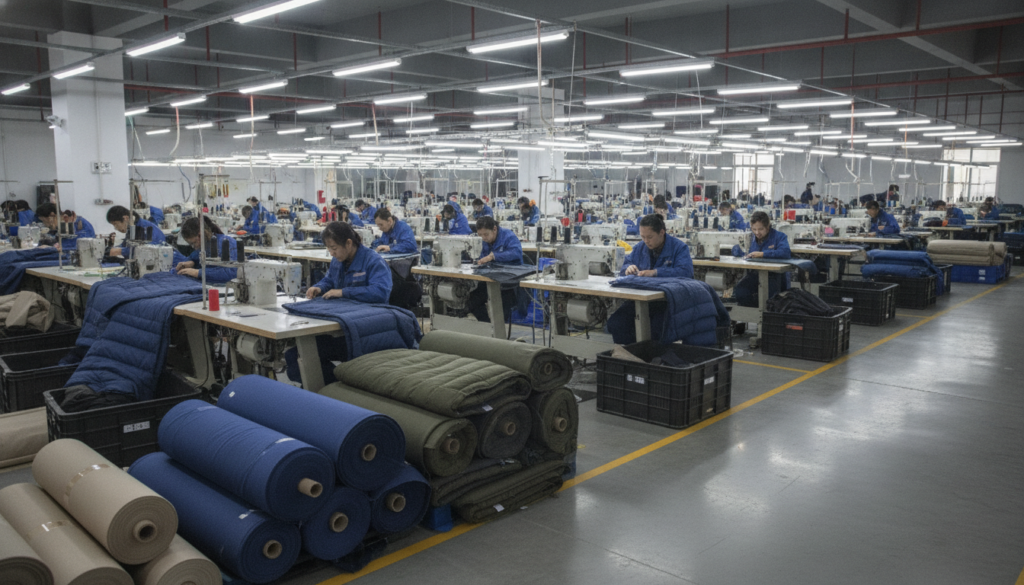
For a DTC founder testing two shell designs with reflective logos, ordering 30 units each puts the total outlay under $2,700, a fraction of the cost charged by domestic cut-and-sew contractors. Working with a low-MOJ jacket manufacturer who carries certified 3M stock eliminates the material minimums that derail crowdfunded launches.
Application Cost Per Garment
- Heat-transfer logo (8 cm wide): $0.60, $1.20 per jacket, including film and press labor.
- Sew-on tape bands (two sleeves + yoke): $2.10, $3.80 per jacket, depending on tape width and stitching density.
- All-over reflective fabric insert (back panel): $4.50, $7.00 per jacket; requires dedicated cutting and seam taping to preserve waterproofness.
Application Methods for Garment Production
Incorrect application is the leading cause of warranty returns for jackets claiming reflective performance. Each method has distinct process controls.
Heat Transfer
The film is positioned on the cut panel, then pressed with a flatbed heat press at 160-175°C for 8-12 seconds, depending on the substrate. For waterproof shells with a DWR finish, the factory must test adhesion on production-intent fabric because silicone-based water repellents can inhibit bonding. A sample development round with 3 identical jackets-each pressed at a slightly different temperature-pinpoints the safe process window before bulk production.
Sew-On Tape and Reflective Fabric
Tape is fed under a lockstitch or multi-needle machine with a single fold. The stitch line must sit 1.5 mm from the tape edge to prevent fraying without crushing the beads. Operators use a roller foot to avoid puckering on lightweight ripstop shells. All stitching runs parallel to the reflective strip; perpendicular stitching interrupts the bead path and reduces reflectivity by up to 30%.
Key Takeaways
- The global heat reflective fabrics market reached $4.2 billion in 2026 and is forecast to top $2.1 billion in cumulative consumption by 2035, according to IndexBox.
- ANSI/ISEA 107 (US) requires a minimum retroreflective area of 1,200 cm2 for performance class 2; EN ISO 20471 (EU) demands 0.13 m2 for class 3.
- Scotchlite heat-transfer films can maintain over 80% reflectivity after 50 wash cycles when applied within the manufacturer’s temperature and pressure windows.
- Small brands can test the market with a 1-piece sample and scale to a 30-piece-per-SKU order without holding excessive inventory, as confirmed by BSCI-certified facilities.
- ANSI 107 certification testing through an accredited lab like SGS costs $800, $1,200 per style, a recoverable investment that opens regulated US workwear channels.
- Using a manufacturer that stocks certified Scotchlite reduces material lead times from 4-6 weeks to on-demand cutting, eliminating the risk of counterfeit reflective film.
FAQ
What is 3M Scotchlite reflective fabric used for?
It is used on safety workwear, outdoor jackets, and sports apparel to reflect light back to its source, making the wearer visible in low light. Applications include highway crew uniforms, cycling shells, and school outerwear where nighttime conspicuity is required by law or brand promise.
Is 3M Scotchlite reflective material washable?
Yes. Industrial-wash Scotchlite fabrics withstand 50 home-laundering cycles at 60°C and 25 industrial washes at 75°C without significant retroreflectivity loss. Durability depends on correct application; heat-pressed films and stitched tapes outperform carelessly applied alternatives.
What is the difference between Scotchlite tape and reflective fabric?
Scotchlite tape is a narrow, sew-on strip that delivers the highest retroreflectivity. Reflective fabric is a full-width material that can be cut into garment panels, matching the drape of the base fabric. Tape is ideal for hi-vis striping, while fabric works for all-over reflective designs.
Does 3M Scotchlite meet hi-vis safety standards?
Yes. When correctly specified and applied, Scotchlite materials meet the retroreflective performance requirements of ANSI/ISEA 107 (US), EN ISO 20471 (EU), CSA Z96 (Canada), and AS/NZS 4602.1 (Australia). A full certified garment must also pass background material and design area checks.
How do you apply 3M Scotchlite reflective material to garments?
Two primary methods: heat transfer and sewing. Heat transfer uses a flatbed press at 160-175°C for 8-12 seconds, ideal for logos. Sewn tape is stitched with a lockstitch machine, keeping the stitch 1.5 mm from the edge. Both require testing on production fabric.
Ready to validate your jacket design with 1-piece reflective samples?
Request Sample Pricing →
Explore OEM jacket manufacturing with certified Scotchlite →