A PU laminated rain jacket manufacturer OEKO-TEX certified produces waterproof outerwear using polyurethane membrane or coating bonded to fabric, with materials tested against harmful substances under OEKO-TEX Standard 100. Certification scope varies: fabric components may be certified while finished garments are not, so buyers must verify certificate numbers, test scope, and whether the final product carries the label before placing orders.
📋 Table of Contents
Key Takeaways
- PU laminated rain jackets bond a polyurethane membrane or coating to fabric for waterproofness, with constructions ranging from simple PU coating to multi-layer laminated membranes.
- OEKO-TEX Standard 100 certification tests textiles against harmful substances, but it does not measure waterproofness, breathability, or durability performance.
- According to SDF Clothing (2026), PU-coated rain jackets typically achieve 5,000-10,000 mm hydrostatic head and 3,000-5,000 g/m²/24h breathability, though performance varies substantially between manufacturers.
- Minimum order quantities for PU laminated rain jackets range from 10 pieces per style at PTOUTWEAR to 300 pieces at other technical outerwear manufacturers, with sampling turnaround between 7 and 14 days.
- EU buyers face landed costs including fabric, production, seam taping, freight, customs duty (typically 12% for textile outerwear), VAT, and compliance documentation when importing rain jackets from China.
- Independent laboratory validation of hydrostatic head (ISO 811), breathability (ISO 11092), and seam performance prevents the common issue where samples pass but bulk production drifts in quality.
What PU Lamination Means for Rain Jackets
PU lamination bonds a polyurethane layer to woven or knit fabric to block water penetration. The construction differs from simple coating: laminated jackets use a separate membrane adhered to the face fabric, while coated jackets apply liquid PU directly onto the textile surface. Both methods create a waterproof barrier, but laminated constructions typically offer better breathability and durability because the membrane remains intact even when the face fabric flexes or abrades.
PU Coating vs. PU Lamination
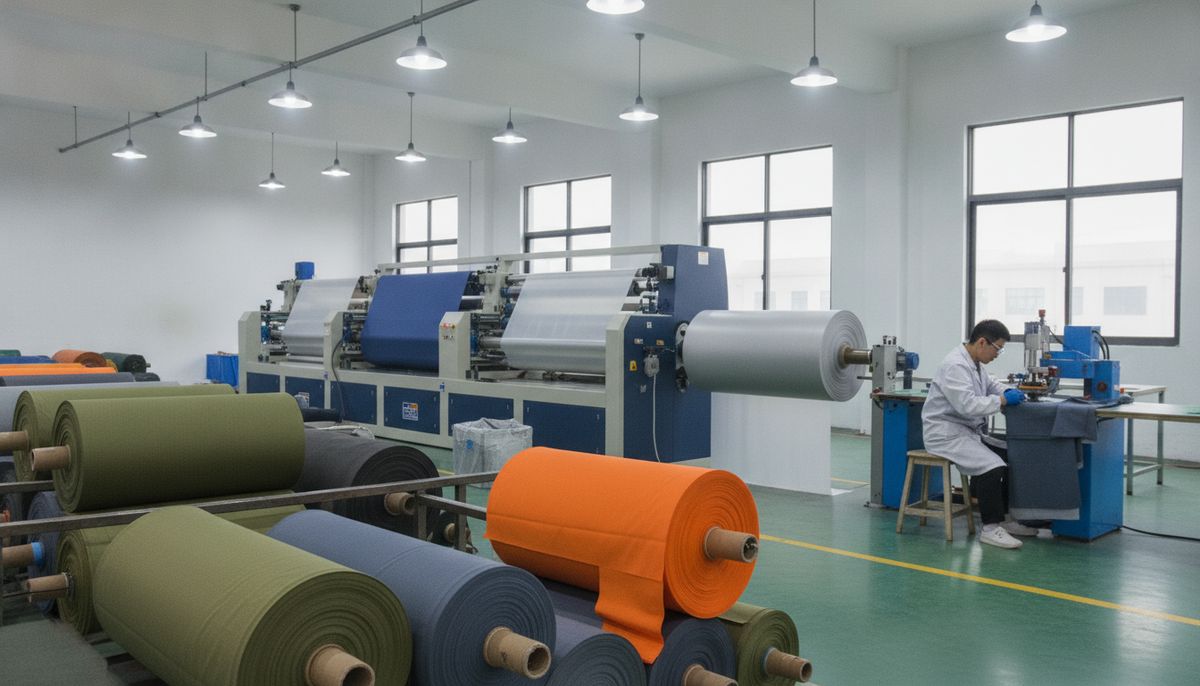
PU coating applies a liquid polyurethane layer to the fabric back, with thickness ranging from 0.40 to 0.55 mm according to Puraingear (2026). The coating penetrates the fabric structure, creating a continuous film. PU lamination, by contrast, bonds a pre-formed membrane to the fabric using heat and adhesive. The laminated membrane maintains consistent thickness and performance across the garment, while coated fabrics can show variation where the coating application is uneven.
Waterproofness and Breathability Trade-Offs
Thicker PU layers increase waterproofness but reduce breathability. A 0.55 mm coating may achieve 10,000 mm hydrostatic head but trap perspiration, while a thinner 0.40 mm coating breathes better but offers lower water resistance. Laminated membranes address this by using microporous PU structures that block liquid water while allowing vapor transmission. Buyers selecting a PU laminated rain jacket manufacturer OEKO-TEX certified must specify both waterproofness and breathability targets, because certification alone does not define performance.
Seam Sealing and Construction Details
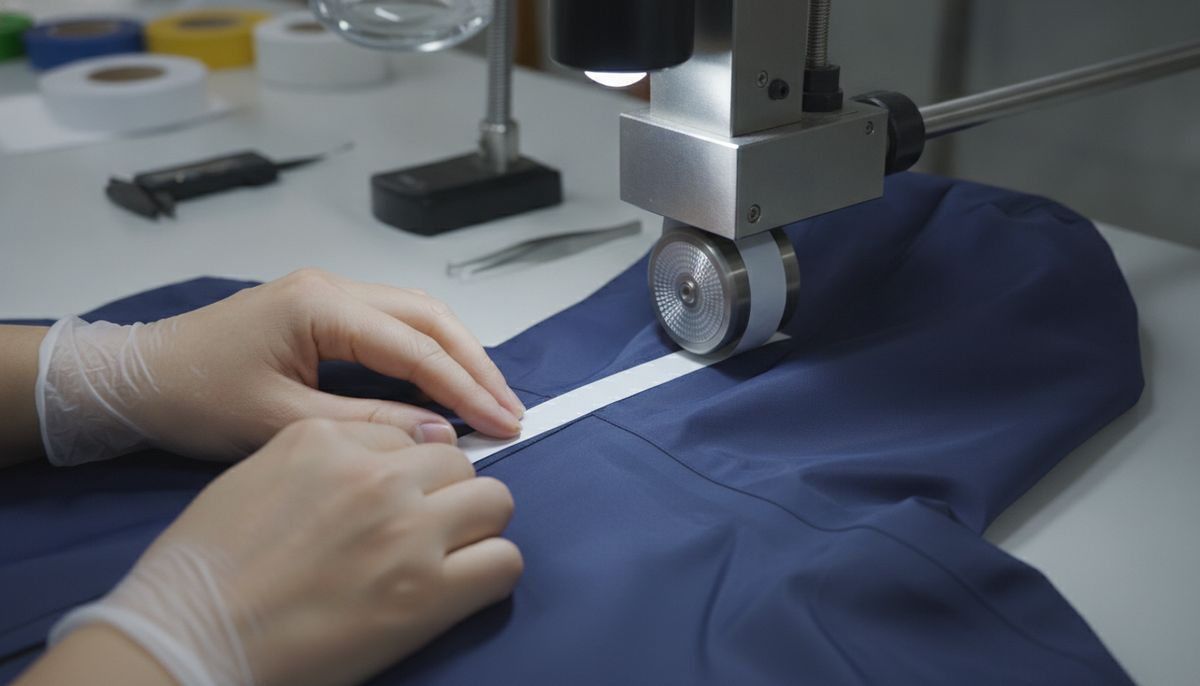
PU laminated rain jackets require taped seams to prevent water ingress through needle holes. According to Da Nang Outdoor Gear (2026), a technical-garment factory profile reports five seam-sealing machines, a PU coating line, an ultrasonic welder, and a rain-test chamber as standard equipment. Seam tape width, adhesive type, and application temperature all affect long-term waterproofness. Buyers should request seam-tape samples and wash-test results before committing to bulk orders.
In practice: Seam taping is what separates a jacket that survives a wash test from one that delaminates after three cycles, which is why verification on the pre-production sample prevents bulk-order failures that cannot be remedied after cutting.
OEKO-TEX Scope: Fabric vs. Finished Garment
OEKO-TEX Standard 100 certification tests textiles against harmful substances, including formaldehyde, heavy metals, pesticides, and phthalates. Certification scope determines which components are tested: fabric-only certification covers the shell material, while finished-garment certification includes zippers, threads, labels, and trims. Buyers must verify certificate numbers and test scope before assuming a jacket is fully certified.
What OEKO-TEX Standard 100 Tests
OEKO-TEX Standard 100 screens textiles against regulated and non-regulated substances that may harm human health. The certification does not measure waterproofness, breathability, or durability. According to BikeTour-Global technical review (2026), users may assume OEKO-TEX or bluesign proves waterproofness and breathability, but technical reviewers note that these certifications address chemical or production impacts rather than performance ratings. A certified fabric can still fail hydrostatic-head or MVTR testing if the membrane structure is inadequate.
Certificate Verification Process
Every OEKO-TEX Standard 100 certificate carries a unique number, test scope, and expiration date. Buyers should request the actual certificate PDF, not just a logo on a website. The certificate lists which components were tested: if only the face fabric appears, the lining, membrane, zippers, and threads remain unverified. A PU laminated rain jacket manufacturer OEKO-TEX certified for the finished garment will show all components in the certificate scope, with individual test results for each material.
Common Certification Gaps
Many manufacturers hold OEKO-TEX certification for fabric suppliers but not for their own finished products. The fabric mill may be certified, while the garment factory is not. This creates a gap: certified fabric can be contaminated during cutting, sewing, or finishing if the factory uses non-certified threads, adhesives, or packaging. Buyers sourcing for EU markets should confirm that the factory itself holds OEKO-TEX certification, not just its suppliers.
Manufacturer Comparison: MOQ, Certification, Lead Time
Minimum order quantities, certification holdings, and production lead times vary widely among PU laminated rain jacket manufacturers. Small brands and uniform buyers need low MOQs to test market fit before committing capital, while larger importers prioritize factory capacity and compliance documentation. This section compares manufacturers by key sourcing criteria.
MOQ and Sampling Terms
According to SDF Clothing (2026), one technical outerwear manufacturer advertises a minimum order quantity of 300 pieces for waterproof, PU-coated, and laminated jackets. PTOUTWEAR offers a sample MOQ of 1 piece with a $100 sample fee refunded against a first bulk order of 30+ pieces, and a bulk MOQ of 10 pieces per style with colours and sizes mixed. According to Ginwen Wear (2026), one insulated-outerwear OEM advertises sampling in 7-14 days and bulk production in 25-40 days, with an MOQ from 50 pieces per style. Buyers starting a DTC outdoor brand or testing a corporate uniform program benefit from lower MOQs that reduce upfront inventory risk.
Factory Location and Capacity
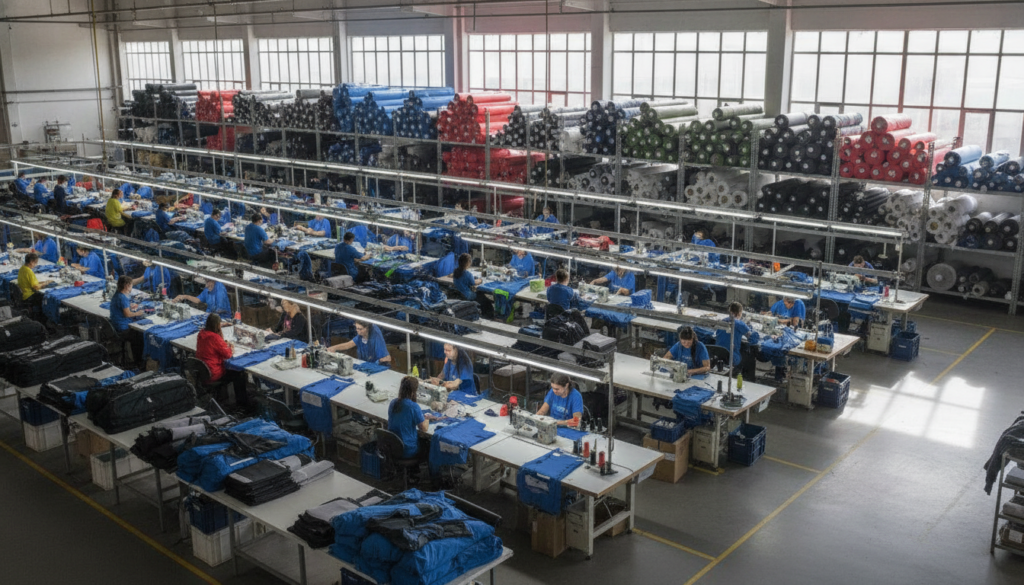
PTOUTWEAR operates a 3,000m² facility in Taizhou Sanmen, Zhejiang, with a trade office in Yiwu. The facility runs 20 production lines with 240 workers and an annual capacity of 200,000 pieces. According to Da Nang Outdoor Gear (2026), a technical-garment factory profile reports 160 sewing machines, five seam-sealing machines, a PU coating line, an ultrasonic welder, and a rain-test chamber. Factory equipment determines production capability: facilities with in-house seam-sealing and rain-testing can verify waterproofness before shipping, while factories that outsource these steps add lead time and quality-control risk.
Lead Time Breakdown
According to Huahao Garments (2026), one OEM supplier states that pre-production prototypes for custom raincoats can be delivered in approximately 10-14 days. PTOUTWEAR offers sampling in 7-10 days and bulk production in 25-35 days (about 4 weeks), with a rush option for 1,000 pieces in 2 weeks at a +25% surcharge. Lead time includes fabric sourcing, cutting, sewing, seam sealing, quality inspection, and packaging. Buyers should add freight time (15-25 days ocean, 5-7 days air) and customs clearance (3-5 days) when calculating delivery to EU warehouses.
Performance Testing Beyond Certification
OEKO-TEX certification confirms chemical safety but does not measure waterproofness, breathability, or seam durability. Buyers need independent laboratory validation of hydrostatic head, moisture vapor transmission rate, and seam performance to ensure the jacket meets end-user expectations. Performance testing prevents the common issue where samples pass visual inspection but fail in field use.
Hydrostatic Head Testing (ISO 811)
ISO 811 measures waterproofness by applying increasing water pressure to fabric until three points of leakage occur. Results are reported in millimeters of water column. According to SDF Clothing (2026), PU-coated rain jackets typically achieve 5,000-10,000 mm waterproofness. A 5,000 mm rating handles light rain, while 10,000 mm withstands moderate rain with wind. Buyers should request ISO 811 test reports from an independent laboratory (SGS, TÜV, Intertek) for both the fabric and the finished garment, because seam sealing affects whole-garment performance.
Breathability Testing (ISO 11092)
ISO 11092 measures moisture vapor transmission rate (MVTR) by tracking how much water vapor passes through fabric over 24 hours. Results are reported in grams per square meter per 24 hours (g/m²/24h). According to SDF Clothing (2026), PU-coated rain jackets typically achieve 3,000-5,000 g/m²/24h breathability. Higher MVTR values reduce interior condensation during active use. According to BikeTour-Global technical review (2026), PU membrane performance varies substantially between brands, and there is no single unified performance standard equivalent to a shared Gore-Tex specification. Buyers should specify minimum MVTR targets in the tech pack and verify results on the pre-production sample.
Seam Performance and Wash Durability
Seam tape can delaminate after repeated washing or dry cleaning. Buyers should request wash-durability testing per ISO 6330 (domestic washing) or ISO 3175 (dry cleaning) to confirm that seam tape adhesion survives the garment’s intended care instructions. A jacket that passes hydrostatic-head testing on day one but fails after five washes creates returns and damages brand reputation. Sample development should include wash testing before bulk production begins.
- Hydrostatic head (ISO 811): measures waterproofness in millimeters of water column; 5,000 mm handles light rain, 10,000 mm withstands moderate rain with wind.
- MVTR (ISO 11092): measures breathability in grams per square meter per 24 hours; 3,000-5,000 g/m²/24h is typical for PU-coated jackets.
- Seam strength (ISO 13935-2): measures seam breaking force; critical for jackets with taped seams under stress.
- Wash durability (ISO 6330): confirms that waterproofness and seam adhesion survive the garment’s care instructions.
- Abrasion resistance (ISO 12947): measures fabric durability under repeated rubbing; important for backpack contact areas.
Landed Cost Guidance for EU Buyers
EU buyers sourcing PU laminated rain jackets from China face landed costs including fabric, production, seam taping, freight, customs duty, VAT, and compliance documentation. Understanding each cost component prevents budget overruns and allows accurate retail pricing before committing to an order.
FOB Pricing and Production Costs
According to SDF Clothing (2026), indicative PU rain-jacket pricing ranges from approximately $10-$22 per unit depending on order volume. FOB (Free On Board) pricing includes fabric, cutting, sewing, seam taping, quality inspection, and packaging, but excludes freight and import duties. Higher-volume orders reduce per-unit costs because fabric minimums are met and production-line setup is amortized. Buyers should request tiered pricing: 100 pieces, 300 pieces, 500 pieces, and 1,000 pieces to understand scale economies.
Freight and Logistics
Ocean freight from China to EU ports (Hamburg, Rotterdam, Antwerp) takes 15-25 days and costs approximately $1.50-$3.00 per kilogram depending on volume and routing. Air freight takes 5-7 days but costs $5.00-$8.00 per kilogram. A 400-gram rain jacket shipped by ocean adds roughly $0.60-$1.20 per unit to landed cost, while air freight adds $2.00-$3.20 per unit. PTOUTWEAR offers DDP (Delivered Duty Paid) shipping, which includes freight, customs clearance, and delivery to the buyer’s warehouse, simplifying cost calculation and reducing customs-clearance delays.
Customs Duty and VAT
EU customs duty for textile outerwear (HS code 6201.93 for synthetic-fiber jackets) is typically 12%. VAT rates vary by EU member state: Germany 19%, France 20%, Netherlands 21%. A $15 FOB jacket with $1 freight incurs $1.92 duty (12% of $16) and $3.23 VAT (19% of $16 + $1.92 in Germany), raising landed cost to $21.15 before domestic logistics. Buyers should confirm HS code classification with a customs broker before placing large orders, because misclassification can trigger duty adjustments and penalties.
Compliance Documentation
EU imports require a commercial invoice, packing list, bill of lading, and certificate of origin. OEKO-TEX or other certification documents support REACH compliance claims but do not replace mandatory product-safety documentation. Buyers should budget for third-party testing (SGS, TÜV, Intertek) if the factory does not hold EU-recognized certifications. Testing costs range from $500 to $1,500 per product depending on scope, but this expense is amortized across the order quantity.
Quality Control Checkpoints
Quality control for PU laminated rain jackets requires verification at fabric inspection, pre-production sampling, during-production inspection, and pre-shipment final inspection. Each checkpoint catches specific defects before they multiply across the order. Buyers who skip checkpoints discover problems only after goods arrive, when remedies are expensive and time-consuming.
Fabric Inspection
Fabric inspection verifies that the PU membrane is bonded uniformly, with no delamination, pinholes, or coating voids. Buyers should request a fabric swatch with the pre-production sample and conduct a visual inspection under bright light. Hold the fabric up to a light source: pinholes appear as bright spots, indicating membrane defects. According to Amazon customer review, a customer reported a strong, unpleasant smell when a PU rain jacket was removed from its packaging and had to air it out for several days before the odor disappeared. Odor issues stem from residual solvents in the PU coating or adhesive; buyers should specify low-VOC adhesives and request odor testing if the target market is sensitive to chemical smells.
Pre-Production Sample
The pre-production sample confirms fit, construction, and material specifications before bulk cutting begins. Buyers should test the sample for waterproofness (spray test or shower test), seam integrity (pull test), and zipper function (repeated open-close cycles). According to Amazon customer review, a customer said the PU rain-jacket material felt like rubber and returned it because the hand feel differed from expectations. Hand feel varies with PU thickness and face-fabric construction; buyers should approve the sample’s tactile properties before production, because changing fabric mid-order is not feasible.
During-Production Inspection
During-production inspection (DUPRO) occurs when 30-50% of the order is complete. The inspector checks cutting accuracy, sewing quality, seam-tape adhesion, and color consistency. DUPRO catches systemic issues (wrong thread color, incorrect seam-tape width, misaligned logos) while there is still time to correct them. Buyers should engage a third-party inspection company (SGS, TÜV, Intertek, QIMA) or visit the factory in person if the order value justifies travel costs.
Pre-Shipment Final Inspection
Pre-shipment final inspection (PSI) occurs when 100% of the order is complete and 80% is packed. The inspector selects a random sample (AQL 2.5 standard) and checks for defects: loose threads, skipped stitches, delaminated seam tape, broken zippers, and packaging errors. The inspection report includes photos and a pass/fail recommendation. Buyers should specify that payment release is contingent on a passing PSI report, creating an incentive for the factory to maintain quality through the final production stage.
- Fabric inspection: verify PU membrane bonding, check for pinholes and delamination, request low-VOC adhesives to prevent odor issues.
- Pre-production sample: test waterproofness, seam integrity, zipper function, and hand feel before bulk cutting begins.
- During-production inspection: catch systemic issues (wrong thread, incorrect seam tape, misaligned logos) while correction is still feasible.
- Pre-shipment final inspection: random-sample check per AQL 2.5 standard, with photos and pass/fail recommendation before payment release.
- Independent lab testing: verify ISO 811 hydrostatic head, ISO 11092 MVTR, and wash durability before accepting the order.
In practice: A factory that cannot produce a real OEKO-TEX certificate number and test-scope document is either using non-certified materials or relying on a supplier’s certification that does not extend to the finished garment, which is why certificate verification happens before the sample is approved.
Frequently Asked Questions
What is the difference between PU-coated and PU-laminated rain jacket fabric?
PU-coated fabric applies liquid polyurethane directly onto the textile surface, creating a bonded layer that penetrates the fabric structure. PU-laminated fabric bonds a pre-formed polyurethane membrane to the face fabric using heat and adhesive, maintaining consistent thickness and performance. Laminated constructions typically offer better breathability and durability because the membrane remains intact even when the face fabric flexes or abrades, while coated fabrics can show variation where the coating application is uneven.
How do I verify that a manufacturer’s OEKO-TEX certification covers the finished rain jacket, not just the fabric?
Request the actual OEKO-TEX Standard 100 certificate PDF, which lists the certificate number, test scope, and expiration date. The certificate should itemize all tested components: face fabric, membrane, lining, zippers, threads, labels, and trims. If only the face fabric appears in the test scope, the finished garment is not fully certified. Verify the certificate on the OEKO-TEX website using the certificate number, and confirm that the factory name matches the certificate holder, not just a fabric supplier.
What minimum waterproofness rating should I specify for a PU laminated rain jacket used in moderate rain?
A hydrostatic head of 10,000 mm (ISO 811) is recommended for moderate rain with wind. Jackets rated 5,000 mm handle light rain but may leak under pressure from backpack straps or prolonged exposure. Specify both the fabric waterproofness and the finished-garment waterproofness in your tech pack, because seam sealing affects whole-garment performance. Request independent laboratory test reports (SGS, TÜV, Intertek) for both the fabric and the finished sample before approving bulk production.
Ready to source PU laminated rain jackets with verified OEKO-TEX materials and independent performance testing?
Request 1-Piece Samples →
Written by Ivan Chen, Sales Engineer at PTOUTWEAR, 13 years in outdoor apparel manufacturing.