DDP softshell jacket shipping France customs means the seller pays all freight, customs clearance, import duty, French VAT (20% standard rate), and final delivery to your door, giving you a single landed price with no surprise charges at the border. Under DDP (Delivered Duty Paid), the supplier or their freight forwarder acts as the importer of record, files the French customs declaration, and covers all costs through to your specified address. For corporate uniform buyers, DTC outdoor brands, and school programs sourcing technical jackets from China, this eliminates cash-flow surprises and simplifies budgeting, though VAT recoverability depends on whether your business is the legal importer or the forwarder clears goods under their own EORI and VAT registration.
📋 Table of Contents
Executive Summary
- DDP Incoterm: Seller pays freight, customs clearance, duty, French import VAT, and final-mile delivery, providing a single landed price with no border surprises.
- French VAT rate: France applies a standard 20% import VAT to clothing and textile imports, charged on the sum of FOB value, freight, insurance, and customs duty.
- Importer of record: The party named on the customs declaration determines who can reclaim VAT; if the forwarder clears under their own EORI, your business may not recover the VAT paid.
- Softshell duty rates: EU customs duty on textile and clothing imports can reach approximately 12%, depending on HS classification, fabric construction, and country of origin.
- Documentation requirements: French customs requires commercial invoice, packing list, bill of lading or air waybill, certificate of origin (if preferential), and EUR.1 or Form A where applicable.
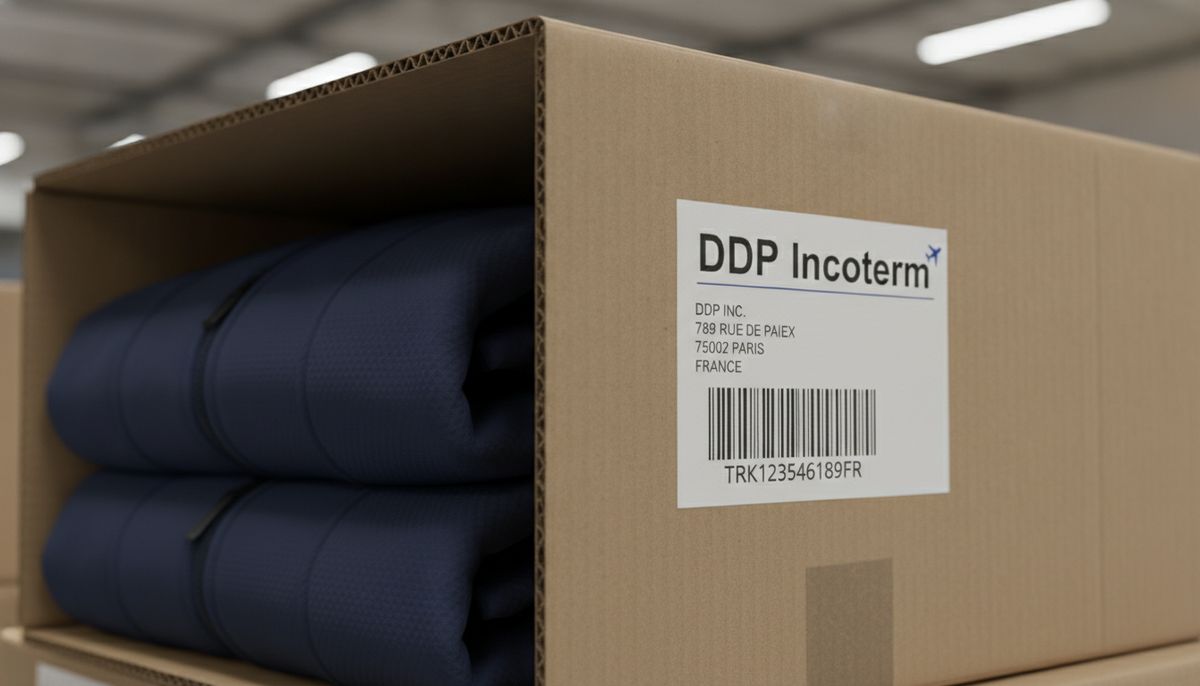
What Does DDP Mean for France?
DDP (Delivered Duty Paid) is an Incoterm where the seller assumes all costs and risks to deliver goods to a named destination, including export clearance, freight, import customs clearance, duty, taxes, and final delivery. For buyers importing softshell jackets into France, this means the Chinese manufacturer or their freight forwarder pays French customs duty, the 20% import VAT, and any brokerage or handling fees, then delivers the cartons to your warehouse, office, or fulfillment center. The price you see on the proforma invoice is the price you pay, with no additional charges when the shipment arrives.
Seller Responsibilities Under DDP
The seller must arrange and pay for export clearance in China, international freight (air or ocean), import clearance in France, all duties and taxes, and final-mile delivery to the agreed address. The seller also bears the risk of loss or damage throughout the journey, including during customs clearance. For corporate uniform buyers or DTC outdoor brands without customs experience, this shifts the complexity and cash-flow burden to the supplier, who typically has established freight partners and customs brokers.
Buyer Responsibilities Under DDP
The buyer provides a clear delivery address, unloads the goods at destination (unless otherwise agreed), and verifies the shipment against the packing list. The buyer does not arrange freight, file customs declarations, or pay duty and VAT directly. However, the buyer must still confirm who is named as the importer of record on the French customs declaration, because that determines whether the business can reclaim the import VAT through its French VAT return.
When DDP Makes Sense
DDP works well for first-time importers, small-batch orders where predictable budgeting matters more than marginal cost savings, and buyers who lack a customs broker or freight forwarder relationship. It also suits school uniform programs and corporate team-gear buyers who need a single purchase-order price for internal approval, with no variable customs charges to reconcile later. For high-volume buyers with established logistics partners and VAT recovery processes, DAP (Delivered at Place) or FOB may offer better cost control and full VAT recoverability.
Softshell Jacket HS Code and Duty Rates
French customs duty on softshell jackets depends on the Harmonized System (HS) code, which classifies the garment by fabric construction, fiber content, and end use. Softshell jackets typically fall under HS chapter 62 (woven garments) or chapter 61 (knitted garments), with specific subheadings for coated, laminated, or membrane fabrics. Textile and clothing imports into France can face EU customs duty rates of up to approximately 12%, depending on classification and origin, according to Good Hope Freight (2026).
Common HS Codes for Softshell Jackets
- 6201.93: Men’s or boys’ woven jackets, of synthetic fibers, not knitted, covers many two-layer softshell constructions with woven face fabric and fleece backing.
- 6202.93: Women’s or girls’ woven jackets, of synthetic fibers, not knitted, parallel to 6201.93 for female sizing.
- 6211.33 / 6211.43: Track suits and other garments, of synthetic fibers, used for some lightweight softshell pullovers or activewear-style jackets.
- 3926.20 (plastic garments): Rarely applies to softshell, but can be cited for fully coated or laminated shells where the plastic coating is the essential character, not the textile substrate.
Duty Rates and Preferential Arrangements
Standard EU Most Favored Nation (MFN) duty rates for synthetic-fiber woven jackets range from 10.5% to 12%. Garments made in countries with preferential trade agreements (Bangladesh under Everything But Arms, Vietnam under EVFTA, or Turkey under the EU-Turkey Customs Union) may qualify for reduced or zero-percent duty, provided the manufacturer supplies a valid EUR.1 movement certificate or certificate of origin. Bangladesh-made garments qualifying under the EU Everything But Arms arrangement may enter France at 0% customs duty, while standard French import VAT remains 20%, according to Collective Studio (2026).
Classification Factors That Change the Rate
French customs classifies softshell jackets based on the fabric’s essential character. A woven-face softshell with a thin fleece backing is classified as woven (chapter 62). A knitted-face softshell with a membrane laminate is classified as knitted (chapter 61). A jacket with a plastic-coated outer layer where the coating provides the waterproofing may be classified under chapter 39 (plastics) or remain in chapter 62 with a note on the coating. The presence of a membrane (ePTFE, polyurethane, or polyester) does not automatically change the HS code; the underlying fabric construction and the coating’s role determine classification. Misclassification can trigger post-clearance audits, duty adjustments, and penalties, so the commercial invoice must describe the fabric construction accurately (woven polyester face, knitted polyester backing, polyurethane membrane laminate, for example).
French VAT and Recovery Under DDP
France applies a standard 20% import VAT to clothing imports, charged on the CIF value (cost, insurance, freight) plus any customs duty paid. For a softshell jacket with a $30 FOB value, $5 freight, and $4.20 duty (12% on $35 CIF), the VAT base is $39.20, and the VAT charge is $7.84, bringing the total landed cost to $47.04 before final-mile delivery. France’s standard VAT rate applied to clothing imports is 20%, according to the European Commission / Your Europe (2026).
VAT Self-Accounting for French Businesses
French businesses and organizations registered for French VAT use a self-accounting system where import VAT is declared on the monthly or quarterly VAT return (ligne 3B) and simultaneously reclaimed as input VAT (ligne 20), resulting in zero net cash outflow. This system is mandatory and automatic for entities identified for French VAT. However, self-accounting only applies when the importing business is named as the importer of record on the customs declaration and holds a French EORI number and VAT registration. If the freight forwarder or supplier clears the goods under their own EORI, the forwarder pays the VAT to French customs, and the buyer’s business cannot reclaim it because the buyer is not the legal importer.
When VAT Is Not Recoverable Under DDP
A key DDP pain point is uncertainty over whether the forwarder or buyer is the importer of record, which can determine whether import VAT is recoverable. If the DDP quotation does not specify who will be named as the importer, the forwarder may default to using their own EORI to simplify clearance, especially for small shipments or first-time buyers without a French VAT number. In this scenario, the 20% VAT is embedded in the DDP price the buyer pays, but the buyer cannot reclaim it because they are not the importer on the customs declaration. For a 500-piece softshell order with a $15,000 CIF value and $1,800 duty, the VAT charge is $3,360. If the buyer cannot reclaim that $3,360, the effective cost is 22.4% higher than it would be under DAP with self-accounting.
How to Ensure VAT Recoverability
Before accepting a DDP quotation, confirm in writing that your business will be named as the importer of record on the French customs declaration, using your French EORI number and VAT registration. Request a sample customs declaration or SAD (Single Administrative Document) showing your company as the declarant. Some OEM jacket manufacturers and freight forwarders offer fiscal representation services, where they clear goods on your behalf but name you as the importer, allowing you to use self-accounting. Others offer a hybrid DDP arrangement where they advance the VAT payment but you remain the importer, and you reimburse the VAT portion separately. Clarify this before the first shipment, not after goods arrive.
Who Is the Importer of Record?
The importer of record is the legal entity responsible for ensuring goods comply with French and EU import regulations, paying duties and taxes, and maintaining customs records for post-clearance audit. Under DDP, the Incoterm does not automatically determine who the importer is; the parties must agree and document it in the freight contract and the customs declaration. The importer of record is identified by the EORI (Economic Operators Registration and Identification) number on box 8 of the French customs declaration (SAD).
Supplier or Forwarder as Importer
Many Chinese manufacturers and freight forwarders default to acting as the importer of record for DDP shipments because it simplifies the process and avoids requiring the buyer to register for a French EORI and VAT number. The forwarder uses their own EORI, files the declaration, pays the duty and VAT to French customs, then invoices the buyer for the total landed cost. This works well for one-time shipments, samples, or buyers without French VAT registration, but it means the buyer cannot reclaim the import VAT and has no direct access to the customs declaration or clearance documents for audit purposes.
Buyer as Importer (Fiscal Representation)
For VAT-registered French businesses or companies with a French branch, the preferred arrangement is for the buyer to be named as the importer of record, with the freight forwarder acting as the customs representative. The forwarder files the declaration using the buyer’s EORI and VAT number, pays the duty and VAT on the buyer’s behalf (or the buyer uses self-accounting), and the buyer receives the SAD and clearance documents directly. This allows the buyer to reclaim the import VAT and maintain full audit visibility. Some forwarders charge a fiscal-representation fee (typically €50 to €150 per shipment) for this service.
Documentation to Request
Request the following documents from your DDP supplier or forwarder to verify the importer of record and ensure VAT recoverability:
- Customs declaration (SAD): Box 8 shows the importer’s EORI; box 44 shows the customs value and duty paid; box 47 shows the VAT paid.
- Proof of VAT payment: French customs issues a receipt or electronic confirmation when VAT is paid; this is required to reclaim the VAT on your French VAT return.
- Commercial invoice: Must match the customs declaration value and description to avoid post-clearance discrepancies.
- Certificate of origin: Required for preferential duty rates; EUR.1 for many countries, Form A for GSP beneficiaries like Bangladesh.
Complete Landed-Cost Breakdown
DDP softshell-jacket pricing commonly adds approximately 15-25% to FOB pricing, depending on destination and order value, according to PT Outwear (2026). The landed cost includes FOB price, international freight, insurance, customs duty, French import VAT, customs brokerage, and final-mile delivery. Understanding each component helps buyers compare DDP quotations and identify where costs can be optimized.
FOB Price Variables
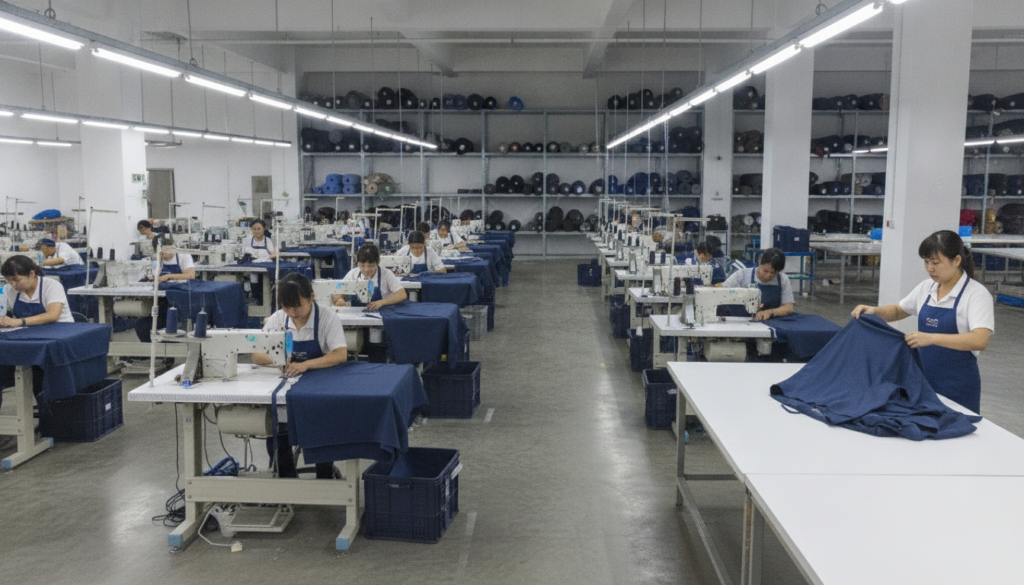
The factory price depends on fabric specification, membrane type (if any), construction complexity, order quantity, and customization requirements. A basic two-layer woven-fleece softshell with no membrane starts around $25 FOB for 500 pieces. A three-layer laminated softshell with ePTFE membrane, YKK AquaGuard zippers, and laser-cut ventilation starts around $42 FOB for the same quantity. Our 3,000m² Taizhou Sanmen facility runs 20 production lines with in-house cut-and-sew, membrane lamination, and seam-taping capabilities, allowing tighter tolerances and shorter lead times than brokers who outsource lamination.
Freight Mode and Timing
Air freight from Shanghai to Paris CDG takes 5 to 7 days door-to-door under DDP, with per-piece costs of $3 to $6 depending on season and fuel surcharges. Ocean freight from Shanghai to Le Havre takes 28 to 35 days door-to-door, with per-piece costs of $0.80 to $1.50 for a full container. For sample orders (1 to 10 pieces), express courier (DHL, FedEx, UPS) is faster (3 to 5 days) but more expensive ($25 to $40 per piece including duties and taxes). For bulk orders above 500 pieces, ocean freight offers the best cost per piece, while air freight suits rush restocks or seasonal launches where speed justifies the premium.
Hidden Costs to Watch
Some DDP quotations exclude final-mile delivery beyond the port or airport, leaving the buyer to arrange inland trucking. Others include delivery to a commercial address but charge extra for residential delivery or liftgate service. Confirm the exact delivery address (warehouse, office, or home) and whether the quotation includes unloading, because some carriers charge a fee if the receiver cannot offload the pallets. Also confirm whether the quotation includes customs examination fees, which French customs may levy if they select the shipment for physical inspection (typically €150 to €300 per container, rarely applied to small parcels).
Key Takeaways
- DDP (Delivered Duty Paid) means the seller pays all freight, customs clearance, duty, French import VAT, and final delivery, providing a single landed price with no border surprises.
- France applies a standard 20% import VAT to clothing, charged on the sum of FOB value, freight, insurance, and customs duty, and VAT-registered French businesses can reclaim this VAT only if they are named as the importer of record on the customs declaration.
- Softshell jackets are classified under HS chapter 62 (woven) or 61 (knitted) depending on fabric construction, with EU customs duty rates reaching approximately 12% for synthetic-fiber garments, though preferential arrangements like Everything But Arms can reduce duty to zero for qualifying origins.
- The importer of record is identified by the EORI number in box 8 of the French customs declaration, and if the freight forwarder uses their own EORI to simplify clearance, the buyer cannot reclaim the 20% import VAT even though it is embedded in the DDP price.
- DDP softshell-jacket pricing commonly adds approximately 15-25% to FOB pricing, covering freight, insurance, duty, VAT, brokerage, and final-mile delivery, with air freight costing $3 to $6 per piece and ocean freight $0.80 to $1.50 per piece for bulk orders.
- Before accepting a DDP quotation, confirm in writing that your business will be named as the importer of record, request a sample customs declaration showing your EORI in box 8, and verify that you will receive the SAD and proof of VAT payment required to reclaim the import VAT on your French VAT return.
Frequently Asked Questions
Can I reclaim French import VAT if my supplier ships DDP?
You can reclaim the 20% French import VAT only if your business is named as the importer of record on the customs declaration and you hold a French EORI number and VAT registration. If the freight forwarder or supplier clears the goods under their own EORI to simplify the process, the VAT is embedded in the DDP price you pay, but you cannot reclaim it because you are not the legal importer. Before accepting a DDP quotation, confirm in writing that your company will be listed as the importer in box 8 of the SAD (Single Administrative Document) and that you will receive the customs declaration and proof of VAT payment required to file your French VAT return. Some forwarders offer fiscal representation services where they clear goods on your behalf but name you as the importer, allowing you to use the self-accounting system where import VAT is declared and simultaneously reclaimed on the same VAT return, resulting in zero net cash outflow.
What documents do I need to import softshell jackets into France under DDP?
French customs requires a commercial invoice describing the goods (fabric construction, fiber content, HS code), a packing list showing carton count and dimensions, a bill of lading (ocean) or air waybill (air), and a certificate of origin if you are claiming preferential duty treatment under a trade agreement. For garments made in Bangladesh, Vietnam, Turkey, or other countries with EU preferential arrangements, you need a EUR.1 movement certificate or certificate of origin Form A to qualify for reduced or zero-percent duty. The freight forwarder files the Single Administrative Document (SAD) electronically through the French customs system, and you should request a copy of the SAD showing your company as the importer (box 8) and the duty and VAT paid (boxes 44 and 47). If the shipment value exceeds €3,000 or French customs selects it for examination, you may also need a pro forma invoice, product photos, or fabric test reports to verify the HS classification and declared value.
How long does DDP shipping from China to France take?
Air freight DDP from Shanghai to Paris or Lyon takes 5 to 7 days door-to-door, including 1 to 2 days for customs clearance and final-mile delivery. Ocean freight DDP from Shanghai to Le Havre or Marseille takes 28 to 35 days door-to-door, including 3 to 5 days for port handling, customs clearance, and inland trucking to your warehouse. Express courier (DHL, FedEx, UPS) takes 3 to 5 days for small parcels and sample shipments, with duties and taxes pre-paid. Lead times can extend during peak seasons (Chinese New Year in January-February, European summer holidays in July-August, and the pre-Christmas rush in October-November) or if French customs selects the shipment for physical examination, which adds 2 to 5 business days. For predictable delivery, book ocean freight 6 to 8 weeks before your target in-stock date, or air freight 3 to 4 weeks before, allowing buffer time for any customs delays or documentation corrections.
Need a DDP softshell jacket quotation with transparent duty, VAT, and delivery costs?
Request a detailed landed-cost breakdown →
Written by Ivan Chen, Sales Engineer at PTOUTWEAR – 13 years in outdoor apparel manufacturing.