When sourcing from an embroidered logo placement softshell jacket factory, left-chest embroidery is the professional default for corporate, team, and branded outerwear, positioned 7-10 cm below the shoulder seam and centered between the armhole and center-front zip. Back embroidery is used for crew visibility, uniforms, and high-impact branding but costs 15-25% more due to hooping complexity on lined technical garments. PTOUTWEAR produces embroidered softshell jackets with 1-piece sample MOQ and 30-piece bulk MOQ, with in-house digitizing and stabilizer-matched embroidery to prevent puckering on stretch-woven softshells.
📋 Table of Contents
Key Takeaways
- Left-chest embroidery is the default professional placement for softshell jackets, positioned 7-10 cm below the shoulder seam and centered between the armhole and the center-front zip.
- Back embroidery is used for crew visibility, uniforms, and high-impact branding but costs 15-25% more due to hooping complexity on lined technical garments.
- Embroidery placement must avoid seams, zips, pockets, reflective tape, and waterproof membranes to prevent needle damage, thread breakage, and compromised garment performance.
- Softshell jackets are ideal for embroidery because the chest panel is flat, stable, and stretch-woven, but the fleece backing requires proper stabilizer or stitches sink into the pile.
- Sample MOQ for embroidered softshell jackets at PTOUTWEAR is 1 piece with 7-10 day lead time; bulk MOQ is 30 pieces per SKU with 25-35 day production.
- According to Grand View Research (2025), the global workwear market was valued at USD 19.7 billion in 2024 and is projected to reach USD 30.4 billion by 2030.
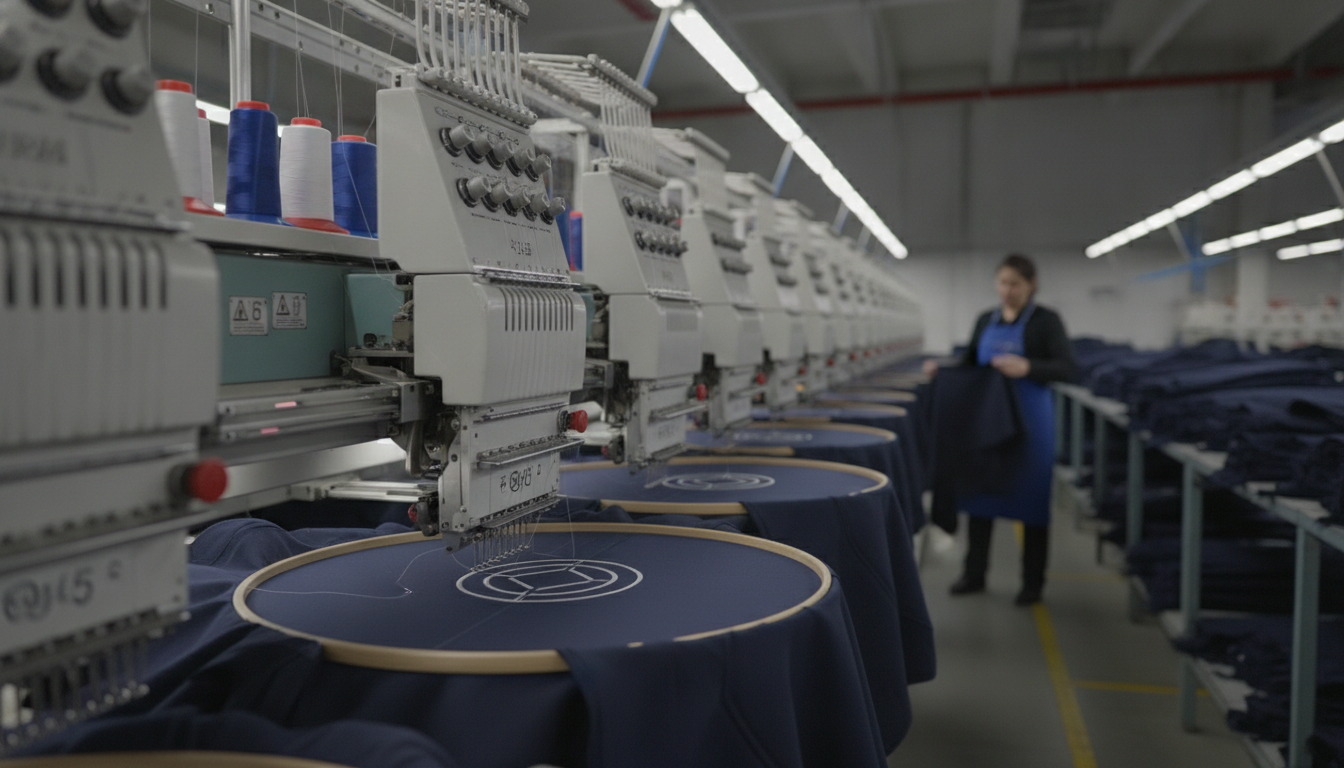
Standard Embroidery Positions for Softshell Jackets
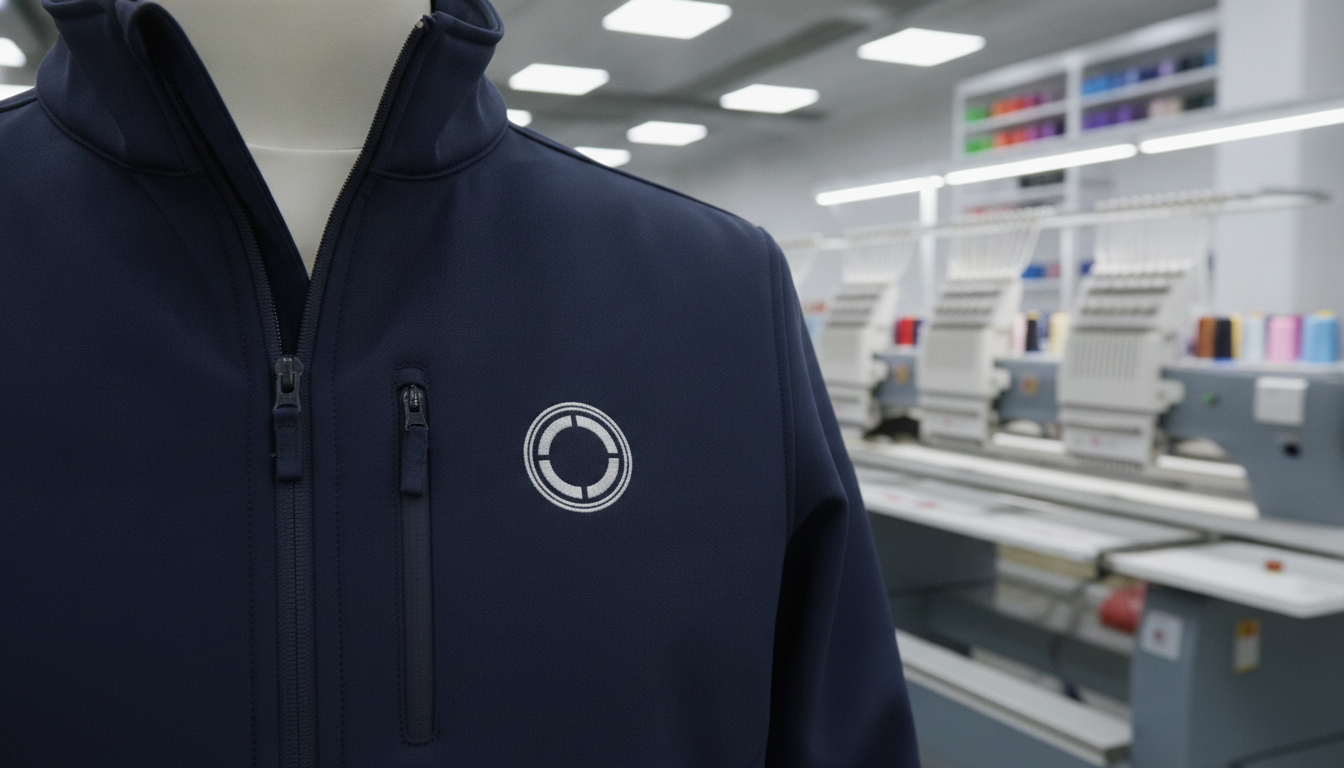
Left-chest embroidery is the most common placement for corporate, team, and branded softshell jackets. The standard position is 7-10 cm below the shoulder seam, centered between the armhole and the center-front zip, with logo dimensions typically 8-10 cm wide for adult sizing. This placement keeps the logo visible when the jacket is worn open or closed, sits above the pocket line on most designs, and avoids the stress zones around the armhole and side seam.
Left-Chest Placement
Left-chest is the default for professional and corporate branding. The chest panel on a softshell jacket is flat, stable, and free from seams or pockets in most designs, making it the easiest area to hoop and embroider. The logo sits in a high-visibility zone without interfering with the garment’s technical features like waterproof zips or ventilation panels. For youth or small adult sizing, the logo is scaled down to 6-8 cm wide to maintain proportion.
Back Placement
Back embroidery is used for crew visibility, uniforms, and high-impact branding where the logo needs to be seen from a distance. The standard position is centered between the shoulder seams, 5-8 cm below the collar, with logo dimensions typically 20-30 cm wide. Back placement costs 15-25% more than left-chest because the back panel on a lined softshell jacket is harder to hoop, requires a larger embroidery frame, and takes longer to stitch due to the increased stitch count.
Sleeve and Shoulder Placement
Sleeve embroidery is used for sponsor logos, team patches, or secondary branding. The standard position is on the upper left sleeve, 10-12 cm below the shoulder seam, with logo dimensions typically 5-7 cm wide. Shoulder placement is less common because the curved seam and the stress from arm movement make it prone to puckering and thread breakage. Sleeve embroidery adds 10-15% to the unit cost due to the smaller hoop size and the need for precise alignment on a curved surface.
Placement Constraints: Seams, Zips, and Membranes
Embroidery placement on softshell jackets must avoid construction features that interfere with the needle path or compromise the garment’s technical performance. Seams, zips, pockets, reflective tape, and waterproof membranes are all exclusion zones where embroidery cannot be placed without damaging the fabric or the decoration.
Seams and Stress Zones
Embroidery cannot cross seams because the needle will hit the seam allowance, causing thread breakage and needle damage. The shoulder seam, armhole seam, and side seam are all exclusion zones. Embroidery also cannot be placed within 2-3 cm of a seam because the stress from body movement will pull the stitches and cause puckering. On a softshell jacket with a yoke seam, the back embroidery position must be lowered to sit below the yoke line.
Zips and Pockets
Embroidery cannot be placed over or within 3 cm of a zip because the needle will hit the zip teeth or the zip tape, causing needle breakage and damage to the zip. The center-front zip, chest pockets, and hand pockets are all exclusion zones. On a softshell jacket with a chest pocket, the left-chest logo position is adjusted to sit above the pocket or moved to the right chest if the left chest is fully occupied by the pocket.
Reflective Tape and Waterproof Membranes
Embroidery cannot be placed over reflective tape because the needle will damage the reflective coating and compromise the visibility performance. On a hi-vis softshell jacket with reflective tape on the chest, the logo is moved to a non-reflective panel or applied as a heat-transfer patch instead of direct embroidery. Embroidery also cannot be placed over a waterproof membrane or a taped seam because the needle holes will compromise the waterproofing. On a waterproof softshell jacket with a membrane laminate, the logo is placed on an outer panel that does not penetrate the membrane layer.
In practice: Embroidery over a taped seam creates needle holes that allow water ingress, which is why the placement must be verified on the sample before bulk production is cut.
Factory Workflow: Sampling to Bulk Production
The workflow for embroidered softshell jackets at an OEM jacket manufacturing factory starts with artwork digitizing, moves through 1-piece sample production, and ends with bulk production and final QC. Each step has specific MOQ, lead time, and cost implications that buyers need to understand before placing an order.
Artwork Digitizing and Setup
Embroidery artwork must be digitized into a stitch file before production can begin. The digitizing process converts a vector logo into a machine-readable file that controls the needle path, stitch type, and thread color. Digitizing takes 1-2 days and costs $30-50 per logo, charged once per design. The stitch file is tested on a sample fabric swatch to verify thread tension, stitch density, and color match before the logo is embroidered on the actual garment.
Sample Production
Sample MOQ at PTOUTWEAR is 1 piece with a $100 sample fee that is refundable against bulk orders. The sample is produced in 7-10 days and includes the embroidered logo in the buyer’s specified placement, size, and thread color. The sample allows the buyer to verify the logo appearance, the fabric hand-feel, and the garment fit before committing to bulk production. Buyers should request samples in multiple placements (left-chest, back, sleeve) if they are unsure which position works best for their design.
Bulk Production
Bulk MOQ is 30 pieces per SKU with a 25-35 day production lead time. The embroidery is completed on cut panels before the garment is sewn, which ensures precise placement and avoids the risk of the logo shifting during assembly. Each garment is inspected after embroidery to check for thread breaks, puckering, and color match. The embroidered panels are then sent to the sewing line where the jacket is assembled, pressed, and packed. Rush production is available for orders of 1,000 pieces or more, with a 2-week lead time at a 25% surcharge.
Cost Breakdown by Placement and Stitch Count
Embroidery cost is calculated by stitch count, placement complexity, and thread color count. Left-chest embroidery is the lowest-cost option because it requires a smaller hoop, fewer stitches, and less setup time. Back embroidery costs more due to the larger logo size and the hooping difficulty on lined garments. Sleeve embroidery costs more due to the curved surface and the need for precise alignment.
Stitch Count and Thread Colors
Embroidery cost is primarily driven by stitch count. A simple text logo with 5,000 stitches costs $1.50-2.00 per piece. A detailed logo with 15,000 stitches costs $3.00-4.00 per piece. Thread color count also affects cost: each additional color adds $0.20-0.30 per piece due to the thread change and the setup time. Buyers should simplify logos to reduce stitch count and limit thread colors to 3-4 to keep costs down.
Placement Surcharges
Left-chest embroidery has no surcharge. Back embroidery adds 15-25% to the base embroidery cost due to the larger hoop size and the longer stitch time. Sleeve embroidery adds 10-15% due to the curved surface and the alignment difficulty. Multiple placements (left-chest + back, or left-chest + sleeve) are charged separately, with each placement billed at its own rate.
Setup Fees and Reorder Discounts
Digitizing is a one-time setup fee of $30-50 per logo. The stitch file is stored by the factory and reused for reorders at no additional charge. Reorders of the same logo in the same placement receive a 10-15% discount on the embroidery cost because the setup time is eliminated. Buyers should plan for reorders when negotiating the initial embroidery price to lock in the reorder discount rate.
Quality Control: Stabilizers and Thread Tension
Embroidery quality on softshell jackets depends on three factors: stabilizer selection, thread tension, and needle type. Poor stabilizer choice causes puckering. Incorrect thread tension causes thread breaks or loose stitches. Wrong needle type causes fabric damage or skipped stitches.
Stabilizer Selection
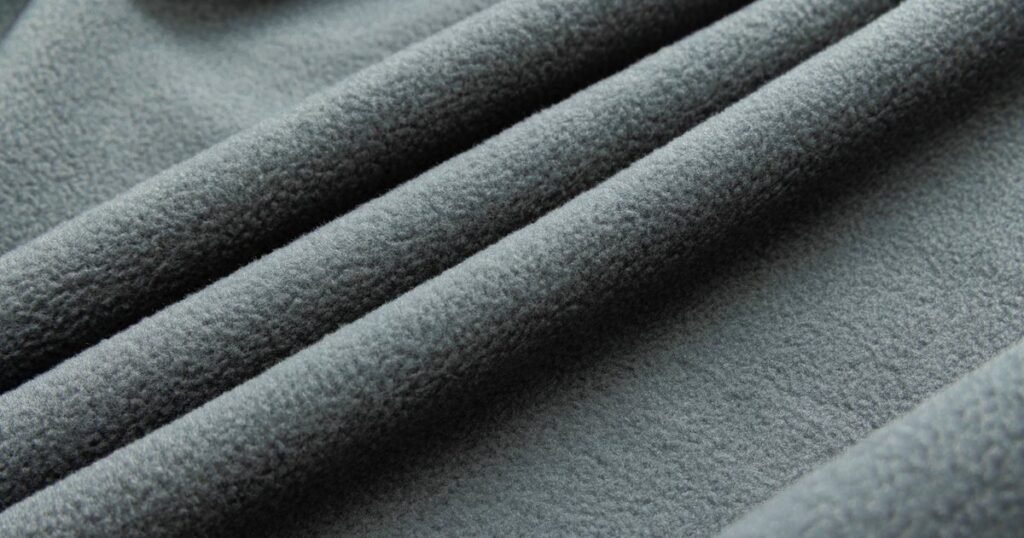
Softshell jackets have a fleece backing that requires a cut-away stabilizer to prevent stitches from sinking into the pile. The stabilizer is placed under the fabric during embroidery and remains in the garment after the logo is stitched. Tear-away stabilizers are not suitable for softshell jackets because they leave no support for the stitches, causing the logo to pucker or distort over time. The stabilizer weight should match the fabric weight: 50-70 gsm stabilizer for lightweight softshells, 80-100 gsm for midweight softshells.
Thread Tension and Stitch Density
Thread tension must be calibrated for the fabric type and the stitch density. Too-tight tension causes the fabric to pucker around the logo. Too-loose tension causes the stitches to sit on top of the fabric instead of locking into the weave. Stitch density should be 4-5 stitches per millimeter for softshell jackets. Higher density causes the fabric to stiffen and the logo to feel heavy. Lower density causes the stitches to spread and the logo to look sparse.
Needle Type and Size
Embroidery needles for softshell jackets are 75/11 or 80/12 ballpoint needles, which push the fabric fibers aside instead of cutting them. Sharp needles will damage the stretch-woven face fabric and cause runs or holes. The needle should be changed every 8-10 hours of stitching to prevent burrs that cause thread breaks. Buyers should request a pre-production sample with the embroidered logo to verify the needle type, stabilizer, and thread tension before bulk production begins.
Our 3,000m² Taizhou Sanmen facility runs 20 production lines with in-house cut-and-sew, embroidery digitizing, and QC, allowing us to control embroidery quality from artwork setup through final inspection. We test every stitch file on a sample swatch before production and inspect every embroidered panel for puckering, thread breaks, and color match before the garment is assembled.
Frequently Asked Questions
Can you embroider on waterproof softshell jackets?
Embroidery on waterproof softshell jackets is possible but requires careful placement to avoid compromising the waterproof membrane. The logo must be placed on an outer panel that does not penetrate the membrane layer, or applied as a heat-transfer patch instead of direct embroidery. If the softshell has a taped seam or a laminated membrane, embroidery will create needle holes that allow water ingress, which is why buyers should request a sample to verify the placement before bulk production.
What size should a left-chest logo be on a softshell jacket?
The standard left-chest logo size for adult softshell jackets is 8-10 cm wide and 5-7 cm tall, positioned 7-10 cm below the shoulder seam and centered between the armhole and the center-front zip. For youth or small adult sizing, the logo is scaled down to 6-8 cm wide to maintain proportion. Logos larger than 10 cm wide require a larger embroidery hoop and may not fit within the flat chest panel on smaller sizes.
How much does embroidered logo placement on a softshell jacket factory order cost?
Embroidery cost for softshell jackets is calculated by stitch count and placement. A simple left-chest logo with 5,000 stitches costs $1.50-2.00 per piece. A detailed logo with 15,000 stitches costs $3.00-4.00 per piece. Back embroidery adds 15-25% to the base cost due to the larger hoop size and longer stitch time. Sleeve embroidery adds 10-15%. Digitizing is a one-time setup fee of $30-50 per logo, and buyers should request a sample development quote before placing a bulk order.
Ready to source embroidered softshell jackets with precise logo placement, 1-piece sample MOQ, and 30-piece bulk MOQ?
Request Your Sample Quote →
Written by Ivan Chen, Sales Engineer at PTOUTWEAR, 13 years in outdoor apparel manufacturing.