📋 Table of Contents
Designing dog jacket sizing by breed group requires understanding skeletal structure, movement patterns, and thermal regulation differences across breeds. A Corgi’s barrel chest demands different chest-girth-to-back-length ratios than a Greyhound’s deep keel. Standardized measurement protocols and breed-specific fit adjustments prevent restricted movement, chafing, and poor thermal performance.
Executive Summary
- Market growth: The global pet care market is projected to grow from $289.17 billion in 2026 to $499.06 billion by 2034, at a CAGR of 7.06%, according to Fortune Business Insights (2026).
- Critical measurement: Back length measured from base of neck to base of tail serves as the primary sizing reference, with chest girth as the secondary constraint for breed groups with barrel or deep chests.
- Breed variation: Terrier breeds typically require chest girth 10-15% larger than back length, while sighthounds need chest girth only 5-8% larger due to deep keel structure.
- Size increment standard: Most commercial dog jacket lines use 2-inch (5cm) back-length increments for small breeds and 3-inch (7.5cm) increments for medium-to-large breeds to balance inventory SKU count with fit precision.
- Material compatibility: Double-coated breeds (Huskies, Malamutes) require breathable shell fabrics with moisture-wicking liners, while short-haired breeds (Greyhounds, Whippets) benefit from insulated softshell construction for thermal retention.
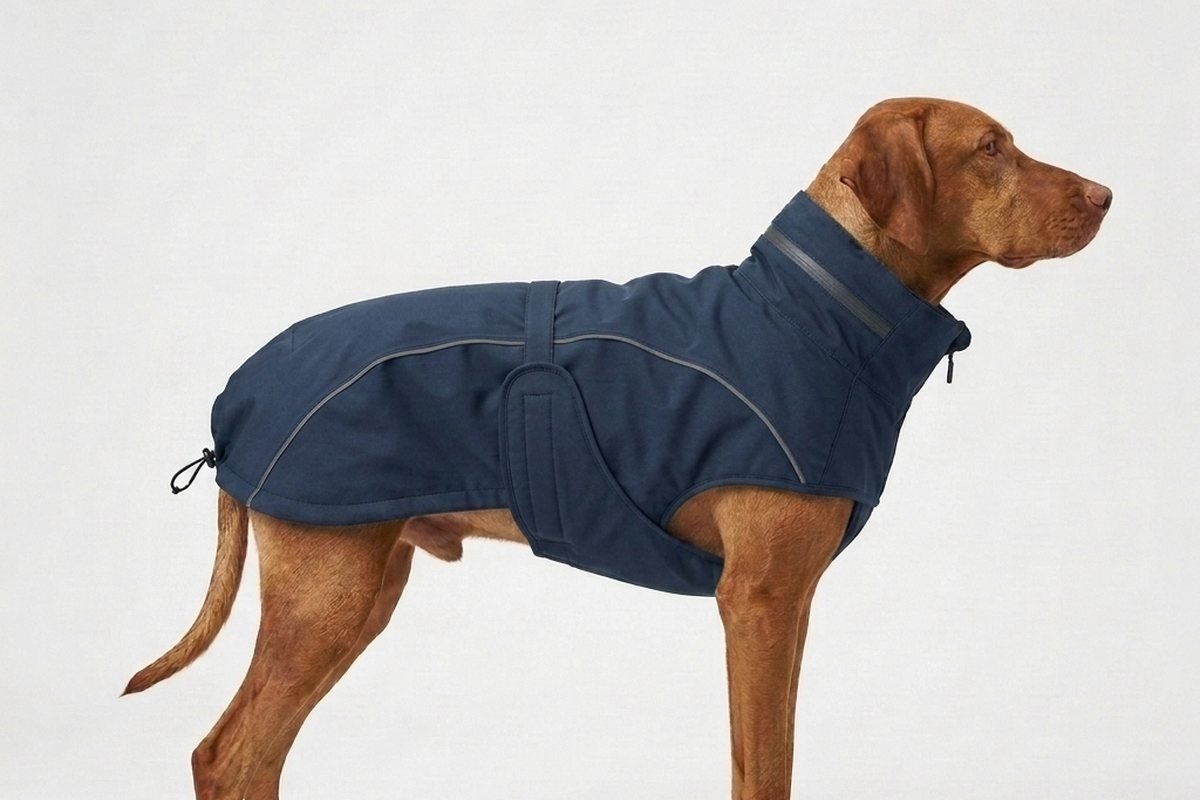
Breed Group Body Shape Fundamentals
Dog jacket fit engineering starts with skeletal morphology. Breeds cluster into five primary body-shape groups, each requiring distinct sizing approaches.
Barrel-Chested Breeds (Bulldogs, Corgis, Basset Hounds)
These breeds have chest girth measurements 15-20% larger than back length. A Corgi with 16-inch back length typically measures 19-20 inches around the chest. Standard human-apparel grading (proportional scaling) creates armhole restriction when applied to barrel-chested dogs.
Jacket patterns for this group require wider chest panels and shorter body lengths. The chest girth must allow 2 fingers of ease when the dog is standing, expanding to 4 fingers when the dog sits or lies down. Our 12+ years manufacturing outdoor jackets have shown that restricting chest expansion by more than 10% causes dogs to refuse wearing the garment.
Deep-Chested Breeds (Greyhounds, Whippets, Dobermans)
Sighthounds and working breeds have deep keels with narrow chest width. A 24-inch Greyhound back length pairs with only 26-inch chest girth. The sternum-to-spine depth exceeds the lateral chest width, creating a vertical oval cross-section.
Jacket underbody panels must extend 6-8 inches deeper than barrel-chested equivalents. Elastic belly straps prevent ride-up during running. The neck opening requires a longer drop to clear the pronounced sternum.
Square-Built Breeds (Labrador Retrievers, Golden Retrievers, Beagles)
These breeds have balanced proportions with chest girth approximately equal to back length plus 2-3 inches. A 20-inch back length pairs with 22-23 inch chest girth. This group accepts standard grading rules with minimal adjustment.
Jacket fit focuses on leg opening placement. The front leg opening should sit 30-35% of back length from the neck edge to align with the shoulder blade rotation axis. Misplaced leg openings create pressure points during stride extension.
Long-Backed Breeds (Dachshunds, Basenjis)
Dachshunds have back lengths 2-3 times their leg height. A standard Dachshund measures 18-20 inches back length with only 16-18 inch chest girth. The extended spine requires flexible fabric panels to prevent binding during turning movements.
Jacket construction uses bias-cut side panels or 4-way stretch softshell fabric. Rigid woven shells restrict lateral flexion. The back panel should extend to cover the loin but stop 2 inches before the tail base to allow natural tail carriage.
Small Compact Breeds (Terriers, Pugs, Boston Terriers)
These breeds combine short back length (10-14 inches) with proportionally large chest girth. A Jack Russell Terrier with 12-inch back length measures 14-15 inches around the chest. Neck girth is disproportionately large relative to body size.
Jacket neck openings must accommodate thick neck musculature without choking. The opening diameter should measure 60-65% of chest girth. Adjustable hook-and-loop or snap closures allow 2-3 inches of adjustment range per size.
Measurement Protocol for Dog Jackets
Accurate measurement eliminates 70% of fit-related returns in direct-to-consumer dog apparel brands. The protocol below standardizes data collection for OEM jacket manufacturing and private-label development.
Back Length Measurement
Position the dog standing on a flat surface with head level. Locate the base of the neck where the collar naturally sits (C7 vertebra prominence). Measure along the spine to the base of the tail (first caudal vertebra). Do not include tail length.
Record to the nearest 0.5 inch or 1cm. A dog measuring 19.75 inches rounds to 20 inches. This measurement determines the primary size category (XS through XXL).
Chest Girth Measurement
Wrap a flexible tape measure around the widest part of the ribcage, typically 2-3 inches behind the front legs. The dog should be standing with weight evenly distributed. The tape should lie flat against the coat without compressing the fur.
Add 2 inches to the measured girth for the jacket specification. A dog measuring 22 inches requires a 24-inch jacket chest girth. This ease allowance permits breathing expansion and sitting movement.
Neck Girth Measurement
Measure around the base of the neck where a collar sits. Add 1 inch for the jacket neck opening. Breeds with thick ruffs (Collies, Shelties) require an additional 0.5-1 inch ease.
The neck opening must clear the head during donning. For pull-over designs, the opening diameter should equal 70% of the head circumference measured at the widest point (across the ears and under the jaw).
Leg Opening Placement
Measure from the base of the neck to the point of the shoulder (scapula-humerus joint). This distance determines front leg opening placement. The opening center should align with the shoulder joint to prevent restriction during stride.
Opening diameter should measure 1.5 times the leg circumference at the elbow. A 6-inch leg circumference requires a 9-inch opening diameter. Elastic binding or adjustable straps accommodate different leg thicknesses within a size range.
Standardized Size Increments by Breed
Commercial dog jacket lines balance fit precision against SKU proliferation. A brand offering 12 sizes across 4 colorways manages 48 SKUs. Each additional size adds 4 SKUs and increases inventory carrying cost.
Small Breed Sizing (Back Length 8-16 Inches)
Small breeds use 2-inch back-length increments. A typical range covers:
- XXS: 8-10 inch back length, 10-12 inch chest girth (Chihuahuas, toy breeds)
- XS: 10-12 inch back length, 12-14 inch chest girth (Yorkies, Maltese)
- S: 12-14 inch back length, 14-16 inch chest girth (Jack Russells, Pugs)
- M: 14-16 inch back length, 16-18 inch chest girth (Beagles, Cocker Spaniels)
The 2-inch increment captures 85% of small-breed fit requirements. Outlier breeds (Dachshunds, Basset Hounds) require dedicated size charts with adjusted chest-to-back ratios.
Medium Breed Sizing (Back Length 16-22 Inches)
Medium breeds use 3-inch increments to reduce SKU count while maintaining acceptable fit:
- L: 16-19 inch back length, 19-22 inch chest girth (Bulldogs, Corgis)
- XL: 19-22 inch back length, 22-25 inch chest girth (Border Collies, Springer Spaniels)
The wider increment range requires adjustable closures. Hook-and-loop belly straps provide 3-4 inches of adjustment to accommodate chest girth variation within each size.
Large Breed Sizing (Back Length 22-30 Inches)
Large breeds use 4-inch increments due to lower unit sales volume per size:
- 2XL: 22-26 inch back length, 26-30 inch chest girth (Labrador Retrievers, Golden Retrievers)
- 3XL: 26-30 inch back length, 30-34 inch chest girth (German Shepherds, Rottweilers)
- 4XL: 30-34 inch back length, 34-38 inch chest girth (Great Danes, Mastiffs)
Large-breed jackets require reinforced stitching and heavier-duty hardware. A 90-pound Labrador generates 3-4 times the stress load of a 20-pound Beagle during running and jumping.
Breed-Specific Adjustment Factors
Certain breeds require chest girth adjustments outside standard grading rules. Apply these multipliers to the base back-length measurement:
- Bulldogs and barrel-chested breeds: Chest girth = back length × 1.25
- Greyhounds and sighthounds: Chest girth = back length × 1.08
- Dachshunds and long-backed breeds: Chest girth = back length × 0.90
- Standard proportional breeds: Chest girth = back length × 1.15
A 20-inch Bulldog requires 25-inch chest girth (20 × 1.25), while a 20-inch Greyhound needs only 21.6 inches (20 × 1.08). Brands serving multiple breed groups maintain separate size charts for each morphology category.
Material Performance by Breed Activity
Fabric selection depends on breed coat type, activity level, and climate exposure. Double-coated breeds have different thermal and moisture-management needs than short-haired breeds.
Double-Coated Breeds (Huskies, Malamutes, Bernese Mountain Dogs)
These breeds generate significant body heat during activity. Their dense undercoat traps moisture against the skin when covered by non-breathable shells. Jacket construction requires:
- Outer shell: 2.5-layer waterproof-breathable membrane with minimum 10,000g/m²/24hr MVTR (moisture vapor transmission rate)
- Liner fabric: Moisture-wicking polyester mesh, not insulation
- Ventilation: Underarm mesh panels or zippered vents to exhaust heat
A common complaint about waterproof jackets is that breathability fails when the DWR coating wets out, leaving the dog feeling clammy. PFC-free DWR treatments require reapplication every 20-30 wash cycles to maintain surface water repellency and preserve breathability.
Short-Haired Breeds (Greyhounds, Whippets, Vizslas)
Thin coats provide minimal insulation. These breeds lose body heat rapidly in temperatures below 50°F (10°C). Jacket specifications should include:
- Insulation: 60-100g synthetic fill or fleece lining for 40-50°F conditions, 100-200g for below 40°F
- Shell fabric: Windproof softshell (10,000mm water column minimum) to block convective heat loss
- Coverage: Extended belly panel to protect the thin abdominal skin and organs
Softshell construction combines stretch mobility with thermal retention. A 4-way stretch fabric (20-30% elongation) accommodates the extreme stride extension of sighthounds without restricting movement.
Water-Retrieving Breeds (Labrador Retrievers, Chesapeake Bay Retrievers)
These breeds work in wet conditions but have water-resistant topcoats. Jacket design focuses on post-swim warmth retention:
- Quick-dry liner: Hydrophobic polyester that wicks water away from the coat
- Drainage grommets: At the lowest jacket points to prevent water pooling
- Reflective trim: For low-light water work visibility
The jacket should dry within 30-45 minutes of removing it from a wet dog. Absorbent cotton or slow-drying fabrics remain damp for hours, promoting bacterial growth and odor.
Working and Sporting Breeds (German Shepherds, Border Collies, Pointers)
High-activity breeds require abrasion resistance and range of motion. Jacket construction uses:
- Reinforced chest and shoulder panels: 500D Cordura or ripstop nylon in high-wear zones
- Articulated sleeve design: Gusseted underarm panels to prevent binding during running
- Reflective accents: 3M Scotchlite or equivalent for visibility during dawn/dusk work
A working dog jacket endures ground contact, brush abrasion, and repeated flexing. The fabric should withstand 10,000+ Martindale abrasion cycles without pilling or fiber breakdown. Our 3,000m² Taizhou Sanmen facility runs abrasion testing on all low-MOQ jacket production samples before bulk manufacturing.
Manufacturability for Apparel Brands
Dog jacket production for outdoor apparel brands entering the pet category requires understanding size-range economics, pattern grading, and material sourcing.
SKU Management and Inventory Strategy
A brand offering 8 sizes across 3 colorways manages 24 SKUs. Each SKU requires separate pattern grading, cutting, and inventory tracking. Minimum order quantities multiply by SKU count.
Sample MOQ: 1 piece. Bulk MOQ: 30 pieces per SKU. Sampling time: 7-10 days.
A brand launching with 6 sizes and 2 colorways needs 360 units minimum (30 pieces × 12 SKUs). Reducing the size range to 4 sizes drops the minimum to 240 units, lowering cash outlay by 33%.
Inventory distribution follows a bell curve. Medium sizes (M, L, XL) account for 60-70% of sales volume. Small and extra-large sizes move slower. A typical distribution allocates:
- XS and XXS: 10% of total inventory
- S: 15% of total inventory
- M and L: 50% of total inventory (25% each)
- XL: 15% of total inventory
- 2XL and larger: 10% of total inventory
This distribution minimizes slow-moving inventory while maintaining in-stock rates for high-demand sizes. Brands can test market demand with a limited size range (S, M, L, XL) before expanding to XXS and 3XL.
Pattern Grading and Fit Sampling
Dog jacket patterns grade differently than human apparel. The chest girth increases faster than back length as sizes scale up. A medium-size pattern cannot simply scale proportionally to create a large size.
Grade rules specify how each pattern piece changes between sizes. A typical grade rule set for standard-proportioned breeds:
- Back length: +2 inches per size (small breeds), +3 inches per size (medium/large breeds)
- Chest girth: +2.5 inches per size (small breeds), +4 inches per size (medium/large breeds)
- Neck opening: +1 inch diameter per size
- Leg opening: +0.75 inch diameter per size
Fit samples validate grade rules before bulk production. A brand should sample the smallest size, middle size, and largest size in the range. A dog matching each size specification wears the sample to check for restriction, gaping, or ride-up.
Material Sourcing and Certification
Pet apparel sold in North America and Europe increasingly requires material safety certification. Fabrics and trims must be free of harmful chemicals that dogs might ingest through licking or chewing.
OEKO-TEX Standard 100 certification screens textiles for restricted substances including heavy metals, formaldehyde, and phthalates. The certification applies to all jacket components: shell fabric, lining, insulation, thread, zippers, and hook-and-loop closures.
Brands sourcing from manufacturers should verify:
- Fabric mill certifications: OEKO-TEX, bluesign, or equivalent for shell and lining materials
- Trim supplier certifications: YKK zippers carry OEKO-TEX certification when specified
- DWR treatment: PFC-free formulations (C0 chemistry) to eliminate perfluorinated compound exposure
Our facility sources PFC-free DWR-treated fabrics and maintains SGS testing records for all production materials. Brands targeting the premium pet market should request material test reports before placing bulk orders.
Care and Maintenance Protocols
Dog jackets accumulate dirt, saliva, and outdoor debris faster than human garments. Care instructions affect fabric longevity and customer satisfaction.
Recommended care protocols by fabric type:
Tumble drying on low heat reactivates DWR coatings after washing. High heat damages waterproof membranes and melts synthetic insulation. Air drying preserves fabric performance but takes 8-12 hours.
Brands should include care tags with specific washing instructions. Generic “machine wash cold” guidance leads to premature DWR failure and customer complaints about lost waterproofing.
Cost Structure and Pricing Strategy
Dog jacket production costs scale with material quality, construction complexity, and order volume. A basic windbreaker costs less than an insulated waterproof jacket with reflective trim.
Typical cost components for a mid-range waterproof dog jacket:
- Shell fabric: 2.5-layer waterproof-breathable nylon, $4-6 per yard
- Lining fabric: Moisture-wicking polyester mesh, $2-3 per yard
- Trims and hardware: YKK zippers, reflective binding, hook-and-loop closures, $1.50-2.50 per unit
- Labor and overhead: Cut-and-sew, quality control, packaging, $3-5 per unit
- Total manufacturing cost: $8-12 per unit at 500-unit order volume
Retail pricing typically applies a 4-6× markup to manufacturing cost. A $10 manufacturing cost jacket retails for $40-60. Premium brands with strong positioning can achieve 6-8× markups.
Brands launching with limited capital should consider starting with a single jacket style in 4-6 sizes rather than multiple styles with full size ranges. A focused product line reduces inventory investment and simplifies marketing messaging.
Regulatory Compliance for Pet Apparel
Pet products sold in the United States fall under Consumer Product Safety Commission (CPSC) oversight when marketed for companion animals. While dog jackets face fewer restrictions than children’s products, brands must ensure:
- Choking hazards: Buttons, snaps, and decorative elements must withstand 90 Newtons of pull force without detaching
- Flammability: Fabrics should meet general flammability standards (16 CFR 1610) if marketed for indoor use
- Labeling: Country of origin, fiber content, and care instructions must appear on permanent labels
European Union markets require CE marking for pet products containing electronic components (LED lights, heating elements). Basic dog jackets without electronics do not require CE marking but must comply with REACH regulation restricting hazardous substances.
Canadian markets follow similar standards to the US with additional French-language labeling requirements for products sold in Quebec. Brands should work with private-label manufacturers familiar with multi-market compliance to avoid customs delays.
Key Takeaways
- The global pet care market is projected to grow from $289.17 billion in 2026 to $499.06 billion by 2034, at a CAGR of 7.06%, according to Fortune Business Insights (2026).
- Back length measurement from base of neck to base of tail serves as the primary sizing reference, with chest girth as the secondary constraint that varies by breed body shape.
- Barrel-chested breeds like Bulldogs and Corgis require chest girth measurements 15-20% larger than back length, while sighthounds need only 5-8% larger due to deep keel structure.
- Commercial dog jacket lines typically use 2-inch back-length increments for small breeds and 3-inch increments for medium-to-large breeds to balance fit precision against SKU proliferation.
- OEKO-TEX Standard 100 certification screens textiles for restricted substances and applies to all jacket components including shell fabric, lining, insulation, thread, zippers, and closures.
- PFC-free DWR treatments require reapplication every 20-30 wash cycles to maintain surface water repellency and preserve breathability in waterproof-breathable shells.
FAQ
How do I measure my dog for a jacket by breed group?
Measure back length from the base of the neck (C7 vertebra) to the base of the tail, then measure chest girth around the widest part of the ribcage behind the front legs. Add 2 inches to chest girth for ease. Barrel-chested breeds (Bulldogs, Corgis) need chest girth 15-20% larger than back length, while sighthounds (Greyhounds, Whippets) need only 5-8% larger. Standard-proportioned breeds use back length plus 2-3 inches for chest girth.
Do breed-specific dog jackets fit better than general ones?
Breed-specific jackets account for skeletal morphology differences that generic sizing cannot address. A Dachshund-specific pattern uses chest girth 10% smaller than back length, while a Bulldog pattern uses chest girth 25% larger. Generic sizing forces compromise fits that restrict movement in barrel-chested breeds or gap excessively on sighthounds. Brands serving multiple breed groups maintain separate size charts for each morphology category to ensure proper fit.
What are the standard size increments for dog jackets by breed?
Small breeds (8-16 inch back length) use 2-inch increments to capture fit precision. Medium breeds (16-22 inch back length) use 3-inch increments with adjustable closures providing 3-4 inches of adjustment range. Large breeds (22-30+ inch back length) use 4-inch increments due to lower unit sales volume per size. These increment ranges balance inventory SKU count against acceptable fit tolerance for each size category.
Can I use a generic size chart for all dog breeds?
Generic size charts work only for standard-proportioned breeds like Labrador Retrievers and Beagles where chest girth equals back length plus 2-3 inches. Breeds with extreme morphology (barrel-chested Bulldogs, deep-chested Greyhounds, long-backed Dachshunds) require dedicated size charts with adjusted chest-to-back ratios. A single generic chart applied to all breeds results in 30-40% fit-related returns from customers with non-standard breed types.
Why is back length critical for dog jacket sizing?
Back length determines the jacket’s coverage area and positions the leg openings relative to the shoulder joint. A jacket too short exposes the loin and kidneys to cold, while a jacket too long restricts tail movement and causes the dog to refuse wearing it. The back length measurement also serves as the base reference for calculating chest girth, neck opening, and leg opening dimensions using breed-specific multipliers.
Written by Ivan Chen, Sales Engineer at PTOUTWEAR – 13 years in outdoor apparel manufacturing.
Ready to develop a breed-specific dog jacket line with technical outdoor fabrics and low minimum orders?
Request 1-Piece Samples →