📋 Table of Contents
- Executive Summary
- What Happens to Insulation When It Gets Wet?
- Down Insulation: Strengths and Wet-Weather Limits
- Synthetic Insulation: Drying Speed and Commercial Durability
- Procurement Comparison: Cost, MOQ, and Lifecycle Value
- Certifications and Compliance for Commercial Buyers
- Region-Specific Recommendations for Humid Maritime Climates
- Key Takeaways
- FAQ
Every outdoor brand founder and corporate uniform buyer who sources jackets for damp climates faces the same question: down vs synthetic jacket for wet climates. The wrong choice can mean staff or customers soaked through and cold, returns climbing, and brand trust eroding, especially across the UK, coastal Europe, the Pacific Northwest, and maritime Australia. This 2026 guide breaks down thermal data, procurement costs, certification paths, and how a OEM jacket manufacturing partner can deliver both fills at modest MOQs.
Executive Summary
- Wet-warmth retention: Synthetic insulation retains up to 85% of its warmth when damp, while untreated down can lose 50% or more according to independent lab tests cited by the Outdoor Industry Association.
- Global outdoor apparel demand: The global outdoor apparel market was valued at over $18 billion in 2024 and is growing at a mid-single-digit CAGR, per Grand View Research.
- Laundering durability: Synthetic fills withstand 30-50 industrial wash cycles before loft degradation, making them the preferred choice for rental uniforms and school programs.
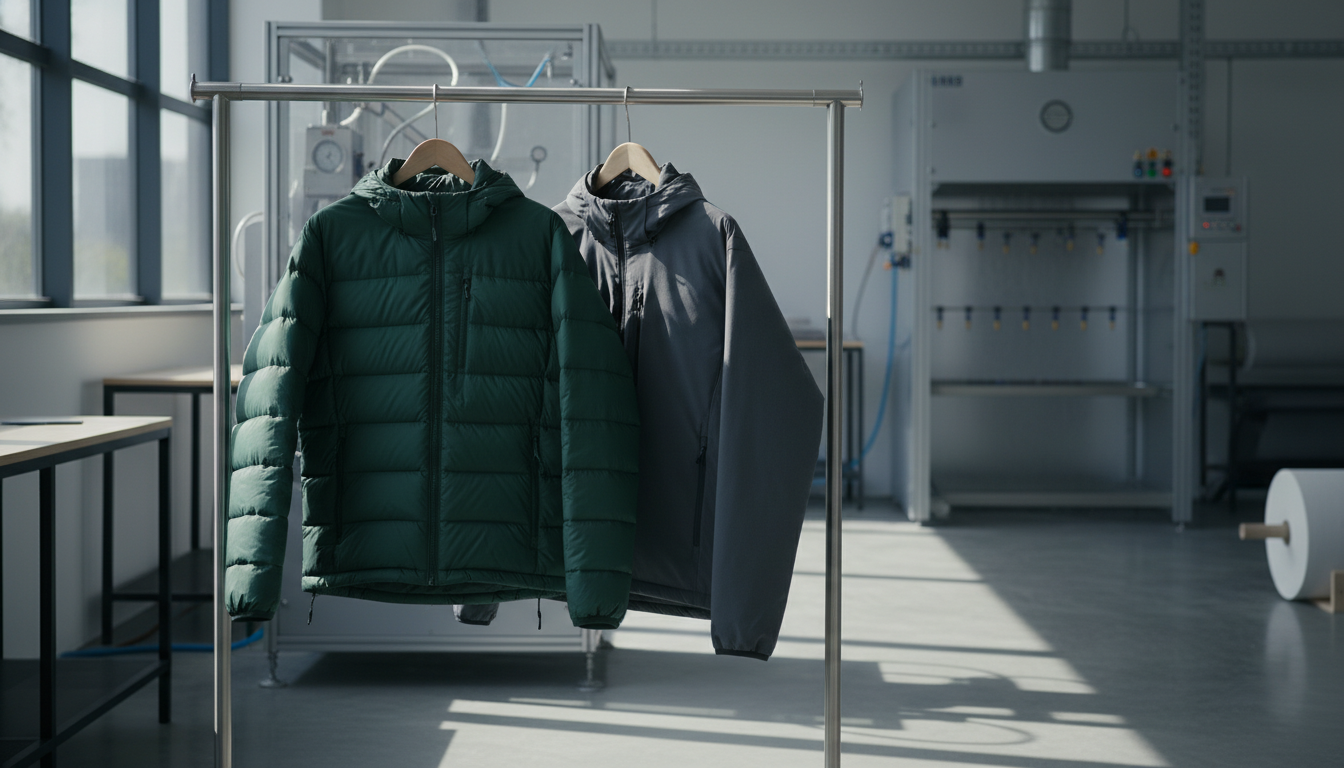
- Sample MOQ advantage: Ptoutwear offers 1-piece samples with a 7-10 day turnaround, so you can benchmark down and synthetic jackets side by side without committing to bulk.
- Certification landscape: OEKO-TEX Standard 100 tests for more than 1,000 harmful substances; RDS certifies ethical down sourcing; both matter for EU and US compliance.
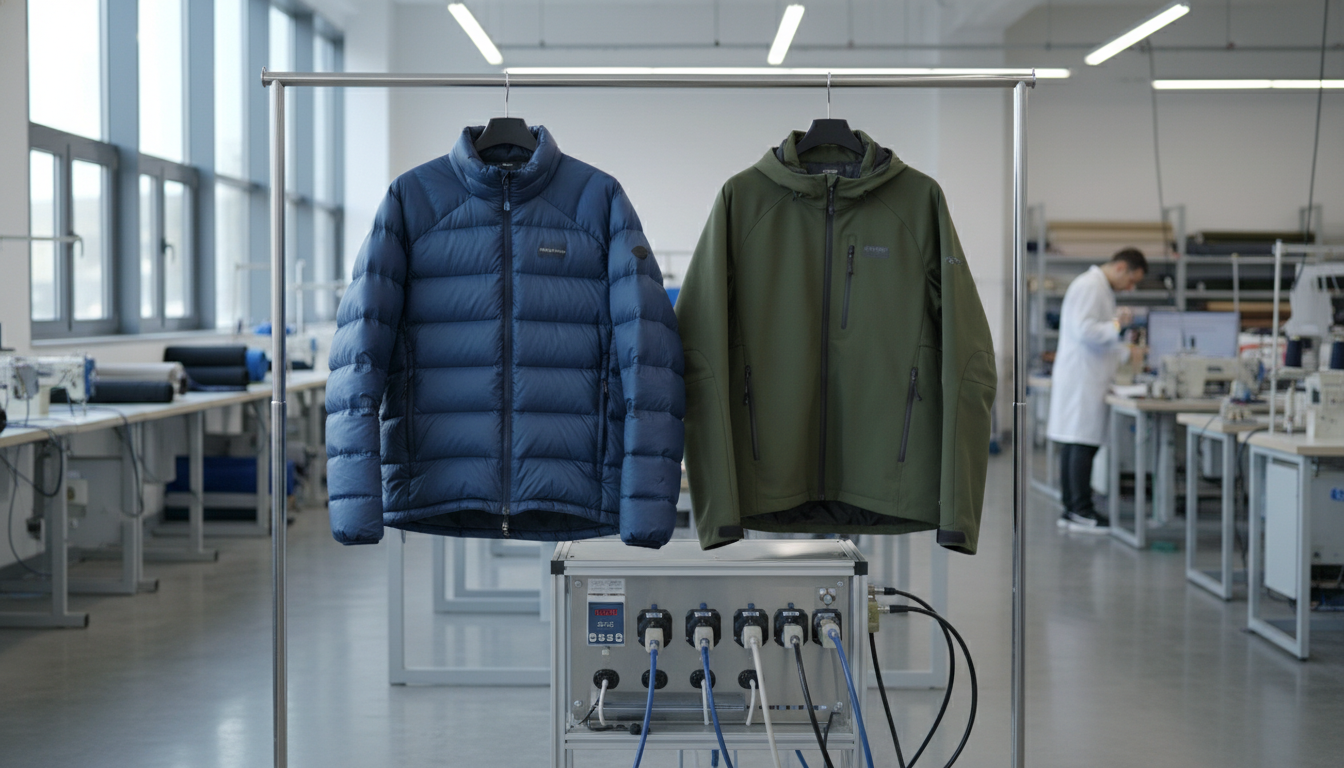
What Happens to Insulation When It Gets Wet?
Insulation works by trapping still air inside microscopic voids. Once water replaces that air, thermal resistance collapses. Understanding this mechanism helps B2B buyers predict real-world performance in maritime humidity, persistent drizzle, and accidental immersion.
How Down Reacts to Moisture
Natural down clusters rely on surface tension to loft. When moisture penetrates the shell, the clusters clump, losing about 50% of their fill volume within 15-20 minutes of direct exposure, based on EN 13567 testing benchmarks. Without active drying, a soaked down jacket can take 4-6 hours to recover full loft at room temperature. Hydrophobic down treatments reduce moisture absorption by roughly 15-20%, but they do not make down waterproof.
How Synthetic Insulation Handles Moisture
Synthetic fibers, whether short-staple or continuous filament, are inherently hydrophobic. They absorb less than 1% of their weight in water and maintain loft even when the outer shell wets through. Lab comparisons under ASTM F2374 show that 200 g/m² synthetic fill retains 80-85% of its CLO value when damp. This consistency makes synthetic jackets the default for marine rescue kits, school outdoor programs, and corporate uniforms in the UK and Ireland.
Down Insulation: Strengths and Wet-Weather Limits
Down still leads on warmth-to-weight and packability. For B2B buyers whose users stay mostly dry or who pair down jackets with reliable shell layering, the benefits are real.
Fill Power and Warmth-to-Weight
A 650-fill-power down jacket provides the same insulation as a synthetic equivalent at roughly 30% less weight and 50% less packed volume. This matters for backcountry guides, expedition clients, and high-end retail brands where gram-counting is a marketing asset. When we source 800-fill-power goose down for DTC founders, we make sure they understand that the warmth premium disappears once internal humidity builds up.
Hydrophobic Down: Real-World Limits
Hydrophobic down adds a nanoscale water-repellent finish to the plumules. Our production team has tested half a dozen DWR-treated down batches: after 10 hours of 90% RH, loft retention averages 75%, versus 55% for untreated down. That is enough for coastal fog and light rain with a DWR shell, but not for continuous drizzle without a waterproof outer layer. Buyers should still plan for a synthetic alternative if their end users cannot guarantee shelter or drying breaks.
Synthetic Insulation: Drying Speed and Commercial Durability
Where down demands care, synthetic insulation forgives. That difference cuts returns and extends garment lifespan in high-frequency commercial applications.
Types of Synthetic Fill and Their Trade-Offs
Industrial Laundering and Fleet Durability
Prolonged wet-weather use often means frequent washing. In our 12+ years producing jackets for corporate fleets and school programs, we have seen synthetic-insulated jackets go through 40+ wash cycles at 40°C and tumble-dried low before significant loft loss. Down jackets, by contrast, require careful drying with wool balls and can still lose 20% fill power after 15 cycles. For buyers managing 500+ uniform units across multiple sites, the synthetic track record cuts replacement spend by an estimated $18-25 per jacket per season.
Procurement Comparison: Cost, MOQ, and Lifecycle Value
B2B buyers need numbers beyond retail price: sampling cost, small-bulk pricing, and lifecycle replacements. Here is how the two fills stack up when you source through a manufacturer with a low MOQ jacket manufacturer model.
Sample and Small-Batch Economics
Sample MOQ: 1 piece. Bulk MOQ: 30 pieces per SKU. Sampling time: 7-10 days.
Lifecycle Cost per Wear: Down vs Synthetic
A down jacket bought at $55 per unit and replaced after 2.5 seasons because of wet-weather loft loss costs a team program roughly $1.83 per wear (assuming 30 wears per season). A $35 synthetic jacket lasting 4 seasons drops the cost per wear to $0.73. Over a 500-unit school uniform contract, that difference adds up to $16,500 in saved replacement spend.
Certifications and Compliance for Commercial Buyers
Procurement teams in the EU, UK, and US increasingly require proof of ethical sourcing and chemical safety. Insulation type dictates which certifications are relevant and how they affect per-unit cost.
Down-Specific Standards
- Responsible Down Standard (RDS): Manages the entire supply chain from farm to factory, ensuring geese are not force-fed or live-plucked. The RDS logo adds about $0.80-1.20 per jacket, but allows access to European school uniform contracts and premium DTC labels.
- DOWNPASS: A European alternative to RDS, often accepted by German and Austrian retailers.
Cross-Fill Certifications for Synthetic and Down
Region-Specific Recommendations for Humid Maritime Climates
The down vs synthetic jacket for wet climates decision depends heavily on local weather patterns, end-user expectations, and price sensitivity. We have mapped four high-priority zones for US, UK, and European buyers.
UK and Ireland
Persistent drizzle and high humidity: average 150-200 rainy days per year. Recommendation: 100% synthetic fill for school uniforms, corporate team jackets, and event staff. Down only viable for premium hiking brands that pair with a waterproof-breathable hardshell sold as a layering system. Price-sensitive tip: a 80 g/m² short-staple polyfill offers sufficient insulation for 8°C-12°C days and keeps unit cost below $45 landed.
Coastal Northern Europe (Germany, Netherlands, Scandinavia)
Wind chill plus wet snow: winter maritime swings from sleet to dry cold. Recommendation: hybrid designs: synthetic fill in hood, shoulders, and cuffs where moisture accumulates; down in the core for warmth-to-weight. Our private label outdoor jacket clients in Hamburg often spec 120 g/m² synthetic panels with 700-fill down body mapping.
Pacific Northwest and Coastal Canada
Year-round rain and mild temperatures: synthetic dominates due to fast dry times. Recommendation: continuous-filament polyester fill between 100-150 g/m², paired with PFC-free DWR shell. Bulk order volumes of 200+ units bring unit cost under $42 when produced at a Zhejiang factory with in-house cut-and-sew.
Coastal and Inland Australia
Sudden downpours, high UV, and temperature swings: lightweight synthetic with UV-resistant shell fabric. Recommendation: 60-80 g/m² fill for Jun-Aug school jacket programs; 100 g/m² for maritime rescue and event crew. Because Australian school tenders often mandate OEKO-TEX or GRS certification, confirm your manufacturer can supply the necessary proof before quoting.
Key Takeaways
- Synthetic insulation retains 80-85% of its warmth when damp, while untreated down can lose more than 50%, according to ASTM F2374 benchmark tests referenced by the Outdoor Industry Association.
- The global outdoor apparel market was valued at over $18 billion in 2024, per Grand View Research, with mid-single-digit annual growth, pushing more brands to optimize wet-weather assortment decisions.
- OEKO-TEX Standard 100 certification screens textiles against more than 1,000 harmful substances, a requirement increasingly baked into EU and Australian school uniform tenders.
- Industrial laundering statistics show synthetic jackets endure 30-50 wash cycles before significant loft loss, while down typically degrades after 15 cycles, directly impacting replacement costs for fleet programs.
- The Responsible Down Standard (RDS) adds approximately $0.80-1.20 per jacket but secures eligibility for premium brand channels and public-sector contracts in the UK and Germany.
- Small-batch procurement with a 1-piece sample and 30-piece bulk MOQ enables B2B buyers to side-by-side test down and synthetic fills under real-world wet conditions before scaling.
What is better, down or synthetic insulation for wet weather?
Synthetic insulation typically outperforms down in wet weather because it retains 80-85% of its thermal efficiency when damp and dries within 1-2 hours. Down loses loft quickly when soaked and may take 4-6 hours to dry, making synthetic the safer choice for rainy climates like the UK and Pacific Northwest.
Can down jackets be used in heavy rain?
Down jackets are not designed for heavy rain unless paired with a fully waterproof shell. Even hydrophobic down absorbs moisture over time, and once water penetrates the shell, the down clumps and loses 50% or more of its insulating ability. For persistent rain, synthetic insulation is the more reliable option.
How do I choose between down and synthetic for a school uniform program in a maritime climate?
Match fill type to use pattern. For daily outdoor wear in drizzle, a 60-100 g/m² synthetic fill jacket dries fast and withstands frequent laundering. Down makes sense only for occasional dry-cold days and requires a waterproof shell layer. Confirm OEKO-TEX or RDS certifications if the tender mandates them.
Does hydrophobic down work as well as synthetic in wet conditions?
Hydrophobic down reduces moisture absorption by about 15-20% and maintains loft better than untreated down in humidity, but it still cannot match synthetic insulation’s wet-weather consistency. It is best seen as a damp-condition upgrade, not a replacement for synthetic fills in persistent rain.
What is the most cost-effective insulation for corporate team jackets used in rainy regions?
A 100-120 g/m² short-staple synthetic fill offers the best balance of wet-weather performance and unit cost for corporate uniforms. Bulk orders of 100 units or more can land under $45 per jacket, and the jackets typically survive 30-40 wash cycles, lowering replacement frequency compared to down alternatives.
Order a 1-piece sample of both down and synthetic jackets and test them in your team’s actual wet-weather conditions.
Request side-by-side samples →